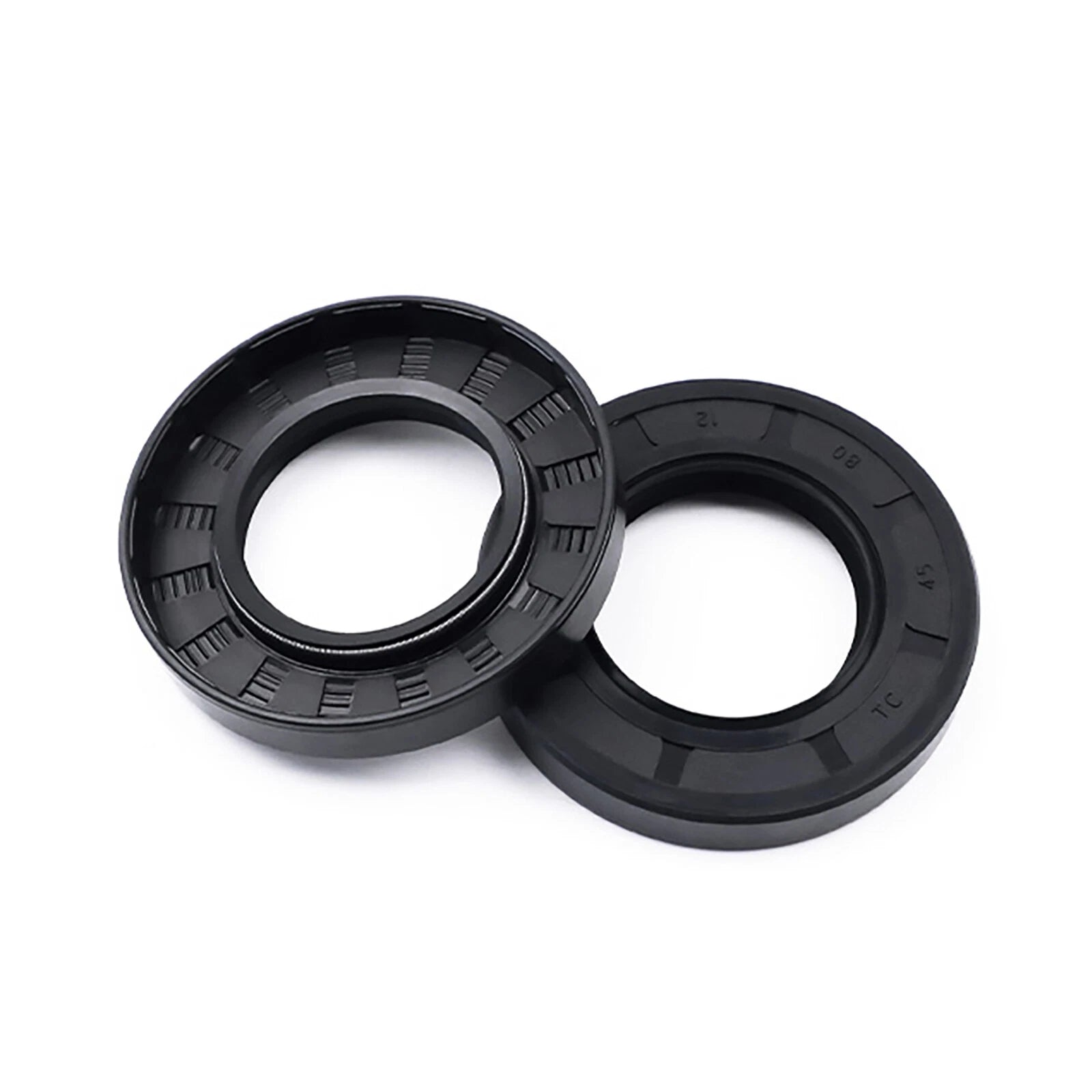
Metric NBR Oil Shaft Seal Dust Grease Seal TC Double Lip w Spring ID 35-40mm

No reviews

Price:
Sale price$4.07 USD
Stock:
In stock (500 units), ready to be shipped

Payment & Security

Ach Direct Debit Amazon American Express Apple Pay Bancontact Diners Club Discover Google Pay iDEAL Wero Mastercard PayPal Shop Pay USDC Visa

Your payment information is processed securely. We do not store credit card details nor have access to your credit card information.

Quantity Discount Promotion
🎯 BULK DISCOUNT: Buy More, Save More!
Buy 2 Items
5% OFF
Buy 4 Items
10% OFF
Buy 6 Items
15% OFF
Expert

DIY Expert Support

Get fitment advice & recommendations

Mon-Fri, 8:30AM-8PM
24-Hour Fast Ship
🚚
Arrives in 3-14 days
🌍
Global Reach
↩️
30-Day Returns
🌱 1 tree planted with every purchase

Description

Metric NBR TC Oil Shaft Seals — Reliable Grease & Dust Exclusion for ID 35–40mm Shafts

When a worn or missing shaft seal lets grease escape and contaminants enter, bearings fail ahead of schedule and downtime costs mount. Mechanics, maintenance technicians, and serious DIYers working on motors, gearboxes, agricultural equipment, and automotive axles need a seal they can size precisely and trust to hold under continuous rotation.

These metric NBR TC double-lip oil shaft seals are manufactured from nitrile rubber (NBR) with a carbon-steel outer case and a garter spring that keeps the primary lip in constant, even contact with the shaft. Inner diameters span 35–40mm; outer diameters and widths vary by variant (e.g., 35×46×7mm up to 40×85×12mm — see variant options for the full size matrix). The TC designation indicates two sealing lips: the primary oil-retention lip and a secondary dust-exclusion lip.

Typical applications include electric motor output shafts, manual gearbox input/output shafts, tractor PTO seals, wheel hub grease retention, hydraulic pump shafts, and general industrial rotating equipment where an NBR-compatible lubricant (mineral oil, grease) is present. The double-lip design is especially suited to environments with airborne dust, grit, or moisture that would compromise a single-lip seal.

⚙️ Compatibility note: NBR compound is compatible with mineral oils, greases, and water. It is not recommended for use with phosphate-ester fluids, ketones, or strong acids. Verify shaft surface finish (typically Ra 0.2–0.8 µm) and housing bore tolerance before installation.

✅ Key Features of These NBR TC Double-Lip Oil Shaft Seals

  • 🔩Garter-spring loaded primary lip — maintains consistent radial contact force across the shaft surface, compensating for minor shaft runout and lip wear over time.
  • 🛡️Secondary dust-exclusion lip (TC design) — the outer lip blocks ingress of dirt, grit, and moisture, extending lubricant life and reducing bearing contamination in harsh environments.
  • 🧪NBR nitrile rubber compound — resists mineral oils, greases, and water; rated for continuous service typically from −40°C to +120°C (−40°F to +248°F), suitable for most automotive and industrial lubricants.
  • 🏗️Carbon-steel outer case — provides a firm interference fit in the housing bore, resisting rotation and maintaining concentricity under vibration and thermal cycling.
  • 📐Metric sizing across a wide range — ID 35–40mm with OD options from 46mm to 85mm and widths from 5mm to 12mm; select the exact ID × OD × Width combination your application requires.
  • 📦Single or 5-pack quantities — order one seal for a single repair or a 5-pack for fleet maintenance, workshop stock, or multi-seal assemblies at a lower per-unit cost.

📐 Technical Specifications — NBR TC Oil Shaft Seals

Seal Type TC (Double Lip with Garter Spring)
Material NBR (Nitrile Butadiene Rubber) with carbon-steel case
Inner Diameter (ID) 35mm – 40mm (see variant options)
Outer Diameter (OD) See variant options
Width See variant options
Temperature Range Typically −40°C to +120°C (−40°F to +248°F)
Fluid Compatibility Mineral oils, greases, water
Shaft Speed Contact us to confirm for your specific application
Lip Configuration Primary oil-retention lip + secondary dust-exclusion lip
Spring Garter spring (included, factory-installed)
Pack Size 1 or 5 (see variant options)
Standard Metric (mm dimensions)

❓ Frequently Asked Questions

How do I choose the correct seal size for my application?

Measure the shaft outer diameter (this becomes the seal ID), the housing bore inner diameter (this becomes the seal OD), and the available axial depth in the housing (this determines the seal width). Cross-reference all three dimensions against the variant size matrix (ID × OD × Width in mm). If the housing bore is worn, measure it carefully — an oversized bore may require a repair sleeve or a seal with a slightly larger OD.

What does "TC" mean on an oil seal?

TC stands for a double-lip seal design: the primary lip retains lubricant (oil or grease) on the inboard side, while the secondary lip faces outward to exclude dust, dirt, and moisture. A garter spring behind the primary lip maintains consistent contact pressure against the shaft. This makes TC seals the standard choice for most automotive and industrial rotating shaft applications.

Is NBR rubber suitable for my lubricant?

NBR (nitrile) is compatible with mineral-based engine oils, gear oils, hydraulic oils, greases, and water. It is not suitable for phosphate-ester hydraulic fluids (e.g., Skydrol), ketones, strong acids, or aromatic/chlorinated solvents. If your application uses synthetic esters or silicone-based fluids, consider a Viton (FKM) seal instead. When in doubt, check the lubricant manufacturer's elastomer compatibility data.

What shaft surface finish is required for a good seal?

For reliable sealing, the shaft contact surface should have a ground or polished finish with a roughness of approximately Ra 0.2–0.8 µm (8–32 µin). The surface should be free of machining marks that run parallel to the shaft axis, as these can act as leak paths. Avoid using emery cloth in a back-and-forth motion; instead, polish in a circular direction. A hardness of 45–60 HRC at the contact zone is recommended for long seal life.

How do I install a TC oil seal without damaging it?

Clean the housing bore and lightly lubricate the seal OD with clean grease or oil before pressing in. Use a flat driver or a seal installation tool sized to the OD — never strike the seal face directly with a hammer. Press the seal in squarely until it is flush with or just below the housing face. Lightly coat the primary lip with the lubricant it will be sealing before fitting over the shaft. Protect the lip from sharp keyways or splines by wrapping the shaft end with thin tape or a cone during installation.

Can these seals handle high shaft speeds?

NBR TC seals are suitable for a wide range of shaft speeds, but the maximum peripheral velocity depends on the shaft diameter, lubricant viscosity, and operating temperature. As a general guide, NBR lip seals are commonly used up to approximately 4–8 m/s peripheral speed under normal conditions. For high-speed applications (e.g., above 6 m/s), verify with the application data or contact us to confirm suitability before ordering.

What is the difference between ordering 1 vs. 5 pack?

Both pack sizes contain identical seals — the same size, material, and specification. The 5-pack is priced at a lower per-unit cost and is practical for workshop stock, fleet maintenance programs, or assemblies that use multiple seals of the same size (e.g., both input and output shafts of a gearbox). Select your size first, then choose the pack quantity that suits your needs.

🛒 Select your Size (ID × OD × Width) and Pack Size above, then add to cart.

You may also like

Recently viewed