1018 - 2205 Metric Self Aligning Ball Bearings - ALL SIZES IN HERE

No reviews

Price:
Sale price$4.42 USD
Stock:
In stock (500 units), ready to be shipped

Payment & Security

Ach Direct Debit Amazon American Express Apple Pay Bancontact BLIK Diners Club Discover EPS Google Pay iDEAL Wero JCB Maestro Mastercard Multibanco MobilePay PayPal Przelewy24 Shop Pay Twint Union Pay USDC Visa

Your payment information is processed securely. We do not store credit card details nor have access to your credit card information.

Limited Offer — Spend More, Save More
Spend $55+
Save $5
Spend $100+
Save $10
Spend $200+
Save $25
HomeDIYer DIY Expert Support

DIY Expert Support

Get fitment advice & recommendations

Mon–Fri  8:30 AM – 8:00 PM
24-Hour Fast Ship
Arrives in 3–14 Days
Worldwide Shipping
30-Day Returns
1 tree planted with every purchase

Description

Metric Self Aligning Ball Bearings — Built for Misalignment Tolerance Across Industrial and Agricultural Applications

When shaft deflection, housing misalignment, or mounting errors cause premature bearing failure, the right bearing geometry makes all the difference. Metric self aligning ball bearings are engineered for engineers, maintenance technicians, and equipment builders who need reliable rotation even when shaft and housing axes are not perfectly aligned — tolerating angular misalignment of typically 2°–3°.

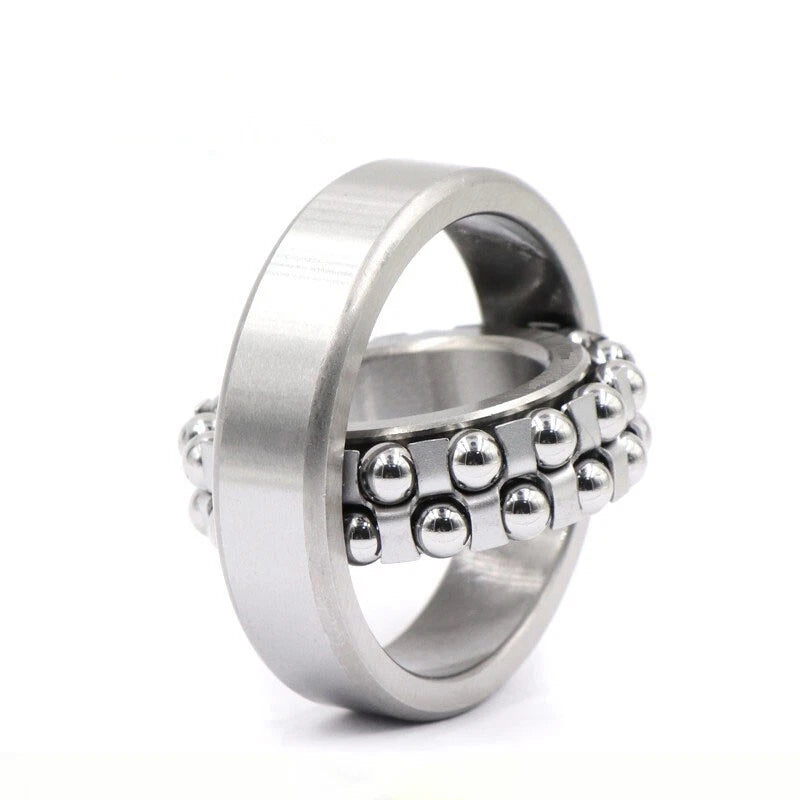
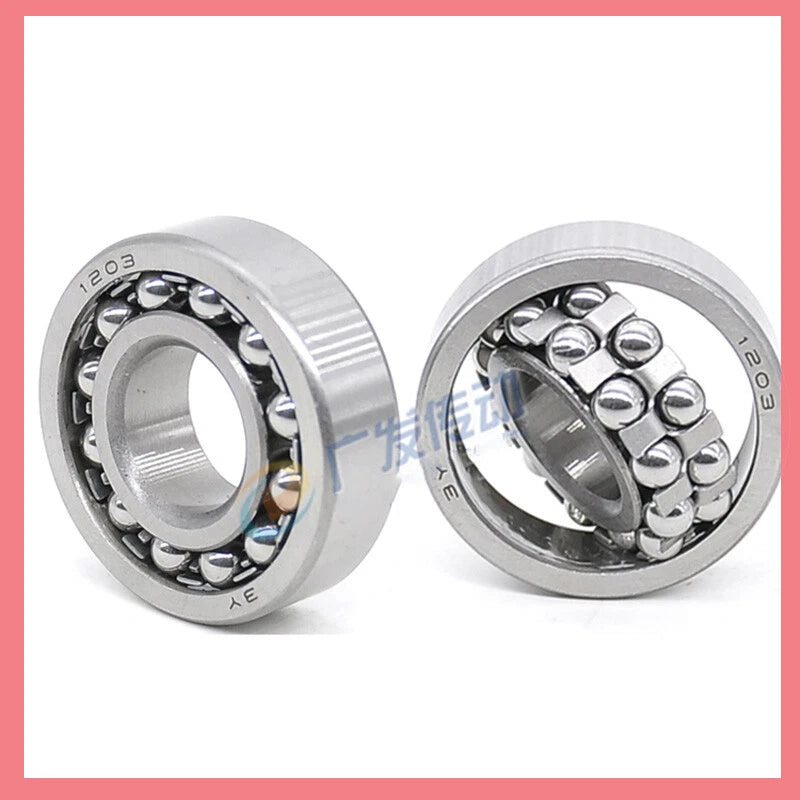
This listing covers the full range of metric self aligning ball bearings from series 1018 through 2205, with bore diameters from 7 mm (0.28 in) to 50 mm (1.97 in), outer diameters from 22 mm (0.87 in) to 90 mm (3.54 in), and widths from 7 mm (0.28 in) to 23 mm (0.91 in). The inner ring features a spherical raceway that seats against the outer ring's concave spherical surface, allowing the self-aligning action without generating edge stress.

Typical use cases include conveyor drive shafts where frame flex causes continuous misalignment, agricultural equipment such as seeders and spreaders subject to vibration and debris, and light industrial gearboxes or fan assemblies where precise shaft alignment is difficult to maintain during field installation.

⚙️ Compatibility Note: These bearings follow ISO metric dimensional standards. Verify bore (d), outer diameter (D), and width (B) against your housing and shaft specs before ordering. Series prefix (1xxx = single-row, 2xxx = double-row) determines load capacity and width.

✅ Key Features of These Metric Self Aligning Ball Bearings

🔄Self-Aligning Outer Raceway
The concave spherical outer ring raceway compensates for angular misalignment of up to approximately 2°–3°, preventing edge loading and extending service life in applications with shaft flex or mounting inaccuracy.
📐Full Metric Size Range
24 size variants from 7×22×7 mm to 50×90×20 mm cover a wide range of shaft diameters, making it straightforward to find a direct replacement or new-design fit without custom sourcing.
⚖️Single-Row and Double-Row Options
Series 1xxx provides single-row construction for lighter axial loads and compact housings; series 2xxx offers double-row construction for higher radial load capacity and greater rigidity in the same bore size.
🔩ISO Metric Dimensional Compliance
Bore, outer diameter, and width conform to ISO metric bearing standards, ensuring interchangeability with housings and shafts designed to metric tolerances without modification.
🏭Suited for Continuous-Duty Environments
The two-ball-row design distributes radial loads evenly across the raceway, reducing contact stress and supporting continuous operation in conveyors, fans, and rotating agricultural machinery.
🔍Consistent Dimensional Accuracy
Each bearing is manufactured to maintain tight tolerances on bore and outer diameter, ensuring consistent fit in standard metric housings and minimizing vibration caused by loose fits.

📐 Technical Specifications — Metric Self Aligning Ball Bearings

Bearing Type Self Aligning Ball Bearing
Series 1018, 1027, 1029, 1201–1210, 1300–1306, 2202–2207
Row Configuration Single-row (1xxx series) / Double-row (2xxx series)
Bore Diameter (d) 7 mm – 50 mm (0.28 in – 1.97 in)
Outer Diameter (D) 22 mm – 90 mm (0.87 in – 3.54 in)
Width (B) 7 mm – 23 mm (0.28 in – 0.91 in)
Angular Misalignment Tolerance Typically 2°– 3°
Dimensional Standard ISO Metric
Cage Type See variant options
Lubrication See variant options
Sealing / Shielding See variant options
Dynamic Load Rating (C) See variant options
Static Load Rating (C₀) See variant options
Product Type Ball Bearings

❓ Frequently Asked Questions

How do I choose the correct size self aligning ball bearing for my application?

Match the bore diameter (d) to your shaft diameter, the outer diameter (D) to your housing bore, and the width (B) to your housing depth. All three dimensions must fit within tolerance. Use the size code in the variant name — for example, 1205 – 25×52×15mm means bore 25 mm, OD 52 mm, width 15 mm. If you are replacing an existing bearing, the series number stamped on the old bearing ring is the fastest reference.

What is the difference between the 1xxx and 2xxx series in this listing?

The 1xxx series (e.g., 1201, 1205) are single-row self aligning ball bearings with a narrower width, suited for lighter radial loads and compact housings. The 2xxx series (e.g., 2205, 2206) are double-row self aligning ball bearings with a wider body that carries higher radial loads and provides greater shaft support. For the same bore size, the 2xxx series will have a larger width (B) dimension.

How much angular misalignment can these bearings handle?

Metric self aligning ball bearings typically tolerate angular misalignment of 2° to 3° between the shaft and housing axes. This is sufficient for most conveyor, agricultural, and light industrial applications where shaft deflection or imprecise mounting is expected. Exceeding this range will cause uneven ball loading and accelerated wear — if your application requires greater misalignment tolerance, consider spherical roller bearings instead.

Are these bearings corrosion resistant for outdoor or wet environments?

Standard metric self aligning ball bearings use carbon chromium steel rings and balls, which provide moderate corrosion resistance when properly lubricated and sealed. For consistently wet, washdown, or chemically exposed environments, look for variants with stainless steel construction or sealed (2RS) configurations that retain grease and exclude moisture. Contact us to confirm sealing options for your specific size.

Can I use these bearings as direct replacements for existing bearings with the same series number?

Yes, provided the bore (d), outer diameter (D), and width (B) match your existing bearing exactly. Metric self aligning ball bearings follow ISO dimensional standards, so a 1205 bearing from any ISO-compliant source will share the same envelope dimensions: 25×52×15 mm. Always verify the three key dimensions rather than relying solely on the series number, as some manufacturers use non-standard suffixes that indicate modified dimensions.

What lubrication do these bearings require, and how often should I re-lubricate?

Open (unshielded) self aligning ball bearings require periodic grease replenishment — typically lithium-based NLGI #2 grease. Re-lubrication intervals depend on operating speed, temperature, and load, but a general guideline for moderate-duty applications is every 500–2,000 operating hours. Pre-greased and sealed (2RS) variants are maintenance-free for their rated service life. Contact us to confirm the lubrication state of your selected size.

What industries and machines are these self aligning ball bearings commonly used in?

Common applications include conveyor belt drive and tail shafts, agricultural equipment (seeders, spreaders, augers), centrifugal fans and blowers, light gearboxes, textile machinery, and general industrial rotating equipment where shaft deflection or housing misalignment is a known design constraint. The smaller sizes (bore 7–15 mm) are also used in power tools and small motors.

🛒 Select your size above, then add to cart.


You may also like

Recently viewed