POM Plastic Glass Ball Bearings — Waterproof, Lubricant-Free Precision for Wet and Corrosive Environments
When standard steel bearings corrode, seize, or require constant re-lubrication in wet, chemical, or food-contact environments, engineers and DIY builders turn to POM plastic glass ball bearings. These open-race, no-seal bearings are designed for applications where moisture ingress is unavoidable and metal contamination is unacceptable — from aquaponics pumps and marine hardware to laboratory equipment and food processing fixtures.
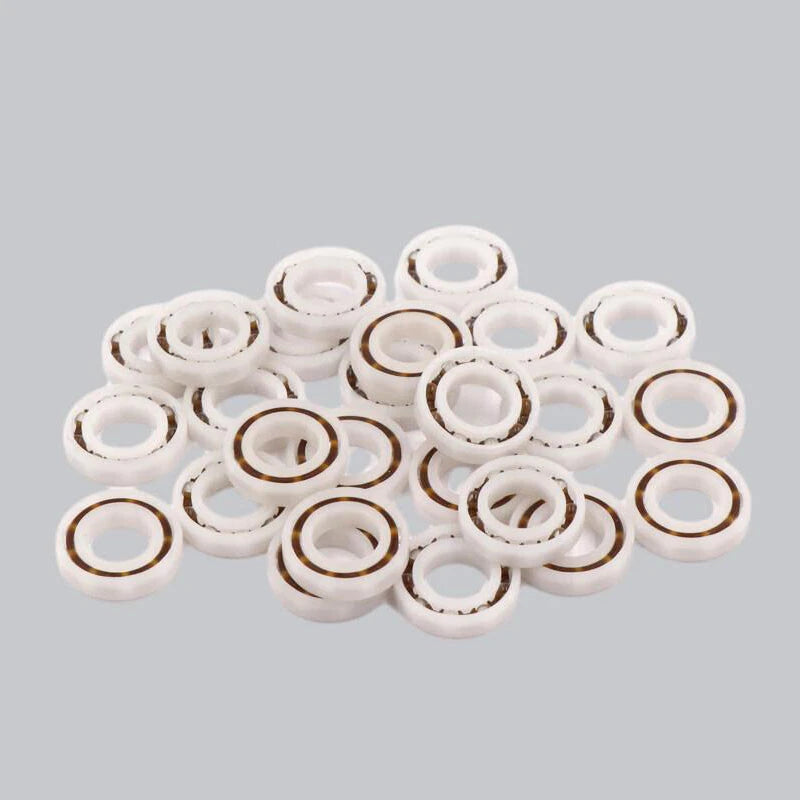
Each bearing features a POM (polyoxymethylene / acetal) outer and inner ring paired with precision glass rolling elements. The open construction eliminates the need for grease or oil lubrication, making them genuinely maintenance-free in submerged or spray-wash conditions. Available sizes span from miniature 623 (3×10×4 mm / 0.12"×0.39"×0.16") up to 6914 (70×100×16 mm / 2.76"×3.94"×0.63"), covering a wide range of bore and OD requirements.
Typical use cases include: corrosion-resistant replacement bearings in water filtration and pump assemblies; non-magnetic, non-conductive bearings for MRI-adjacent or electronics-sensitive fixtures; and lightweight bearing solutions for RC vehicles, 3D printer carriages, and small automation mechanisms where reduced rotating mass matters.
⚙️ Compatibility: Open-bore design fits standard shaft diameters per bearing designation (e.g., 624 = 4 mm bore). Verify ID, OD, and thickness against your housing before ordering. Select your size from the variant options above.
✅ Key Features of These POM Plastic Glass Ball Bearings
💧 Fully Waterproof Construction
POM ring material and glass balls resist water absorption and corrosion — suitable for continuous immersion, spray environments, and wash-down applications without degradation.
🔧 No Seals — Lubricant-Free Operation
Open-race design requires no grease or oil. Eliminates lubrication maintenance cycles and prevents lubricant contamination in food-grade or clean-room adjacent applications.
⚗️ Chemical Resistance
POM offers resistance to dilute acids, alkalis, fuels, and many solvents. Glass rolling elements add further inertness compared to steel balls in chemically aggressive settings.
🧲 Non-Magnetic and Non-Conductive
Neither POM nor glass is ferromagnetic or electrically conductive, making these bearings suitable for MRI equipment surrounds, electronics assemblies, and static-sensitive mechanisms.
📐 Wide Size Range — 19 Dimensions Available
From 623 (3×10×4 mm) to 6914 (70×100×16 mm), covering miniature to medium-duty bore sizes. Quantity options from 1 to 15 pcs per order for prototyping through small-batch production.
⚖️ Lightweight — Lower Rotating Inertia
POM density is significantly lower than steel, reducing bearing mass and rotating inertia — beneficial in high-speed, low-torque applications such as 3D printer axes and RC drivetrains.
📐 Technical Specifications — POM Plastic Glass Ball Bearings
| Bearing Type |
Deep Groove Ball Bearing, Open (No Seals) |
| Ring Material |
POM (Polyoxymethylene / Acetal) |
| Rolling Elements |
Glass Balls |
| Seal / Shield |
None (Open) |
| Lubrication |
Not required |
| Available Sizes (ID×OD×THK) |
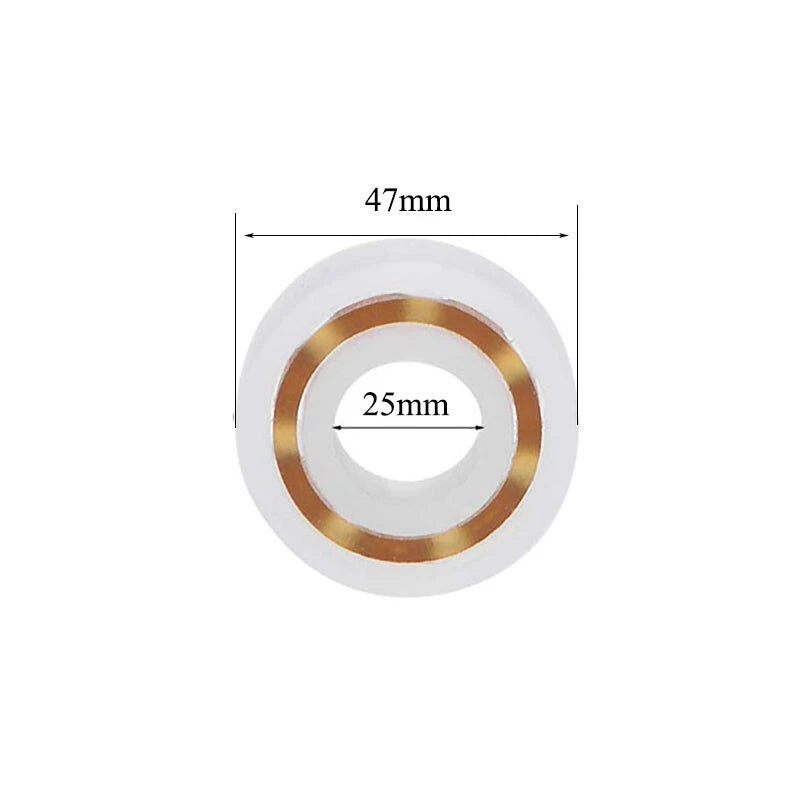
623 (3×10×4 mm) · 624 (4×13×5 mm) · 625 (5×16×5 mm) · 626 (6×19×6 mm) · 627 (7×22×7 mm) · 628 (8×24×8 mm) · 629 (9×26×8 mm) · 6000 (10×26×8 mm) · 6001 (12×28×8 mm) · 6002 (15×32×9 mm) · 6003 (17×35×10 mm) · 6004 (20×42×12 mm) · 6005 (25×47×12 mm) · 6006 (30×55×13 mm) · 6007 (35×62×14 mm) · 6008 (40×68×15 mm) · 6010 (50×80×16 mm) · 6912 (60×85×13 mm) · 6914 (70×100×16 mm) |
| Quantity Options |
1 / 2 / 4 / 6 / 10 / 15 pcs |
| Operating Temperature |
Typically −40°C to +100°C (−40°F to +212°F) — contact us to confirm for your application |
| Load Capacity |
See variant options |
| Radial Clearance |
See variant options |
| Waterproof Rating |
Suitable for continuous immersion |
❓ Frequently Asked Questions
Which size should I choose for my application?
Match the bearing designation to your shaft diameter (bore / ID) and housing bore (OD). For example, if your shaft is 8 mm, select the 628 (8×24×8 mm) variant. Always verify the OD fits your housing and the thickness (THK) clears your assembly. If you are unsure, contact us with your shaft diameter and housing dimensions.
Do these bearings really require no lubrication?
Yes. The open POM + glass construction is designed for dry or wet operation without grease or oil. Adding lubricant is not harmful but provides no meaningful benefit in most use cases. In high-speed, continuous-duty applications, a light application of PTFE-based dry lubricant can extend service life.
How do POM plastic bearings compare to stainless steel bearings in wet environments?
POM bearings are fully corrosion-proof — they will not rust regardless of water exposure. Stainless steel bearings (e.g., 440C or 316) resist corrosion but can still corrode under prolonged exposure to chlorinated water or salt. POM bearings are also lighter and non-conductive, but carry lower radial and axial load ratings than steel equivalents of the same size.
Are these bearings compatible with food-contact or aquaponics applications?
POM (acetal) is widely used in food-processing equipment due to its chemical inertness and absence of lubrication requirements. Glass balls add no metallic contamination risk. However, formal food-grade certification (FDA, EU 10/2011) depends on the specific POM grade used. Contact us to confirm compliance requirements for your application before ordering for regulated food-contact use.
What load ratings can I expect from these bearings?
POM plastic bearings carry lower dynamic and static load ratings than equivalent steel bearings — typically 20–40% of a comparable steel bearing's rated capacity. They are well-suited for light-to-medium radial loads in low-to-moderate speed applications. For heavy radial loads or high-impact conditions, a steel bearing is more appropriate. Contact us with your load and speed requirements for guidance.
Can I use these in high-temperature environments?
POM has a continuous service temperature of approximately −40°C to +100°C (−40°F to +212°F). Intermittent peaks up to ~120°C may be tolerable for short durations. Above these thresholds, POM softens and dimensional stability is compromised. For high-temperature applications, consider PEEK or ceramic bearings instead.
What is the difference between the 6xxx series and the 69xx series sizes?
The 6xxx series (e.g., 6000–6010) follows standard deep groove ball bearing dimensions with a moderate OD-to-bore ratio. The 69xx series (e.g., 6912, 6914) are thin-section bearings — they have a larger bore relative to their OD and thickness, making them ideal for compact assemblies where radial space is limited but a large shaft diameter is needed.
🛒 Select your Size (ID×OD×THK) and Qty above, then add to cart.