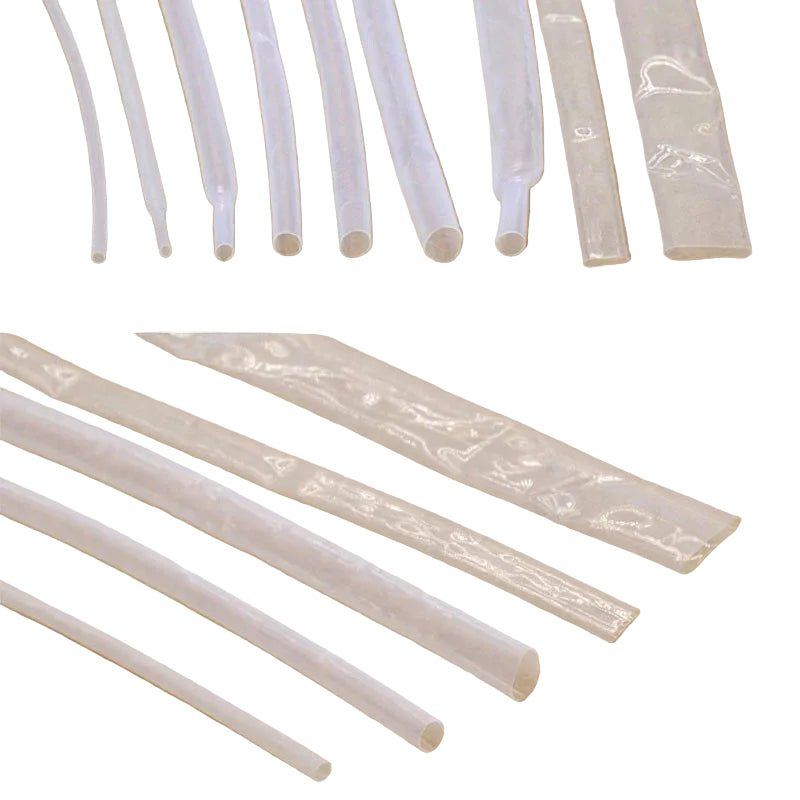
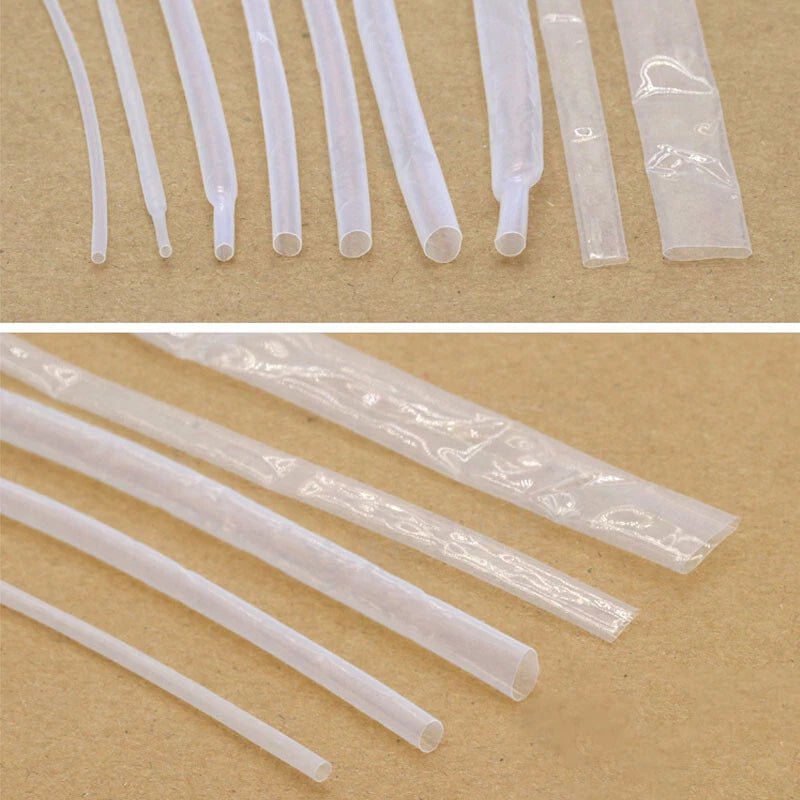
PTFE & FEP Heat Shrink Tubing — Clear, φ0.5mm–40mm, 1.7:1 / 4:1 / 1.3:1 Shrink Ratio

No reviews

Price:
Sale price$9.97 USD
Stock:
In stock (500 units), ready to be shipped

Payment & Security

Amazon American Express Apple Pay Bancontact Diners Club Discover Google Pay iDEAL Wero Mastercard PayPal Shop Pay USDC Visa

Your payment information is processed securely. We do not store credit card details nor have access to your credit card information.

Quantity Discount Promotion
🎯 BULK DISCOUNT: Buy More, Save More!
Buy 2 Items
5% OFF
Buy 4 Items
10% OFF
Buy 6 Items
15% OFF
Expert

DIY Expert Support

Get fitment advice & recommendations

Mon-Fri, 8:30AM-8PM
24-Hour Fast Ship
🚚
Arrives in 3-14 days
🌍
Global Reach
↩️
30-Day Returns
🌱 1 tree planted with every purchase

Description

PTFE & FEP Heat Shrink Tubing — Reliable Wire Insulation for Demanding Environments

When standard polyolefin heat shrink just isn't enough — because your application runs hot, gets exposed to harsh chemicals, or demands long-term reliability — engineers, lab technicians, and serious DIYers turn to PTFE heat shrink tubing. Whether you're insulating thermocouple wires, protecting fluid lines, or bundling aerospace-grade cable harnesses, the wrong tubing material can fail at the worst moment.

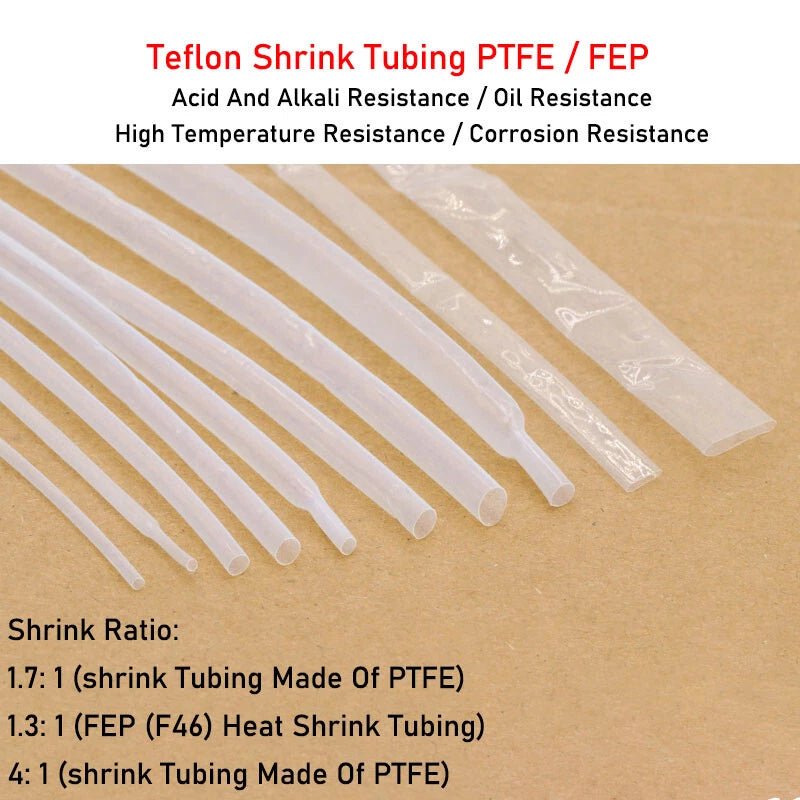
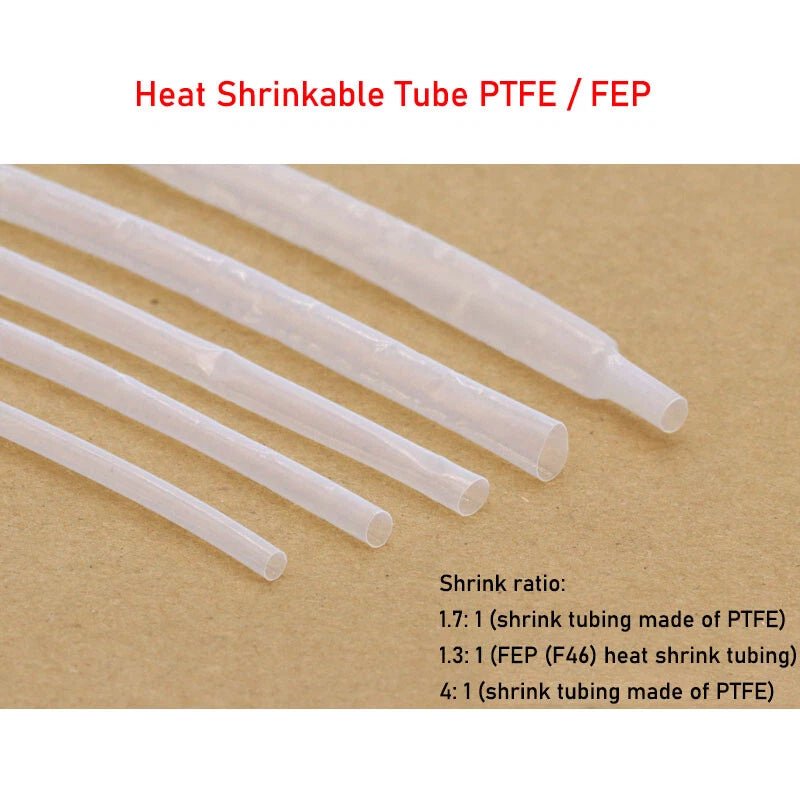
Each order is sold by the meter and covers inside diameters from φ0.5mm (≈0.020") to φ40mm (≈1.57"), available in three shrink ratios: PTFE 1.7:1 standard, PTFE high-shrinkage 4:1, and FEP(F46) 1.3:1. All variants are clear/translucent, allowing visual inspection of the underlying component after installation. Lengths range from 1 meter (≈3.3 ft) to 20 meters (≈65.6 ft) per piece.

Typical use cases include insulating fine-gauge thermocouple leads in laboratory instruments, protecting wire splices in automotive and marine wiring harnesses, lining chemical-resistant fluid tubing in lab or industrial settings, and providing dielectric insulation on high-frequency coaxial cable assemblies where low dielectric loss PTFE heat shrink tubing is specified.

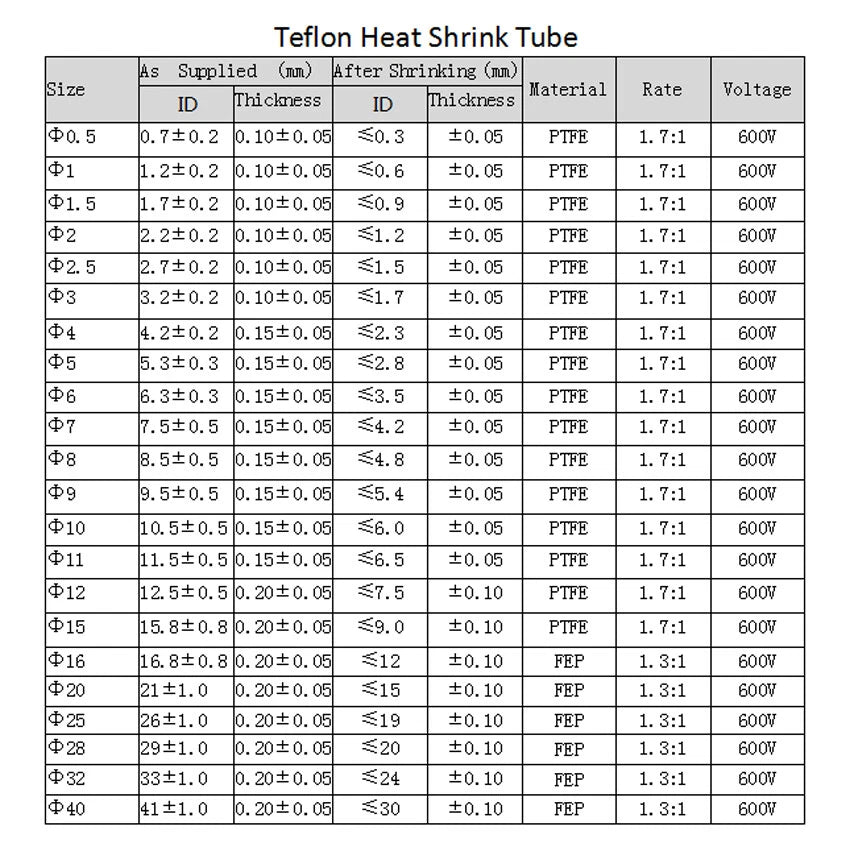
ℹ️ Compatibility Note: Select your inside diameter based on the outside diameter of the component before shrinking. PTFE 1.7:1 shrinks to ~59% of listed ID; PTFE 4:1 shrinks to ~25%; FEP 1.3:1 shrinks to ~77%. When in doubt, size up one step.

✅ Key Features of These PTFE & FEP Heat Shrink Tubes

  • 🌡️Wide Temperature Range — PTFE heat shrink tubing generally withstands continuous service from -200°C to +260°C (-328°F to +500°F), making it suitable for cryogenic lines, engine bays, and high-temperature industrial wiring.
  • 🧪Chemical Inertness — Both PTFE and FEP resist virtually all industrial solvents, acids, and bases, making this clear heat shrink tubing a go-to for laboratory fluid handling and chemical processing environments.
  • 🔍Optically Clear Wall — The transparent finish allows visual inspection of wire color codes, connector markings, and solder joints after installation — no need to remove the tubing to verify the connection.
  • Low Dielectric Loss — PTFE's exceptionally low dielectric constant makes this tubing a preferred choice for RF coaxial cable insulation and high-frequency signal wire protection where signal integrity matters.
  • 📏Broad Size Range — Available in inside diameters from φ0.5mm to φ40mm (≈0.020" to 1.57") and lengths from 1 m to 20 m, covering fine thermocouple wire up to large-diameter hydraulic hose protection.
  • 🌊UV & Moisture Stable — Inherently resistant to UV degradation and water absorption, this FEP and PTFE shrink tubing performs reliably in outdoor, marine, and high-humidity installations without cracking or swelling.

📐 Technical Specifications — PTFE & FEP Heat Shrink Tubing

Material Options PTFE (Polytetrafluoroethylene) / FEP — F46 (Fluorinated Ethylene Propylene)
Shrink Ratios Available 1.7:1 (PTFE standard) · 4:1 (PTFE high-shrinkage) · 1.3:1 (FEP)
Inside Diameter Range (before shrink) φ0.5mm (≈0.020") — φ40mm (≈1.57")
Length Options 1 m (≈3.3 ft) · 2 m · 3 m · 5 m · 8 m · 10 m · 15 m · 20 m (≈65.6 ft)
Color / Finish Clear / Translucent
Operating Temperature (PTFE) Typically -200°C to +260°C (-328°F to +500°F)
Operating Temperature (FEP) Typically -200°C to +200°C (-328°F to +392°F)
Shrink Temperature (PTFE) Generally ≥327°C (≥620°F) — high-output heat gun or oven recommended
Shrink Temperature (FEP) Generally 200–250°C (390–480°F)
Chemical Resistance Resistant to most acids, bases, solvents, and fuels
Dielectric Properties Low dielectric constant — suitable for RF and high-frequency applications
Wall Thickness (after shrink) See variant options
Longitudinal Shrinkage Typically ≤5–10% — order extra length to compensate
Flammability Contact us to confirm — varies by material grade
⚠️ Sizing Tip: PTFE tubing requires significantly higher shrink temperatures than standard polyolefin. Always use a calibrated heat gun or oven. Avoid open flame, which can cause uneven shrinkage or discoloration.

❓ Frequently Asked Questions

How do I choose the right inside diameter and length?

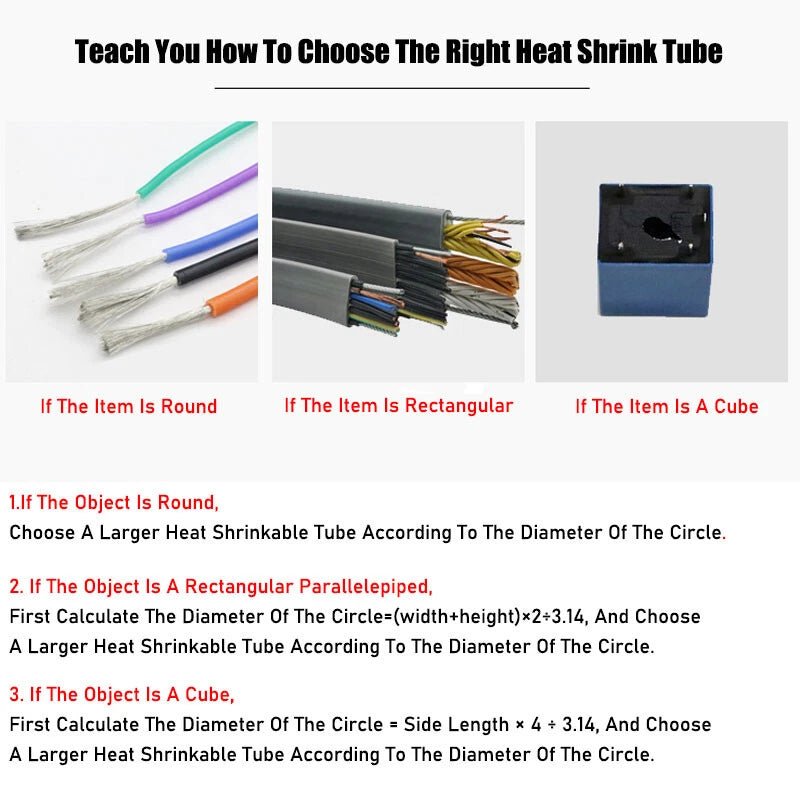
Measure the outside diameter of the wire, cable, or component you need to cover. Select a tubing ID that is slightly larger than that measurement before shrinking. For example, a 3mm (≈1/8") cable typically fits well inside φ4mm tubing with a 1.7:1 ratio. For length, add at least 10–15% extra to account for longitudinal shrinkage during heat application.

What temperature is needed to shrink PTFE tubing?

PTFE heat shrink tubing generally requires higher activation temperatures than standard polyolefin tubing — typically around 327°C (620°F) or above. A heat gun set to its highest setting or a controlled oven is recommended. FEP tubing generally shrinks at slightly lower temperatures, around 200–250°C (390–480°F).

How strong and durable is PTFE heat shrink tubing?

PTFE is known for its mechanical toughness and resistance to abrasion. It generally maintains its structural integrity across a wide temperature range (typically -200°C to +260°C / -328°F to +500°F), making it suitable for demanding industrial and aerospace applications.

Can PTFE or FEP heat shrink tubing be used outdoors?

Yes. Both PTFE and FEP are inherently UV-stable and moisture-resistant, making them well-suited for outdoor wiring, marine environments, and exposed cable runs. They do not absorb water and resist degradation from sunlight over time.

What wire gauges and connector types is this tubing compatible with?

This tubing is not thread-specific — it is designed to slip over wires, cables, connectors, and tubing of matching outside diameter. It is compatible with standard wire gauges (AWG/metric), coaxial cables, thermocouple leads, and fluid-carrying tubes in laboratory or industrial settings. Refer to the size chart above to match your component's OD to the correct tubing ID.

What is the difference between PTFE 1.7:1, PTFE 4:1, and FEP 1.3:1?

The shrink ratio describes how much the tubing reduces in diameter when heat is applied. A 1.7:1 ratio means the tubing shrinks to roughly 59% of its original ID — suitable for most standard wire insulation tasks. The 4:1 high-shrinkage PTFE is ideal when you need to cover irregular shapes or connectors with significant diameter variation. FEP 1.3:1 offers a more modest shrink and is chosen for its superior optical clarity and slightly lower shrink temperature.

Is this tubing safe for use with chemicals and solvents?

Yes. PTFE and FEP are among the most chemically inert materials available. They are generally resistant to virtually all industrial solvents, acids, bases, and fuels. This makes them a common choice for laboratory fluid handling, chemical processing equipment, and pharmaceutical applications.

🛒 Select your material, shrink ratio, and size above, then add to cart — ships from our US warehouse.

You may also like

Recently viewed