The chain is fine...but I ordered the wrong size. Nine links of the chain I ordered equals six of the size I wanted. My error...
How can I straighten out the springs? I can't use them coil uo as is.
Your payment information is processed securely. We do not store credit card details nor have access to your credit card information.
Get fitment advice & recommendations
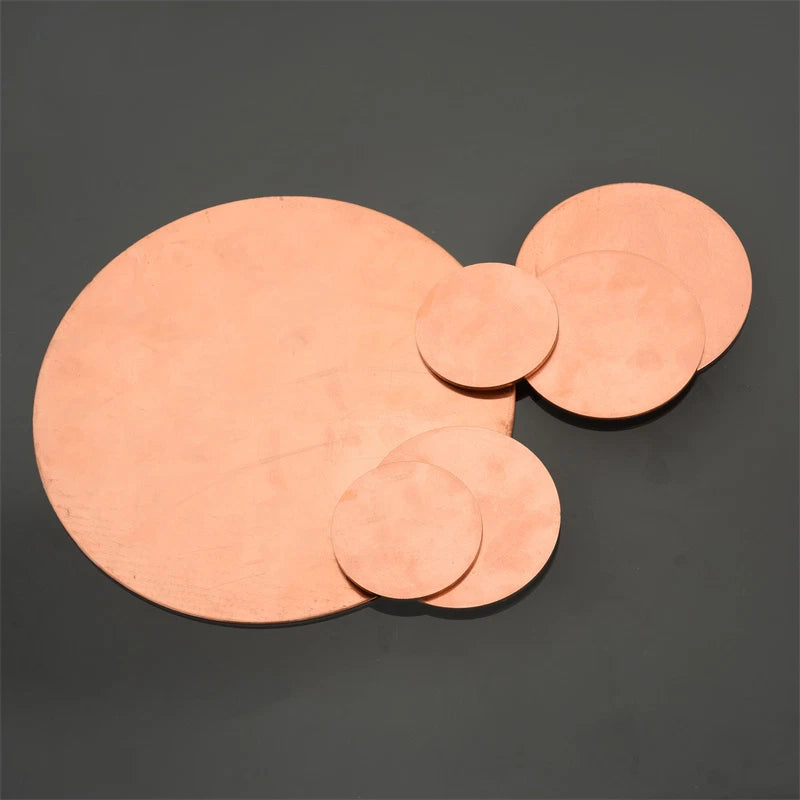
When your project demands reliable electrical conductivity and clean, consistent dimensions, finding the right copper disc can be frustrating — undersized blanks warp under heat, and impure alloys corrode faster than expected. These pure copper round sheet disc plates are designed for makers, hobbyists, and small-workshop builders who need dependable raw stock without compromise.
Each disc is cut from solid copper sheet stock with a purity typically above 99%. Available in diameters from 20mm (approx. 0.79 in) to 100mm (approx. 3.94 in) and thicknesses ranging from 0.5mm (approx. 0.020 in) to 3mm (approx. 0.118 in), these blanks arrive ready for further shaping, drilling, or finishing. Edges are cleanly sheared with minimal burr.
Typical use cases include copper electrode blanks for EDM and spot-welding fixtures, heat-spreader shims in DIY PC cooling builds, decorative medallion blanks for metalsmithing and jewelry work, and grounding pads in custom electrical enclosures. The combination of diameter and thickness options makes these discs a versatile addition to any metal stock inventory.
Copper purity typically ≥99%, delivering low electrical resistance and reliable thermal conductivity for electronics and heat-management applications.
Diameter options from 20mm to 100mm (0.79–3.94 in); thickness options from 0.5mm to 3mm (0.020–0.118 in) — select the exact blank your project requires.
Discs are shear-cut with minimal burr, reducing prep time before machining, soldering, or surface finishing.
Soft-annealed copper responds well to drilling, turning, stamping, and cold-forming — no pre-annealing required for most hobby-scale operations.
Copper's natural oxide layer provides baseline corrosion resistance; discs can be lacquered, tinned, or left bare depending on application requirements.
Order from 1 to 30 pieces per variant — ideal for prototyping single units or stocking up for batch production runs.
| Material | Pure Copper (Cu ≥99% typical) |
|---|---|
| Shape | Round / Disc |
| Diameter Range | 20mm / 30mm / 50mm / 60mm / 80mm / 100mm (0.79–3.94 in) |
| Thickness Range | 0.5mm / 0.8mm / 1mm / 1.5mm / 2mm / 3mm (0.020–0.118 in) |
| Surface Finish | Mill finish (bare copper, uncoated) |
| Edge Condition | Shear-cut, low burr |
| Quantity per Order | 1 / 2 / 3 / 5 / 10 / 15 / 20 / 30 pcs (see variant options) |
| Electrical Conductivity | See variant options |
| Hardness | See variant options |
| Weight per Piece | See variant options |
Start with your functional requirement: for heat spreaders, match the diameter to your component footprint and choose a thickness of 1–2mm for adequate thermal mass. For electrical contacts or electrodes, thinner discs (0.5–1mm) are easier to form and solder. For decorative or structural blanks, thicker options (2–3mm) provide rigidity. Select your diameter and thickness from the variant dropdowns above.
These discs are made from copper stock with a purity typically at or above 99% (equivalent to C11000 electrolytic tough pitch copper). This grade offers excellent electrical and thermal conductivity suitable for most electronics, grounding, and heat-management applications.
Pure copper is a relatively soft, ductile metal — it is not intended for structural or load-bearing applications. It excels in electrical, thermal, and decorative roles. For structural parts, consider brass or bronze alloys instead. For hobby-scale fixtures and jigs, the 2–3mm thickness options provide adequate rigidity.
Copper naturally oxidizes when exposed to air and moisture, developing a patina that ranges from brown to green (verdigris) over time. This patina is superficial and does not significantly affect conductivity in most applications. To prevent tarnishing, you can apply a clear lacquer, tin-plate the surface, or store discs in sealed, dry packaging.
Yes. Pure copper solders and brazes readily with standard copper-compatible fluxes and filler materials. For soft soldering, use a rosin or water-soluble flux with tin-silver or tin-lead solder. For brazing, use a silver-bearing brazing alloy with an appropriate flux. Clean the surface with isopropyl alcohol or fine abrasive before joining for best results.
The discs are shear-cut with minimal burr, making them generally safe to handle for most workshop tasks. However, for applications requiring a smooth, finished edge — such as jewelry or precision assemblies — we recommend a light pass with fine-grit sandpaper (400–600 grit) or a deburring tool before use.
Yes. Pure copper machines well with standard HSS or carbide tooling. Use sharp tools, moderate speeds, and a cutting fluid or lubricant to prevent built-up edge. For drilling, use a center punch to prevent wandering. Cold-stamping and forming are also feasible for the thinner variants (0.5–1mm) with appropriate tooling.