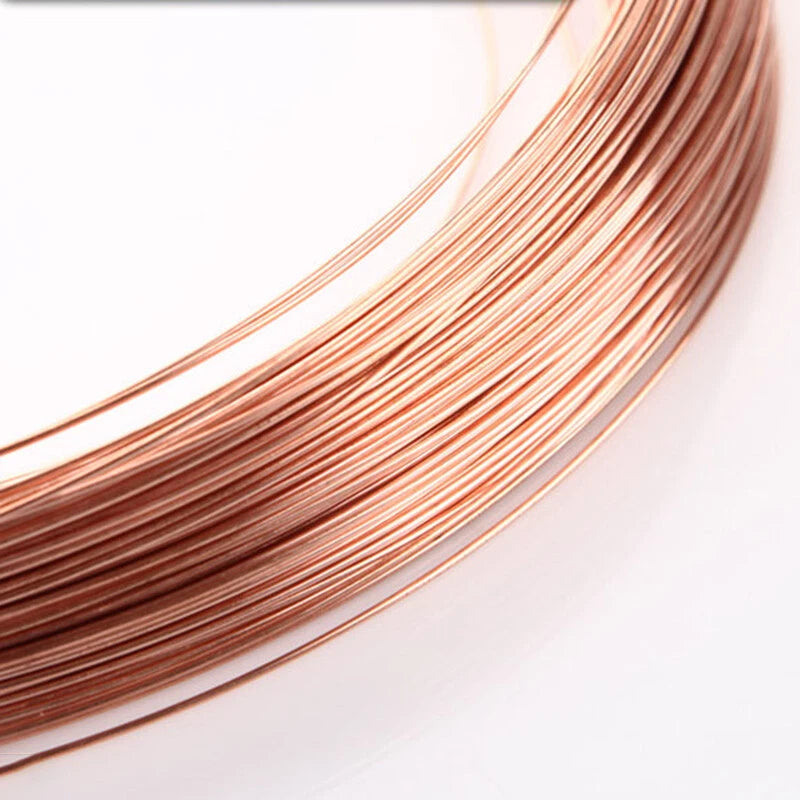
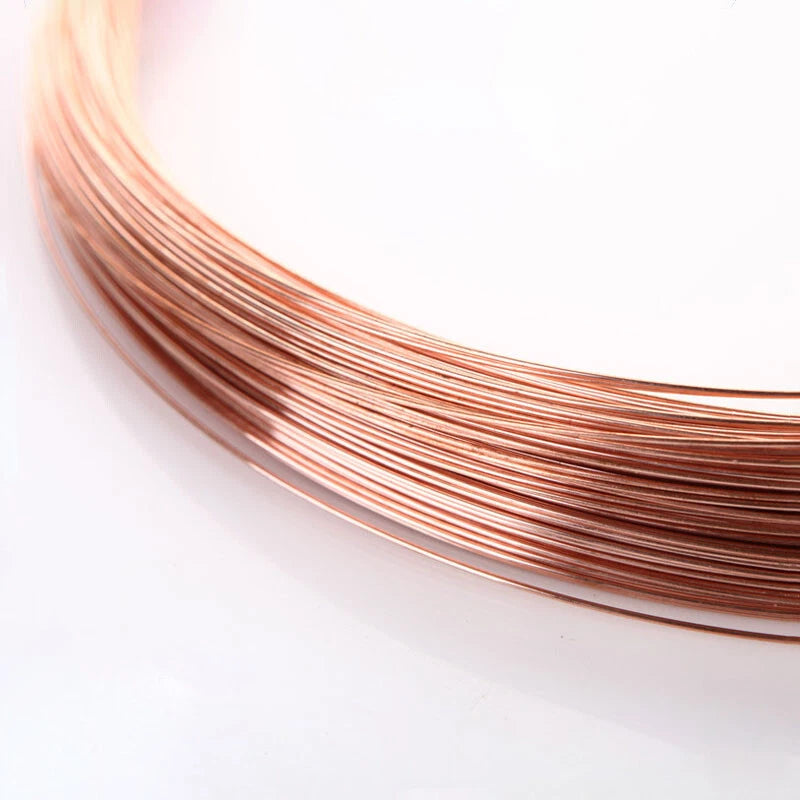
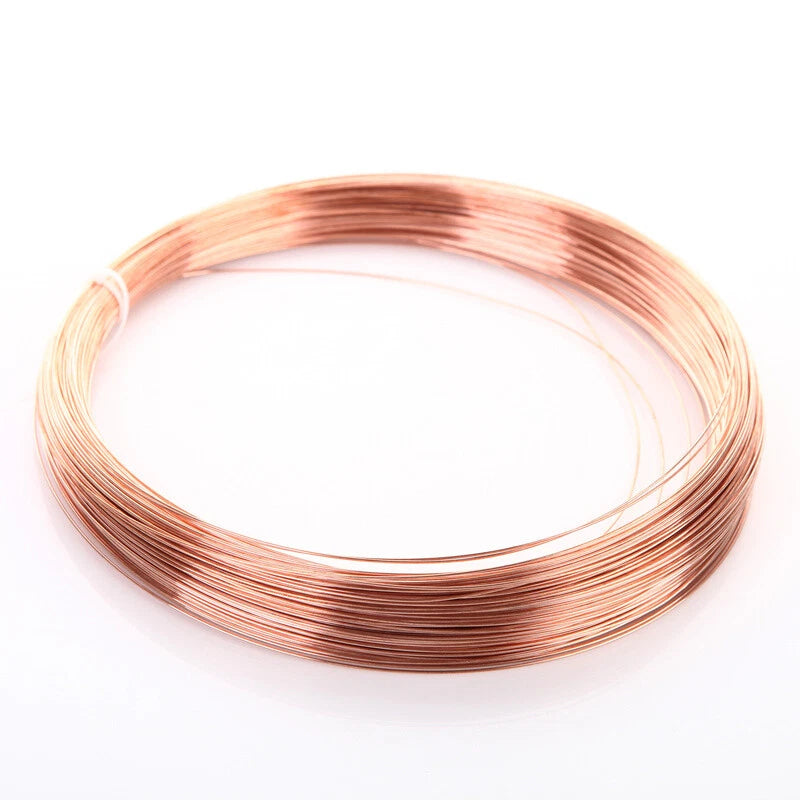
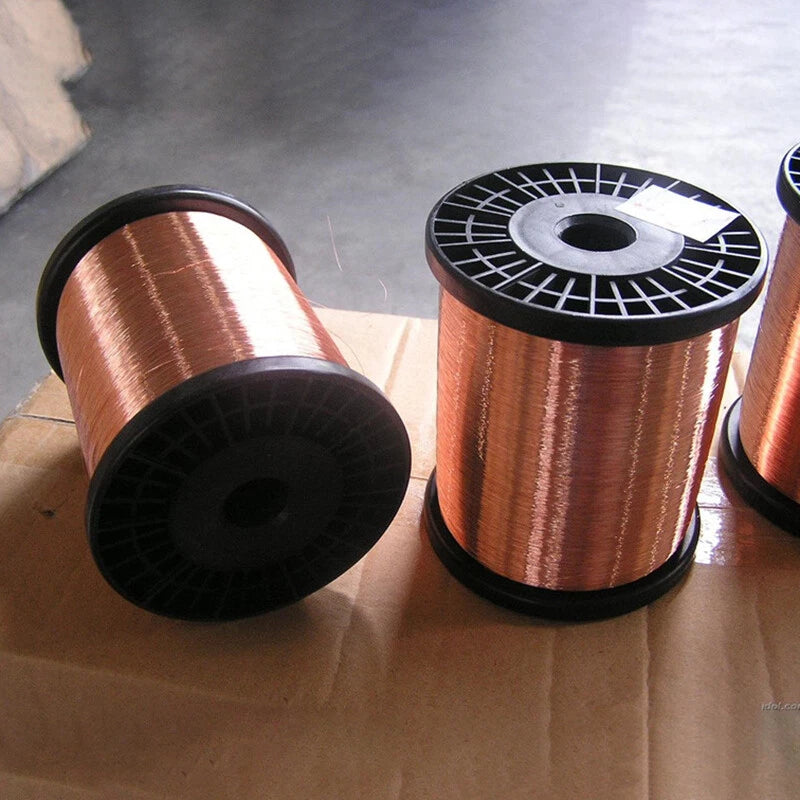
Pure Copper Round Solid Bare Wire 3mm 3.5mm 4mm 4.5mm 5mm Craft DIY

No reviews

Price:
Sale price$4.75 USD
Stock:
In stock (500 units), ready to be shipped

Payment & Security

Ach Direct Debit Amazon American Express Apple Pay Bancontact Diners Club Discover Google Pay iDEAL Wero Mastercard PayPal Shop Pay USDC Visa

Your payment information is processed securely. We do not store credit card details nor have access to your credit card information.

Quantity Discount Promotion
🎯 BULK DISCOUNT: Buy More, Save More!
Buy 2 Items
5% OFF
Buy 4 Items
10% OFF
Buy 6 Items
15% OFF
Expert

DIY Expert Support

Get fitment advice & recommendations

Mon-Fri, 8:30AM-8PM
24-Hour Fast Ship
🚚
Arrives in 3-14 days
🌍
Global Reach
↩️
30-Day Returns
🌱 1 tree planted with every purchase

Description

Pure Copper Round Solid Bare Wire — Reliable Conductivity for Grounding, Craft & DIY Electrical Work

When a project demands a conductor that bends cleanly, holds its shape, and resists corrosion over years of service, most generic wire options fall short. Electricians, jewelers, sculptors, and serious DIYers who need a dependable solid bare copper wire in a specific diameter and length will find this listing covers the full range they need — from a compact 1 m coil to a 15 m run — without having to buy more than the job requires.

Each piece is drawn from solid, uncoated pure copper rod, giving you a round cross-section with no hollow core. Available diameters span 3 mm (~0.118 in), 3 mm soft-temper, 3.5 mm (~0.138 in), 4 mm (~0.157 in), 4.5 mm (~0.177 in), and 5 mm (~0.197 in). Lengths run 1 m, 3 m, 5 m, 10 m, and 15 m per variant. The soft-temper 3 mm option offers noticeably easier hand-bending for intricate shapes, while the standard-temper sizes provide greater rigidity for structural or grounding applications.

Typical use cases include bare copper grounding wire for residential and light-commercial electrical panels, copper wire for jewelry making and wire-wrapping pendants, armature wire for clay sculpture and stop-motion models, and decorative copper wire craft projects such as garden art, floral arrangements, and custom furniture accents. The corrosion-resistant surface means outdoor installations and humid environments won't cause the rapid oxidation that degrades thinner coated alternatives.

Compatibility note: Verify local electrical codes before using bare copper wire in live circuits. This wire is uninsulated and intended for grounding, bonding, craft, and decorative applications. For insulated wiring, select a coated alternative.

✅ Key Features of These Pure Copper Round Solid Bare Wires

  • 🔩 Solid round cross-section — No hollow core; the full diameter is copper, giving consistent conductivity and mechanical strength along the entire length.
  • 🛡️ Corrosion-resistant copper — Bare copper naturally forms a stable patina that slows further oxidation, making it suitable for grounding runs, outdoor garden art, and long-term craft installations.
  • 📏 Six diameter options (3–5 mm) — Choose the cross-section that matches your current-carrying or structural requirement; the soft-temper 3 mm variant bends by hand without tools for fine jewelry and wire-wrap work.
  • 📦 Five length options (1–15 m) — Buy exactly what the job needs — a 1 m sample for prototyping or a 15 m run for a full grounding circuit — reducing offcuts and waste.
  • 🔧 Workable with standard tools — Cuts cleanly with wire cutters or bolt croppers; bends with round-nose pliers for jewelry or conduit benders for electrical work; solders and brazes without flux stripping.
  • 🎨 Uncoated bare finish — The natural copper surface is ready for patination, lacquering, or direct burial (check local code); no stripping required before soldering or bonding.

📐 Technical Specifications — Solid Bare Copper Wire

Material Pure copper (uncoated / bare)
Wire Form Solid round rod (no hollow core)
Available Diameters 3 mm, 3 mm (soft), 3.5 mm, 4 mm, 4.5 mm, 5 mm
Available Lengths 1 m, 3 m, 5 m, 10 m, 15 m
Temper Standard (hard-drawn) for 3.5–5 mm; Soft-temper available for 3 mm
Surface Finish Bare / uncoated
Corrosion Resistance Yes — natural copper oxide patina
Typical Applications Grounding & bonding, jewelry making, sculpture armature, craft & garden art
Diameter Tolerance See variant options
Conductivity Rating See variant options
Packaging Contact us to confirm

❓ Frequently Asked Questions

Which diameter should I choose for a grounding application?

For most residential grounding and bonding runs, 4 mm (~AWG 6 equivalent) or 5 mm (~AWG 4 equivalent) solid bare copper wire is commonly specified. Always consult your local electrical code (e.g., NEC in the US) and a licensed electrician to confirm the minimum conductor size for your specific circuit and fault-current rating before purchasing.

What is the difference between the standard 3 mm and the 3 mm (soft) option?

Both are the same 3 mm diameter solid copper wire. The soft-temper version has been annealed (heat-treated) after drawing, which relieves internal stress and makes the wire significantly more pliable. It bends smoothly by hand with round-nose pliers — ideal for jewelry wire-wrapping, fine sculpture armature, and intricate craft shapes. The standard 3 mm retains more spring-back and is better suited for applications where rigidity matters, such as structural supports or grounding clips.

Is this wire suitable for outdoor or direct-burial use?

Bare copper naturally develops a protective oxide layer that slows further corrosion, making it widely used in outdoor grounding electrodes and garden art. However, direct-burial suitability for electrical conductors depends on local code requirements — many jurisdictions require a minimum burial depth and may mandate a protective conduit or a listed direct-burial rated conductor. For purely decorative outdoor use (garden sculpture, trellises, floral wire), bare copper performs well in most climates.

Can I solder or braze this wire without special preparation?

Yes. Because the wire is uncoated, there is no insulation to strip before soldering. Use a rosin-core or acid-core solder appropriate for copper, and apply flux if needed for a clean joint. For brazing (higher-temperature joining), standard copper-compatible brazing rods and flux work without additional surface preparation. Lightly sanding the joint area with fine-grit paper improves adhesion if the surface has developed a heavy patina.

How do I cut and bend the thicker diameters (4 mm, 4.5 mm, 5 mm)?

For clean cuts, use heavy-duty wire cutters or bolt croppers rated for the wire gauge — standard electrician's diagonal cutters handle up to about 4 mm; for 4.5 mm and 5 mm, bolt croppers or an angle grinder with a cutting disc give a cleaner result. For bending, a conduit bender, bench vise, or pipe bender jig prevents kinking. Gentle curves can be formed around a round mandrel (pipe or dowel) of the desired radius.

Will the copper wire tarnish, and how do I prevent or reverse it?

All bare copper tarnishes over time as it reacts with oxygen and moisture, shifting from bright orange to brown and eventually a green patina (verdigris). To slow tarnishing on decorative pieces, apply a clear lacquer or wax coat after cleaning. To restore brightness, soak briefly in a solution of white vinegar and salt, then rinse and dry thoroughly. For electrical grounding applications, tarnish does not significantly affect conductivity and is generally left untreated.

How do I choose the right length for my project?

Measure the total run of your project and add 10–15% for bends, connections, and waste. The 1 m option suits small jewelry pieces or prototyping. The 3 m and 5 m lengths cover most single-circuit grounding runs or medium craft projects. The 10 m and 15 m coils are cost-effective for larger installations, full garden art structures, or bulk jewelry production where consistent wire from a single draw is important for uniform workability.

🛒 Select your Diameter and Length above, then add to cart.

You may also like

Recently viewed