
The chain is fine...but I ordered the wrong size. Nine links of the chain I ordered equals six of the size I wanted. My error...
How can I straighten out the springs? I can't use them coil uo as is.
Your payment information is processed securely. We do not store credit card details nor have access to your credit card information.
Get fitment advice & recommendations
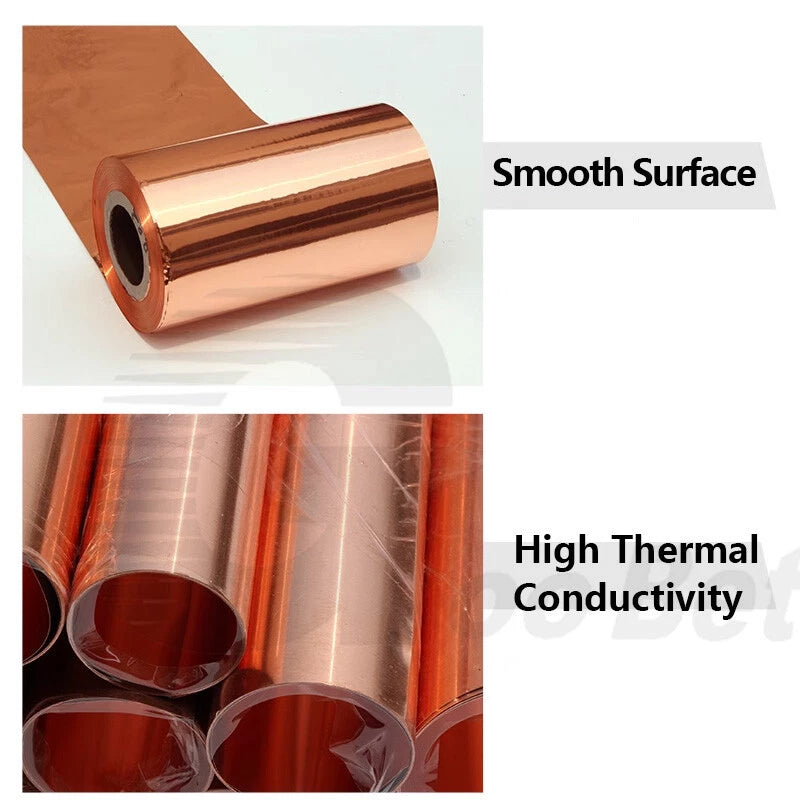
When your project demands exact thickness tolerances and reliable electrical conductivity, standard sheet metal simply falls short. Makers, electronics hobbyists, and small-workshop fabricators working on EMI shielding, thermal management, or decorative metalwork need a copper foil they can trust down to the hundredth of a millimeter. This 99.9% pure T2 copper sheet foil strip delivers that precision in a ready-to-cut format.
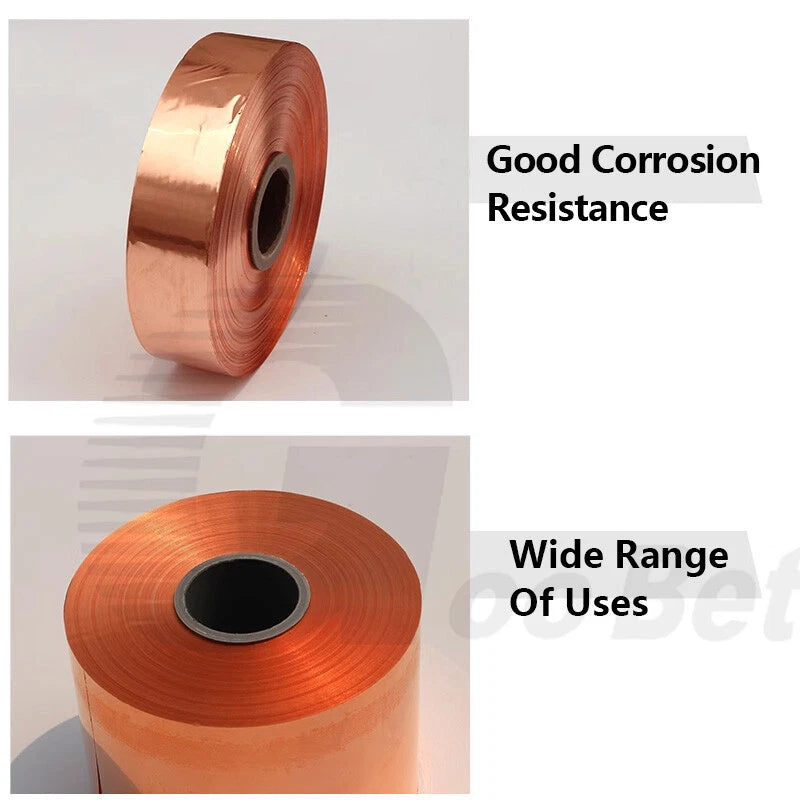
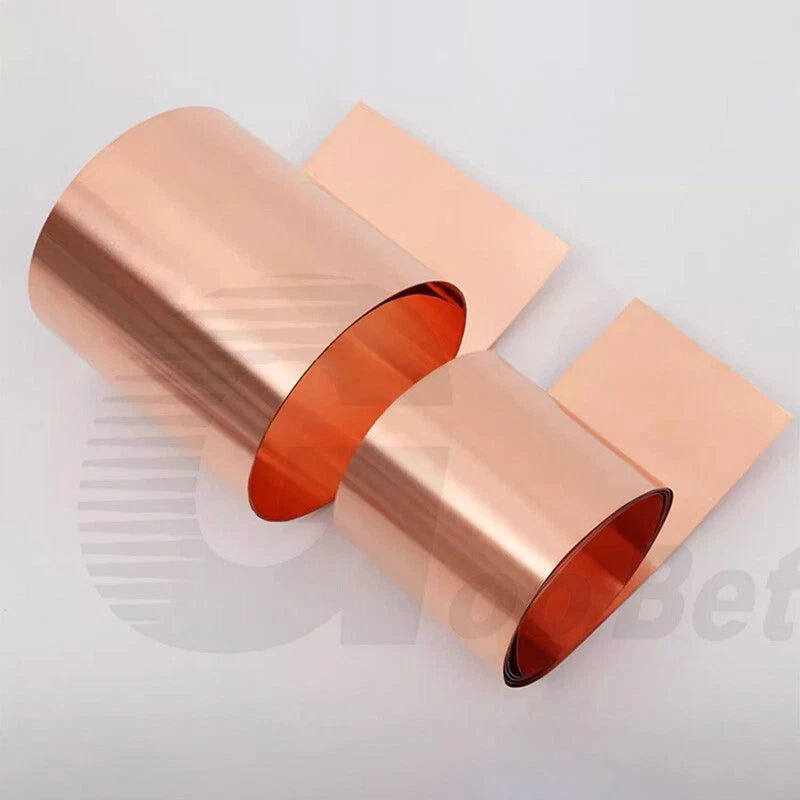
Each strip is composed of 99.9% pure T2 copper (equivalent to C11000 electrolytic tough pitch copper), offering outstanding electrical and thermal conductivity. Thickness ranges from 0.01 mm (approximately 0.0004 in) to 0.08 mm (approximately 0.003 in), with widths spanning 15 mm to 300 mm (roughly 0.6 in to 11.8 in) and a fixed length of 1000 mm (39.4 in) per piece. The surface presents a smooth, bright finish with tight dimensional tolerances typical of rolled copper foil.
Typical use cases include DIY copper foil EMI shielding tape for electronics enclosures, thin copper sheet for stained-glass soldering and art projects, ultrathin copper strip for battery tab welding and spot-welding applications, and precision copper shim stock for mechanical gap-filling and heat-spreader fabrication.
| Material | 99.9% Pure Copper, T2 Grade (C11000 / Electrolytic Tough Pitch) |
|---|---|
| Thickness Range | 0.01 mm – 0.08 mm (0.0004 in – 0.003 in) |
| Width Range | 15 mm – 300 mm (0.59 in – 11.81 in) |
| Length | 1000 mm (39.37 in) per piece |
| Surface Finish | Smooth bright rolled finish |
| Electrical Conductivity | ≥100% IACS |
| Thermal Conductivity | ~390 W/m·K |
| Temper | Soft / Annealed |
| Variant Dimension | See variant options |
| Weight per Piece | See variant options |
For EMI shielding and RF gaskets, 0.05 mm – 0.08 mm typically provides sufficient attenuation while remaining flexible. For battery tab welding or spot-welding applications, 0.05 mm – 0.08 mm is also common. For decorative inlay or stained-glass work where extreme flexibility is needed, 0.01 mm – 0.03 mm foil is easier to conform. When in doubt, start with 0.05 mm as a versatile middle ground.
These strips are designed for electrical, thermal, and decorative applications rather than load-bearing structural use. Soft-annealed T2 copper has a tensile strength of approximately 200–250 MPa, which is adequate for shim stock and gasket applications but not for primary structural members. For mechanical shim use, the thicker 0.08 mm option provides the most rigidity.
Copper naturally oxidizes when exposed to air and moisture, developing a patina over time. For applications requiring a bright finish or low contact resistance, apply a thin coat of clear lacquer or store unused strips in a sealed, dry environment. In most electrical applications, the oxide layer has minimal impact on performance at low voltages.
Yes. T2 copper solders readily with standard rosin-core or no-clean solder and a copper-compatible flux. Clean the surface with isopropyl alcohol before soldering to remove any surface oxidation or handling oils. Avoid excessive heat dwell time on the thinnest foils (0.01–0.02 mm) to prevent burn-through.
For wrapping cables or sealing enclosure seams, 15 mm – 50 mm widths are most practical. For lining larger panels or chassis interiors, 100 mm – 300 mm widths reduce the number of overlapping strips needed and improve shielding continuity. Pair with a conductive adhesive for best results.
No. This product is bare copper foil strip without any adhesive backing, sold in 1000 mm flat lengths. It is intended for applications where you apply your own adhesive, solder, or mechanical fastening. If you need self-adhesive copper tape, that is a separate product category.
Yes. Foils up to 0.05 mm can be cut cleanly with sharp scissors or a craft knife and steel ruler. For 0.06 mm – 0.08 mm, metal shears or a rotary cutter on a cutting mat will give cleaner edges. Score-and-snap is not recommended for foil this thin; always cut in a single smooth motion.





