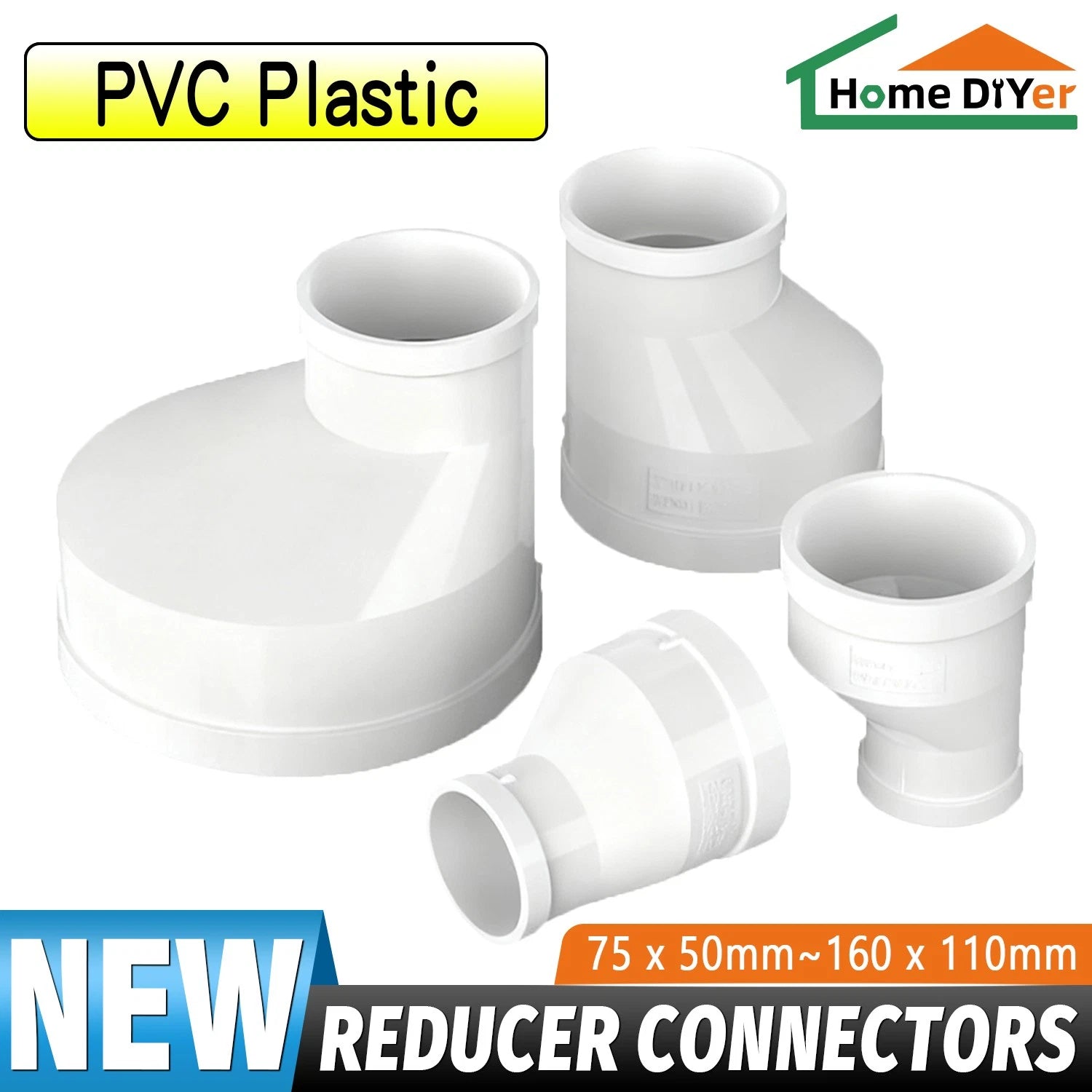
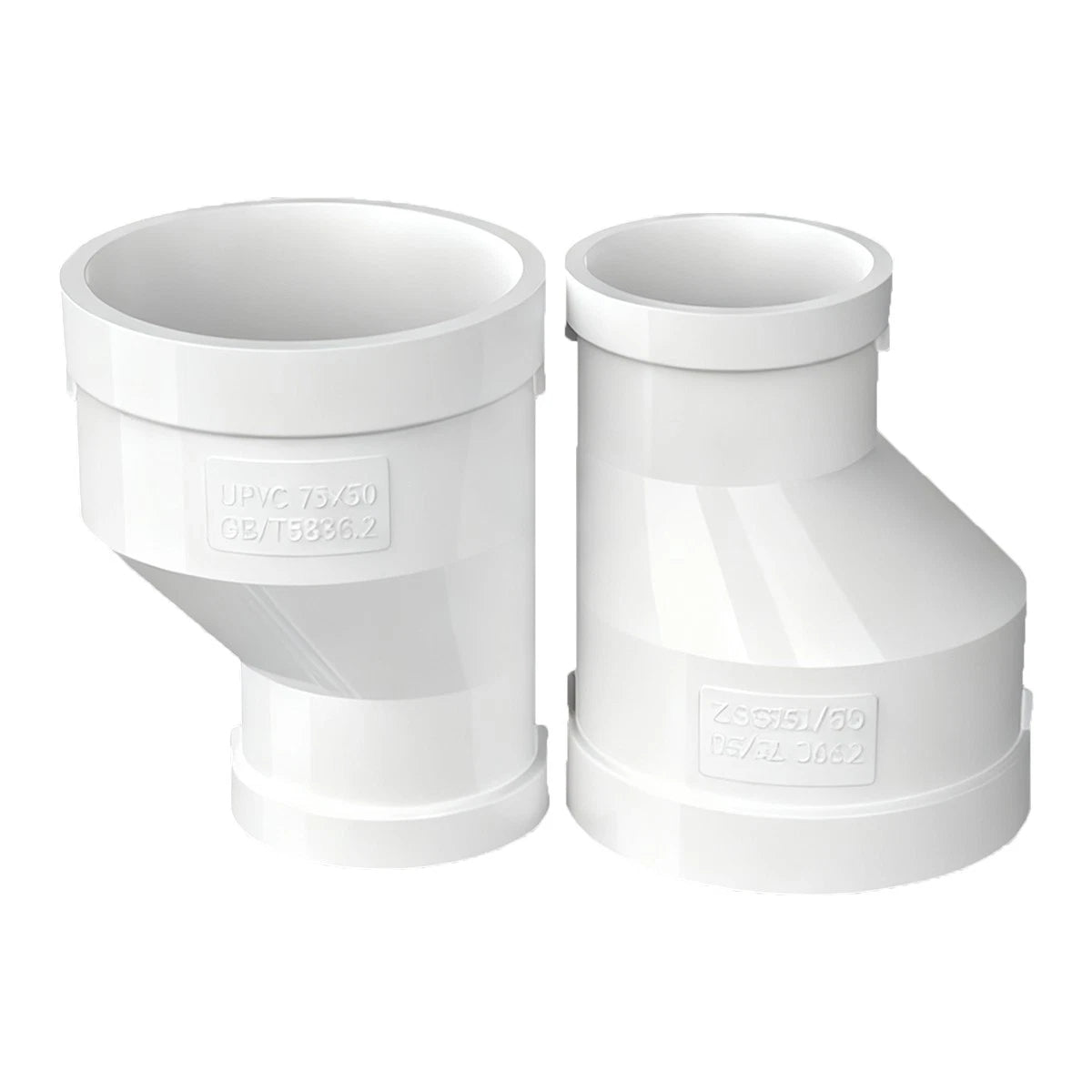
PVC Eccentric Reducer Connectors — Metric Plumbing Fittings for Reliable Water Pipe Transitions
When a pipe run changes diameter and you need the bottom of both pipes to sit flush — not centred — an eccentric reducer is the correct fitting. Plumbers, facilities managers, and DIY renovators working on drainage, irrigation, or water supply lines often reach for a standard concentric reducer only to find it traps air or misaligns with floor-level runs. These PVC eccentric reducer connectors solve that problem by offsetting the centreline so the flat side of both sockets aligns on one plane.
Each connector is moulded from rigid PVC and sized to metric inner diameters. Available transitions are 75mm × 50mm (~3" × 2"), 110mm × 50mm (~4" × 2"), 110mm × 75mm (~4" × 3"), and 160mm × 110mm (~6" × 4"). The socket depth is proportional to the pipe diameter, typically 38–65mm, and the fitting is designed for solvent-weld (cement) jointing to standard metric PVC pipe.
Typical applications include horizontal drainage runs where gravity flow must be maintained without air pockets, pump discharge lines where pipe size steps down after the pump outlet, and irrigation manifold assemblies where branch lines reduce from a main header. These fittings are also used in commercial HVAC condensate drainage and grey-water recycling systems where eccentric offset is specified by the engineer.
🔗
Compatible with metric PVC pressure and drainage pipe to ISO 1452 / EN 1329 standards. Solvent-weld jointing only. Not suitable for push-fit or threaded connections.
✅ Key Features of These PVC Eccentric Reducer Connectors
📐
Eccentric Offset Design
The flat side of both sockets aligns on one plane, keeping the invert (bottom of pipe) level for gravity-fed drainage runs and preventing air lock in horizontal lines.
🔩
Solvent-Weld Socket Ends
Both ends are machined to accept standard metric PVC pipe with solvent cement, forming a leak-free, permanent joint rated for continuous water service.
📏
Four Metric Size Transitions
Covers the most common step-down combinations: 75×50mm, 110×50mm, 110×75mm, and 160×110mm — matching standard metric drainage and pressure pipe schedules.
🛡️
Corrosion-Resistant PVC Body
Rigid PVC resists corrosion from water, mild acids, and common drain chemicals, making these fittings suitable for long-term buried or exposed installations.
📦
Multi-Pack Options
Available in 1, 3, 5, or 10-piece quantities so you can order exactly what a single repair needs or stock up for a full drainage project without overpaying.
⚖️
Lightweight for Easy Handling
PVC construction keeps individual fitting weight low (typically 0.1–0.8 kg depending on size), reducing fatigue during overhead or confined-space installation.
📐 Technical Specifications — PVC Eccentric Reducer Fittings
| Material |
Rigid PVC (Polyvinyl Chloride) |
| Fitting Type |
Eccentric Reducer / Adapter |
| Connection Method |
Solvent-weld (cement) socket both ends |
| Available Size Transitions |
75×50mm · 110×50mm · 110×75mm · 160×110mm |
| Approximate Imperial Equivalents |
3"×2" · 4"×2" · 4"×3" · 6"×4" |
| Socket Depth |
See variant options |
| Wall Thickness |
See variant options |
| Colour / Finish |
Grey (standard PVC) |
| Standard Compliance |
Metric PVC pipe (ISO 1452 / EN 1329 compatible) |
| Application |
Drainage, irrigation, water supply, HVAC condensate |
| Pack Quantities Available |
1 Pcs · 3 Pcs · 5 Pcs · 10 Pcs |
❓ Frequently Asked Questions
What is the difference between an eccentric and a concentric reducer?
A concentric reducer keeps both pipe centrelines on the same axis — the step-down is symmetrical all around. An eccentric reducer offsets the centreline so one side (the flat side) of both sockets is flush. This is critical in horizontal drainage runs because it keeps the invert (bottom of the pipe) level, maintaining gravity flow and preventing air pockets that would disrupt drainage.
How do I choose the correct size transition for my pipe run?
Measure the outer diameter of both pipes and cross-reference with the metric inner diameter listed in the variant options. The larger inner diameter socket connects to the larger pipe; the smaller socket connects to the reduced pipe. If you are unsure, contact us to confirm — do not rely on nominal inch sizes alone, as metric and imperial schedules differ.
Are these fittings suitable for pressure water supply lines?
These fittings are designed for metric PVC pipe systems. Suitability for pressure service depends on the pipe schedule and the working pressure of your system. For drainage and low-pressure irrigation they are appropriate. For mains-pressure supply lines, verify that the pipe and fitting pressure rating meets your system's requirements before installation.
Can I use these fittings for underground or buried installations?
Rigid PVC is widely used in buried drainage applications. It resists soil moisture, mild acids, and common ground chemicals. Ensure the trench is properly bedded with compacted granular material to support the fitting and avoid point loading, which can crack any rigid fitting over time regardless of material.
What solvent cement should I use to join these fittings?
Use a PVC solvent cement rated for the pipe schedule and application (drainage or pressure). Apply primer to both the pipe end and socket, then apply cement to both surfaces and push the pipe firmly into the socket with a slight twist. Hold for 30 seconds and allow the joint to cure per the cement manufacturer's instructions before pressurising or flowing water.
Which quantity pack should I order for a single repair versus a full project?
For a single repair or replacement, the 1 Pcs option gives you exactly what you need without surplus. For a bathroom or kitchen renovation with multiple step-down points, the 3 or 5 Pcs pack reduces per-unit cost. The 10 Pcs pack is suited to trade use or projects with many identical transitions, such as a full drainage reline or irrigation manifold installation.
Are these fittings compatible with push-fit or rubber-ring jointed pipe systems?
No. These fittings use solvent-weld (cement) sockets only. They are not compatible with push-fit systems (such as Osma or Marley push-fit drainage) or rubber-ring jointed pipe. If your existing system uses push-fit connections, you will need an appropriate adapter to transition to solvent-weld before using these fittings.
🛒 Select your Inner Diameter and quantity above, then add to cart.