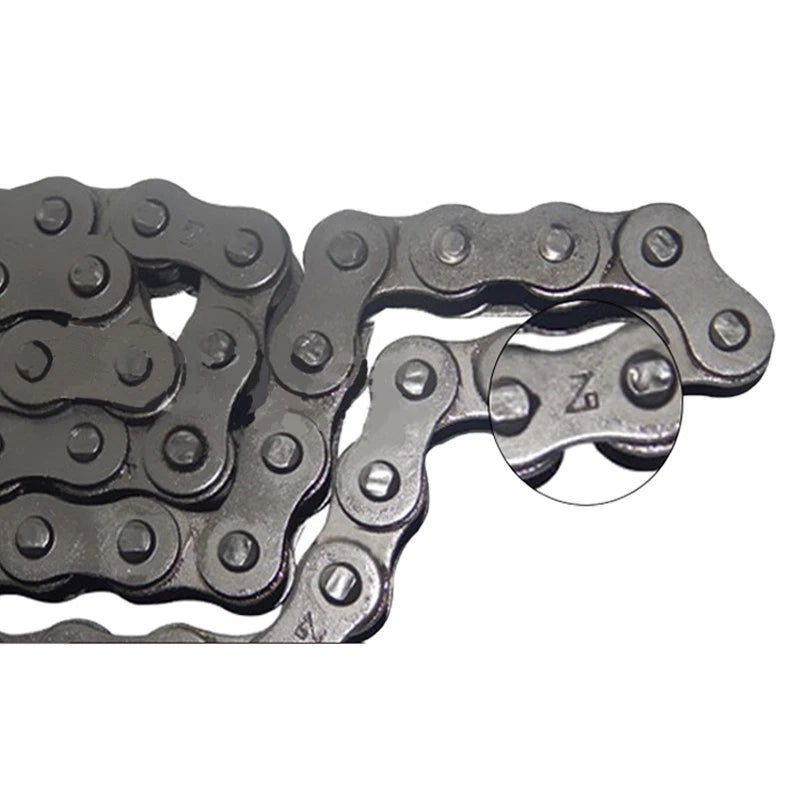
The chain is fine...but I ordered the wrong size. Nine links of the chain I ordered equals six of the size I wanted. My error...
How can I straighten out the springs? I can't use them coil uo as is.
Your payment information is processed securely. We do not store credit card details nor have access to your credit card information.
Get fitment advice & recommendations
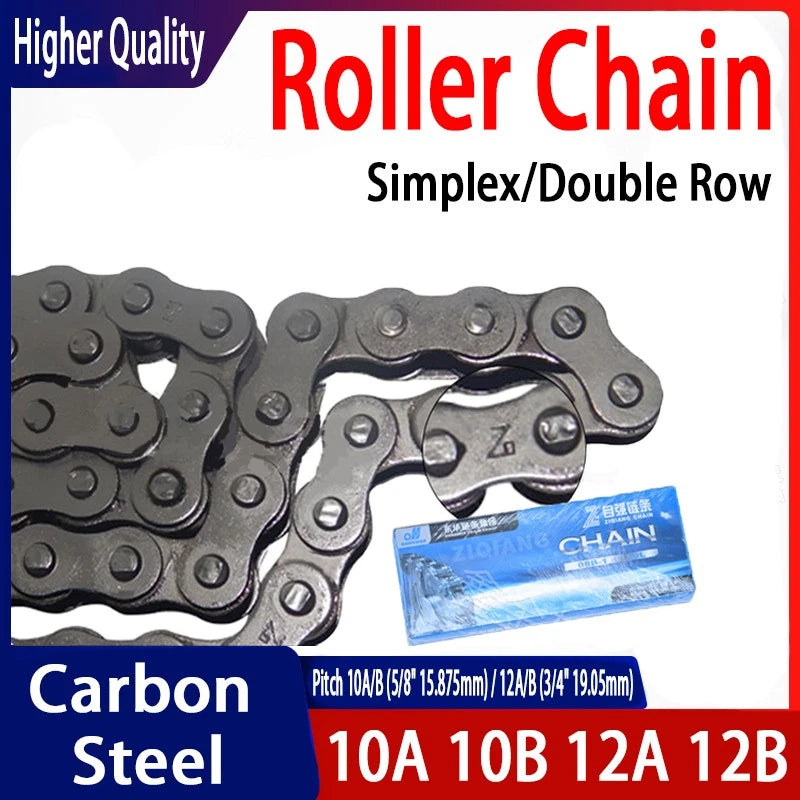
When a worn or snapped drive chain brings your machinery to a halt, every minute of downtime costs you. Whether you're a maintenance technician keeping a production line running, a fabricator building custom conveyor systems, or a maker replacing a bicycle or go-kart drivetrain, finding the right roller chain in the correct pitch and strand configuration shouldn't be a guessing game. This listing covers the full range of #50 and #60 series roller chains — including 10A, 10B, 12A, and 12B standards — along with matching full buckle and half buckle connecting links.
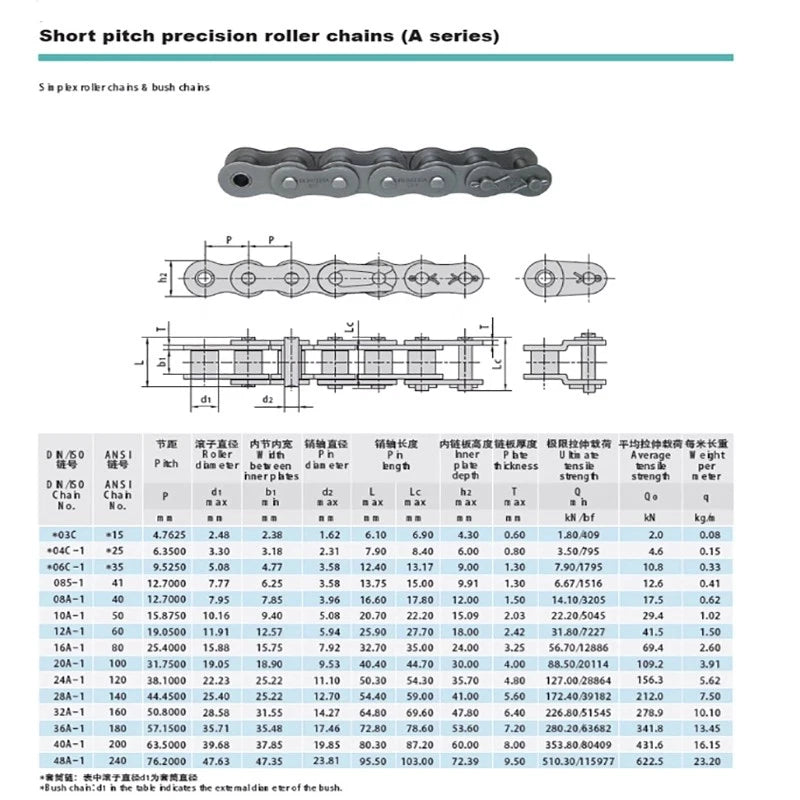
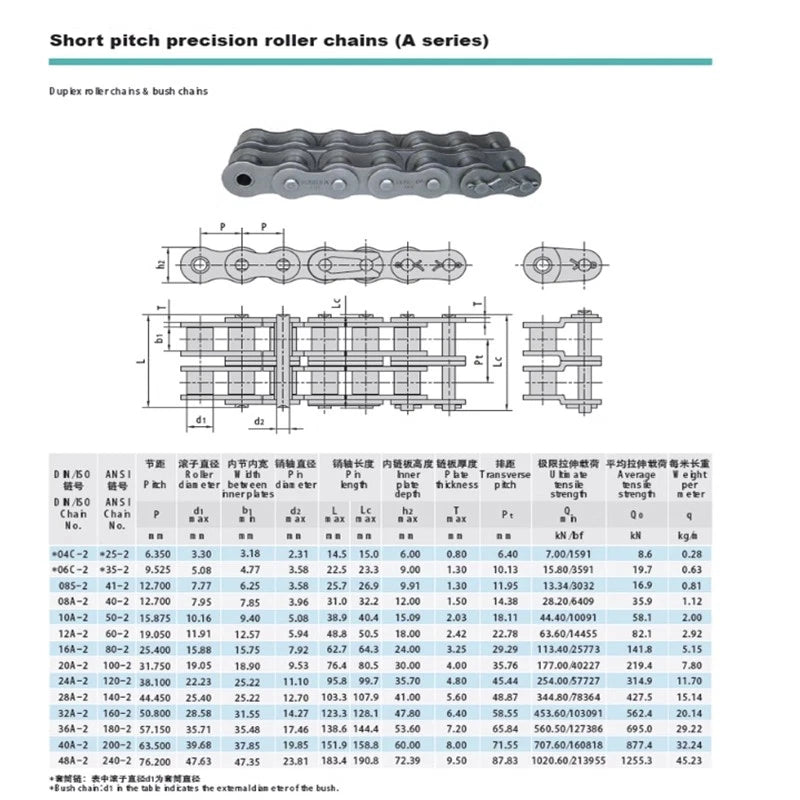
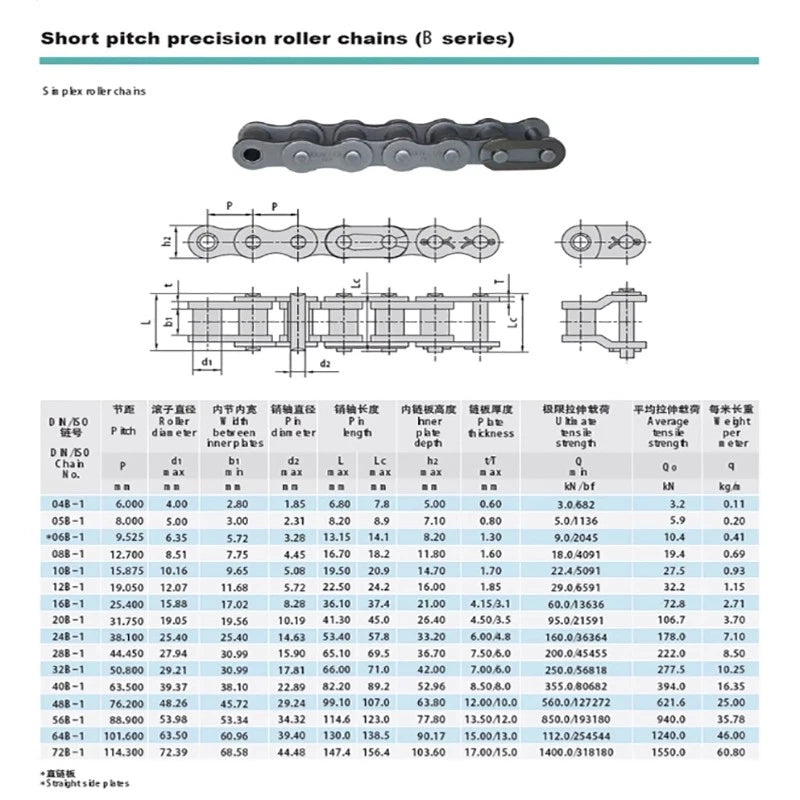
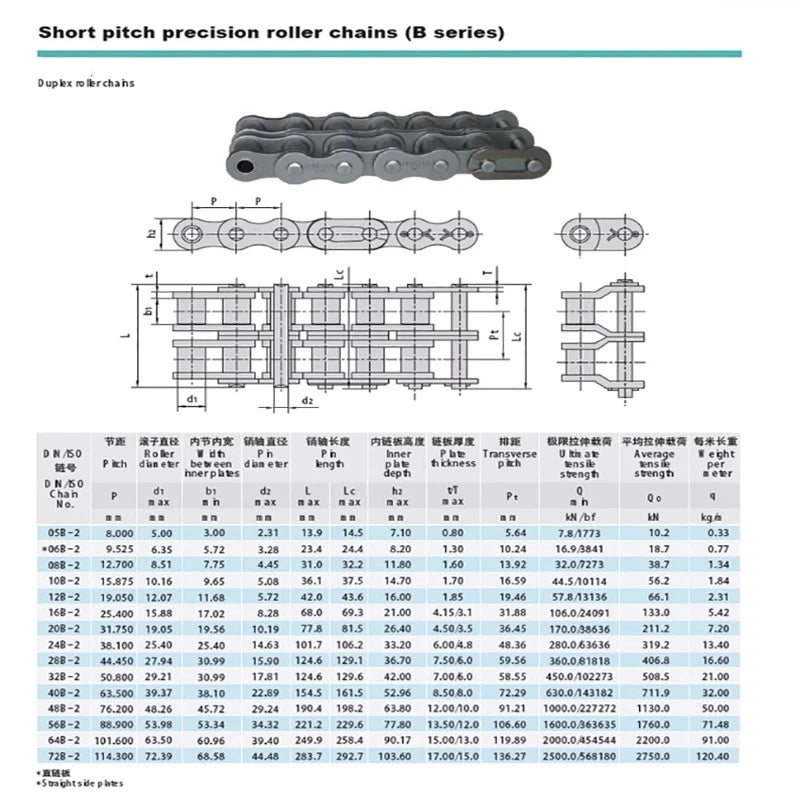
These roller chains are manufactured to ISO/DIN standard dimensions. The #50 / 10A and 10B series feature a 5/8" (15.875 mm) pitch, while the #60 / 12A and 12B series use a 3/4" (19.05 mm) pitch. Roller chains are available in simplex (single-strand) and duplex (double-strand) configurations. Chain lengths are offered in 1.5-meter sections; connecting links (full buckle and half buckle) are sold individually. Inner link width, roller diameter, and plate thickness conform to the respective ANSI/ISO chain standard for each model.
Typical use cases include agricultural equipment drive systems, industrial conveyor lines requiring #50 or #60 pitch chain, go-kart and mini-bike final drive replacement, and light manufacturing machinery where a 5/8" or 3/4" pitch roller chain is specified. Long-tail applications include "#50 roller chain replacement," "10A simplex drive chain 15.875mm pitch," and "#60 duplex conveyor chain 19.05mm."
Choose 5/8" (15.875 mm) pitch for #50 / 10A / 10B applications, or 3/4" (19.05 mm) pitch for #60 / 12A / 12B applications — both ANSI and ISO/DIN variants covered.
Simplex (single-strand) chains suit standard drive loads; duplex (double-strand) chains deliver roughly double the working load capacity for heavier conveyor and drive applications.
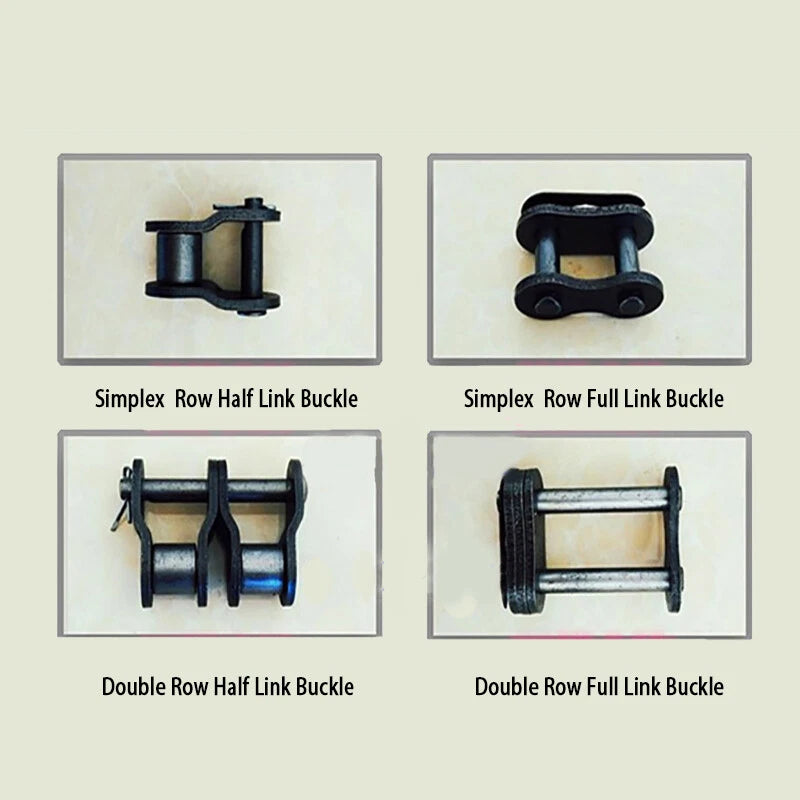
Matching connecting links are available in full buckle (spring clip) and half buckle (cotter pin) styles, allowing field-serviceable chain joining without special tools.
Roller chain sections are supplied in 1.5 m (approximately 59 inches) lengths — a practical cut length for most machinery replacement and custom conveyor builds.
10A and 12A models follow ISO 606 / DIN 8187 metric dimensions; 10B and 12B models follow DIN 8187 British standard dimensions. Both are interchangeable with correctly rated sprockets.
Suitable for agricultural machinery, light industrial conveyors, go-karts, mini-bikes, and general mechanical power transmission where #50 or #60 series chain is specified.
| Chain Standards Covered | 10A, 10B (ANSI #50), 12A, 12B (ANSI #60) |
|---|---|
| Pitch — #50 / 10A / 10B | 5/8" (15.875 mm) |
| Pitch — #60 / 12A / 12B | 3/4" (19.05 mm) |
| Strand Configuration | Simplex (single) or Duplex (double) — see variant options |
| Section Length (Chain) | 1.5 m (~59 in) |
| Connecting Link Types | Full Buckle (spring clip) / Half Buckle (cotter pin) |
| Inner Link Width | See variant options |
| Roller Diameter | See variant options |
| Plate Thickness | See variant options |
| Material | Carbon steel (heat-treated) |
| Finish | See variant options |
| Applicable Standards | ISO 606, DIN 8187 / 8188, ANSI B29.1 |
Both 10A and 10B share the same 5/8" (15.875 mm) pitch, but they differ in inner link width and plate dimensions. 10A follows the ANSI / ISO 606 standard (sometimes called #50 ANSI), while 10B follows the DIN 8187 British standard. They are not directly interchangeable — always match the chain to the sprocket standard specified by your equipment manufacturer.
12A and 12B both use a 3/4" (19.05 mm) pitch. 12A conforms to ISO 606 / ANSI #60 dimensions, while 12B follows DIN 8187 British standard dimensions. Inner link width differs between the two. Check your sprocket specification before selecting a model.
Simplex (single-strand) chain is suitable for standard power transmission loads in most drive and conveyor applications. Duplex (double-strand) chain is used when higher load capacity is required in the same pitch envelope — roughly doubling the working load rating. Duplex chain requires a matching duplex sprocket; it cannot be used on a simplex sprocket.
A full buckle connecting link uses a spring clip (snap-on clip) to retain the outer plate — it is quick to install and remove without tools, making it ideal for applications where the chain is frequently serviced. A half buckle connecting link uses a cotter pin for retention, which provides a more secure lock and is preferred in higher-vibration environments. Both are compatible with the corresponding chain model and pitch.
These chains are manufactured from heat-treated carbon steel and are suitable for general indoor and sheltered outdoor use. For prolonged outdoor or wet environments, regular lubrication with a chain-specific oil or grease is strongly recommended to prevent surface oxidation and extend service life. For highly corrosive environments, consider stainless steel chain variants.
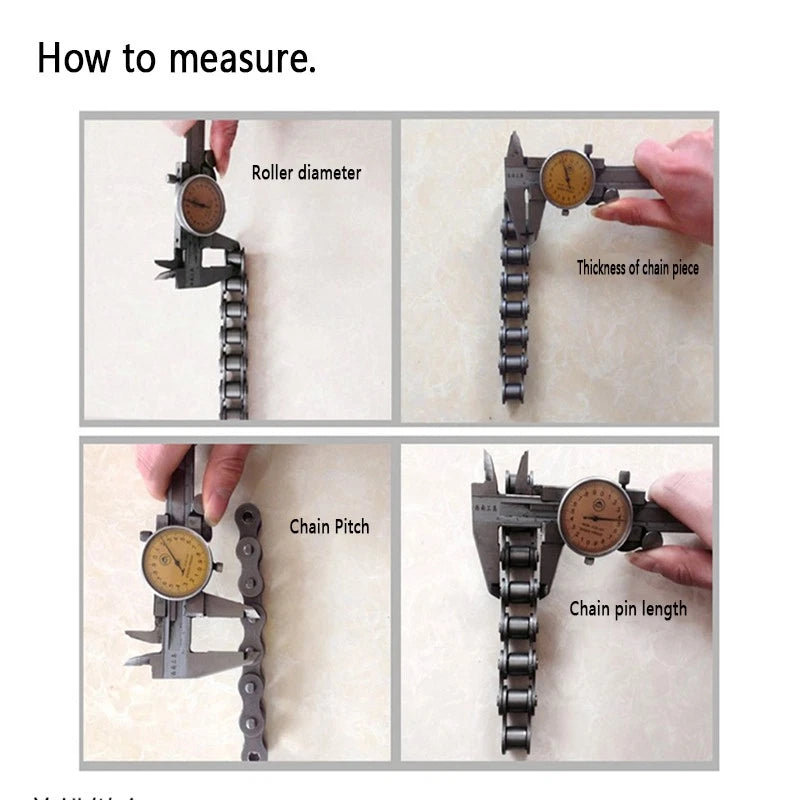
First, identify the pitch of your existing chain or sprocket (5/8" for #50 / 10A / 10B; 3/4" for #60 / 12A / 12B). Then confirm whether your sprocket is ANSI/ISO (A-series) or DIN British (B-series). Count the number of links required for your center distance, or measure the existing chain. The 1.5 m sections in this listing can be cut to length using a chain breaker tool. Order connecting links separately to join cut sections.
#50 (10A) simplex roller chain is one of the most common final-drive chains used on go-karts and mini-bikes with 5/8" pitch sprockets. Verify your sprocket pitch and tooth count before ordering. The 1.5 m section is typically sufficient for most go-kart rear axle configurations, and the full buckle connecting link allows easy chain length adjustment.