The chain is fine...but I ordered the wrong size. Nine links of the chain I ordered equals six of the size I wanted. My error...
How can I straighten out the springs? I can't use them coil uo as is.
Your payment information is processed securely. We do not store credit card details nor have access to your credit card information.
Get fitment advice & recommendations
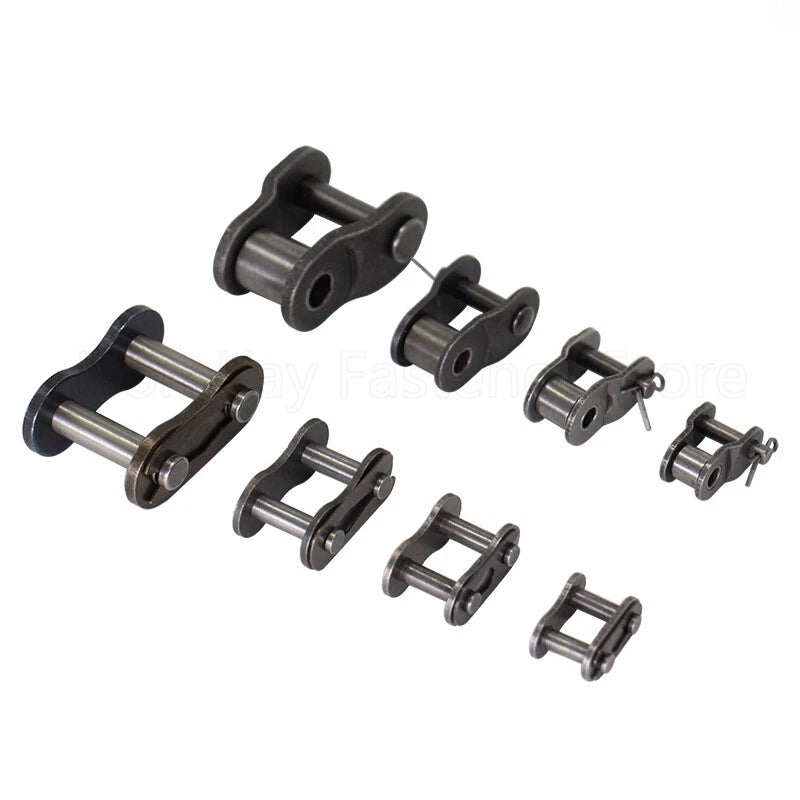
When a drive chain snaps mid-job or needs a precise length adjustment, sourcing the right connecting link fast is critical — whether you're a maintenance technician, agricultural equipment operator, or industrial machinery builder. These roller chain links are stocked across the most common ANSI (A-series) and BS (B-series) chain numbers, from the compact #25 (04C-1) up to the heavy-duty #160 (32A-1/32B-1), so you can get back running without waiting on a full chain order.
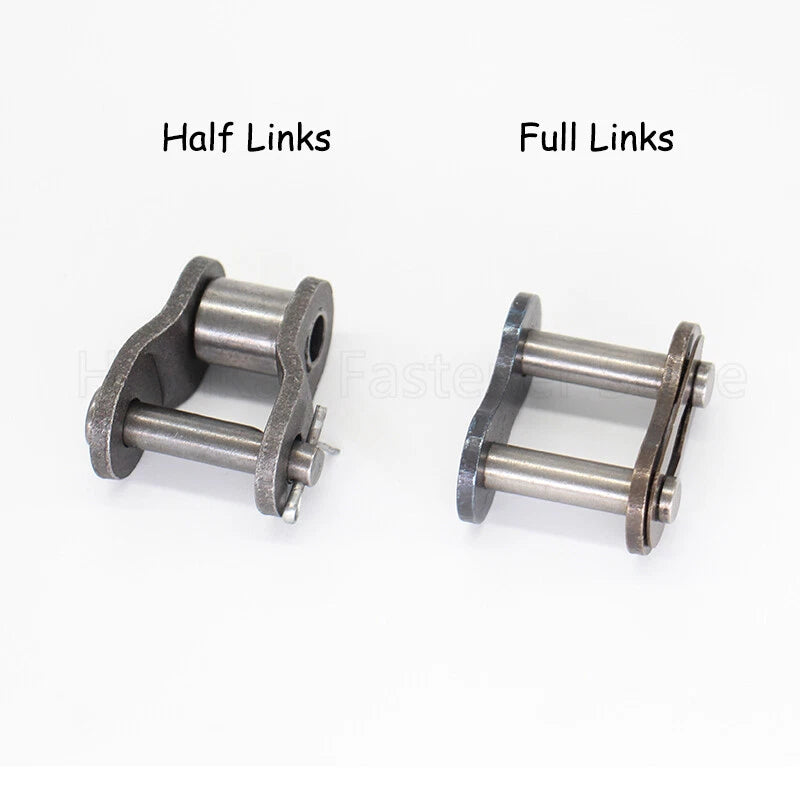
Each connecting link is a single-pitch master link assembly compatible with its corresponding roller chain standard. Full Links provide a complete closed-loop connection, while Half Links allow fine-tuning of chain length by adding a half-pitch increment. Available chain numbers span: 04C-1 (#25), 05B-1 (#35), 06B-1 (#35), 06C-1 (#35), 08A-1 (#40), 08B-1 (#40), 10A-1 (#50), 10B-1 (#50), 12A-1 (#60), 12B-1 (#60), 16A-1 (#80), 16B-1 (#80), 20A-1 (#100), 20B-1 (#100), 24A-1 (#120), 24B-1 (#120), 28A-1 (#140), 28B-1 (#140), 32A-1 (#160), and 32B-1 (#160). Pitch dimensions range from approximately 6.35 mm (1/4 in) for #25 up to 50.8 mm (2 in) for #160.
Typical applications include conveyor system repair, agricultural machinery chain replacement, industrial gearbox drive maintenance, go-kart and small engine drivetrain assembly, and roller chain length adjustment for custom fabrication projects. Whether you need a single replacement roller chain connecting link or a pack of 4 for a maintenance kit, select your chain number and quantity above.
| Product Type | Roller Chain Connecting Link (Master Link) |
|---|---|
| Chain Standards | ANSI A-series / BS B-series (single strand) |
| Available Chain Numbers | #25, #35, #40, #50, #60, #80, #100, #120, #140, #160 |
| Link Types | Full Links / Half Links |
| Pitch Range | 6.35 mm (1/4 in) — 50.8 mm (2 in), varies by chain number |
| Material | See variant options |
| Surface Finish | See variant options |
| Retention Type | Spring clip or cotter pin (varies by chain size) |
| Strand Count | Single strand (1-row) |
| Weight | See variant options |
| Quantity per Order | 1 piece or 4 pieces (select above) |
Locate the chain number stamped on the side plate of your existing chain (e.g., "40", "50", "60"), or measure the pitch — the center-to-center distance between two consecutive pins. Common pitches: #25 = 6.35 mm, #35 = 9.525 mm, #40 = 12.7 mm, #50 = 15.875 mm, #60 = 19.05 mm, #80 = 25.4 mm. Match that number to the Chain.No dropdown above.
A Full Link (also called a master link or connecting link) joins two ends of a chain at a standard pitch interval, completing a closed loop. A Half Link adds exactly half a pitch to the chain length, which is useful when your required chain length falls between two whole-link counts. Use a Half Link when you need to fine-tune chain tension without replacing the entire chain.
A-series chains follow the ANSI/ASME B29.1 standard (common in North America), while B-series chains follow the BS/ISO 606 standard (common in Europe and Asia). Although they share the same pitch for a given chain number, the roller diameter, inner width, and plate dimensions differ. Always match the series letter (A or B) as well as the number — for example, 08A-1 (#40 ANSI) and 08B-1 (#40 BS) are not interchangeable.
Connecting links manufactured to standard specifications are rated to match the minimum tensile strength of the corresponding chain. For critical load-bearing or high-speed applications, verify that the link's rated tensile strength meets your application's requirements. For the specific tensile rating of a given chain number, refer to the ANSI or BS chain standard tables or contact us to confirm.
Standard roller chain connecting links are manufactured from carbon steel and may have a surface treatment (such as zinc plating or black oxide) that provides moderate corrosion resistance for general indoor and light outdoor use. For continuously wet, marine, or chemically exposed environments, consider applying chain lubricant regularly or contact us to confirm whether a stainless steel or nickel-plated variant is available for your chain number.
Yes. Roller chain connecting links are the standard repair method for agricultural machinery (combine harvesters, balers, augers) and conveyor drive systems. Select the chain number that matches your existing chain, choose Full Link for a standard repair, and install using a chain breaker tool and a pair of pliers to seat the spring clip. For heavy-duty conveyor chains running at high speed, ensure the cotter pin type link is used rather than a spring clip for added security.
Order 1 piece if you need an immediate single repair. Order a pack of 4 if you maintain multiple machines, run a workshop, or want to keep spares on hand — the pack of 4 reduces the per-unit cost and ensures you have links ready for the next breakdown without waiting for reorder. Packs of 4 are available for most chain numbers in the #25–#60 range.
1. Thread the connecting link's pin plate through both open ends of the chain. 2. Place the outer plate over the pins. 3. For spring clip types: seat the clip with the closed end facing the direction of chain travel. For cotter pin types: insert and spread the cotter pins. 4. Check that the link moves freely and is fully seated before running the chain under load. Use a chain assembly tool for larger chain numbers (#80 and above).