The chain is fine...but I ordered the wrong size. Nine links of the chain I ordered equals six of the size I wanted. My error...
How can I straighten out the springs? I can't use them coil uo as is.
Your payment information is processed securely. We do not store credit card details nor have access to your credit card information.
Get fitment advice & recommendations
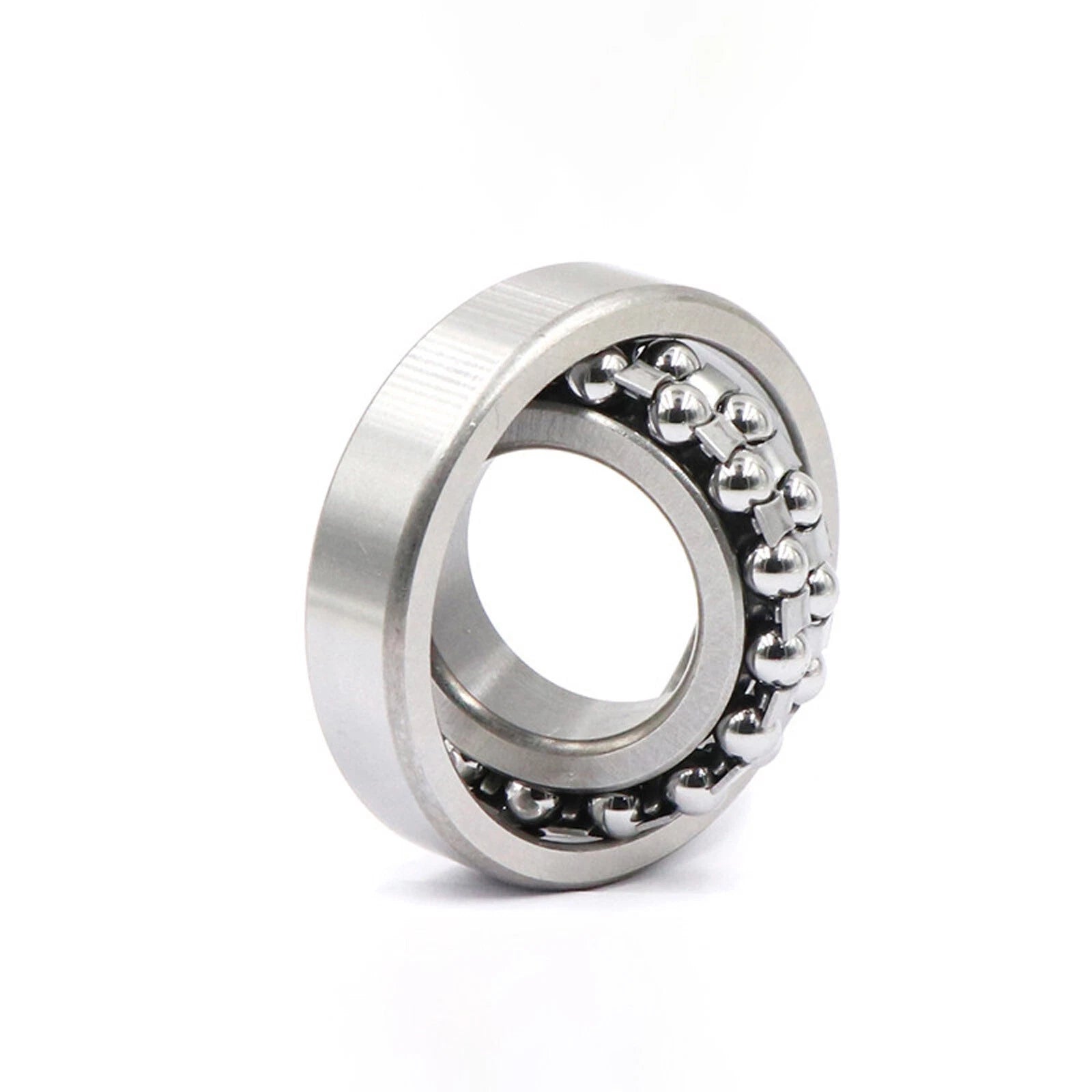
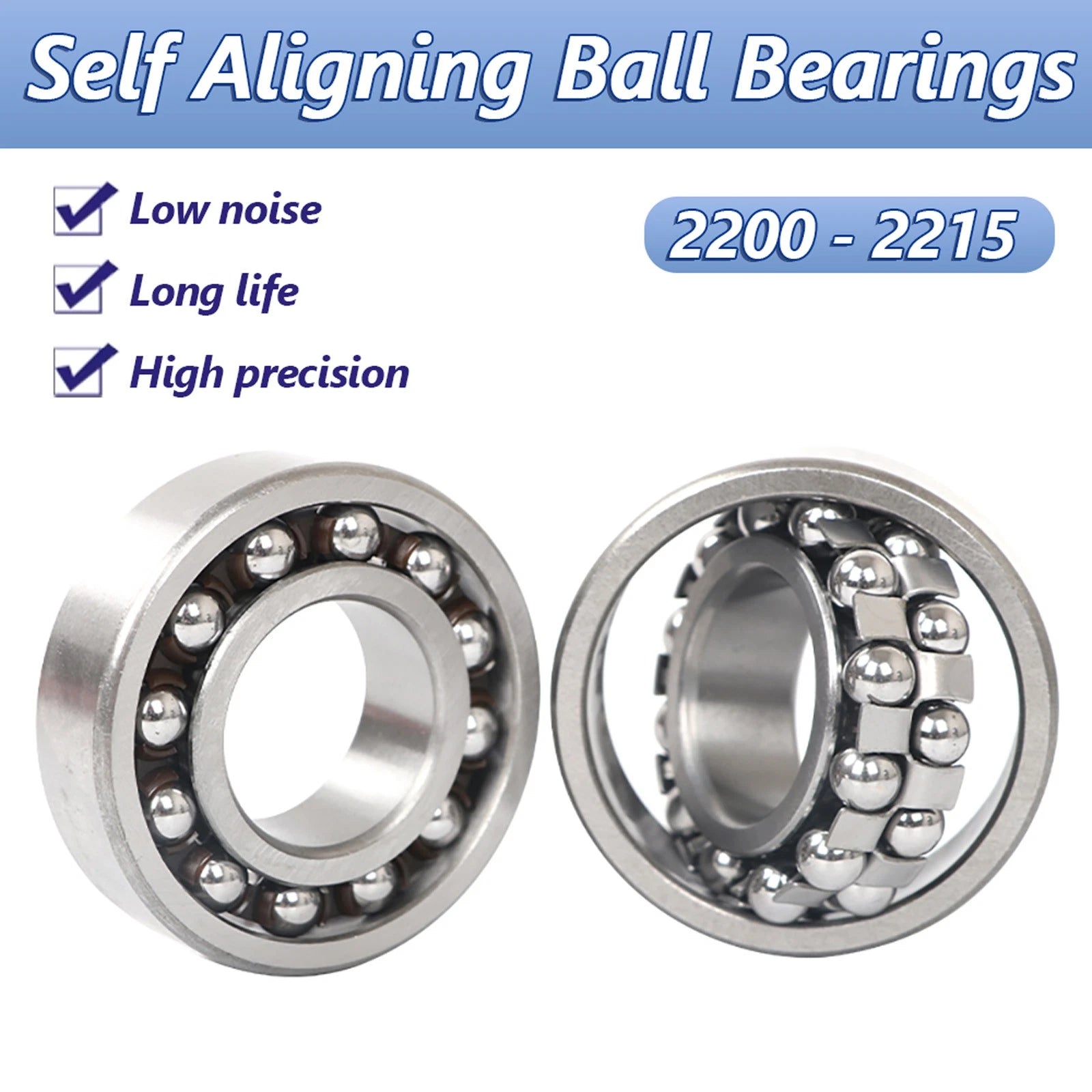
When shaft deflection, housing misalignment, or thermal expansion cause conventional bearings to bind and fail prematurely, engineers and maintenance professionals turn to self-aligning ball bearings. The 2200–2215 series is engineered to accommodate angular misalignment of up to approximately 2–3° while maintaining smooth, low-friction rotation — making it the go-to choice for applications where perfect shaft alignment cannot be guaranteed.
Each self-aligning ball bearing in this series features a double-row ball complement running in a spherical outer-ring raceway. Inner bore diameters range from 10 mm (0.39 in) to 75 mm (2.95 in), outer diameters from 30 mm (1.18 in) to 130 mm (5.12 in), and widths from 14 mm (0.55 in) to 31 mm (1.22 in). Select your exact specification — model number, bore, OD, and width — from the variant options above.
These self-aligning ball bearings are widely used in agricultural machinery shafts, conveyor drive rollers, textile spindle housings, and light industrial gearboxes where vibration and minor shaft flex are everyday operating conditions. Whether you need a single replacement unit or a multi-pack for a maintenance kit, choose your specification and quantity to match your exact requirement.
| Bearing Type | Self-Aligning Ball Bearing, Double Row |
|---|---|
| Series | 2200 / 2201 / 2202 / 2203 / 2204 / 2205 / 2206 / 2207 / 2208 / 2209 / 2210 / 2211 / 2212 / 2213 / 2214 / 2215 |
| Bore Diameter (d) | 10 mm – 75 mm (0.39 in – 2.95 in) — See variant options |
| Outer Diameter (D) | 30 mm – 130 mm (1.18 in – 5.12 in) — See variant options |
| Width (B) | 14 mm – 31 mm (0.55 in – 1.22 in) — See variant options |
| Number of Rows | Double Row |
| Misalignment Capacity | Typically 2°–3° (angular) |
| Cage Material | Stamped Steel |
| Dimensional Standard | ISO 15 / DIN 630 |
| Lubrication | See variant options |
| Sealing | Open (standard) — See variant options |
| Available Quantities | 1 pcs / 2 pcs / 3 pcs |
Measure your shaft's outer diameter — this is the bearing bore (d). Then confirm the housing inner diameter matches the bearing outer diameter (D) and that the available axial space accommodates the bearing width (B). Cross-reference these three dimensions with the variant option table (e.g., 2205 = 25×52×18 mm). If you have the OEM part number, the four-digit suffix directly maps to the ISO series number.
Self-aligning ball bearings in the 2200 series typically accommodate angular misalignment of approximately 2°–3° between the shaft and housing centerlines. Exceeding this range will cause the balls to contact the raceway edges, increasing noise and reducing bearing life. For applications requiring greater misalignment capacity, consider spherical roller bearings instead.
The standard open-type bearings in this listing are not designed for direct water or chemical immersion. For damp or mildly corrosive environments, apply a compatible grease with corrosion-inhibiting additives and consider a sealed or shielded variant. For heavily corrosive conditions, contact us to confirm whether a stainless-steel or special-coated option is available for your required size.
Yes, provided the bore diameter, outer diameter, and width of your existing bearing match the dimensions listed in the variant you select. These bearings conform to ISO 15 / DIN 630 standards, so they are dimensionally interchangeable with any bearing of the same series number from other ISO-compliant manufacturers. Always verify all three dimensions before installation.
Open-type self-aligning ball bearings require grease lubrication before installation if not pre-greased. Use a lithium-based or polyurea grease rated for your operating temperature range. Re-greasing intervals depend on speed, load, and environment — a common starting point for moderate-duty applications is every 500–2,000 operating hours. Consult your equipment manufacturer's maintenance schedule for application-specific guidance.
Deep-groove ball bearings require precise shaft-to-housing alignment; even small angular errors generate edge stress that shortens bearing life. Self-aligning ball bearings tolerate shaft deflection and housing bore misalignment up to ~2–3°, making them the better choice for long shafts supported by multiple housings, shafts subject to bending loads, or assemblies where achieving perfect alignment during installation is difficult.
Both are double-row self-aligning ball bearings, but the 2200 series has a wider width (B dimension) than the 1200 series for the same bore size, which gives it a higher load capacity. The 1200 series uses a narrower profile. Always confirm the exact bore, OD, and width dimensions match your application rather than relying on the series prefix alone.