The chain is fine...but I ordered the wrong size. Nine links of the chain I ordered equals six of the size I wanted. My error...
How can I straighten out the springs? I can't use them coil uo as is.
Your payment information is processed securely. We do not store credit card details nor have access to your credit card information.
Get fitment advice & recommendations
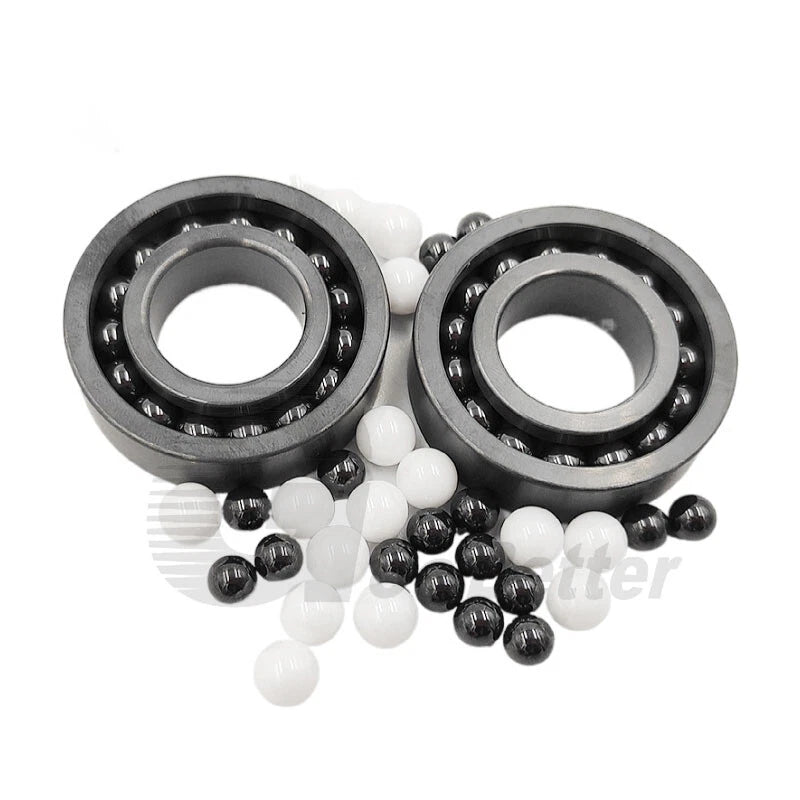
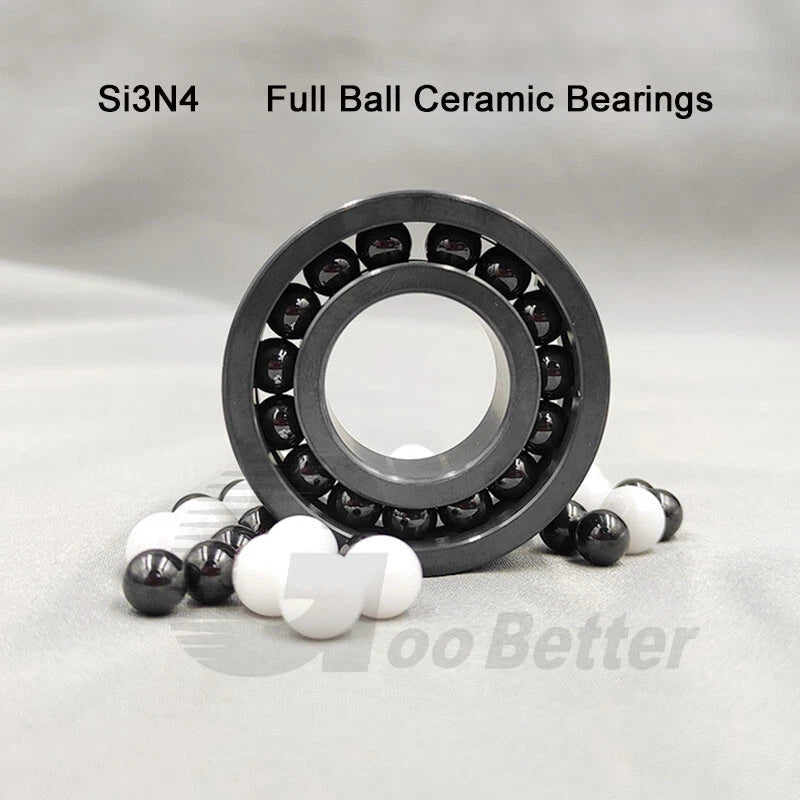
When standard steel bearings corrode, seize, or fail under electrical interference, engineers and DIY builders turn to Si3N4 silicon nitride ceramic ball bearings for a reliable, long-service alternative. These full-ball ceramic bearings are suited for robotics builders, RC hobbyists, lab equipment technicians, and industrial maintenance professionals who need a bearing that performs where steel cannot.
Each bearing is constructed entirely from silicon nitride (Si3N4) rolling elements and races, with bore diameters ranging from 5 mm to 40 mm (approx. 0.20"–1.57") and outer diameters from 16 mm to 68 mm (approx. 0.63"–2.68"). Thickness spans 5 mm to 16 mm (approx. 0.20"–0.63"). Available models include the 606, 608, 625, 688, 6000–6008, 6200–6206, 6800–6806, and 6900–6906 series — each listed with exact ID×OD×Thick dimensions in the variant selector.
Si3N4 silicon nitride ceramic ball bearings are widely used in high-speed spindles, chemical processing pumps, semiconductor handling equipment, saltwater marine applications, and medical devices where non-magnetic, electrically insulating, and corrosion-free operation is required. Their low density also reduces centrifugal load at elevated RPM, making them a practical choice for high-frequency rotation in precision machinery.
Both rolling elements and races are silicon nitride — no steel components. This eliminates galvanic corrosion and makes the bearing fully non-metallic for use in chemically aggressive or electrically sensitive environments.
Si3N4 is an electrical insulator, preventing current leakage through the bearing. Critical for variable-frequency drive (VFD) motors, MRI-adjacent equipment, and any application where stray current causes pitting damage in steel bearings.
Unlike steel or hybrid bearings, full ceramic bearings resist acids, alkalis, and saltwater without surface degradation. Suitable for marine, food processing, and chemical pump applications where moisture ingress is unavoidable.
Silicon nitride is approximately 60% lighter than bearing steel. The reduced mass of rolling elements lowers centrifugal force at high RPM, enabling higher speed ratings and reduced heat generation in spindle and turbine applications.
Si3N4 ceramic maintains dimensional stability from cryogenic conditions up to approximately 800 °C (1472 °F) in dry environments, outperforming standard steel bearings in both extreme cold and elevated-temperature service.
Covers 32 standard metric models across the 600, 6000, 6200, 6800, and 6900 series. Each variant is labeled with exact ID×OD×Thick dimensions so you can match your housing specification without guesswork.
| Material | Silicon Nitride (Si3N4) — full ceramic (races and rolling elements) |
|---|---|
| Bearing Type | Deep groove ball bearing, full ceramic |
| Bore Diameter (ID) | 5 mm – 40 mm (approx. 0.20" – 1.57") |
| Outer Diameter (OD) | 16 mm – 68 mm (approx. 0.63" – 2.68") |
| Width (Thickness) | 5 mm – 16 mm (approx. 0.20" – 0.63") |
| Available Series | 606, 608, 625, 688 / 6000–6008 / 6200–6206 / 6800–6806 / 6900–6906 |
| Dimensional Standard | ISO 15 metric series |
| Lubrication | See variant options (dry / lubrication-free operation supported) |
| Seal / Shield Type | See variant options |
| Max Operating Temperature | Up to approx. 800 °C (1472 °F) in dry conditions |
| Electrical Properties | Non-conductive (insulating) |
| Magnetic Properties | Non-magnetic |
| Corrosion Resistance | Resistant to acids, alkalis, and saltwater |
| Quantity per Order | See variant options (1 pcs available; bulk options may apply) |
Match the three key dimensions: bore diameter (ID), outer diameter (OD), and width (thickness). These are listed in the variant label as ID×OD×Thick in millimeters. For example, "6004 – 20×42×12mm" means a 20 mm bore, 42 mm OD, and 12 mm width. Measure your shaft diameter for the ID and your housing bore for the OD before selecting.
These are full ceramic bearings — both the rolling balls and the inner/outer races are made from Si3N4 silicon nitride. Hybrid ceramic bearings use ceramic balls with steel races. Full ceramic construction provides complete corrosion immunity and electrical insulation that hybrid designs cannot match.
Silicon nitride has inherently low friction and can operate dry in many applications, which is one of its key advantages over steel. However, in high-load or high-speed applications, a compatible lubricant (such as PTFE-based grease) can extend service life. Avoid petroleum-based greases in chemically aggressive environments. Contact us to confirm lubrication recommendations for your specific use case.
Yes. Si3N4 silicon nitride is chemically inert to most acids, alkalis, and saltwater. Full ceramic bearings are a standard choice for marine propulsion systems, desalination equipment, chemical dosing pumps, and food-grade machinery where steel would corrode rapidly. No additional coating or sealing is required for corrosion resistance.
Yes. All models follow ISO 15 standard metric dimensions, so they are drop-in replacements for steel bearings of the same series number. A 6004 ceramic bearing has identical outer dimensions to a 6004 steel bearing and will fit the same housing and shaft without modification.
Si3N4 ceramic bearings typically support higher speed ratings than equivalent steel bearings due to their lower density and reduced centrifugal load. Maximum operating temperature in dry conditions reaches approximately 800 °C (1472 °F). Exact speed limits depend on bearing size, load, and lubrication — contact us to confirm for your specific model and operating conditions.
Full ceramic bearings are the right choice when you need complete electrical insulation (no conductive path through the bearing), total corrosion immunity (including the races), or operation in environments where any metallic component would be problematic — such as MRI rooms, strong magnetic fields, or highly acidic media. Hybrid bearings offer a cost compromise but retain steel races that can corrode or conduct electricity.