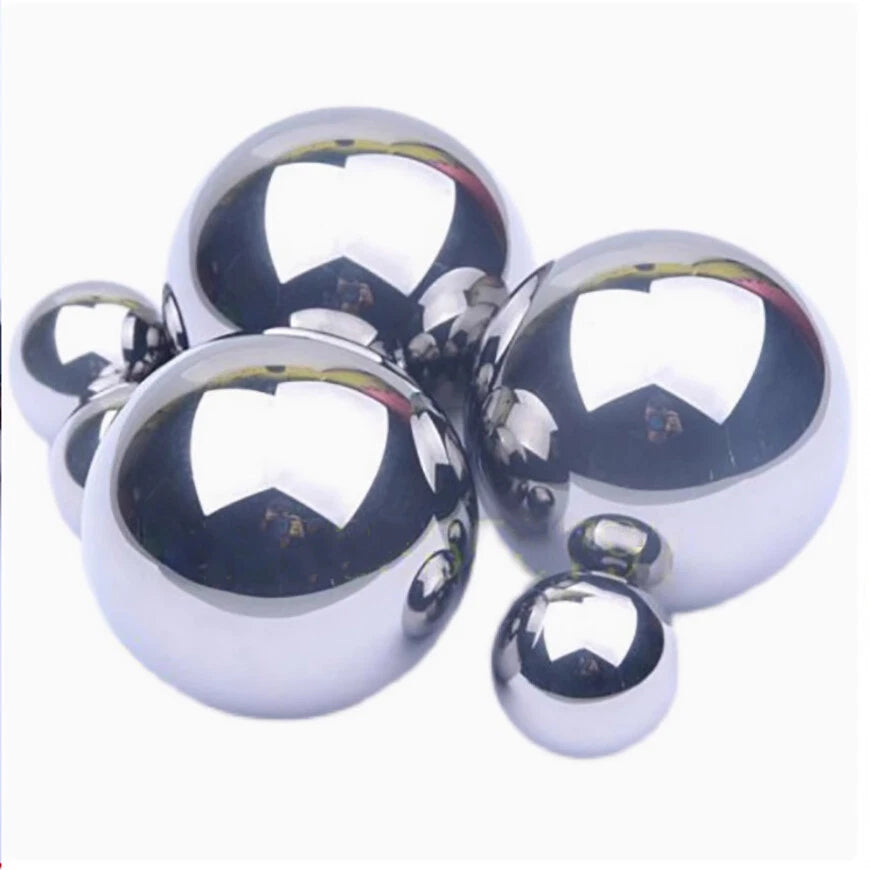
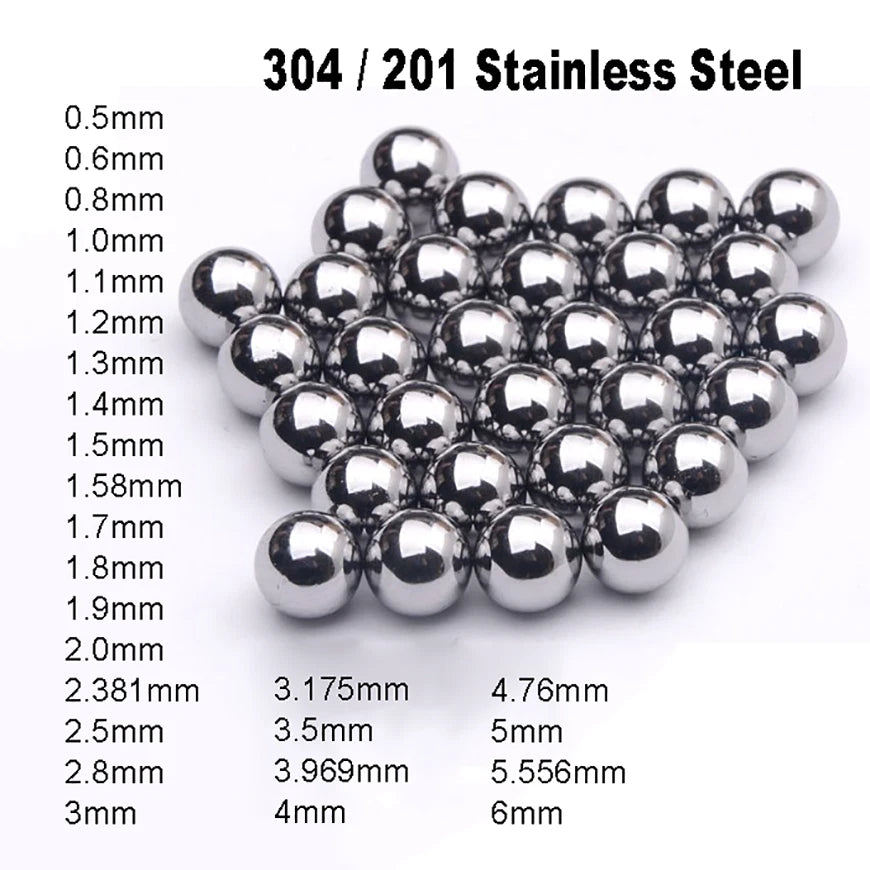
Solid 304-201 Stainless Steel Ball Bearings Precision Bearing Balls 0.5mm- 6mm

No reviews

Price:
Sale price$285.46 USD
Stock:
In stock (500 units), ready to be shipped

Payment & Security

Ach Direct Debit Amazon American Express Apple Pay Bancontact BLIK Diners Club Discover EPS Google Pay iDEAL Wero JCB Maestro Mastercard Multibanco MobilePay PayPal Przelewy24 Shop Pay Twint Union Pay USDC Visa

Your payment information is processed securely. We do not store credit card details nor have access to your credit card information.

Limited Offer — Spend More, Save More
Spend $55+
Save $5
Spend $100+
Save $10
Spend $200+
Save $25
HomeDIYer DIY Expert Support

DIY Expert Support

Get fitment advice & recommendations

Mon–Fri  8:30 AM – 8:00 PM
24-Hour Fast Ship
Arrives in 3–14 Days
Worldwide Shipping
30-Day Returns
1 tree planted with every purchase

Description

Stainless Steel Precision Bearing Balls — Corrosion-Resistant Rolling Elements for Demanding Applications

When a bearing fails mid-project because the rolling elements corrode, pit, or lose their roundness tolerance, the entire assembly pays the price. Engineers, machinists, and serious DIYers who need reliable replacements or bulk fill stock turn to solid stainless steel bearing balls that hold their geometry under load and resist moisture without constant maintenance.

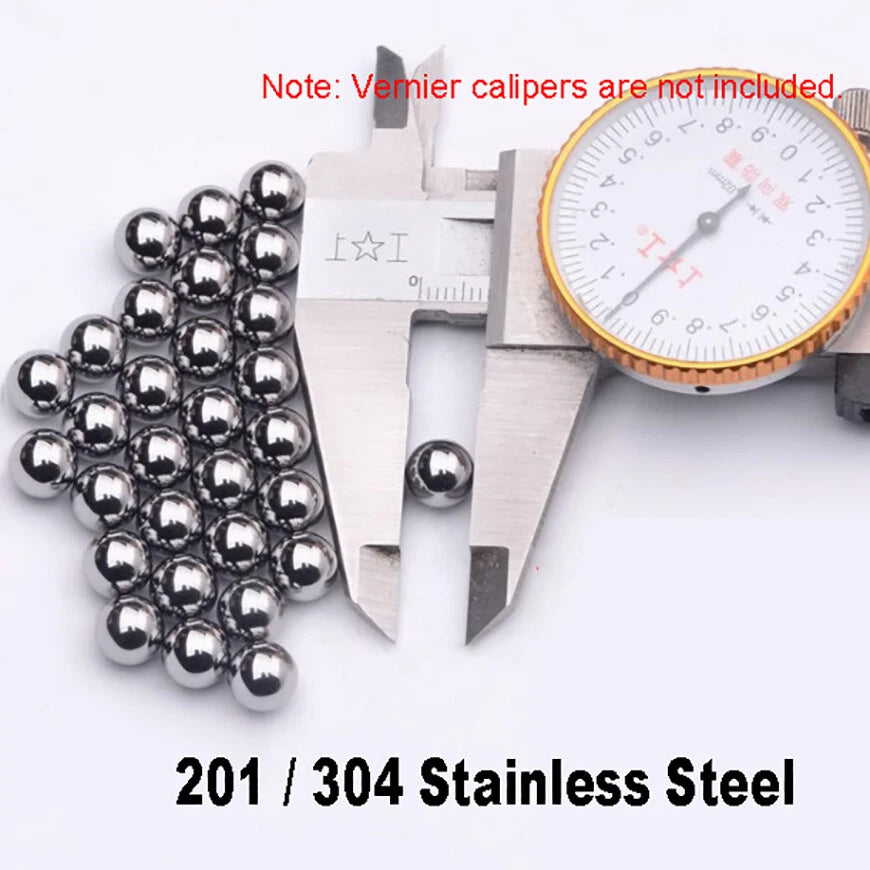
These precision bearing balls are manufactured from solid 304 or 201 stainless steel — your choice — and are available in diameters ranging from 0.5 mm (approx. 0.020 in) up to 6 mm (approx. 0.236 in). Each order is sold by weight (0.1 kg or 0.5 kg packs depending on diameter), so you receive a consistent, countable quantity of balls per pack as indicated in the variant options.

Typical use cases include replacement rolling elements in miniature radial bearings, ball-screw and linear-guide recirculation circuits, valve seats in fluid-control assemblies, and decorative or functional hardware in woodworking jigs and DIY mechanisms. The corrosion resistance of stainless steel makes these balls well-suited for food-adjacent equipment, marine hardware, and humid workshop environments where carbon-steel balls would rust within weeks.

⚙️ Compatibility note: Select the diameter that matches your bearing bore or seat specification. Mixed-grade packs are not available — choose 304 or 201 per order. Contact us to confirm tolerance grade if your application requires ABEC/ISO-rated elements.

✅ Key Features of These Stainless Steel Precision Bearing Balls

  • 🔩 Solid stainless steel construction — Full solid cross-section with no hollow core; maintains load capacity and roundness under radial and axial stress.
  • 🛡️ Corrosion-resistant alloy choice — 304 grade offers superior rust resistance for wet or outdoor environments; 201 grade provides a cost-effective alternative for moderate-humidity indoor use.
  • 📏 Wide diameter range (0.5 mm – 6 mm) — 27 diameter options in a single listing cover miniature instrument bearings up to standard small-bearing assemblies, reducing the need for multiple suppliers.
  • ⚖️ Sold by weight with grain count guidance — Each variant lists approximate grain count per pack so you can estimate coverage before ordering, minimising waste and over-ordering.
  • 🔄 Consistent sphericity for smooth rolling — Uniform diameter within each pack supports even load distribution across the bearing raceway, reducing vibration and premature wear.
  • 🧰 Versatile across industries — Suitable for bearing replacement, valve seats, linear guides, ball-screw recirculation, decorative hardware, and precision DIY mechanisms.

📐 Technical Specifications — Stainless Steel Bearing Balls

Material Options 304 Stainless Steel / 201 Stainless Steel
Diameter Range 0.5 mm – 6 mm (approx. 0.020 in – 0.236 in)
Available Diameters See variant options
Pack Weight Options 0.1 kg / 0.2 kg / 0.5 kg (varies by diameter)
Approximate Grain Count See variant options
Ball Form Solid sphere, no hollow core
Surface Finish Bright / smooth rolled surface
Tolerance Grade Contact us to confirm
Hardness Contact us to confirm
Application Bearing replacement, valve seats, linear guides, DIY mechanisms

❓ Frequently Asked Questions

What is the difference between 304 and 201 stainless steel bearing balls?

304 stainless steel contains a higher nickel content (typically 8–10.5%) which gives it superior corrosion resistance, making it the preferred choice for wet environments, marine applications, and food-adjacent equipment. 201 stainless steel uses manganese in place of some nickel, offering moderate corrosion resistance at a lower cost — suitable for indoor, low-humidity applications where budget is a consideration.

How do I choose the correct diameter for my bearing?

Measure the existing balls with a micrometer or check your bearing's datasheet for the rolling-element diameter. The diameter listed in each variant is the nominal ball diameter. For critical applications, contact us to confirm the tolerance grade before ordering, as some assemblies require tighter roundness tolerances than standard commercial-grade balls provide.

Are these balls suitable for food processing or medical equipment?

304 stainless steel is widely used in food-contact and sanitary environments due to its corrosion resistance and ease of cleaning. However, suitability for regulated food or medical applications depends on your specific compliance requirements (e.g., FDA, NSF). We recommend confirming the material certification with us before use in regulated environments.

What does the approximate grain count mean, and how accurate is it?

The grain count listed per variant is an approximation based on the nominal diameter and pack weight, calculated from the theoretical volume and density of stainless steel. Actual count may vary slightly due to manufacturing tolerances and density variation between alloy grades. Use the count as a planning guide rather than an exact figure.

Can I use these balls in a ball-screw or linear guide recirculation circuit?

Yes, these balls are commonly used as replacement elements in ball-screw and linear-guide recirculation systems. Ensure the diameter matches your circuit's specification exactly — even a 0.1 mm deviation can affect preload and running smoothness. Contact us if you need a specific tolerance grade or surface finish for your application.

Will stainless steel balls rust or corrode over time?

Stainless steel is significantly more corrosion-resistant than carbon steel, but it is not fully immune to corrosion in all environments. 304 grade performs well in most atmospheric and mildly acidic conditions. Prolonged exposure to chloride-rich environments (e.g., salt water) or strong acids can cause surface staining or pitting over time. For highly aggressive environments, consider specifying 316 grade — contact us to discuss availability.

Can I order a mix of diameters in a single pack?

Each variant is a single-diameter pack — mixed-diameter packs are not available as a standard option. If you need multiple diameters, add each as a separate line item. For large-volume or custom mixed orders, contact us directly to discuss options.

🛒 Select your Material, Diameter, and Packing Qty above, then add to cart.


You may also like

Recently viewed