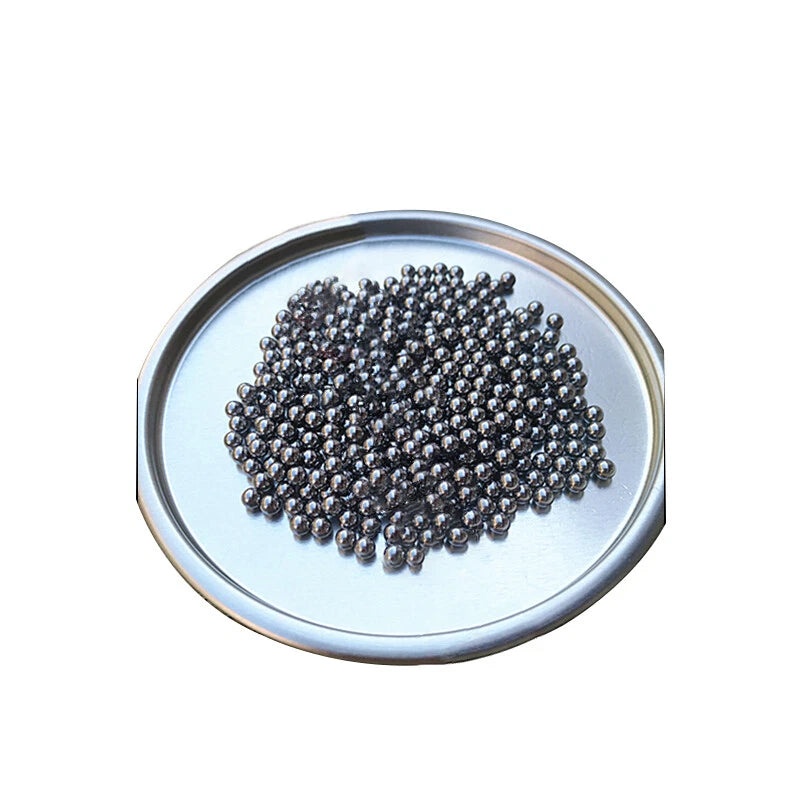
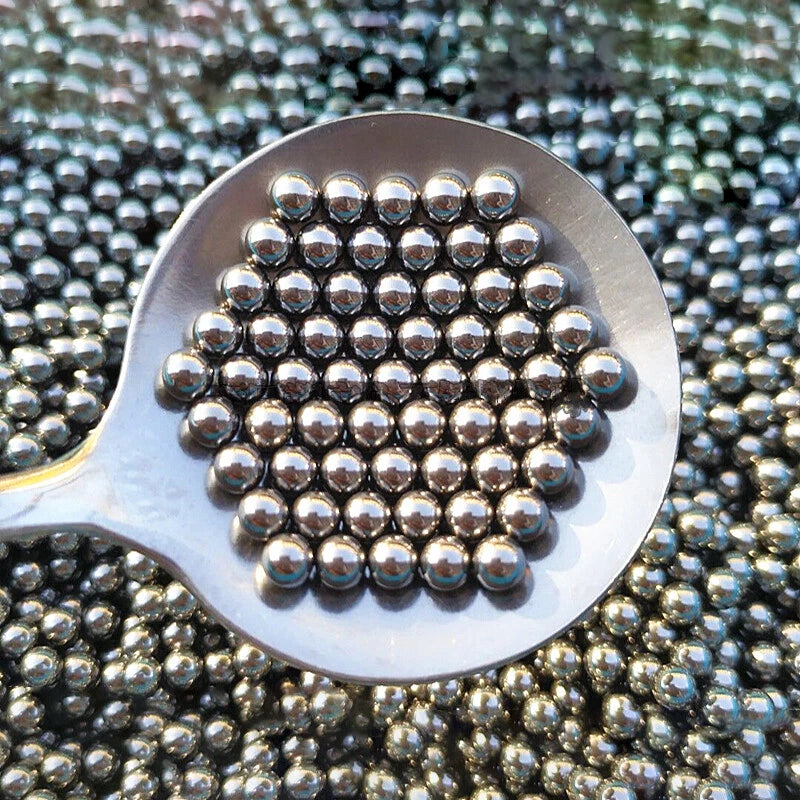
Stainless Steel A1 Ball Bearings — Precision Roller Bearings for DIY & Mechanical Transmission
When a loose or corroded bearing brings your project to a halt, finding the right replacement in the right size shouldn't be another obstacle. Whether you're a DIY enthusiast rebuilding a skateboard, a maker assembling a CNC axis, or a technician servicing small machinery, these stainless steel A1 ball bearings give you a reliable, rust-resistant rolling element in the exact diameter you need.
Each bearing is machined from A1-grade stainless steel (equivalent to AISI 302/304), offering a smooth, polished rolling surface. Available diameters span 3 mm (approx. 0.118 in) through 6.35 mm (approx. 0.250 in / ¼ in), covering the most common sizes used in light-duty mechanical assemblies. Pack quantities range from 20 to 2,000 pieces so you can order exactly what your build or restocking needs require.
Typical applications include 3D printer extruder and axis assemblies, RC car and drone drivetrain components, and small motor and transmission repair — anywhere a corrosion-resistant, dimensionally consistent ball bearing is required for smooth rotational or linear motion.
⚙️ Compatibility Note: These are loose ball bearings intended for use inside bearing races, cages, or housings. Verify your housing's ball seat diameter before ordering. See variant options for available diameters.
✅ Key Features of These Stainless Steel A1 Ball Bearings
🔩 A1 Stainless Steel Construction
Manufactured from A1-grade stainless steel (AISI 302/304 equivalent) for reliable corrosion resistance in humid, wet, or mildly acidic environments — no surface coating required.
📐 Wide Diameter Range: 3 mm to 6.35 mm
Nine diameter options (3 mm, 3.175 mm, 4 mm, 4.5 mm, 5.5 mm, 5.6 mm, 6 mm, 6.35 mm, 6.5 mm) cover the most common light-duty bearing sizes used in DIY and mechanical applications.
🎯 Precision-Ground Spherical Surface
Each ball is ground and polished to a consistent spherical profile, ensuring smooth, low-friction rolling contact and even load distribution within the bearing race.
📦 Flexible Pack Quantities
Available in packs from 20 to 2,000 pieces. Order a small quantity for a single repair or stock up in bulk for ongoing production or workshop inventory.
🛡️ Corrosion-Resistant Without Coatings
Unlike carbon steel balls that rely on oil or plating for rust protection, A1 stainless steel maintains its integrity without additional surface treatment — suitable for environments where lubrication may wash away.
⚡ Broad Application Compatibility
Suited for 3D printers, RC vehicles, drones, small motors, linear rails, drawer slides, and general mechanical transmission assemblies requiring a 3–6.35 mm rolling element.
📐 Technical Specifications — Stainless Steel Ball Bearings
| Material |
A1 Stainless Steel (AISI 302/304 equivalent) |
| Diameter Range |
3 mm – 6.35 mm (approx. 0.118 in – 0.250 in); see variant options |
| Available Diameters |
3 mm, 3.175 mm, 4 mm, 4.5 mm, 5.5 mm, 5.6 mm, 6 mm, 6.35 mm, 6.5 mm |
| Surface Finish |
Precision-ground, polished spherical surface |
| Corrosion Resistance |
Inherent stainless steel corrosion resistance; no additional coating |
| Pack Quantity |
20 / 50 / 100 / 150 / 200 / 250 / 300 / 400 / 500 / 600 / 800 / 1000 / 1500 / 2000 pcs |
| Bearing Type |
Loose ball bearing (for use in races, cages, or housings) |
| Typical Load Rating |
See variant options / Contact us to confirm |
| Operating Temperature |
Typically –20°C to +150°C (–4°F to +302°F) |
| Hardness |
See variant options |
❓ Frequently Asked Questions
Which diameter should I choose for my application?
Measure the inner diameter of your bearing race or housing seat with a caliper. The ball diameter should match the seat specification exactly — a ball that is too small will have excessive play, while one that is too large will not seat properly. Common sizes: 3 mm and 3.175 mm (⅛ in) for miniature assemblies; 4–4.5 mm for light RC and 3D printer use; 6–6.35 mm (¼ in) for small motors and drawer mechanisms.
Are these balls strong enough for load-bearing applications?
A1 stainless steel ball bearings are well-suited for light-to-medium duty applications such as 3D printers, RC vehicles, drones, and small mechanical assemblies. For heavy industrial loads or high-speed precision spindles, a chrome steel (52100) or ceramic bearing may be more appropriate. If you are unsure whether these balls meet your load requirements, contact us with your application details.
Will these rust if used in wet or outdoor environments?
A1 stainless steel (AISI 302/304 equivalent) provides inherent corrosion resistance without relying on oil films or surface coatings. These balls perform well in humid, splashing-water, and mildly corrosive environments. For prolonged saltwater or highly acidic exposure, consider A4 (316) stainless steel, which offers superior chloride resistance.
Are these compatible with standard bearing races and cages?
Yes — these are standard-diameter loose balls designed to fit into bearing races, retainer cages, or custom housings that specify the corresponding ball diameter. Always verify the ball seat diameter in your race or housing before ordering. The 3.175 mm and 6.35 mm sizes correspond to imperial ⅛ in and ¼ in standards, respectively, making them compatible with many North American and UK-spec assemblies.
How do I decide between a small pack and a bulk quantity?
For a single repair or prototype, a 20–50 piece pack is typically sufficient and minimizes upfront cost. If you are running a production batch, stocking a workshop, or building multiple units, ordering 500–2,000 pieces significantly reduces the per-unit cost. Check the price-per-piece across pack sizes before adding to cart — larger packs offer a lower unit price.
Can I mix different diameters in one order?
Yes. Each diameter and pack quantity combination is a separate variant. Simply add each variant you need to your cart individually. There is no requirement to order the same diameter across all packs.
What is the difference between 3.175 mm and 6.35 mm versus the metric sizes?
3.175 mm equals exactly ⅛ inch and 6.35 mm equals exactly ¼ inch — these are imperial-standard sizes commonly found in North American and UK machinery, RC vehicles, and legacy equipment. The metric sizes (3 mm, 4 mm, 4.5 mm, 5.5 mm, 6 mm) are used in most modern European and Asian-spec assemblies. Always check your original equipment specification to confirm which standard applies.
🛒 Select your Diameter and Pack Quantity above, then add to cart.