The chain is fine...but I ordered the wrong size. Nine links of the chain I ordered equals six of the size I wanted. My error...
How can I straighten out the springs? I can't use them coil uo as is.
Your payment information is processed securely. We do not store credit card details nor have access to your credit card information.
Get fitment advice & recommendations
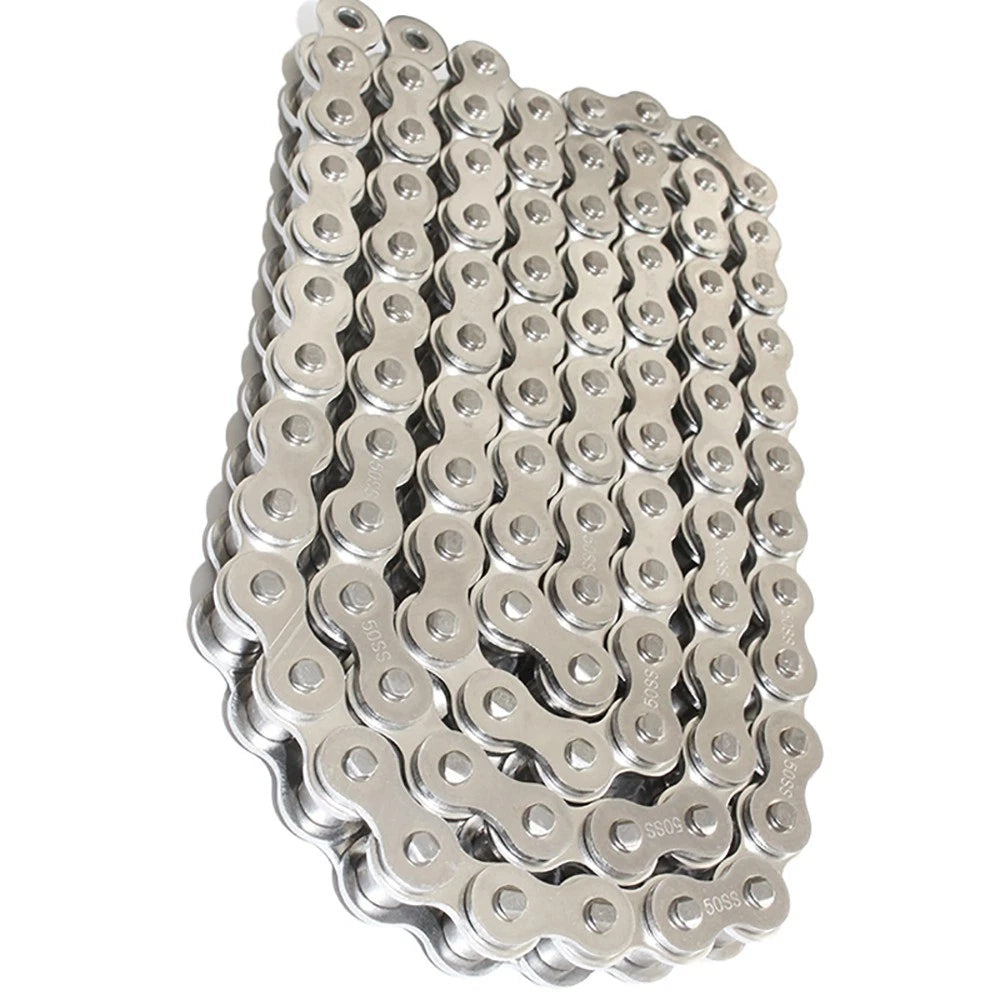
When standard carbon steel chains corrode, seize, or contaminate your process, you need a chain built to resist the environment rather than surrender to it. Engineers, maintenance teams, and equipment builders working in food processing, marine, chemical handling, and outdoor power transmission rely on stainless steel roller chains to keep drives running without constant replacement cycles.
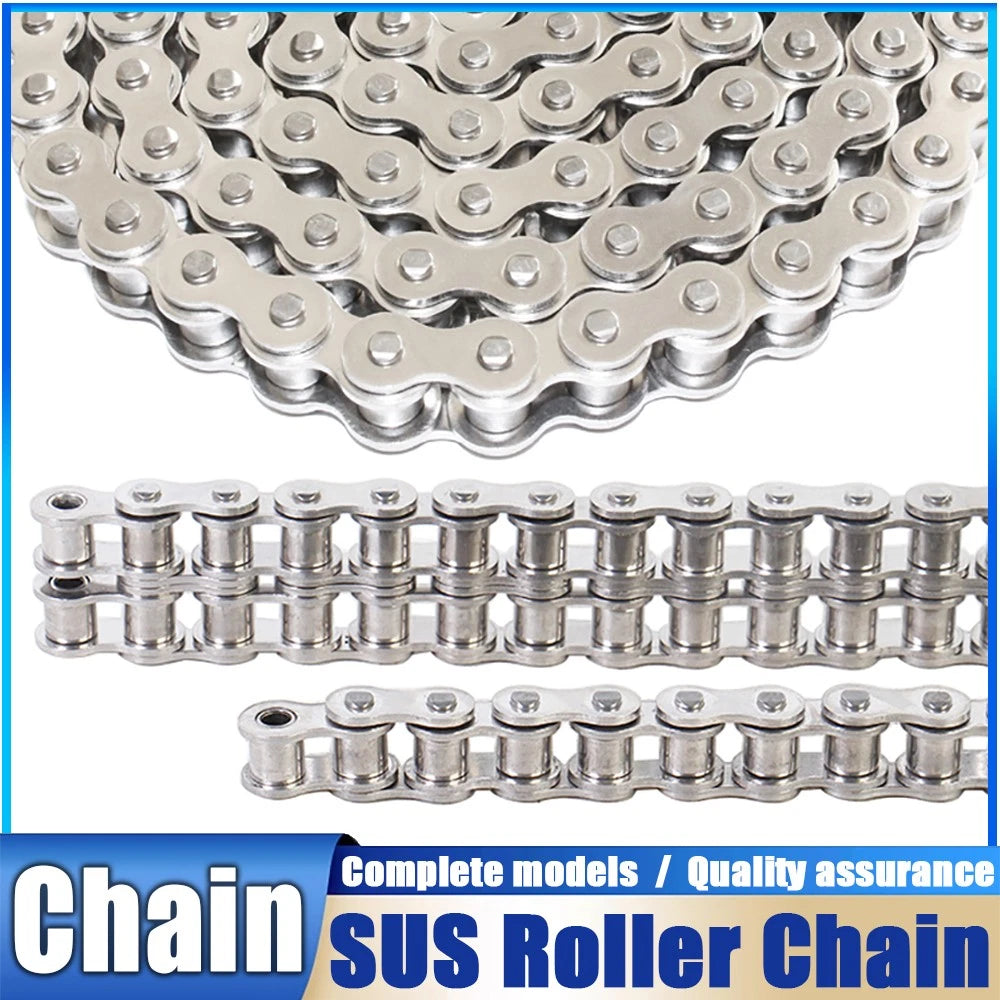
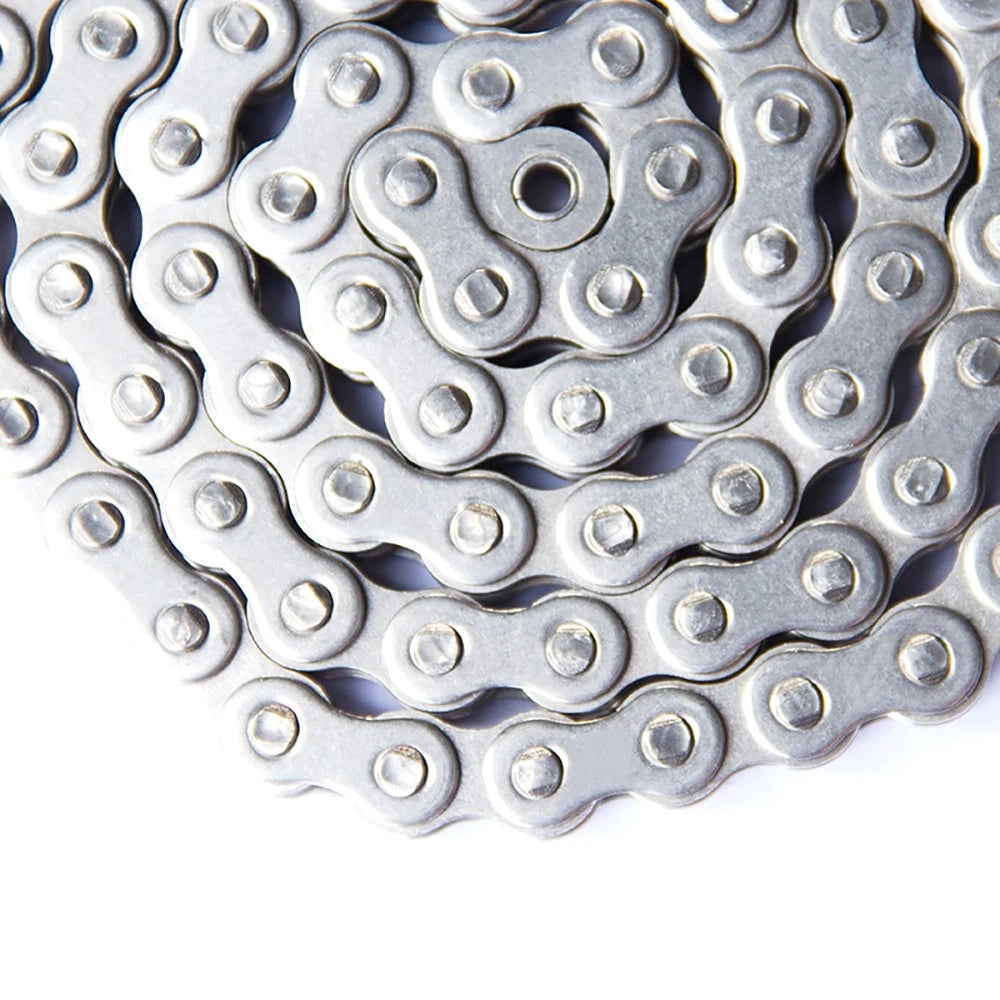
This roller chain is manufactured from 304 stainless steel throughout — inner and outer plates, pins, bushings, and rollers — delivering consistent corrosion resistance across the full chain assembly. Available in both simplex (single-strand) and duplex (double-strand) configurations, sizes range from compact 06C/06B chains up to heavy-duty 24A, with pitches spanning approximately 9.525 mm (3/8 in) for 06-series up to 38.1 mm (1-1/2 in) for 24A. Each variant ships as a complete loop at the standard ISO link count for that size.
Typical applications include food-grade conveyor drives where wash-down resistance is required, marine deck machinery and boat lift mechanisms exposed to salt spray, pharmaceutical and chemical plant equipment where contamination control is critical, and outdoor agricultural or irrigation machinery subject to moisture and debris.
| Material | 304 Stainless Steel (plates, pins, bushings, rollers) |
|---|---|
| Chain Standard | ISO 606 / DIN 8187 (B-series); ANSI/ISO (A-series) |
| Available Sizes | 06C, 06B, 08A, 08B, 10A, 10B, 12A, 12B, 16A, 16B, 20A, 20B, 24A |
| Strand Configuration | Simplex (1-strand) and Duplex (2-strand) — see variant options |
| Pitch Range | 9.525 mm (3/8 in) for 06-series — 38.1 mm (1-1/2 in) for 24A |
| Link Count per Loop | 40–160 links depending on chain model (see variant options) |
| Tensile Strength | See variant options |
| Finish | Natural stainless (uncoated) |
| Lubrication | Light factory lubrication; re-lubricate with food-grade or stainless-compatible oil as required |
| Operating Temperature | Typically –20°C to +300°C (–4°F to +572°F) |
| Corrosion Resistance | Suitable for water, salt spray, mild acids, and cleaning agents |
| Joining Method | Connecting link (sold separately) or press-fit rivet link |
A-series chains (08A, 10A, 12A, etc.) follow ANSI/ISO dimensions common in North American equipment, while B-series chains (06B, 08B, 12B, etc.) follow ISO/DIN dimensions more common in European machinery. The key difference is in plate thickness and pin diameter for the same pitch. Match the series to your existing sprocket — if your sprocket is stamped with an ANSI number (e.g., #40, #50), use the A-series equivalent; if it shows a metric ISO designation, use B-series.
Simplex (single-strand) chain has one row of rollers and is the standard configuration for most drives. Duplex (double-strand) chain has two parallel rows of rollers sharing the same pins, roughly doubling the load capacity for the same pitch. Duplex requires a matching double-strand sprocket. If your drive is currently overloading a simplex chain, switching to duplex at the same pitch is often more space-efficient than upsizing to a larger pitch chain.
304 stainless steel offers good resistance to fresh water, mild salt spray, and general atmospheric corrosion. For continuous immersion in seawater or highly chlorinated environments, 316 stainless steel is typically recommended due to its higher molybdenum content. For intermittent salt spray exposure — such as marine deck machinery, boat lifts, or coastal outdoor equipment — 304 SS chain performs well with periodic rinsing and light lubrication.
304 stainless steel is widely accepted in food processing environments and meets general food-contact material requirements for metal components. The chain should be lubricated with an NSF H1-rated food-grade lubricant when used in direct or incidental food-contact zones. Always verify compliance with your local food safety regulations and equipment certification requirements before installation.
Each variant ships as a complete pre-formed loop at the standard ISO link count. If you need to shorten the chain, use a chain breaker tool to press out a pin at the desired link. To rejoin the ends or connect two chain sections, use a stainless steel connecting link (also called a master link) matched to the chain size and series. Connecting links are sold separately — search for the corresponding size (e.g., 08A SS connecting link) to ensure material compatibility.
Use a lubricant compatible with stainless steel — avoid lubricants containing chlorinated compounds, which can cause stress corrosion cracking in stainless alloys. For general industrial use, a light machine oil or chain-specific lubricant works well. For food processing, use an NSF H1-certified food-grade oil. For high-temperature applications, a dry PTFE or high-temp chain lubricant is recommended. Re-lubricate at regular intervals based on operating speed and environment.
Measure the pitch of your existing chain (center-to-center distance between two adjacent pins) or check the sprocket manufacturer's documentation. Common pitches: 06-series = 9.525 mm, 08-series = 12.7 mm, 10-series = 15.875 mm, 12-series = 19.05 mm, 16-series = 25.4 mm, 20-series = 31.75 mm, 24-series = 38.1 mm. Also confirm whether your sprocket is A-series or B-series, and whether it is single or double strand. If unsure, contact us with your sprocket part number or a photo and we can help confirm compatibility.