The chain is fine...but I ordered the wrong size. Nine links of the chain I ordered equals six of the size I wanted. My error...
How can I straighten out the springs? I can't use them coil uo as is.
Your payment information is processed securely. We do not store credit card details nor have access to your credit card information.
Get fitment advice & recommendations
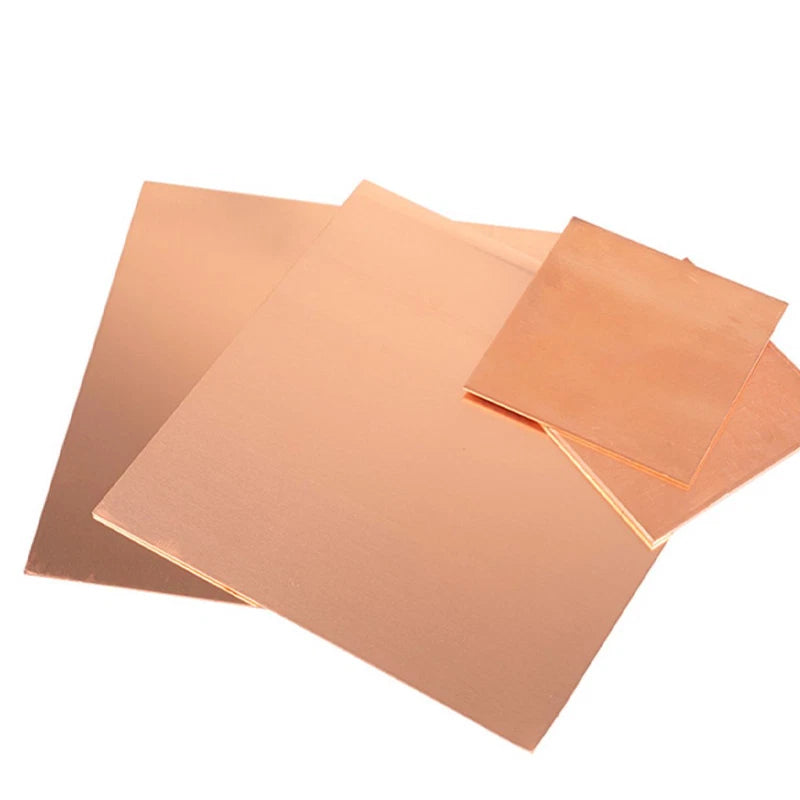
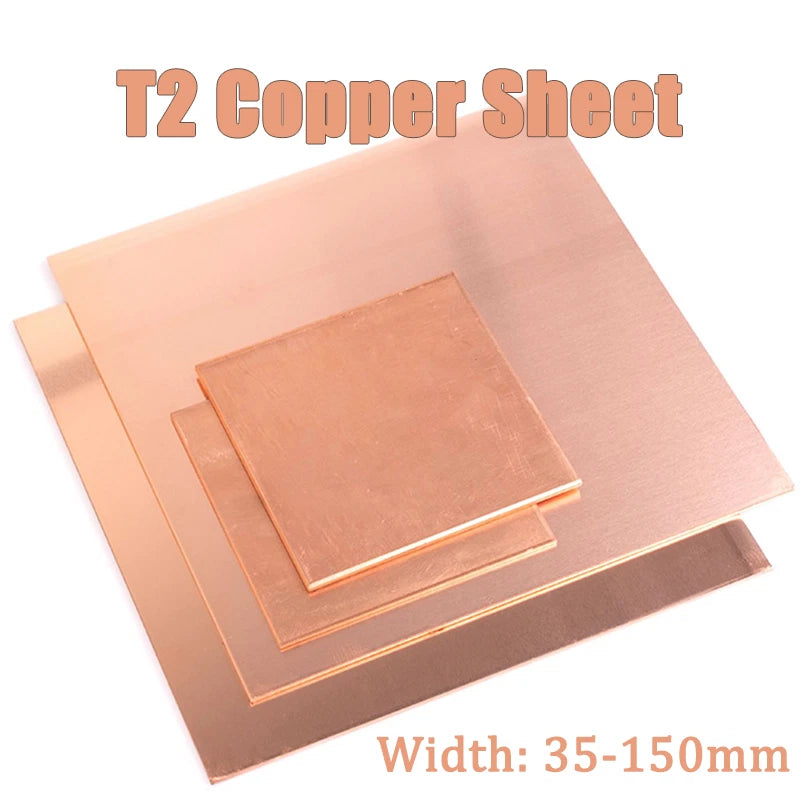
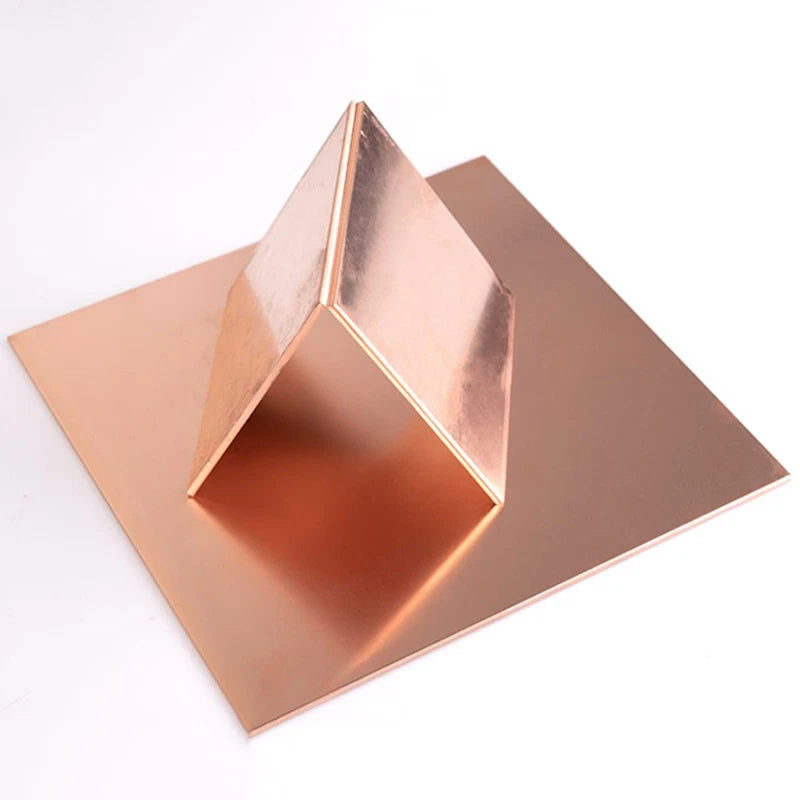
When a project demands reliable electrical conductivity and dimensional accuracy, sourcing the right copper stock is half the battle. Hobbyists building bus bars, engineers prototyping grounding straps, and fabricators cutting custom shims all face the same frustration: off-spec thickness, rough sheared edges, or inconsistent purity that throws off resistance calculations. These T2 electrolytic copper plates and strips are CNC-cut to exact dimensions, giving you a clean, burr-minimized edge straight out of the package.
Each piece is made from T2-grade electrolytic copper — a commercially pure copper alloy with a minimum copper content of 99.9%. Available in flat plate and strip formats, sizes range from compact 35 × 50 mm (approximately 1.38" × 1.97") up to 150 × 150 mm (approximately 5.91" × 5.91") and 100 × 200 mm (approximately 3.94" × 7.87"), with thickness options spanning 0.5 mm to 5 mm (approximately 0.020" to 0.197"). Pieces are sold in sets of 1, 2, 3, 5, 8, or 10 to match your exact quantity needs.
Typical applications include DIY electrical bus bars and grounding plates, RF shielding and EMI gasket blanks, heat spreader inserts in electronics enclosures, custom shim stock for mechanical assemblies, and electroforming or electroplating cathode blanks. The consistent thickness and flat surface also make these sheets well-suited for laser engraving, etching, and small-batch CNC milling of copper components.
| Material Grade | T2 Electrolytic Copper (≥99.9% Cu) |
|---|---|
| Form Factor | Flat plate / strip |
| Thickness Range | 0.5 mm – 5 mm (0.020" – 0.197") |
| Available Sizes (W × L) | 35×50 mm, 55×100 mm, 70×100 mm, 100×100 mm, 100×200 mm, 150×150 mm |
| Pieces per Pack | See variant options (1 / 2 / 3 / 5 / 8 / 10 pcs) |
| Surface Finish | Mill finish (smooth, flat) |
| Edge Condition | CNC-cut, burr-minimized |
| Electrical Resistivity | Typically ~1.72 × 10⁻⁸ Ω·m at 20 °C |
| Thermal Conductivity | Typically ~385 W/(m·K) |
| Hardness | Typically 40–65 HV (annealed to half-hard) |
| Weight per Piece | See variant options (varies by size and thickness) |
| Cutting Method | CNC precision cut |
| Compatible Joining Methods | Soldering, silver brazing, mechanical fastening, riveting |
Thickness selection depends on the current load and mechanical requirements. For light grounding straps or shielding blanks, 0.5 mm – 1 mm is typically sufficient. For bus bars carrying moderate current (up to ~30 A in open air), 2 mm – 3 mm provides a good balance of conductivity and rigidity. For heavy-duty bus bars or structural shim applications, 4 mm – 5 mm is recommended. When in doubt, calculate the required cross-sectional area based on your target current density (a common guideline is 2–4 A/mm² for copper bus bars in free air).
T2 is the Chinese national standard designation for electrolytic tough-pitch copper, broadly equivalent to ASTM C110 (ETP copper) with a minimum copper content of 99.9%. It shares similar electrical and thermal conductivity characteristics. C101 (oxygen-free copper, OFHC) has slightly higher purity (≥99.99% Cu) and is preferred for hydrogen-atmosphere brazing or ultra-high-vacuum applications. For most DIY electrical, grounding, and fabrication uses, T2 / C110 performs equivalently to C101 at a lower cost.
Copper naturally oxidizes when exposed to air and moisture, forming a thin oxide layer that darkens the surface from bright orange-red to brown and eventually to a green patina (verdigris) in humid or outdoor environments. This surface oxidation does not significantly affect bulk electrical conductivity for most applications. To slow tarnishing, store unused pieces in a sealed bag with a desiccant, or apply a thin coat of clear lacquer or anti-tarnish spray. For electrical contact surfaces, clean with isopropyl alcohol and fine abrasive before assembly.
Yes. Thinner sheets (0.5 mm – 1.5 mm) can be scored and snapped with a utility knife and straightedge, or cut with aviation snips. Thicker pieces (2 mm – 5 mm) are best cut with a jigsaw fitted with a fine-tooth metal blade, a bandsaw, or a rotary tool with a cutting disc. Drilling is straightforward with standard HSS drill bits — use a slow speed, firm pressure, and a drop of cutting oil to prevent work-hardening and bit wandering. Deburr cut edges with a file or deburring tool before handling.
Yes. T2 electrolytic copper solders readily with standard rosin-core or water-soluble flux solder (60/40 or lead-free). For silver brazing, use a silver-bearing brazing alloy (e.g., 45% silver) with an appropriate flux rated for copper. Clean the surface with isopropyl alcohol or fine abrasive before joining to remove any oxide layer. These sheets are not pre-tinned, so surface preparation is important for reliable joints. Avoid using acid-based fluxes unless you can thoroughly rinse the assembly afterward, as residual acid accelerates corrosion.
First, select the Width × Length × Thickness that matches your required footprint and current-carrying or structural needs. The number in parentheses after the dimensions (e.g., "4Pcs") indicates how many individual pieces are included in one unit of that size option. Then select the Qty (pcs) option to specify how many units you want — for example, selecting "35×50×3mm (4Pcs)" with Qty = 2 means you will receive 2 units × 4 pieces = 8 pieces total. If you need a size not listed, contact us to confirm availability of custom cuts.
Sheets arrive with a mill finish — a smooth, flat surface with a characteristic copper color that may show minor handling marks or light oxidation from storage. This finish is suitable for most electrical and fabrication uses without further treatment. If a bright, mirror-like finish is required (e.g., for decorative or optical applications), the surface can be polished progressively with 400-, 800-, and 1200-grit wet/dry sandpaper followed by a metal polishing compound. Wear gloves during polishing to avoid re-contaminating the surface with skin oils.