The chain is fine...but I ordered the wrong size. Nine links of the chain I ordered equals six of the size I wanted. My error...
How can I straighten out the springs? I can't use them coil uo as is.
Your payment information is processed securely. We do not store credit card details nor have access to your credit card information.
Get fitment advice & recommendations
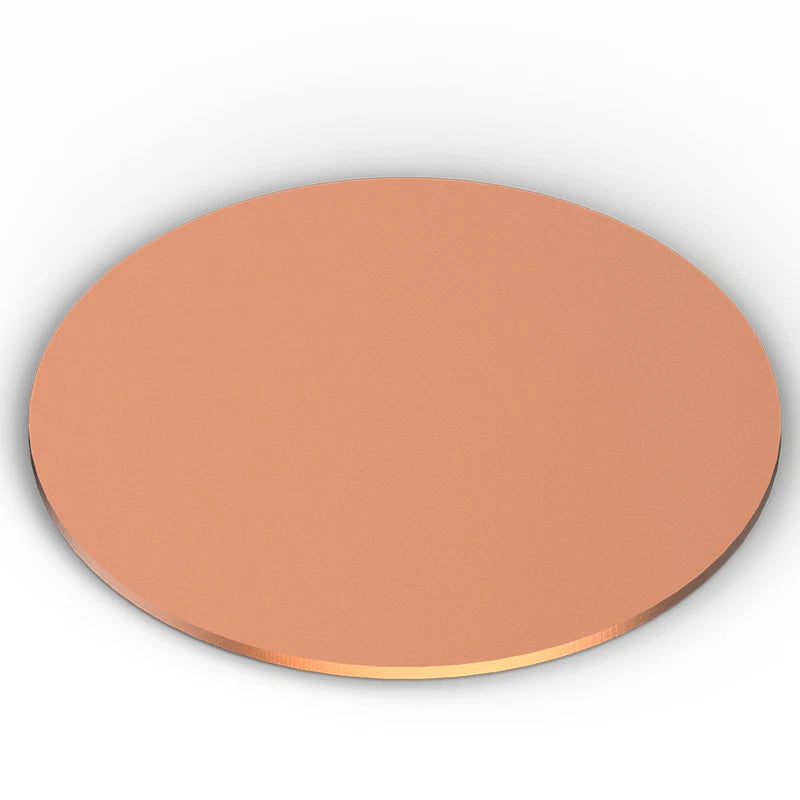
When your project demands a material that conducts reliably, resists corrosion, and machines cleanly, finding the right copper disc in the exact thickness and diameter you need can be a real challenge. Whether you are a hobbyist building custom electronics, a craftsperson shaping decorative metalwork, or a technician fabricating electrical contacts, these T2 copper round plates are sized to match your work — not the other way around.
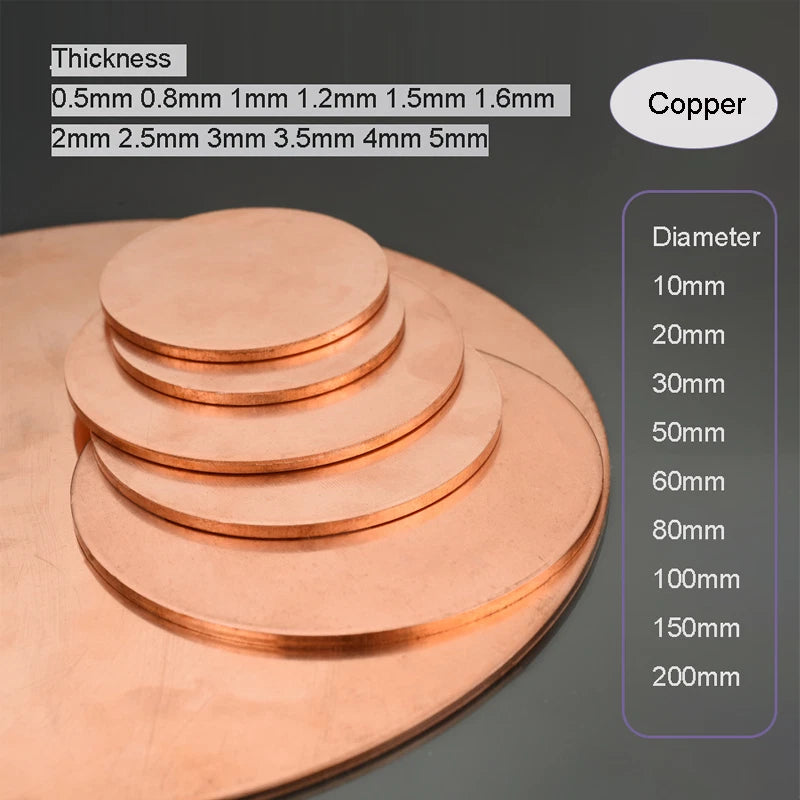
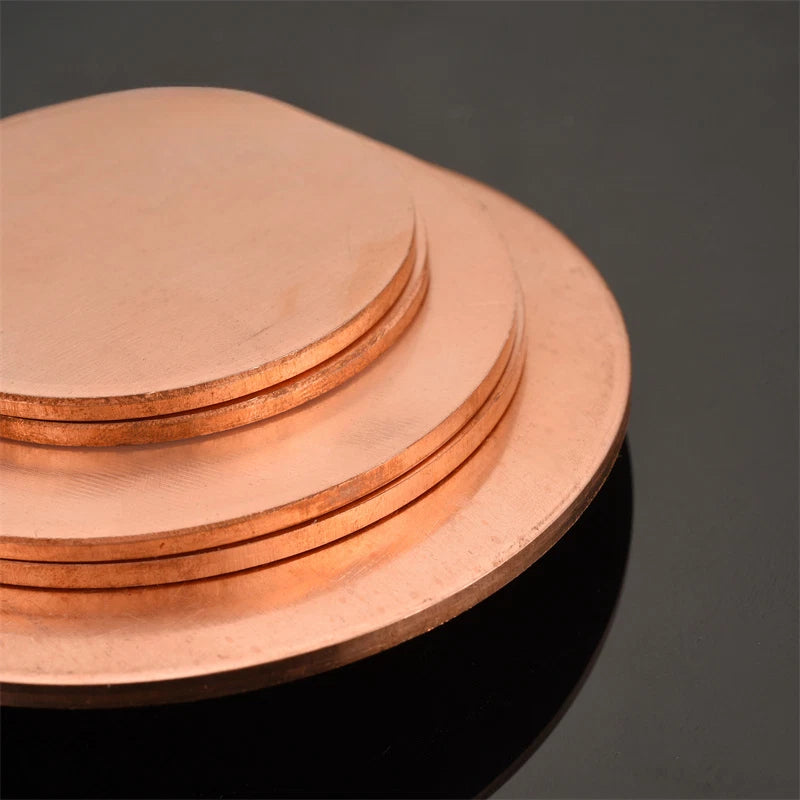
Each disc is cut from T2-grade (C11000-equivalent) solid copper, offering a copper purity of typically 99.9%. Available in wire thicknesses from 0.5 mm (approx. 0.020 in) up to 5 mm (approx. 0.197 in), and diameters ranging from 10 mm (approx. 0.39 in) to 200 mm (approx. 7.87 in), the selection covers a wide range of applications. Surfaces are smooth-rolled and free of visible inclusions.
These copper round sheets are well suited for grounding pads and bus bar blanks in electrical enclosures, heat spreader shims between components in thermal management assemblies, and decorative inlay or stamping blanks in jewelry and metalsmithing. The consistent thickness across each disc makes them a reliable choice for copper sheet gasket cutting and custom RF shielding discs.
| Material Grade | T2 Copper (C11000-equivalent, ≥99.9% Cu) |
|---|---|
| Form | Solid round disc / flat plate |
| Thickness Range | 0.5 mm – 5 mm (0.020 in – 0.197 in) |
| Diameter Range | 10 mm – 200 mm (0.39 in – 7.87 in) |
| Surface Finish | Smooth cold-rolled |
| Electrical Conductivity | ≥ 98% IACS (typical) |
| Thermal Conductivity | Typically 385–400 W/(m·K) |
| Hardness | Soft / annealed (typically 40–65 HB) |
| Quantity per Pack | See variant options |
| Variant Dimension | See variant options (Thick × Diameter) |
Thinner discs (0.5–1 mm) work well for shims, gaskets, decorative inlays, and flexible electrical contacts. Mid-range thicknesses (1.5–2 mm) suit heat spreaders, grounding pads, and stamping blanks. Thicker discs (2.5–5 mm) are better for bus bar sections, turned parts, and structural electrical contacts that need mechanical rigidity.
T2 is the Chinese national standard designation that corresponds closely to C11000 ETP copper. Both specify a minimum copper content of 99.9% and similar conductivity values (≥ 98% IACS). For most DIY, electrical, and craft applications they are functionally interchangeable.
Copper naturally develops a thin oxide layer (patina) when exposed to air and moisture. This layer is stable and actually slows further corrosion. For applications requiring a bright finish, store discs in a sealed bag and apply a thin coat of lacquer or wax after fabrication. For electrical contacts, the oxide layer can be removed with a light abrasive or flux before soldering.
Yes. T2 copper solders and brazes readily with standard rosin-core or water-soluble flux. Use lead-free solder (Sn-Cu or Sn-Ag-Cu alloys) for electronics, or silver brazing alloys for higher-temperature structural joints. Clean the surface with isopropyl alcohol or a mild acid flux before joining for best results.
Thin discs (0.5–1 mm) can be cut with heavy-duty tin snips or a jeweler's saw. Mid-thickness discs (1.5–3 mm) are best handled with an angle grinder, jigsaw with a metal blade, or a hole saw. Thicker discs (3.5–5 mm) typically require a band saw, lathe, or milling machine for precise shaping. Always wear eye protection and gloves when cutting metal.
Measure the footprint of the component or surface you need to cover, then choose the next available diameter that meets or slightly exceeds that dimension. For shim applications, the thickness should match the gap you need to fill — use calipers to measure the gap accurately before ordering. If you are unsure, contact us to confirm compatibility.
Copper performs well in moderately humid indoor environments and can tolerate outdoor exposure, though it will develop a green patina (verdigris) over time in wet or acidic conditions. For long-term outdoor use, consider applying a clear lacquer or patina sealant. For marine or highly corrosive environments, contact us to confirm suitability.