The chain is fine...but I ordered the wrong size. Nine links of the chain I ordered equals six of the size I wanted. My error...
How can I straighten out the springs? I can't use them coil uo as is.
Your payment information is processed securely. We do not store credit card details nor have access to your credit card information.
Get fitment advice & recommendations
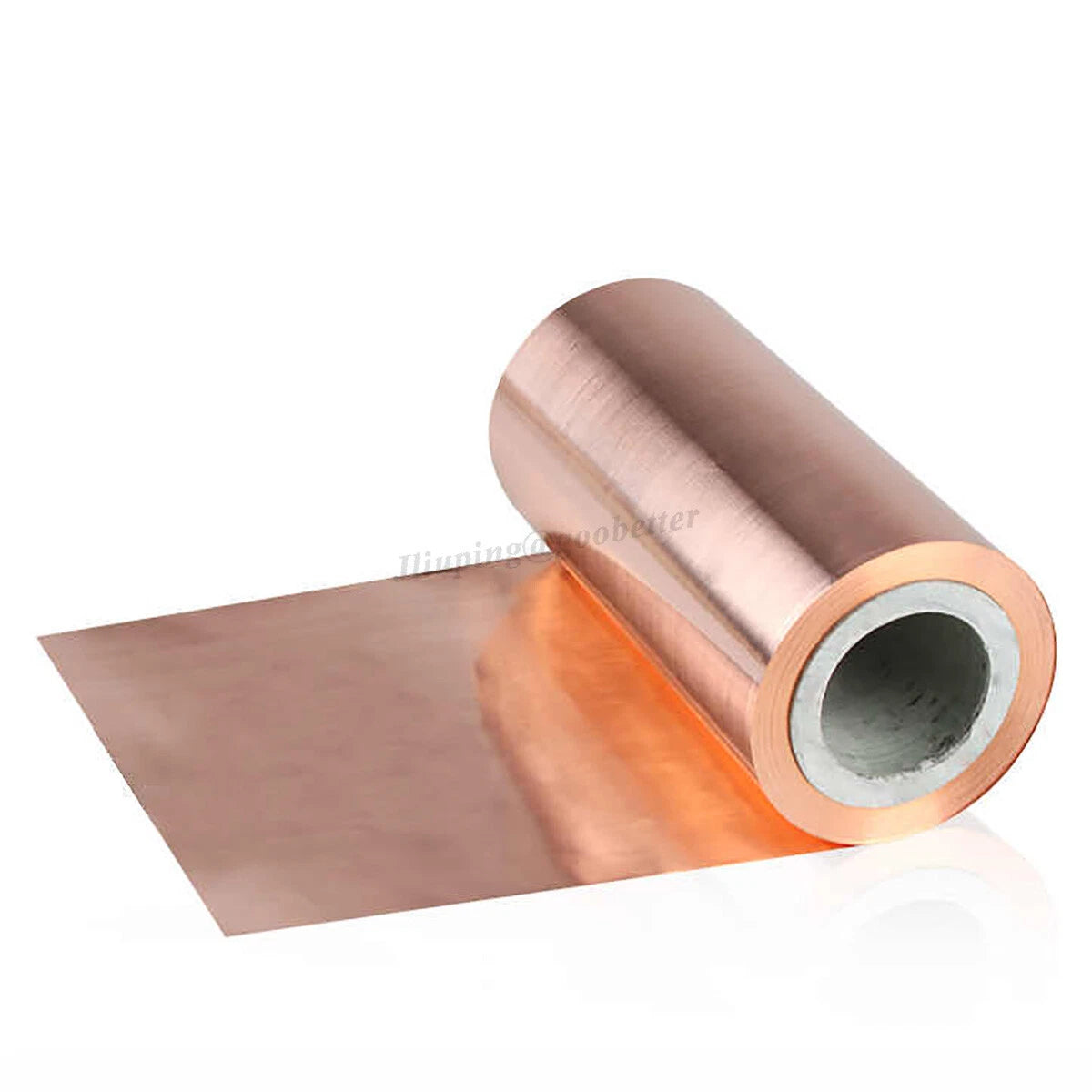
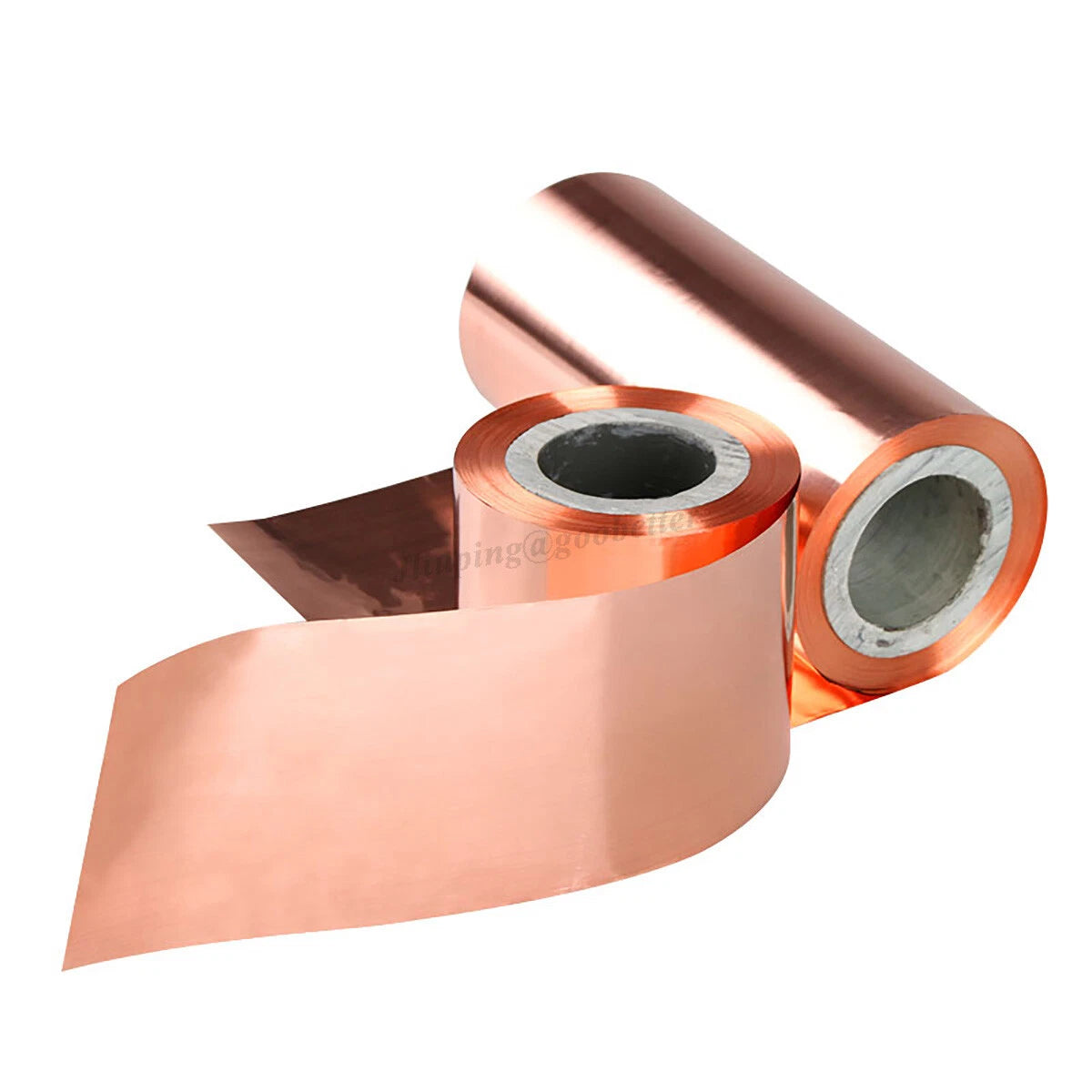
Engineers, makers, and fabricators who need a reliable, dimensionally consistent copper foil strip often struggle to find stock that ships flat, holds tight tolerances, and covers the full range of widths in a single order. This T2 copper sheet roll solves that problem with a broad selection matrix spanning five thickness grades and widths from 5 mm to 120 mm (approximately 0.20 in to 4.72 in), all cut to a standard 1000 mm (39.4 in) length per piece.
Each strip is produced from T2-grade (≥99.9% Cu) electrolytic copper, delivering the conductivity, ductility, and corrosion resistance that the alloy is known for. Thickness options run from 0.1 mm through 0.3 mm (0.004 in – 0.012 in), and widths cover 5, 7, 8, 10, 15, 20, 25, 30, 35, 40, 45, 50, 55, 60, 65, 70, 75, 80, 85, 90, and 120 mm. Surface finish is bright-rolled mill finish with no burrs on the long edges.
Typical use cases include EMI/RFI shielding tape for electronics enclosures, bus-bar blanks and grounding straps in low-voltage electrical panels, heat-spreader shims between components and heatsinks, and decorative inlay work in woodworking or jewelry. The 1000 mm length is long enough for most single-run applications yet compact enough to store flat without coiling stress.
| Material | T2 Electrolytic Copper (≥99.9% Cu) |
|---|---|
| Thickness Options | 0.1 mm / 0.15 mm / 0.2 mm / 0.25 mm / 0.3 mm |
| Width Options | 5, 7, 8, 10, 15, 20, 25, 30, 35, 40, 45, 50, 55, 60, 65, 70, 75, 80, 85, 90, 120 mm |
| Length per Piece | 1000 mm (39.4 in) |
| Surface Finish | Bright-rolled mill finish, burr-free long edges |
| Electrical Conductivity | ≈ 58 MS/m (100% IACS) |
| Thermal Conductivity | ≈ 385 W/m·K |
| Tensile Strength | See variant options |
| Hardness | See variant options |
| Tolerance (Thickness) | ±0.01 mm (typical) |
| Tolerance (Width) | ±0.1 mm (typical) |
| Quantity per Order | 1 piece (select variant for size) |
For EMI/RFI shielding tape and flexible wrapping, 0.1–0.15 mm is the most common choice — thin enough to conform to surfaces and overlap cleanly. For thermal interface shims between a component and a heatsink, 0.1–0.2 mm balances compliance with heat transfer. For structural bus-bar blanks, grounding straps, or applications where the strip must hold its shape under mechanical load, 0.25–0.3 mm provides the necessary rigidity. If you are unsure, 0.2 mm is a versatile mid-point that works across most DIY and light industrial tasks.
T2 is the Chinese national standard designation (GB/T 5585) for electrolytic tough-pitch copper with ≥99.9% Cu content, which is functionally equivalent to C11000 (ETP) under ASTM B187/B272 and CW004A under EN 13601. Conductivity, ductility, and solderability are comparable. If your specification calls for C11000 or ETP copper, T2 strip is a direct substitute for most non-aerospace, non-medical applications.
Yes. T2 copper solders readily with standard rosin-core or water-soluble flux and 60/40 or lead-free solder. For best results, lightly abrade the surface with fine-grit sandpaper or a fiberglass pen immediately before soldering to remove any surface oxide. The strip is not pre-tinned, so flux is required. Avoid aggressive acid fluxes unless you can rinse thoroughly afterward, as residue will accelerate corrosion.
Bare copper oxidizes in air, forming a thin oxide layer that darkens the surface from bright orange to brown and eventually to a green patina (verdigris) in humid or outdoor environments. For indoor electrical and shielding applications this surface oxide does not significantly affect performance. If appearance or low-contact-resistance is critical, apply a clear lacquer, tin-plate the surface, or store unused strips in a sealed, low-humidity bag. The strip is not coated or plated as supplied.
For wrapping cable bundles or sealing seams on enclosures, widths of 10–25 mm are most commonly used. For covering larger panel seams or creating ground planes on PCB enclosures, 30–60 mm widths are typical. The 5–8 mm widths suit narrow trace repairs or fine inlay work. All widths in this listing are 1000 mm long, so you can cut multiple shorter pieces from a single strip to minimize waste.
Yes. At 0.1–0.3 mm thickness, T2 copper cuts cleanly with sharp metal scissors, a utility knife against a steel rule, or a bench shear. Thinner gauges (0.1–0.15 mm) can also be scored and snapped. For straight, repeatable cuts on multiple pieces, a guillotine-style paper trimmer with a metal blade works well. Avoid using dull blades — they tend to deform the edge rather than cut cleanly. Deburr cut ends with a fine file or sandpaper if sharp edges are a concern.
Measure the width of the surface or channel you need to cover, then select the next standard width up to ensure full coverage with a small overlap. For example, if your channel is 18 mm wide, choose the 20 mm strip. If you need to cover a 55 mm panel seam, the 60 mm strip gives a 5 mm overlap on each side when centered. Avoid going significantly oversized — excess copper adds unnecessary weight and cost, and wider strips are harder to form around tight radii.