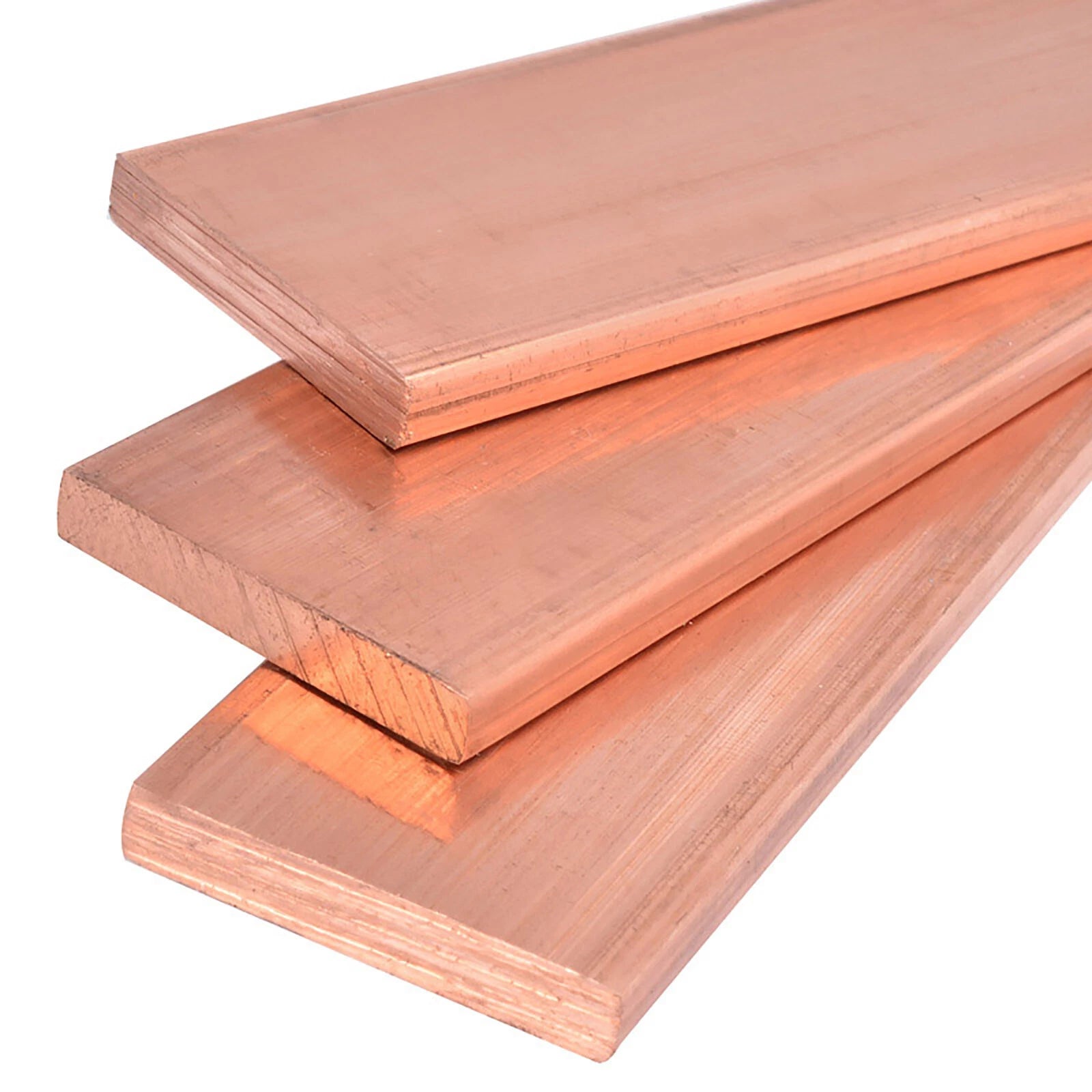
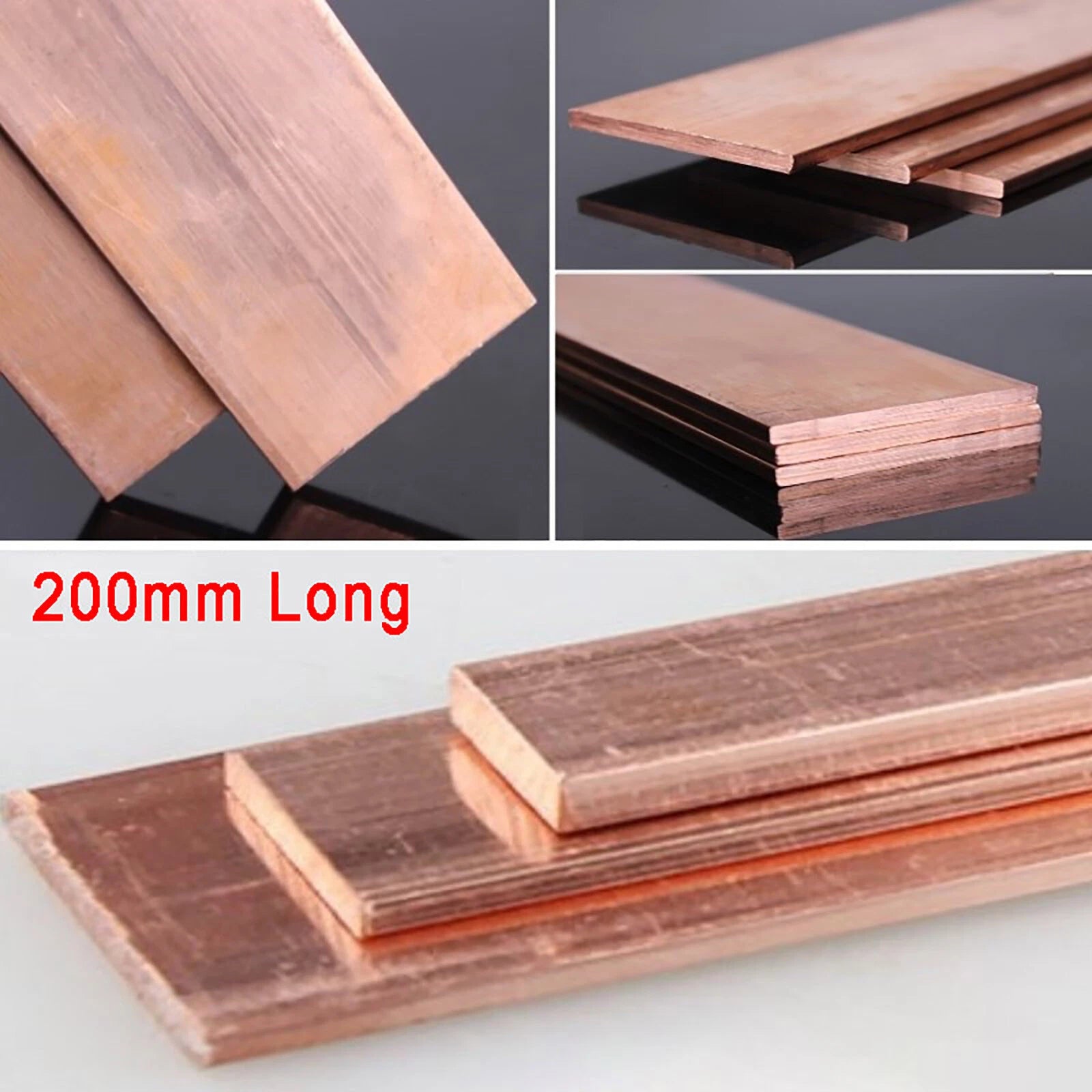
T2 Pure Copper Flat Bar Plate — Precision-Cut Stock for Electrical, Thermal & Fabrication Work
When your project demands reliable conductivity and dimensional accuracy, standard hardware-store stock rarely cuts it. Machinists, electricians, and hands-on builders who need a specific cross-section — not a compromise — turn to T2 pure copper flat bar plate. Whether you're fabricating bus bars, heat spreaders, grounding straps, or custom brackets, having the right thickness-to-width ratio from the start eliminates rework and material waste.
Each piece is T2-grade pure copper flat bar, available in thickness × width combinations ranging from 10 mm × 20 mm up to 12 mm × 50 mm (approximately 0.39" × 0.79" to 0.47" × 1.97"), cut to a fixed 200 mm (≈ 7.87") length. The flat-rolled surface provides consistent cross-section geometry and a smooth finish suitable for direct use or further machining.
Typical applications include DIY electrical bus bar fabrication, RF shielding strips, thermal interface conductors between heat sources and sinks, custom grounding lugs, and decorative metalwork where copper's warm tone is part of the design. The 200 mm cut length suits bench-top prototyping as well as small-batch production runs.
⚙️ Compatibility: Suitable for soldering, brazing, cold-forming, and CNC milling. Compatible with standard copper-rated fasteners, terminals, and flux systems. Not recommended for direct contact with ferrous metals without isolation in corrosive environments.
✅ Key Features of These T2 Pure Copper Flat Bar Plates
-
🔩 T2-Grade Copper Purity — T2 designation indicates ≥99.9% copper content, delivering electrical conductivity of approximately 58 MS/m (100% IACS), making it suitable for bus bars, grounding conductors, and low-resistance connections.
-
📏 Multiple Cross-Section Options — Choose from nine thickness × width combinations (10 mm × 20 mm through 12 mm × 50 mm) to match your exact load-bearing or conductivity requirements without over-specifying material.
-
✂️ Fixed 200 mm Cut Length — Each bar is cut to 200 mm (≈ 7.87"), a practical bench length for prototyping, terminal fabrication, and short-run production without excess offcut waste.
-
🌡️ Excellent Thermal Conductivity — T2 copper conducts heat at approximately 390 W/(m·K), making these bars effective as heat spreaders, thermal bridges, and conductive shims in electronics cooling assemblies.
-
🔧 Machinable & Formable — The flat-rolled profile machines cleanly with standard HSS or carbide tooling and can be cold-bent, drilled, tapped, or silver-soldered without pre-treatment, reducing fabrication steps.
-
🛡️ Natural Corrosion Resistance — Copper forms a stable oxide patina that slows further atmospheric corrosion, making these bars suitable for indoor electrical enclosures, HVAC applications, and decorative metalwork exposed to ambient humidity.
📐 Technical Specifications — Copper Flat Bar Plate
| Material Grade |
T2 Pure Copper (≥99.9% Cu) |
| Thickness Range |
10 mm – 12 mm (0.39" – 0.47") |
| Width Range |
20 mm – 100 mm (0.79" – 3.94") |
| Length |
200 mm (7.87") |
| Available Cross-Sections |
See variant options |
| Surface Finish |
Flat-rolled, mill finish |
| Electrical Conductivity |
≈ 58 MS/m (100% IACS) |
| Thermal Conductivity |
≈ 390 W/(m·K) |
| Density |
≈ 8.96 g/cm³ |
| Melting Point |
≈ 1,085 °C (1,985 °F) |
| Packing Quantity |
1 piece per order |
| Weight per Piece |
See variant options |
❓ Frequently Asked Questions
How do I choose the right thickness and width for my project?
Start with your current-carrying or load-bearing requirement. For electrical bus bars, calculate the required cross-sectional area (mm²) based on your target ampacity — a common rule of thumb is 1 mm² per 1–2 A for copper at moderate temperatures. For structural or thermal applications, match the width to your mounting footprint and the thickness to your rigidity or heat-spreading needs. If you are unsure, contact us with your application details and we can suggest a cross-section.
What is the tensile strength of T2 copper flat bar?
T2 pure copper in the as-rolled (half-hard) condition typically exhibits a tensile strength of approximately 200–250 MPa and a yield strength of around 150–200 MPa. These values are sufficient for bus bar clamping, terminal crimping, and light structural brackets, but T2 copper is not intended as a structural load-bearing material in high-stress applications — for those, consider copper alloys such as C110 or brass.
Will these copper bars corrode or tarnish over time?
Copper naturally forms a thin oxide layer (tarnish) when exposed to air and humidity, which actually slows further corrosion. In dry indoor environments, the surface will darken to a warm brown over months. In humid or outdoor environments, a green patina (verdigris) may develop over years. For applications requiring a bright finish, apply a clear lacquer or anti-tarnish coating. For electrical connections, clean contact surfaces with fine abrasive or flux before soldering or crimping to ensure low-resistance joints.
Are these bars compatible with standard soldering and brazing processes?
Yes. T2 copper is one of the most solderable and brazeable metals available. For soft soldering, use a rosin-core or water-soluble flux with standard 60/40 or lead-free solder. For silver brazing, use a silver-bearing brazing alloy (e.g., 45% silver) with an appropriate flux at temperatures of 600–800 °C. Ensure the surface is clean and free of oxide before joining. The flat geometry makes fixturing straightforward for both bench and torch work.
Can I cut or drill these bars with standard workshop tools?
Yes. T2 copper machines well with standard HSS drill bits, carbide end mills, and hacksaw blades. Use a slow feed rate and cutting fluid (or light oil) to prevent work-hardening and tool wear. For drilling, a sharp bit and moderate speed (300–600 RPM for 6 mm holes) will produce clean results. Cold-bending is possible in the 10–12 mm thickness range using a bench vise and bending bar, though tight radii may require annealing (heating to ~400 °C and quenching) to restore ductility.
Which size should I choose for a DIY electrical grounding strap or bus bar?
For a typical residential or light commercial grounding strap carrying up to 100 A, a 10 mm × 20 mm cross-section (200 mm²) provides ample conductivity with a safety margin. For higher-current bus bars (200–400 A), consider the 10 mm × 50 mm or 10 mm × 80 mm options to increase cross-sectional area. Always verify your local electrical code requirements for minimum conductor sizing before finalizing your selection. If your application exceeds 400 A, contact us to discuss custom lengths or stacked configurations.
🛒 Select your Thick×Wide combination above, then add to cart.