TC Skeleton Oil Seal Rings — FKM Rotary Shaft Sealing for ID 8mm to 25mm
When a leaking shaft seal causes oil contamination, bearing failure, or unplanned downtime, the root cause is often a seal that cannot handle the operating temperature or chemical environment. Maintenance engineers, machine builders, and DIY mechanics who work with rotating equipment — from gearboxes and pumps to agricultural machinery and automotive drivetrains — need a seal that holds up under real-world conditions.
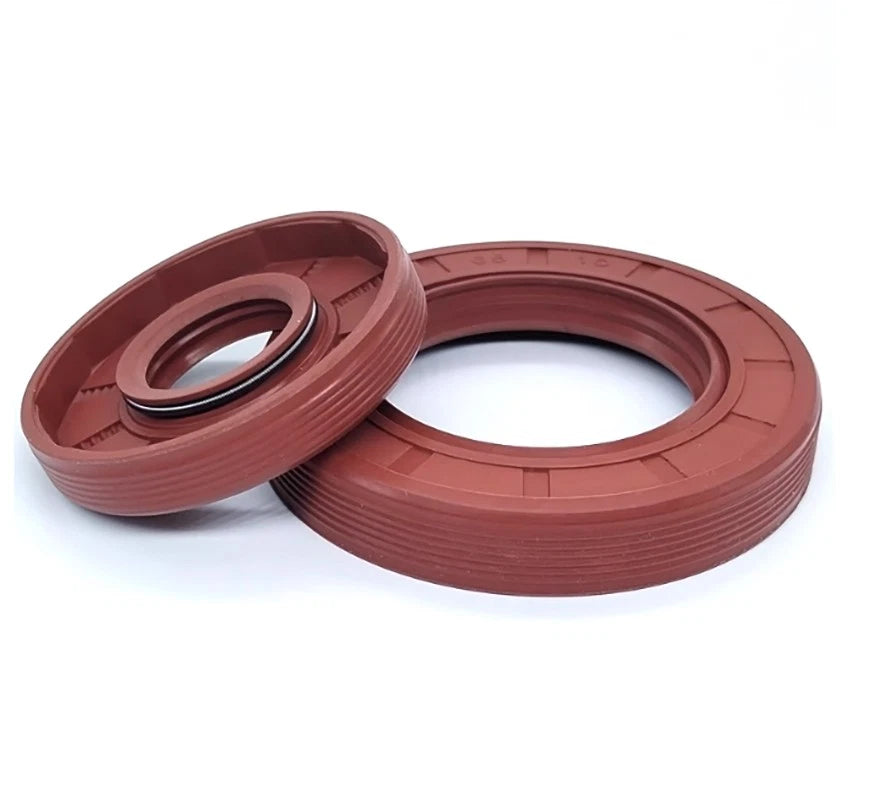
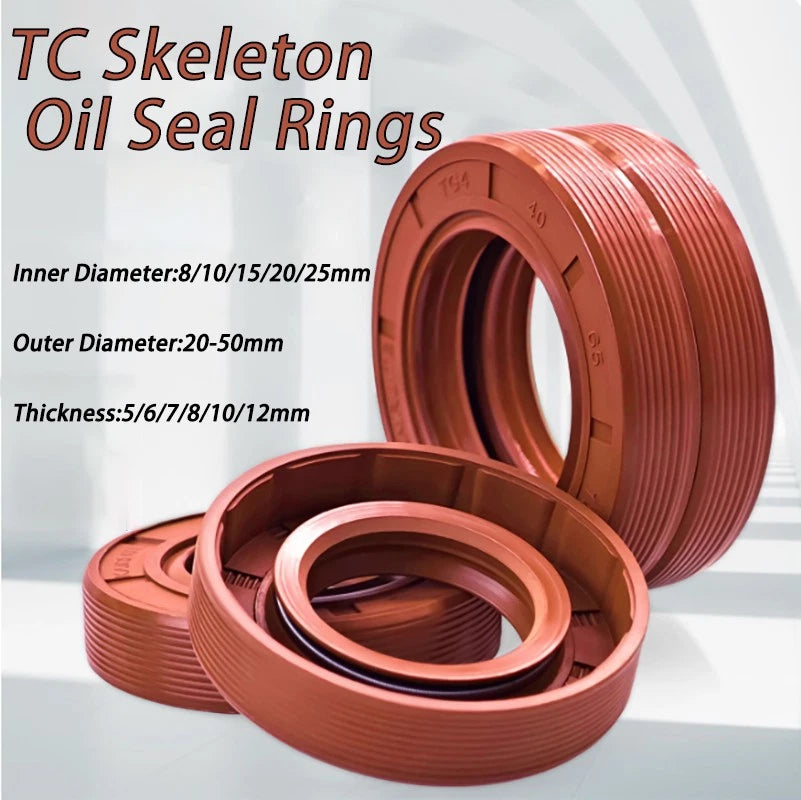
These TC skeleton oil seal rings feature a double-lip TC profile with a garter spring-loaded primary lip and a secondary dust-exclusion lip. The sealing element is FKM (Viton-equivalent fluoroelastomer), bonded to a carbon steel skeleton. Available inner diameters span 8 mm to 25 mm (approximately 0.31 in to 0.98 in), with outer diameters and widths selectable per variant — covering a broad range of shaft and housing combinations.
Typical applications include TC FKM oil seal replacement in automotive gearbox output shafts, hydraulic pump shaft sealing, electric motor end-shield sealing, and light industrial rotary shaft sealing where petroleum-based oils, synthetic lubricants, or mild chemical exposure is present.
⚙️
Compatibility Note: Verify shaft diameter, housing bore, and seal width against your variant selection before ordering. FKM is compatible with petroleum oils, synthetic lubricants, silicone fluids, and many fuels. Not recommended for ketone- or ester-based fluids without further verification.
✅ Key Features of These TC Skeleton Oil Seal Rings
🔩
TC Double-Lip Profile
Primary garter-spring-loaded lip retains lubricant; secondary lip excludes dust and contaminants from the shaft bore.
🌡️
FKM Fluoroelastomer Sealing Element
Operating temperature range typically −20 °C to +200 °C (−4 °F to +392 °F), suitable for high-heat gearbox and pump environments.
🛡️
Carbon Steel Skeleton
Rigid metal case maintains dimensional stability during press-fit installation and resists housing bore distortion under load.
📐
Wide Size Range
Inner diameters from 8 mm to 25 mm with multiple OD and width combinations — select the exact variant matching your shaft and housing dimensions.
🔄
Garter Spring-Loaded Lip
Maintains consistent radial lip force on the shaft surface, compensating for minor shaft runout and lip wear over service life.
📦
Available in 1-Piece or 3-Piece Packs
Order a single seal for a one-off repair or a 3-pack for fleet maintenance, rebuild kits, or keeping a spare on the shelf.
📐 Technical Specifications — TC FKM Rotary Shaft Oil Seal
| Seal Type |
TC (Double Lip with Garter Spring) |
| Sealing Material |
FKM (Fluoroelastomer / Viton-equivalent) |
| Skeleton / Case Material |
Carbon Steel |
| Inner Diameter (ID) |
8 mm – 25 mm (see variant options) |
| Outer Diameter (OD) |
See variant options |
| Width / Thickness |
See variant options |
| Operating Temperature |
Typically −20 °C to +200 °C (−4 °F to +392 °F) |
| Compatible Fluids |
Petroleum oils, synthetic lubricants, silicone fluids, fuels |
| Shaft Speed |
Contact us to confirm for your application |
| Pack Quantity |
1 Pcs or 3 Pcs (see variant options) |
| Lip Configuration |
Primary sealing lip + secondary dust lip |
| Spring Type |
Garter spring (internal) |
❓ Frequently Asked Questions
How do I select the correct seal size for my shaft?
Measure three dimensions: shaft outer diameter (= seal ID), housing bore inner diameter (= seal OD), and housing depth available for the seal (= seal width). Match all three to the variant label shown as ID × OD × Width in mm. If your shaft is in inches, convert: 1 inch = 25.4 mm. When in doubt between two sizes, the seal ID should match the shaft diameter exactly — never go larger.
What is the difference between TC and SC oil seal profiles?
A TC seal has two lips: a primary garter-spring-loaded sealing lip that retains lubricant, and a secondary dust-exclusion lip facing outward. An SC seal has only the single primary lip. TC seals are preferred for environments with external contamination (dust, water, debris) because the secondary lip provides an additional barrier, making them the standard choice for gearboxes, axles, and outdoor equipment.
Is FKM the right elastomer for my application?
FKM (fluoroelastomer, commercially known as Viton) excels with petroleum-based oils, synthetic lubricants, hydraulic fluids, fuels, and many aromatic solvents. It handles continuous temperatures up to approximately 200 °C. It is not recommended for ketones (MEK, acetone), certain esters, or hot steam applications. If your fluid is a ketone or ester, consider NBR or PTFE-lipped alternatives instead.
How do I install a TC oil seal without damaging the lip?
Clean the housing bore and lightly lubricate the seal OD with the same oil used in the application. Apply a thin film of oil or grease to the sealing lip. Use a seal driver or a flat press plate slightly smaller than the OD to press the seal in squarely — never hammer directly on the seal face. Press until the seal face is flush with or just below the housing surface. Protect the lip from sharp shaft edges by using a sleeve or chamfering the shaft lead-in.
What shaft surface finish and hardness are required?
For reliable sealing, the shaft contact surface should have a finish of Ra 0.2–0.8 µm (approximately 8–32 µin) with a lead-free ground finish. Shaft hardness of 45–65 HRC at the sealing contact zone is recommended to resist lip wear. Shafts softer than 45 HRC may show accelerated wear grooves under the lip, shortening seal life. Avoid longitudinal machining marks, which can act as leak paths.
Can these seals be used in submerged or high-pressure applications?
Standard TC oil seals are designed for low-pressure differential applications — typically up to 0.05 MPa (0.5 bar) of internal pressure. They are not rated for continuous submersion under significant head pressure or for hydraulic cylinder rod sealing. For higher-pressure rotary sealing, a cassette seal or a dedicated rotary shaft seal with a pressure-rated lip geometry is required. Contact us to confirm suitability for your specific pressure and speed conditions.
How do I know when a TC oil seal needs replacement?
Common indicators include visible oil weeping or leakage at the shaft exit point, oil contamination on adjacent components, a worn or hardened lip when the seal is removed, or a visible wear groove on the shaft surface. Seals should also be replaced any time a gearbox or pump is fully disassembled for bearing replacement, as reusing an old seal in a new position risks immediate leakage.
🛒 Select your size (ID × OD × Thickness) and pack quantity above, then add to cart.