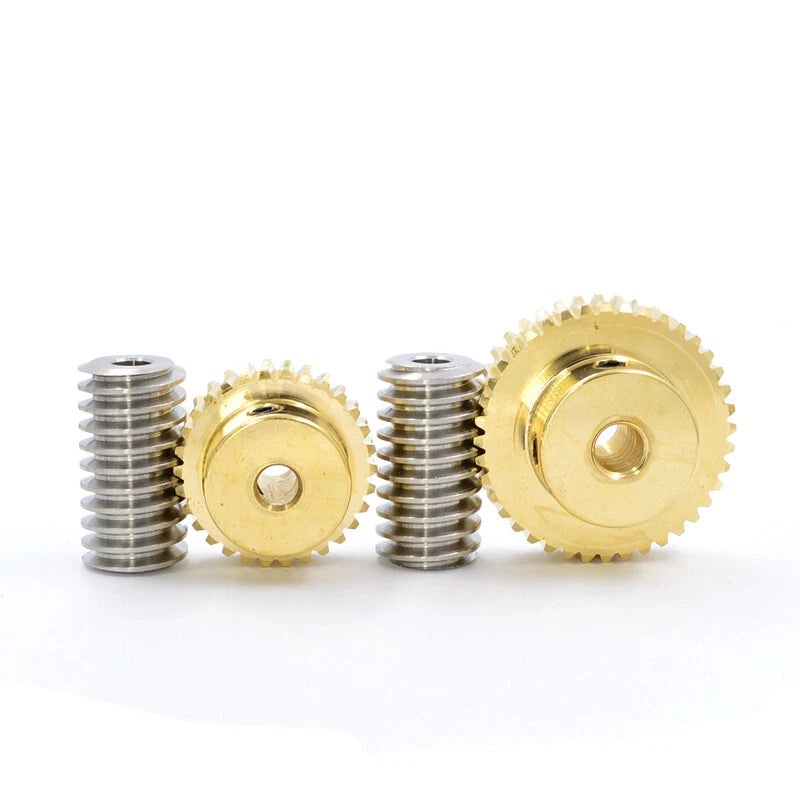
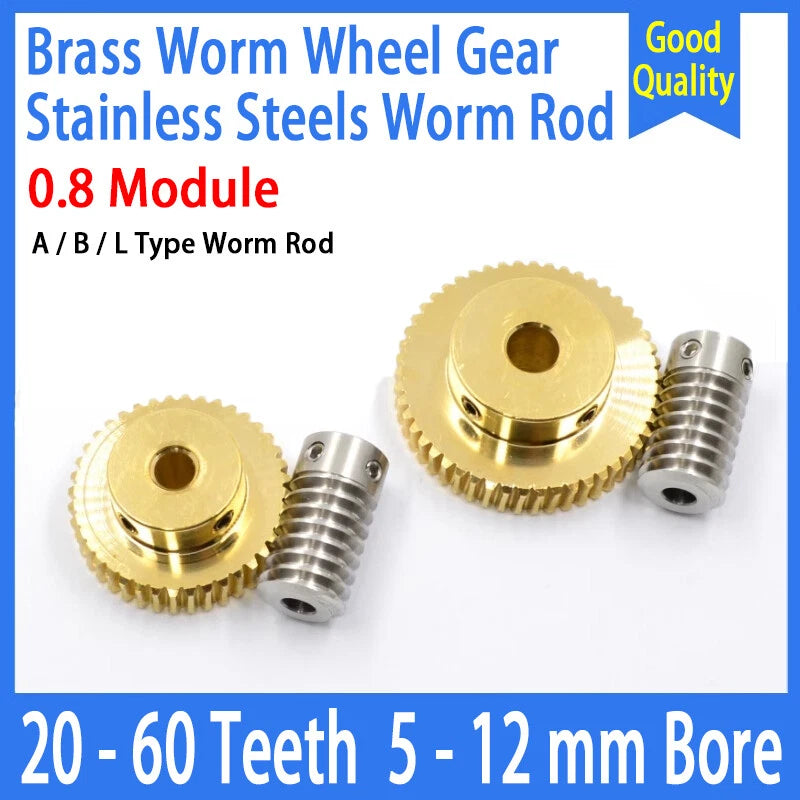
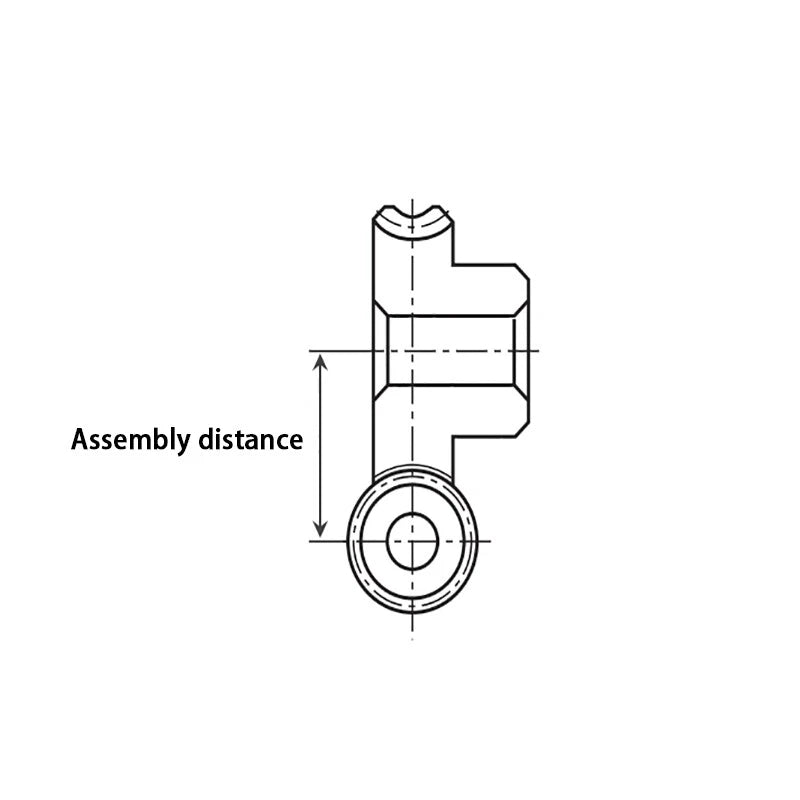
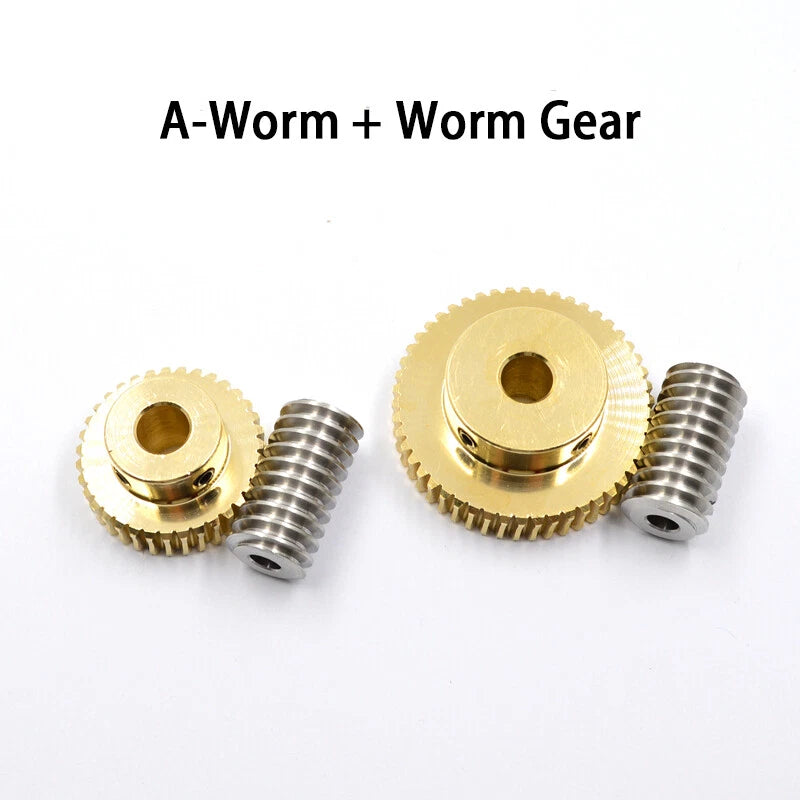
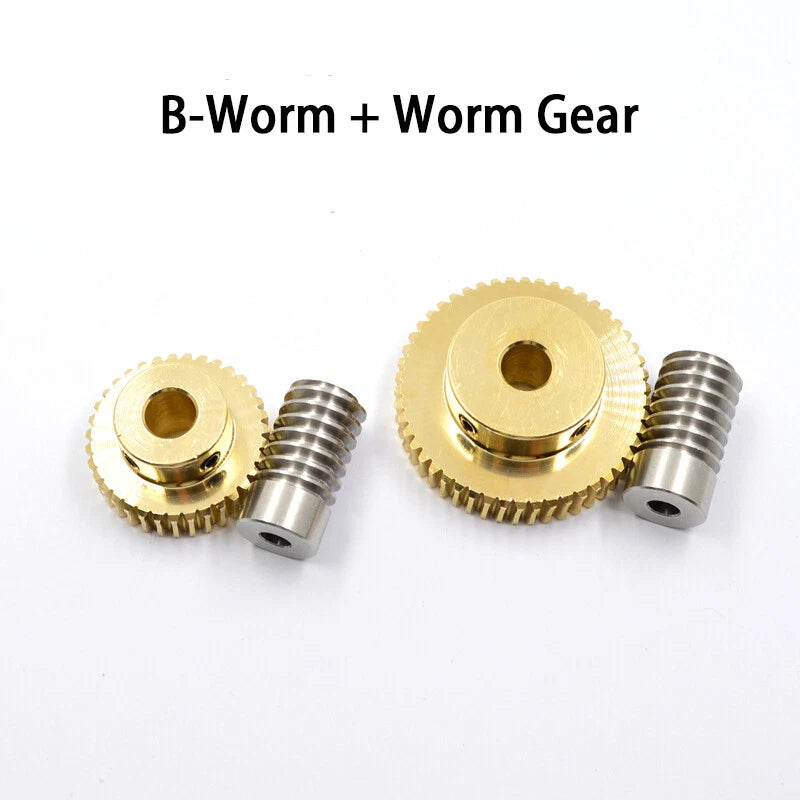
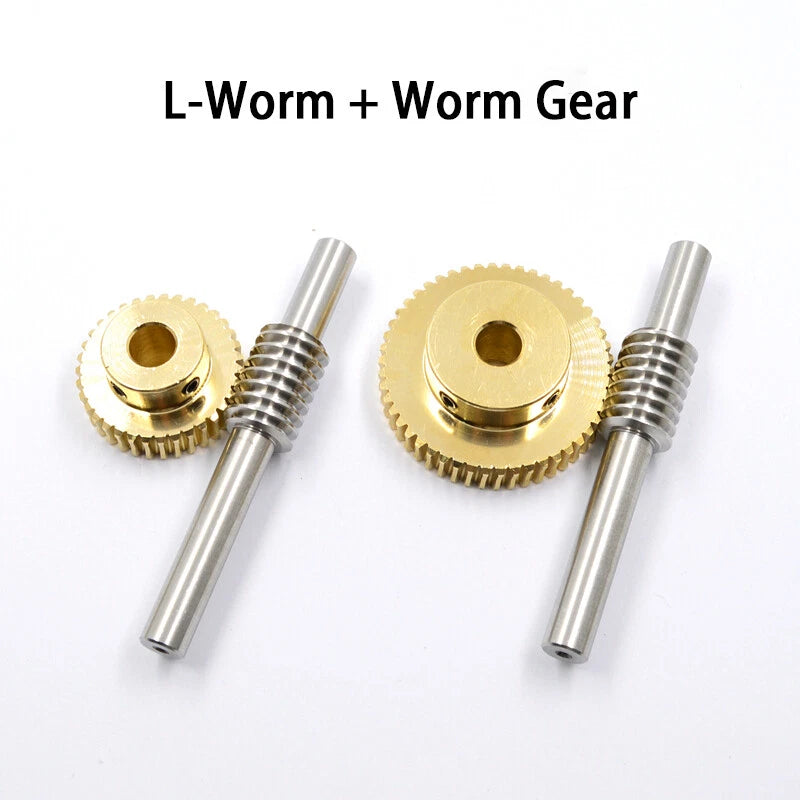
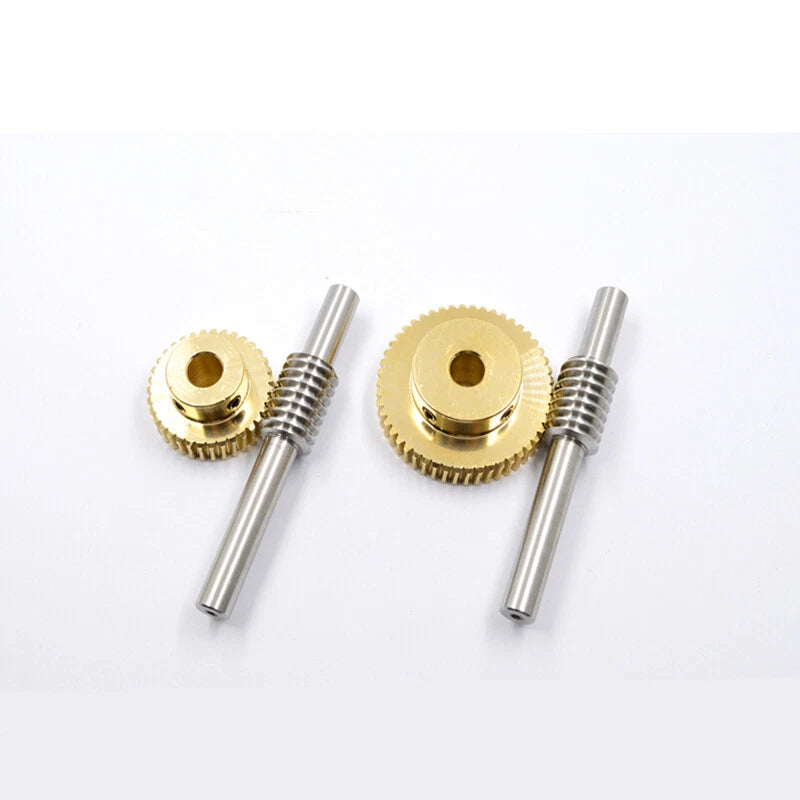
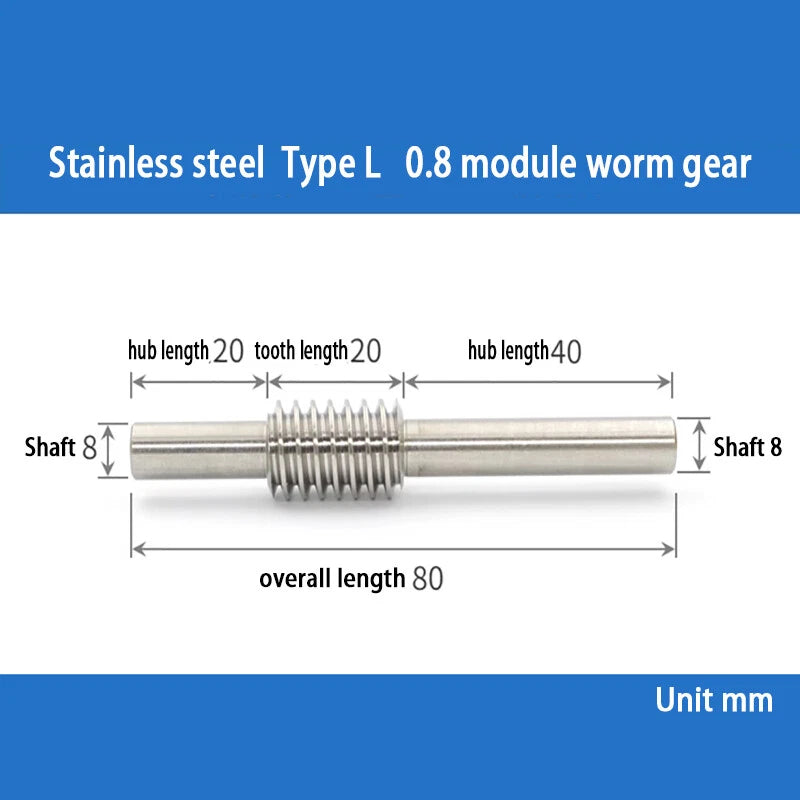
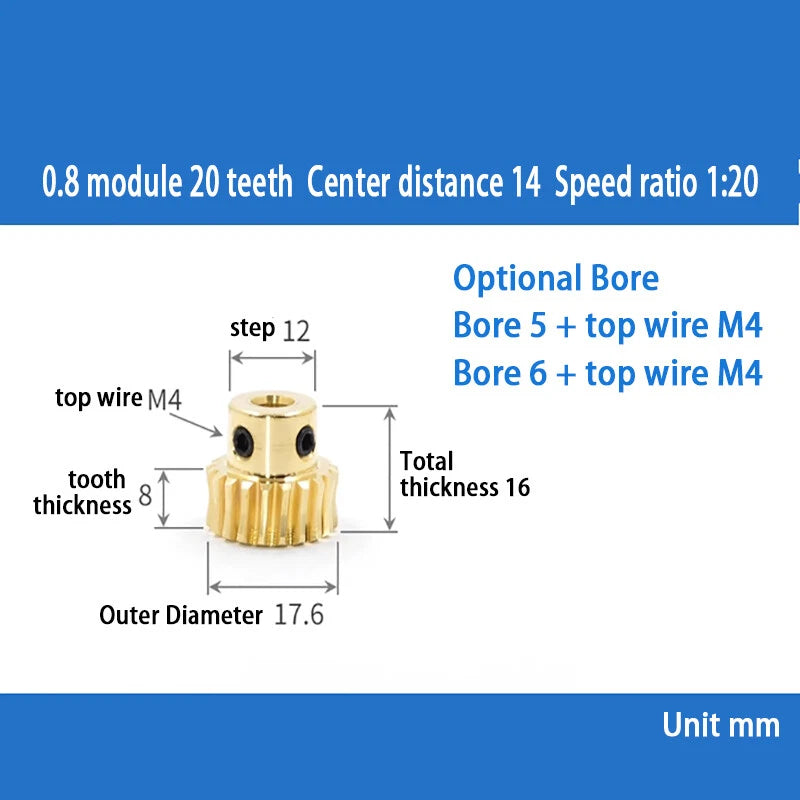
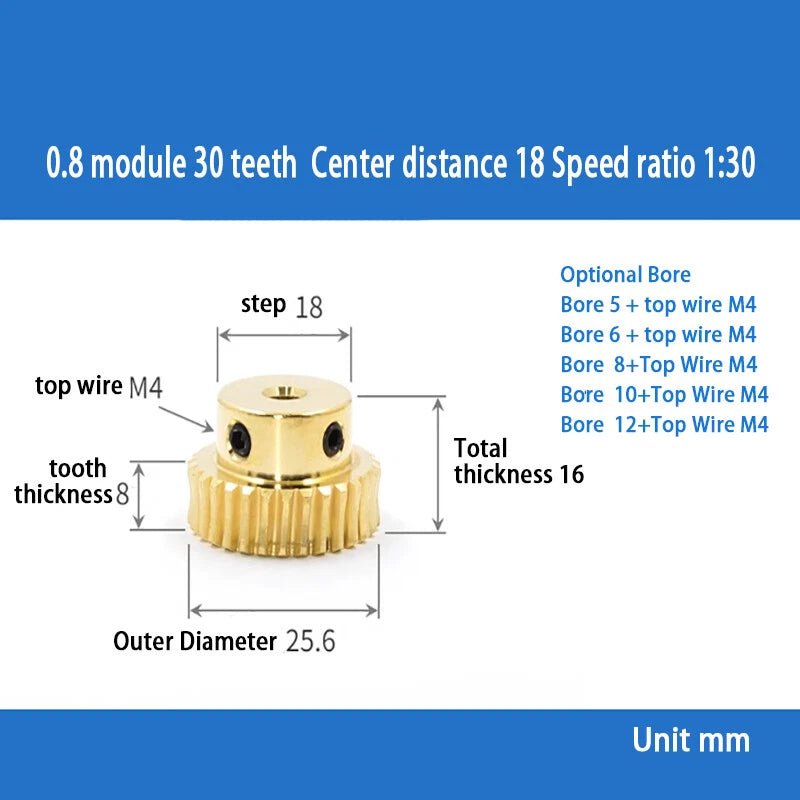
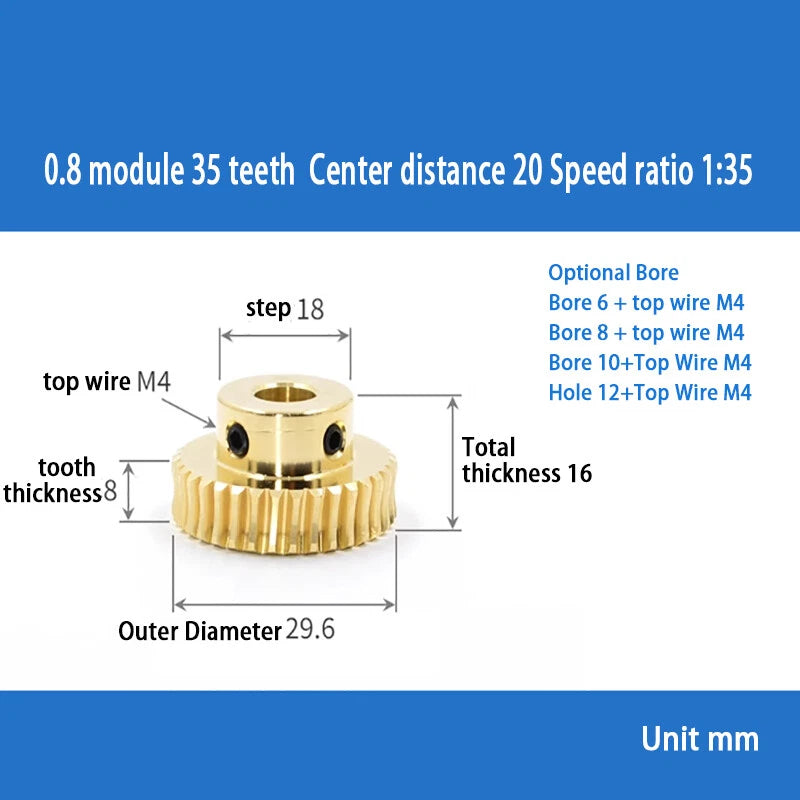
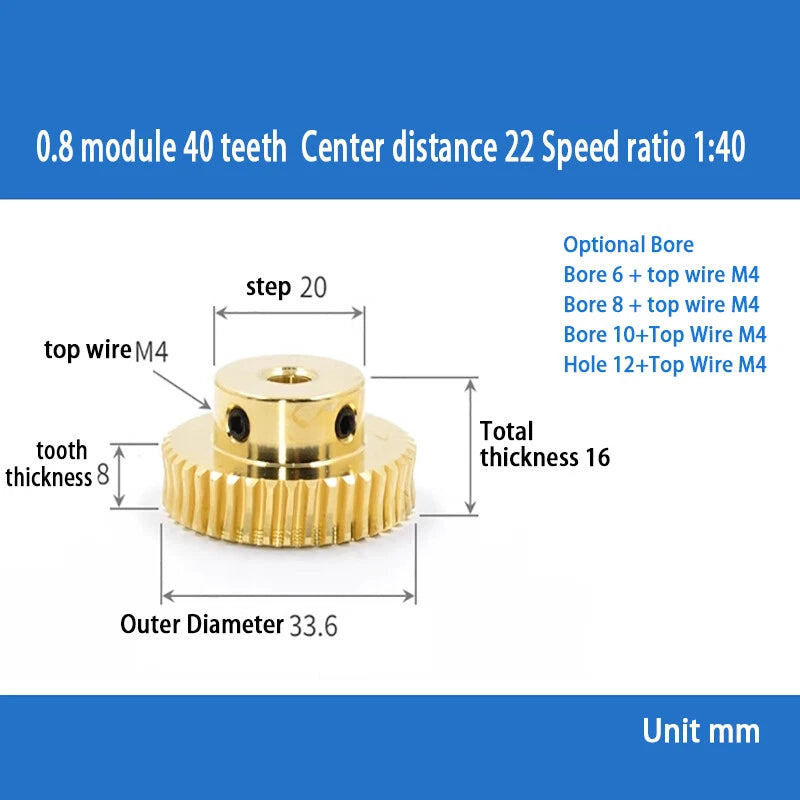
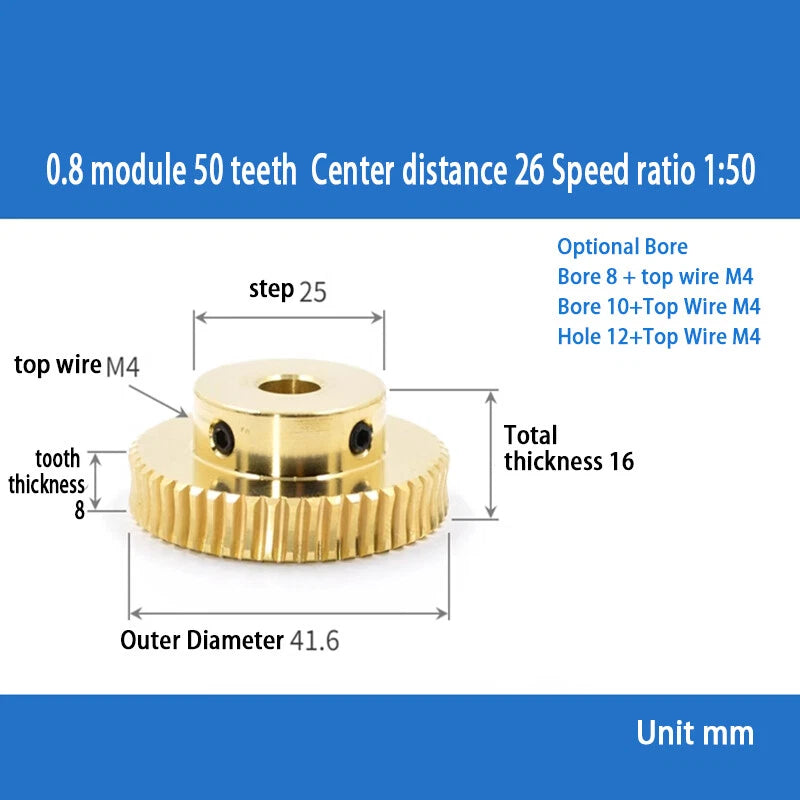
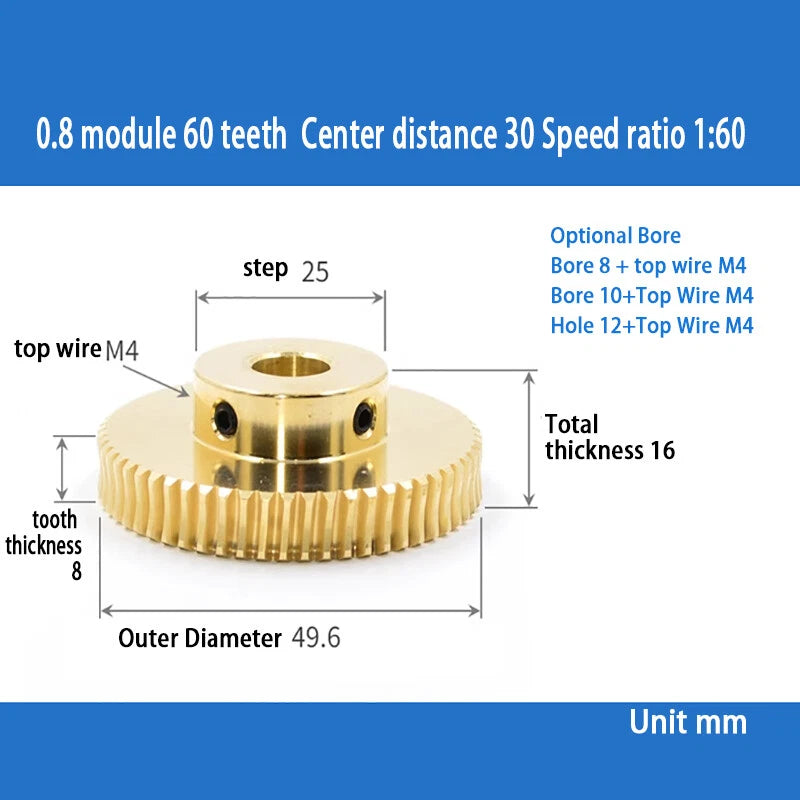
0.8 Module 20T to 60T Gear Copper Worm Wheel Gear & Worm Gear Shaft Bore 5-12mm

No reviews

Price:
Sale price$13.57 USD
Stock:
In stock (500 units), ready to be shipped

Payment & Security

Ach Direct Debit Amazon American Express Apple Pay Bancontact BLIK Diners Club Discover EPS Google Pay iDEAL Wero JCB Maestro Mastercard Multibanco MobilePay PayPal Przelewy24 Shop Pay Twint Union Pay USDC Visa

Your payment information is processed securely. We do not store credit card details nor have access to your credit card information.

Limited Offer — Spend More, Save More
Spend $55+
Save $5
Spend $100+
Save $10
Spend $200+
Save $25
HomeDIYer DIY Expert Support

DIY Expert Support

Get fitment advice & recommendations

Mon–Fri  8:30 AM – 8:00 PM
24-Hour Fast Ship
Arrives in 3–14 Days
Worldwide Shipping
30-Day Returns
1 tree planted with every purchase

Description

0.8 Module Worm Gear Set — Precise Copper Wheel & Stainless Rod for Robotics and CNC Builds

When your motion-control project demands a compact, high-ratio drive that won't slip under load, a mismatched or undersized worm gear set becomes the weakest link in your build. Whether you're a robotics engineer, CNC hobbyist, or automation maker, this 0.8 module worm gear set gives you the dimensional accuracy and material choice needed to keep your drivetrain running smoothly.

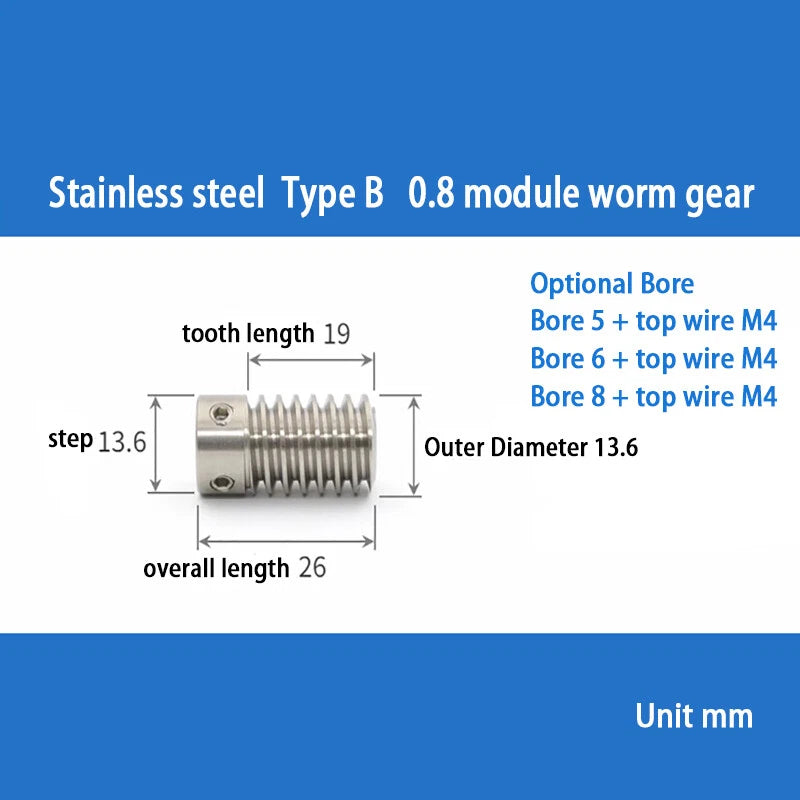
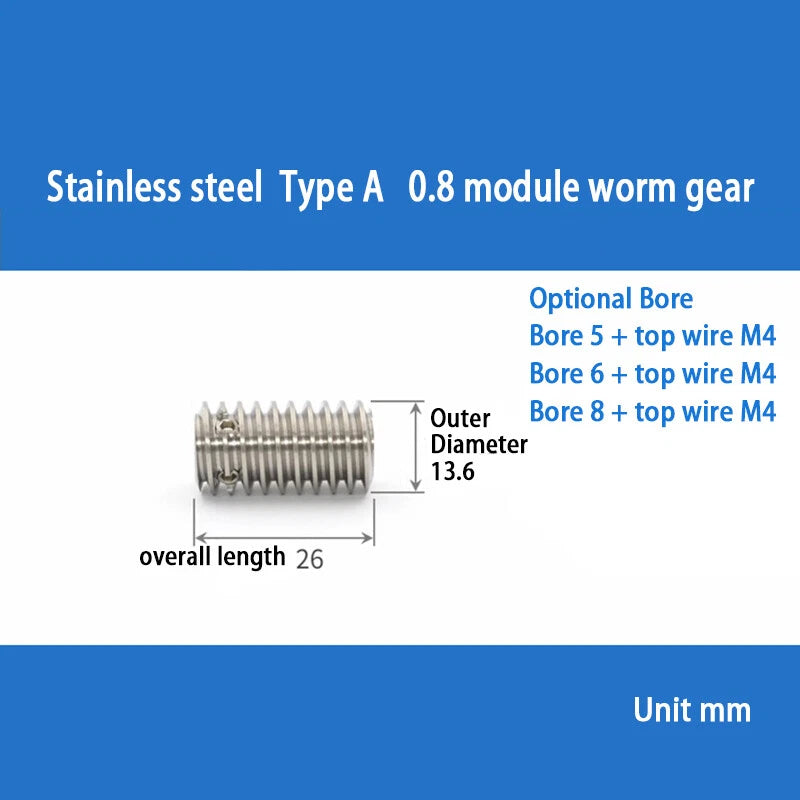
Each set pairs a worm wheel (gear) machined from solid brass with a worm rod (shaft) in stainless steel or brass, depending on your variant selection. Wheel tooth counts range from 20T to 60T, bore diameters span 5 mm to 12 mm (approx. 0.20" to 0.47"), and rod types include A-type, B-type, and L-type configurations. Module is 0.8 throughout, ensuring consistent mesh across the full range.

Typical use cases include low-speed, high-torque actuators for robotic arms and pan-tilt camera rigs, feed-rate reduction stages in DIY CNC routers and laser engravers, and self-locking drive mechanisms in automated door locks and conveyor indexers where back-driving must be prevented.

⚙️ Compatibility: Designed for 0.8 module worm gear systems. Worm rod and worm wheel must share the same module (0.8) and matching lead angle for correct mesh. Verify bore diameter against your shaft OD before ordering.

✅ Key Features of These 0.8 Module Worm Gear Sets

🔩 Dual Material Options

Choose brass worm wheels for excellent machinability and corrosion resistance in light-duty applications, or stainless steel worm rods for added strength in demanding environments.

📐 Wide Tooth Count Range

Worm wheels available in 20T, 25T, 30T, 35T, 40T, 50T, and 60T — giving you gear ratios from 20:1 up to 60:1 with a single-start worm rod.

🎯 Multiple Bore Sizes

Bore options of 5 mm, 6 mm, 8 mm, 10 mm, and 12 mm (plus holeless for custom machining) let you match directly to standard motor and shaft diameters without adapters.

🔄 Three Worm Rod Types

A-type, B-type, and L-type worm rods accommodate different shaft-end configurations and mounting constraints in your gearbox or chassis design.

🛡️ Self-Locking Drive

The 0.8 module worm gear geometry provides inherent self-locking behavior at typical lead angles, preventing back-driving in vertical lifts, rotary tables, and positioning stages.

📦 Sold Individually or as a Set

Order worm rods and worm wheels separately to replace worn components, or select matching rod + wheel variants to build a complete 0.8 mod worm drive from scratch.

📐 Technical Specifications — 0.8 Module Worm Gear

Module 0.8
Worm Wheel Material Brass
Worm Rod Material Stainless Steel (rod variants) / Brass (see variant options)
Tooth Count (Wheel) 20T, 25T, 30T, 35T, 40T, 50T, 60T
Bore Diameter 5 mm / 6 mm / 8 mm / 10 mm / 12 mm / Holeless
Worm Rod Type A-Type, B-Type, L-Type
Pressure Angle See variant options
Lead Angle See variant options
Outer Diameter (Wheel) See variant options
Hub Width See variant options
Quantity per Order 1 PCS
Finish Natural machined

❓ Frequently Asked Questions

How do I choose the right tooth count for my application?

The tooth count of the worm wheel equals the gear ratio when paired with a single-start worm rod. A 20T wheel gives a 20:1 reduction, a 60T wheel gives 60:1. Choose a higher tooth count for more torque and slower output speed; choose a lower count for faster output with less torque multiplication. For most robotics and CNC feed-axis applications, 30T–40T is a practical starting point.

What bore size should I order?

Measure the outer diameter (OD) of your motor shaft or drive shaft with calipers. Select the bore that matches your shaft OD exactly — a 6 mm bore fits a 6 mm shaft. If your shaft is metric and falls between listed sizes, choose the next size up and use a set screw or keyway to secure it. The "Holeless" option is for users who need to machine a custom bore diameter.

What is the difference between A-type, B-type, and L-type worm rods?

A-type, B-type, and L-type refer to the shaft-end configuration of the worm rod. B-type typically features a plain cylindrical shaft on both ends; A-type may include a stepped or shouldered end for easier bearing location; L-type is an extended-length variant suited for applications requiring a longer shaft span. Check your gearbox drawing or chassis clearance to determine which end style fits your mounting arrangement.

Are these worm gears self-locking?

Yes, in most configurations. A 0.8 module worm gear set with a single-start worm rod and typical lead angle will be self-locking, meaning the output (wheel) cannot back-drive the input (rod) when no motor torque is applied. This makes them well-suited for vertical lifts, rotary positioning tables, and any mechanism where holding position without power is required. Self-locking behavior depends on the specific lead angle and friction conditions — confirm with your application's load requirements.

Can I use a brass wheel with a stainless steel worm rod together?

Yes, and this is actually a recommended pairing. Brass and stainless steel have different hardness levels, which reduces galling and wear at the mesh contact point. The softer brass wheel acts as the sacrificial wear component, which is easier and less expensive to replace than the rod. This dissimilar-metal pairing is standard practice in worm drive design for light-to-medium duty applications.

What applications are these 0.8 module worm gears suitable for?

These gears are well-suited for robotics joints and arm actuators, DIY CNC router Z-axis and feed drives, pan-tilt camera platforms, automated door and gate mechanisms, conveyor indexing systems, and small-scale automation projects where a compact, self-locking reduction drive is needed. They are not recommended for high-speed continuous-duty industrial applications without proper lubrication and housing.

Do I need lubrication for these worm gears?

Lubrication is strongly recommended for any worm gear drive under load. Apply a light grease (such as lithium-based or NLGI #2 gear grease) to the mesh contact area during assembly. For intermittent-duty or low-load applications (e.g., hobby robotics), a thin film of grease applied at installation is typically sufficient. For continuous-duty or higher-load use, re-lubricate periodically based on operating hours and temperature.

🛒 Select your Type, Bore, and Material & Amount above, then add to cart.

You may also like

Recently viewed