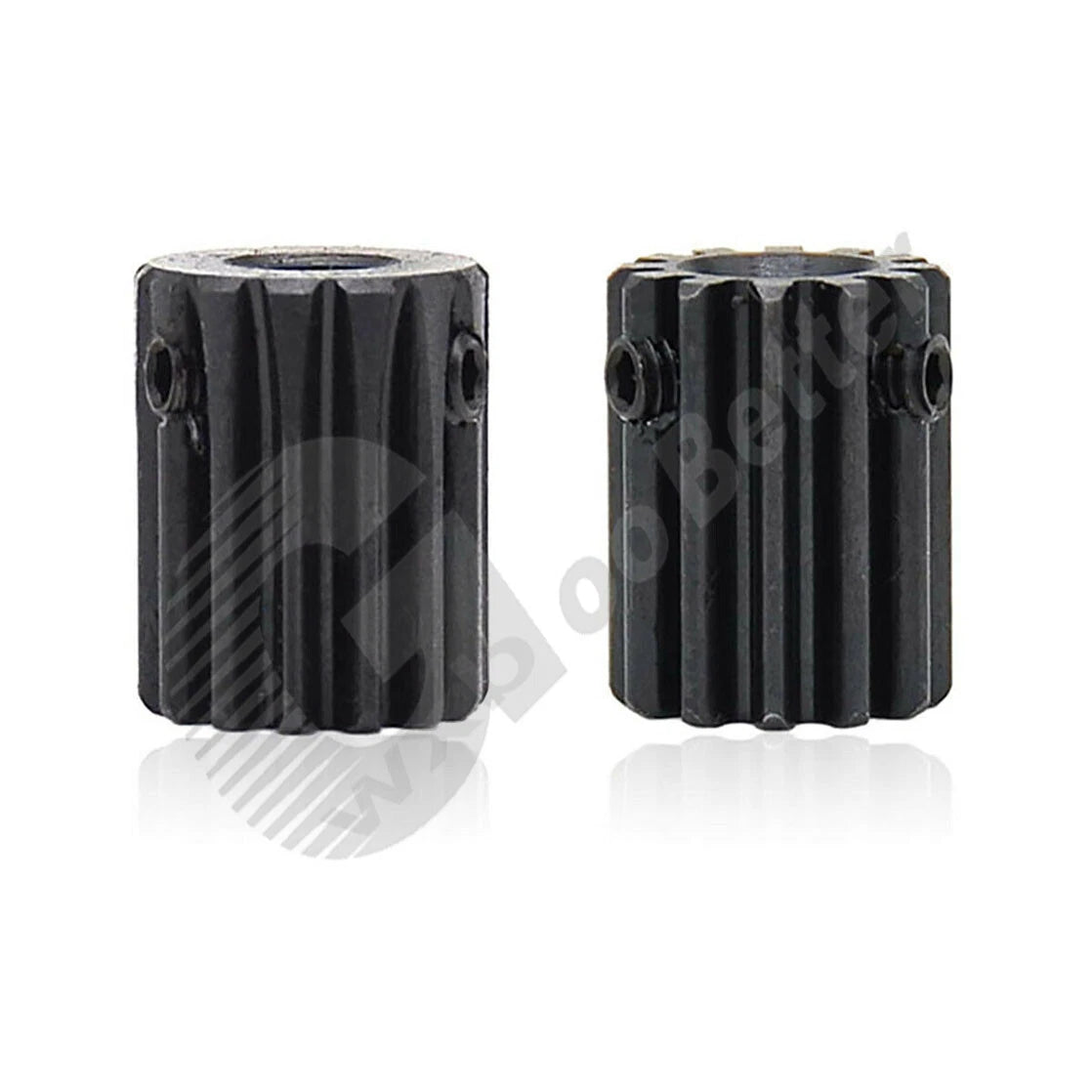
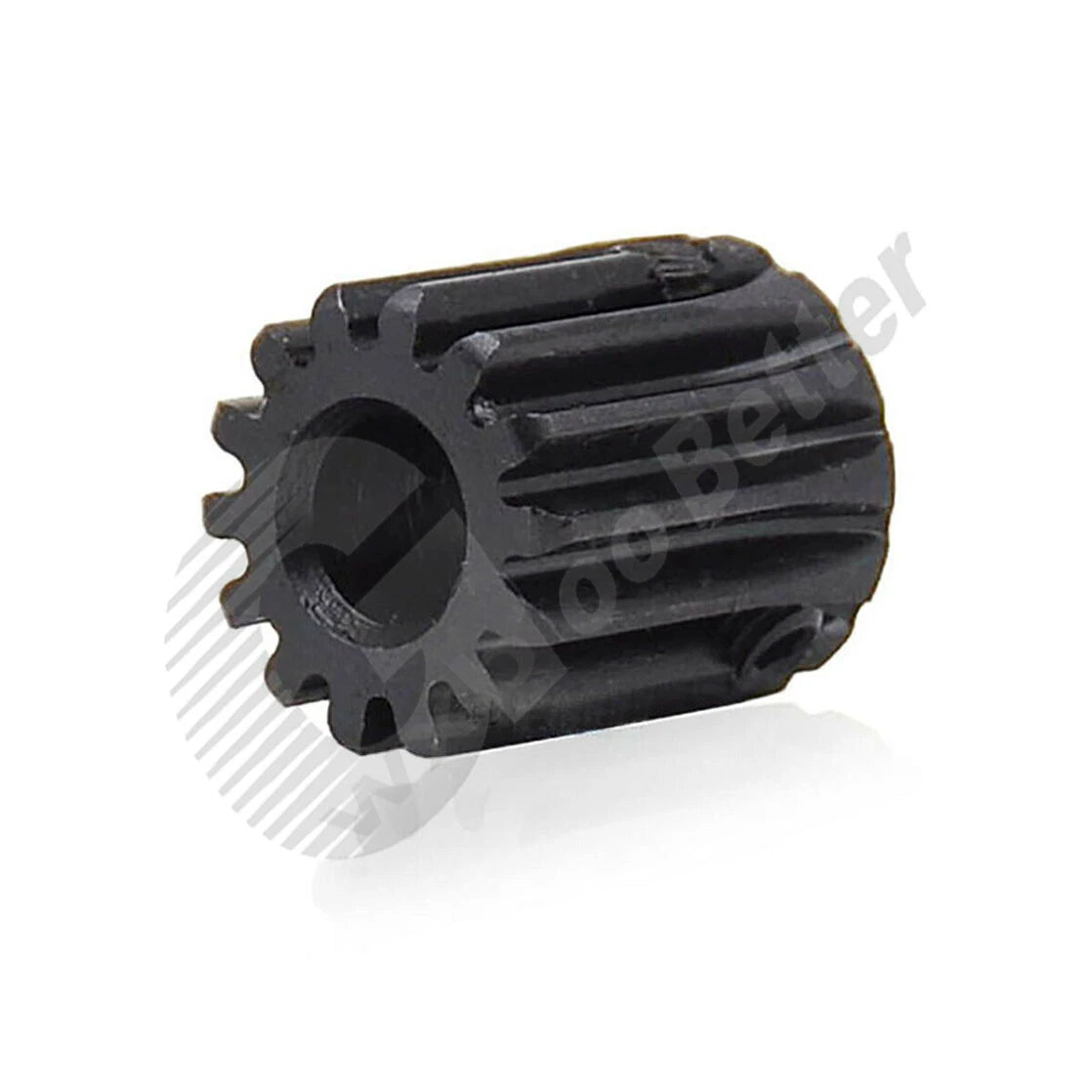
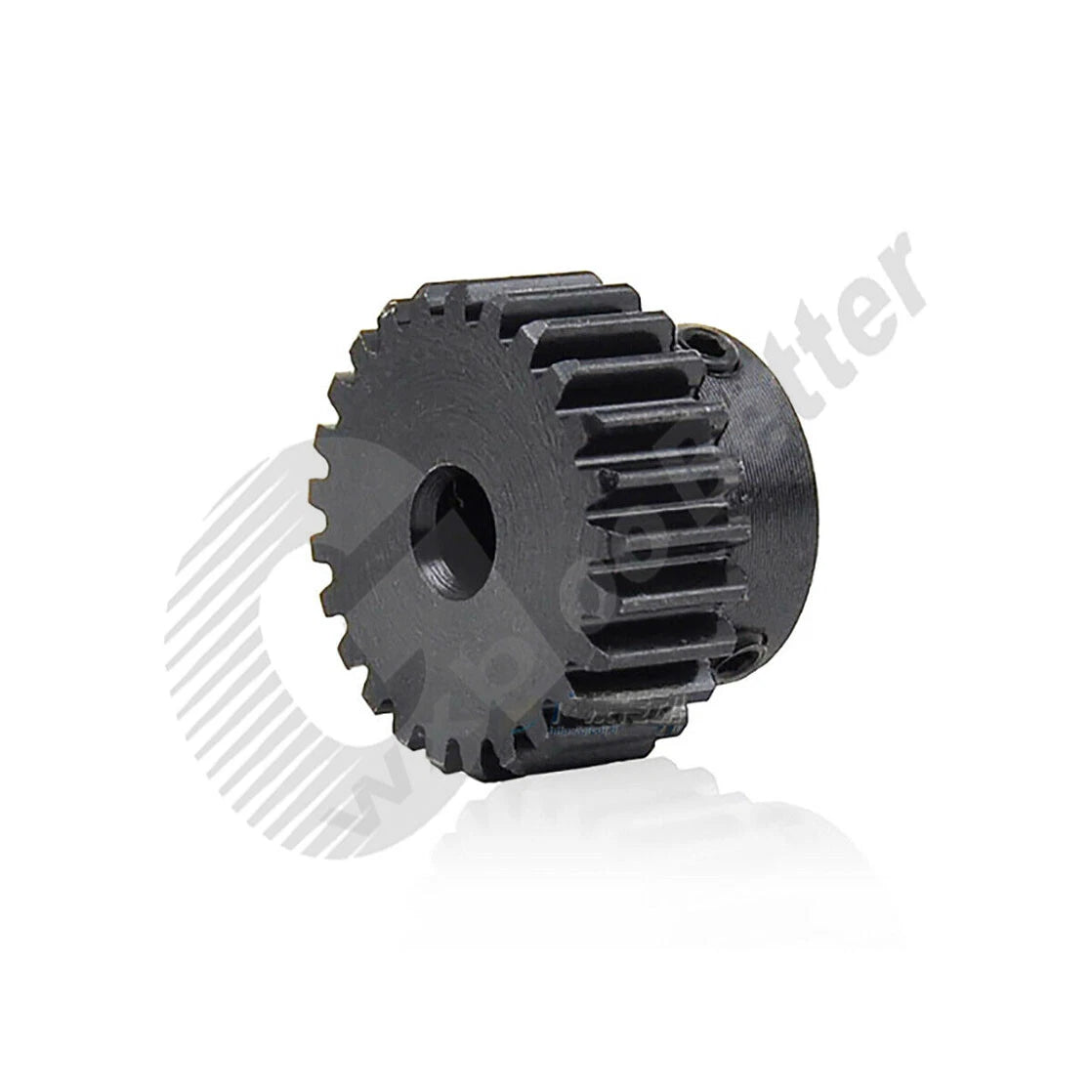
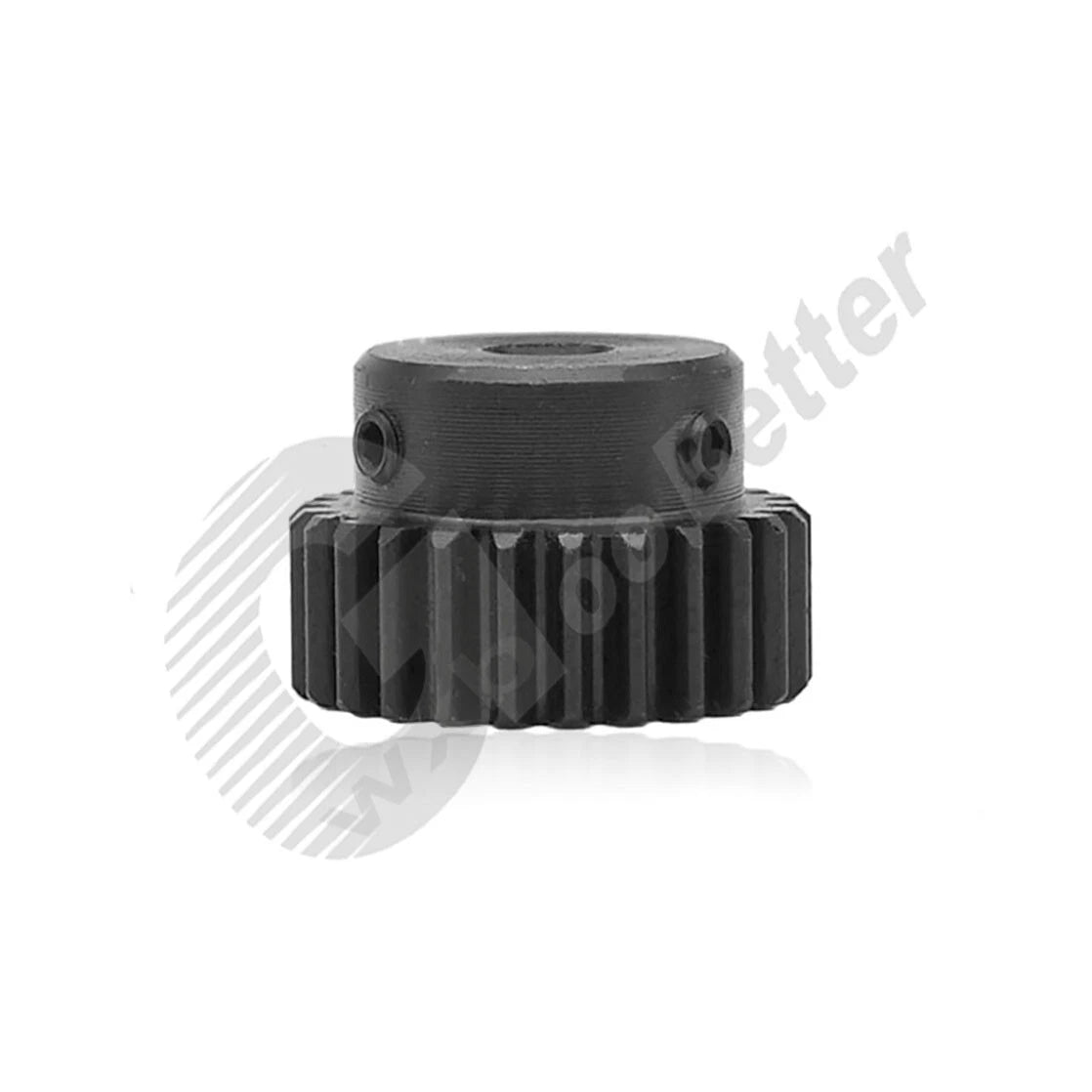
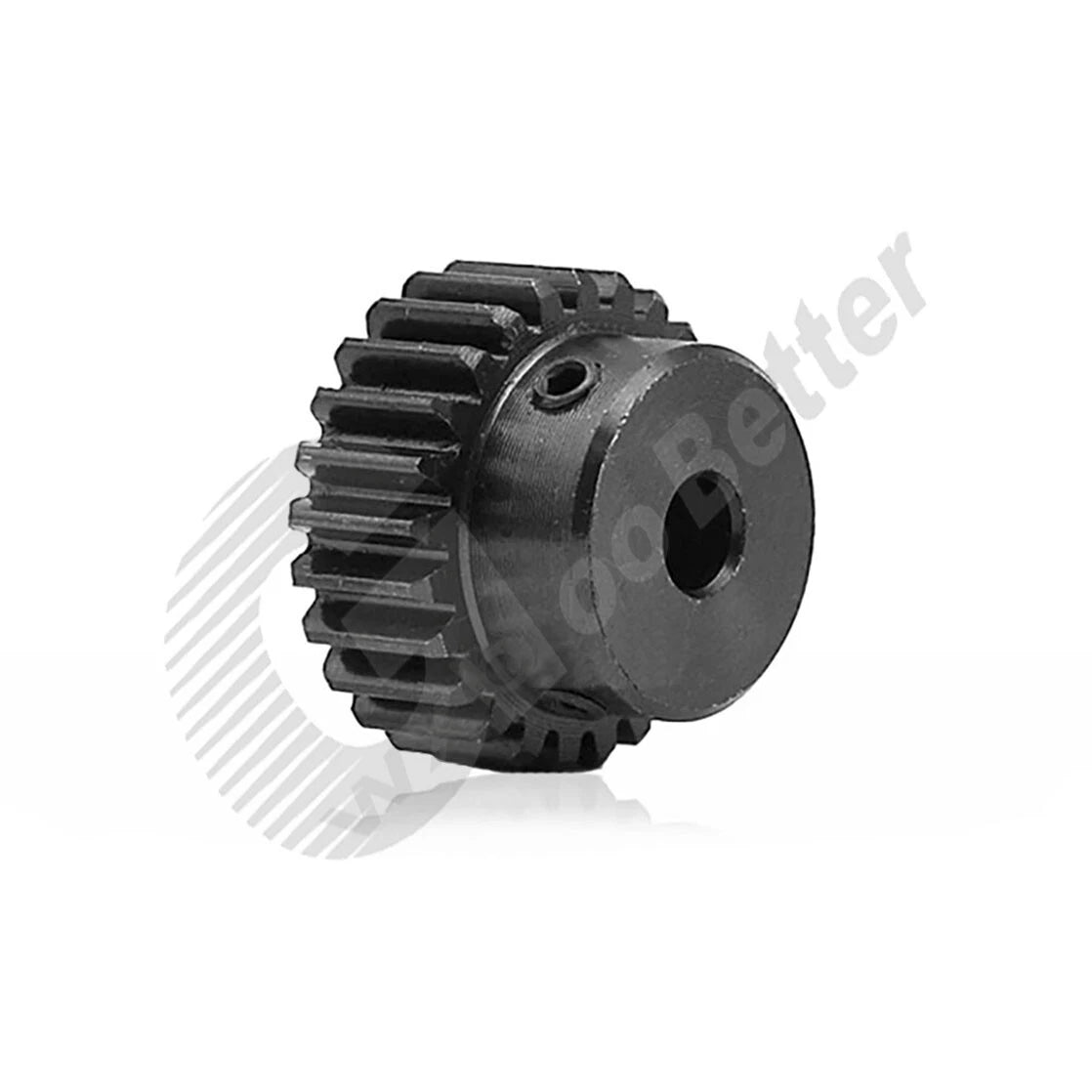
1.0 Mod #45 Steel Convex Spur Gear Spur Gears 12T 13T~ 20T Metal Spur Gears

No reviews

Price:
Sale price$9.37 USD
Stock:
In stock (500 units), ready to be shipped

Payment & Security

Ach Direct Debit Amazon American Express Apple Pay Bancontact BLIK Diners Club Discover EPS Google Pay iDEAL Wero JCB Maestro Mastercard Multibanco MobilePay PayPal Przelewy24 Shop Pay Twint Union Pay USDC Visa

Your payment information is processed securely. We do not store credit card details nor have access to your credit card information.

Limited Offer — Spend More, Save More
Spend $55+
Save $5
Spend $100+
Save $10
Spend $200+
Save $25
HomeDIYer DIY Expert Support

DIY Expert Support

Get fitment advice & recommendations

Mon–Fri  8:30 AM – 8:00 PM
24-Hour Fast Ship
Arrives in 3–14 Days
Worldwide Shipping
30-Day Returns
1 tree planted with every purchase

Description

1.0 Mod #45 Steel Convex Spur Gears — Precision Metal Gears for DIY Automation

When your motion-control project demands reliable, repeatable torque transfer, a poorly machined gear is the last thing you want. Whether you are building a desktop CNC router, a custom robot arm, or a small conveyor system, these 1.0 Module #45 steel convex spur gears give hobbyists, makers, and small-workshop engineers a dependable mechanical foundation without overengineering the budget.

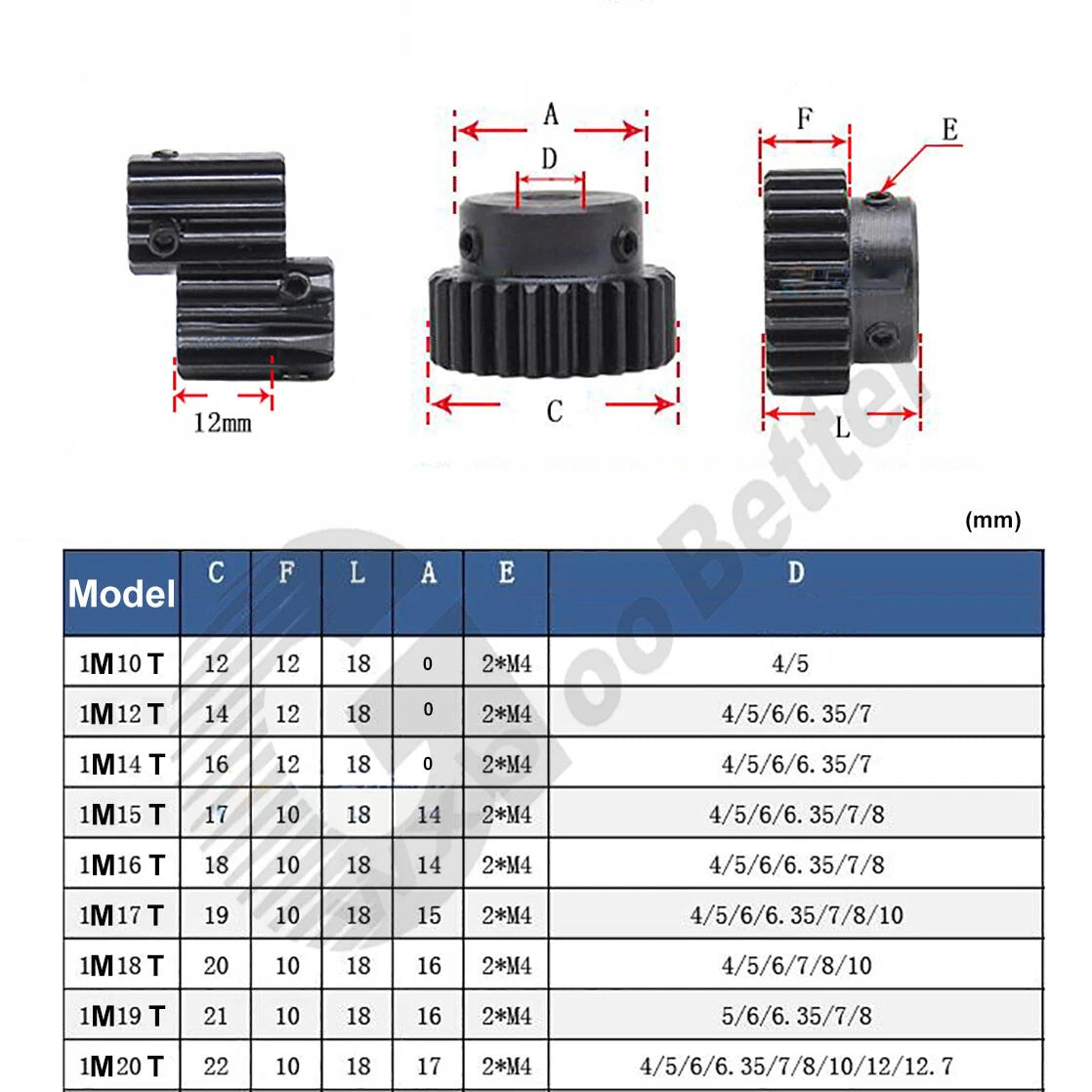
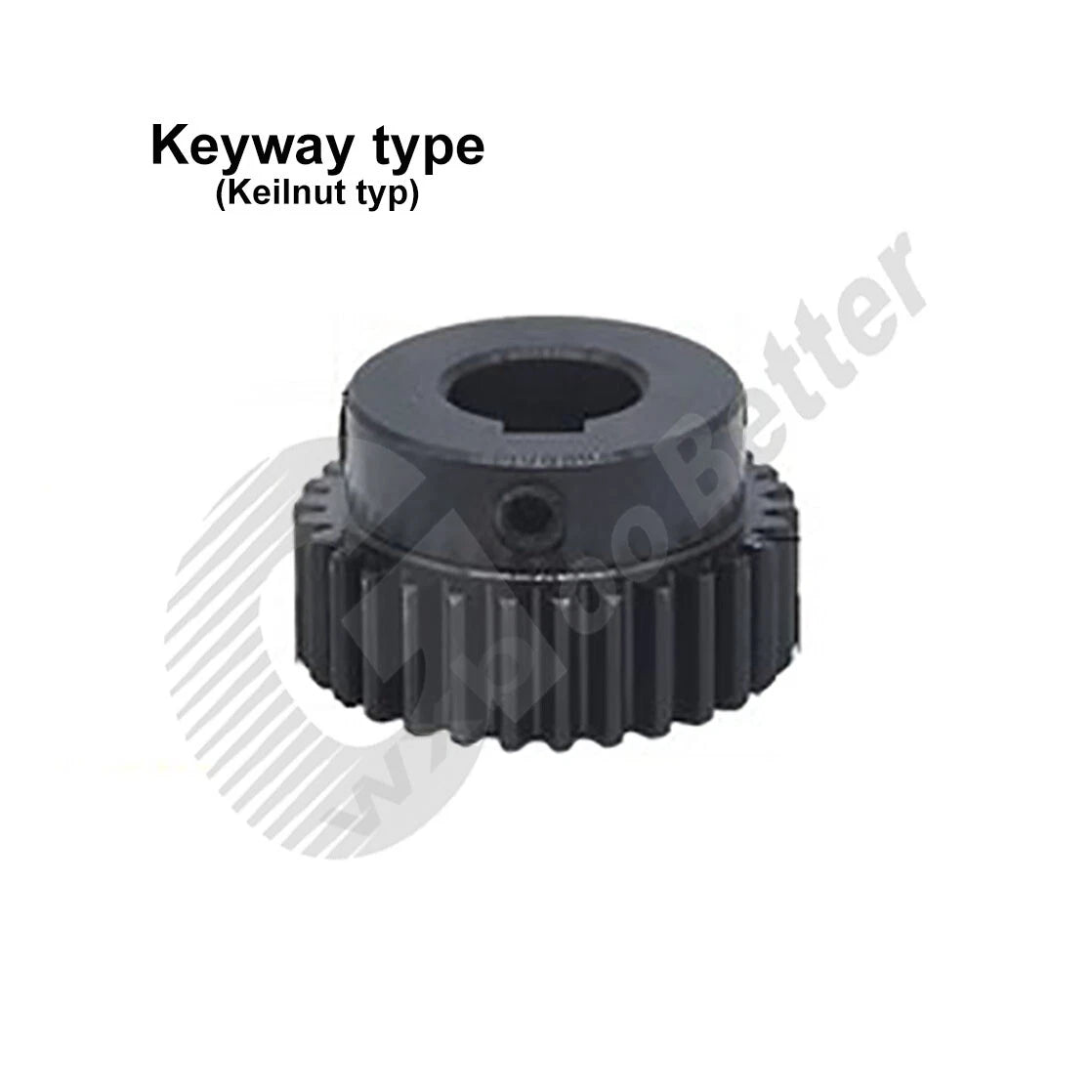
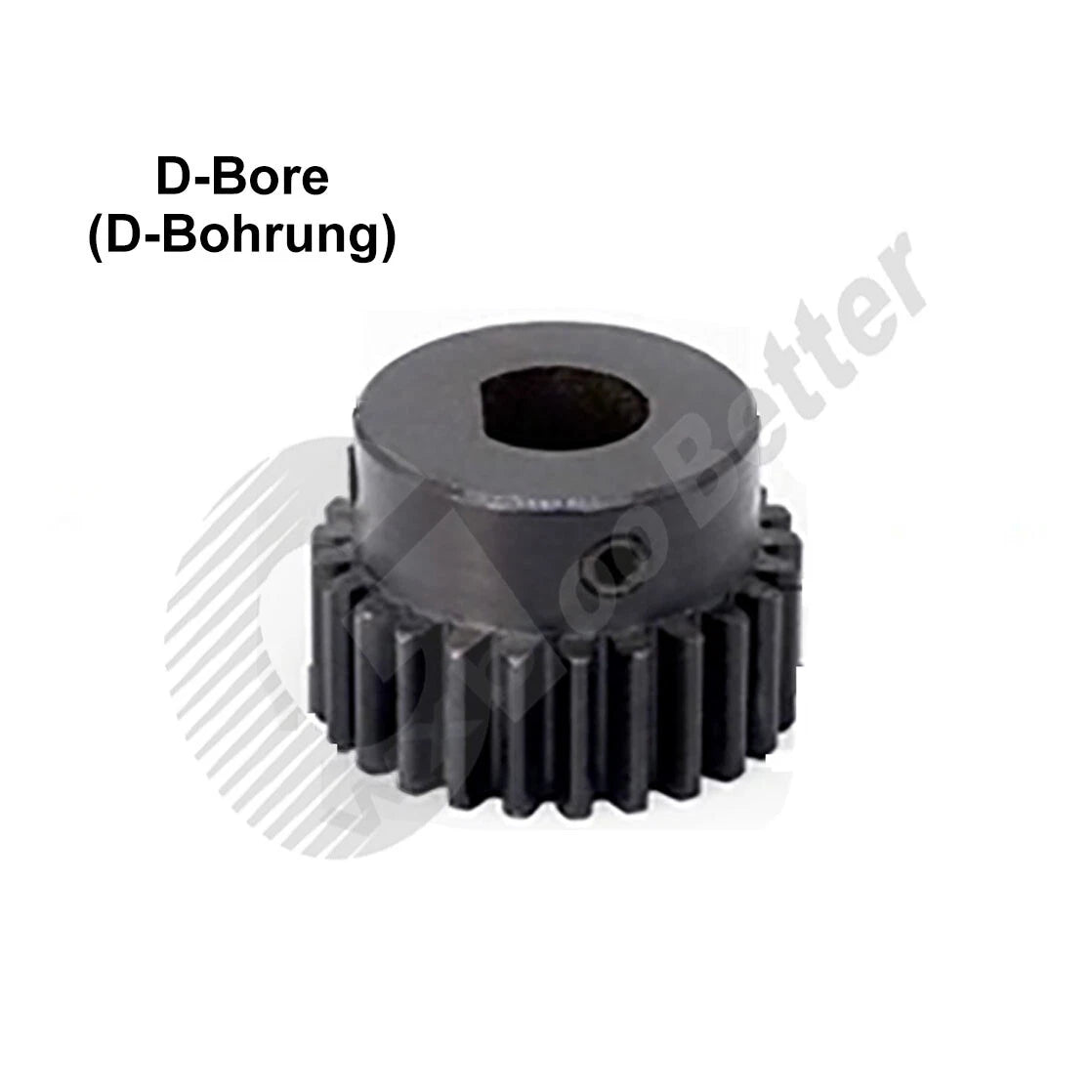
Each gear is machined from #45 medium-carbon steel — a widely used engineering steel valued for its balanced hardness and machinability. The convex tooth profile reduces edge stress concentration compared to a flat-face gear. Tooth counts span 10T through 20T, with outer diameters ranging from approximately 12 mm (0.47 in) for the 10T up to approximately 22 mm (0.87 in) for the 20T. Bore options cover 4 mm, 5 mm, 6 mm, 6.35 mm (1/4 in), 7 mm, 8 mm, 10 mm, 12 mm, and 12.7 mm round bores, plus D-bore configurations (5×4.5 mm, 6×5 mm, 6×5.5 mm, 8×7 mm, 8×7.5 mm, 10×9 mm) for anti-rotation shaft mounting.

Typical use cases include 1.0 mod spur gear pairs for 3D-printer extruder drives, gear-reduction stages in small robotic joints, and feed-roller assemblies in tabletop automation rigs — anywhere a compact, steel-bodied 1M spur gear with a selectable bore is needed for a low-backlash power-transmission solution.

⚙️ Compatibility: Meshes with any standard 1.0 Module (1M) spur gear of matching pressure angle (typically 20°). Verify shaft diameter and keyway requirements before ordering.

✅ Key Features of These 1.0 Mod #45 Steel Convex Spur Gears

  • 🔩#45 Medium-Carbon Steel Body — Offers a practical balance of tensile strength and machinability, suitable for moderate-load power-transmission applications in DIY and light-industrial builds.
  • 🔄Convex Tooth Face Profile — The crowned tooth surface distributes contact stress more evenly across the face width, reducing edge loading and extending service life under slight shaft misalignment.
  • 📐1.0 Module Standard — Fully interchangeable with any 1M-pitch spur gear of the same pressure angle, making it straightforward to pair with existing gears, racks, or pinions in your drivetrain.
  • 🕳️Wide Bore Selection — Round bores from 4 mm to 12.7 mm and multiple D-bore options let you match the gear directly to your motor or shaft without custom machining.
  • 🔢10T to 20T Tooth Range — Nine tooth-count options in a single product listing allow you to dial in the gear ratio you need for speed reduction or torque multiplication in compact drive stages.
  • 📦Single or Pair Quantity — Available in 1-piece or 2-piece packs so you can order exactly what your build requires — whether prototyping a single stage or building a matched gear pair.

📐 Technical Specifications — 1.0 Module Spur Gears

Module 1.0 M
Material #45 Medium-Carbon Steel
Tooth Profile Convex (Crowned Face)
Pressure Angle 20° (standard)
Tooth Count 10T, 12T, 14T, 15T, 16T, 17T, 18T, 19T, 20T (see variant options)
Outer Diameter (approx.) See variant options
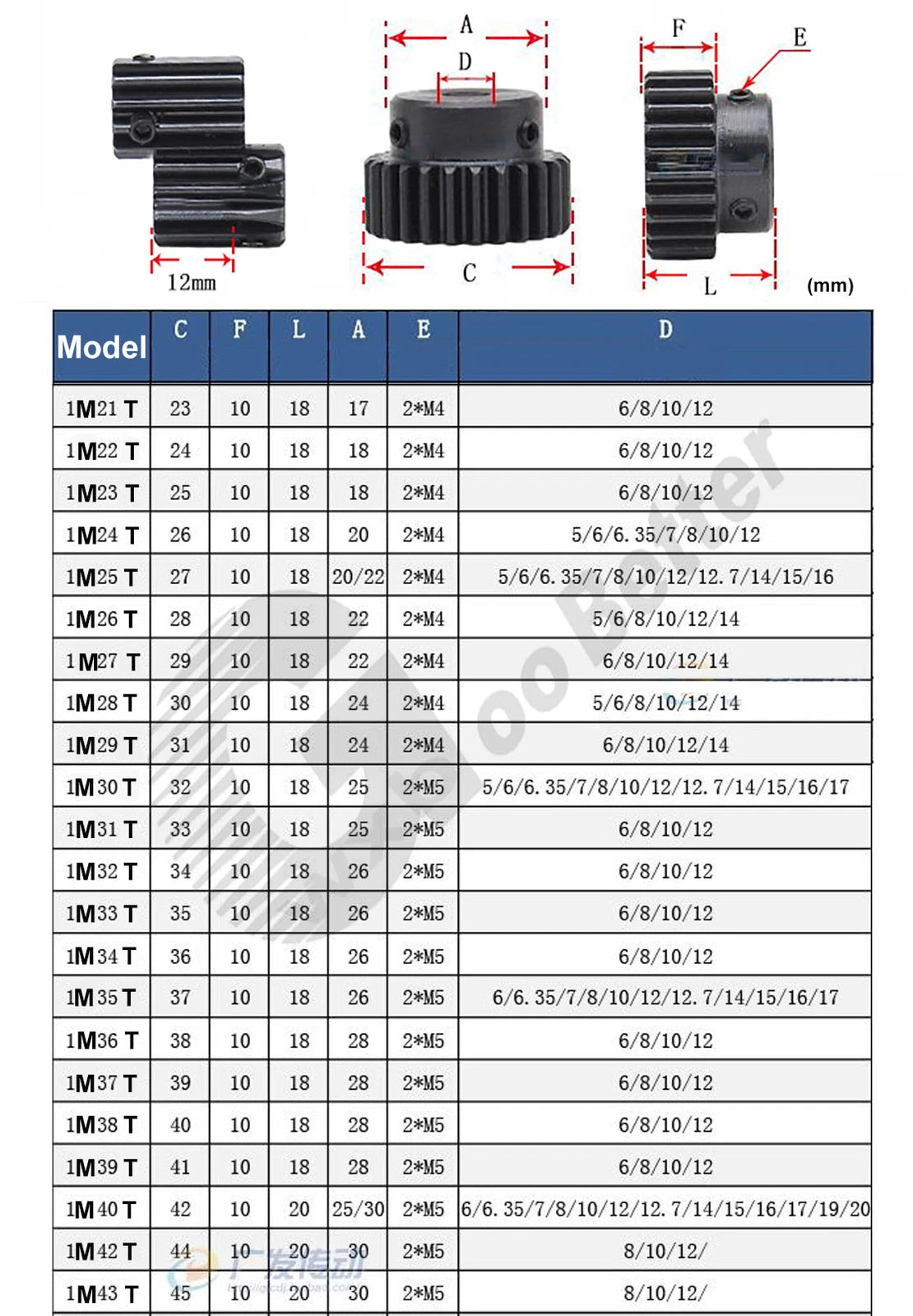
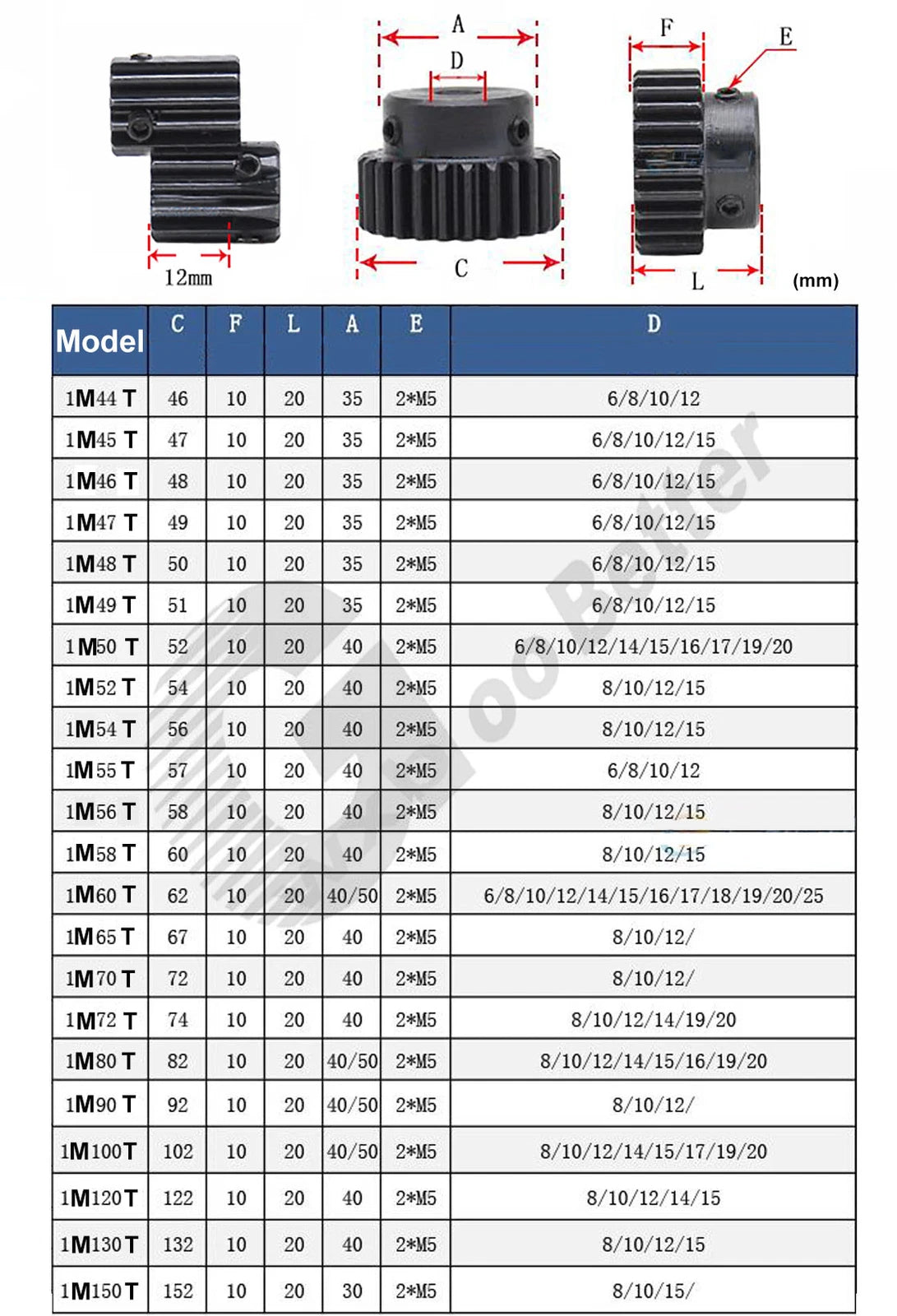
Bore Diameter 4 / 5 / 6 / 6.35 / 7 / 8 / 10 / 12 / 12.7 mm round; D-bore options available (see variant options)
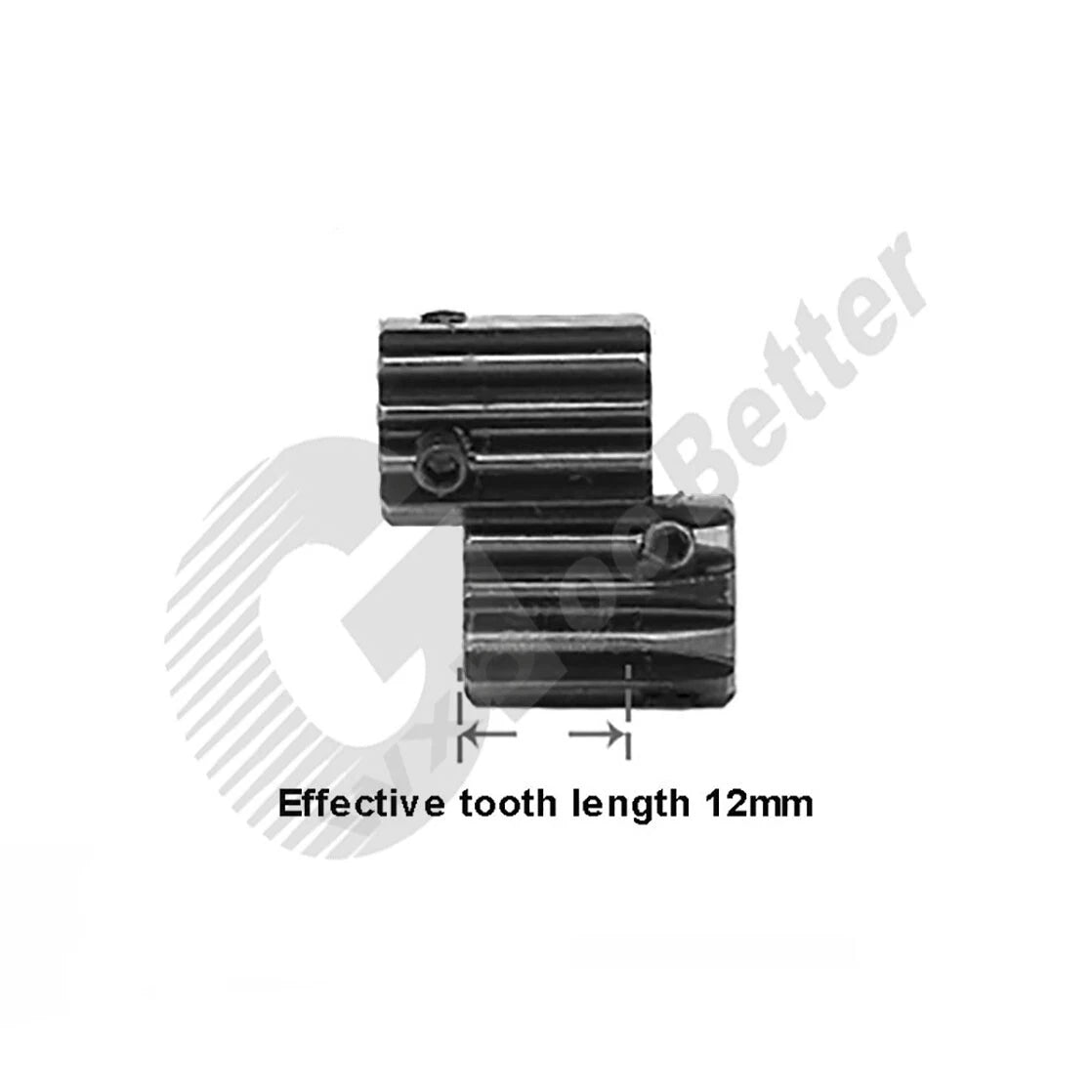
Face Width See variant options
Hub Style See variant options
Surface Finish See variant options
Weight See variant options
Quantity per Pack 1 pc or 2 pcs (see variant options)

❓ Frequently Asked Questions

How do I choose the right tooth count for my application?

The tooth count determines the gear ratio when paired with another gear. Divide the driven gear's tooth count by the driving gear's tooth count to get the ratio. For example, pairing a 10T pinion with a 20T gear gives a 2:1 reduction — the output shaft turns at half the speed but with twice the torque. Choose a smaller tooth count for higher speed, or a larger tooth count for more torque at the output.

What bore size should I select for my motor shaft?

Measure your motor or drive shaft diameter precisely with calipers. Select the bore that matches your shaft. For a 1/4-inch (6.35 mm) shaft common on many hobby motors, choose the 6.35 mm bore option. If your shaft has a flat (D-shaft), select the corresponding D-bore variant (e.g., D-Bore=6×5 mm for a 6 mm D-shaft). A bore that is too large will cause slippage; a bore that is too small will not fit.

Are these gears compatible with other 1.0 Module gears I already own?

Yes — any two 1.0 Module spur gears with the same pressure angle (20° is standard) will mesh correctly regardless of tooth count. You can pair these gears with 1M racks, pinions, or other spur gears from different suppliers as long as the module and pressure angle match. Always verify the pressure angle specification of your existing gears before mixing brands.

How strong are #45 steel gears, and what loads can they handle?

#45 medium-carbon steel has a typical tensile strength of approximately 600–800 MPa in the normalized condition. These gears are well-suited for light-to-moderate loads in DIY automation, robotics, and small machinery. They are not intended for heavy industrial gearboxes or high-shock-load environments. For very high torque or impact applications, consider hardened steel or alloy steel gears instead.

Do these gears require lubrication?

Yes, lubrication is recommended for any steel gear mesh running under load. A light machine oil or gear grease applied to the tooth flanks will reduce friction, lower operating temperature, and extend service life. For low-speed, lightly loaded applications (such as 3D-printer extruder gears), a thin film of grease applied at installation is typically sufficient. Re-lubricate periodically based on your duty cycle.

What is the advantage of a convex (crowned) tooth face over a standard flat-face gear?

A convex or crowned tooth face has a slight curvature across the face width. This means that under load, contact begins at the center of the tooth face rather than at the edges. The result is reduced edge stress concentration, which makes the gear more tolerant of minor shaft misalignment or deflection. In practical DIY builds where perfect shaft parallelism is difficult to guarantee, a crowned tooth profile can meaningfully reduce the risk of premature edge wear.

Should I order 1 piece or 2 pieces?

If you are prototyping or replacing a single gear in an existing drivetrain, the 1-piece option is the most economical choice. If you are building a matched gear pair (for example, a 10T pinion driving a 20T gear), ordering both gears in the same transaction ensures they arrive together and are from the same production batch. The 2-piece pack also offers a modest per-unit saving compared to two separate single-piece orders.

🛒 Select your Module/Teeth count, Bore Diameter, and Qty above, then add to cart.

You may also like

Recently viewed