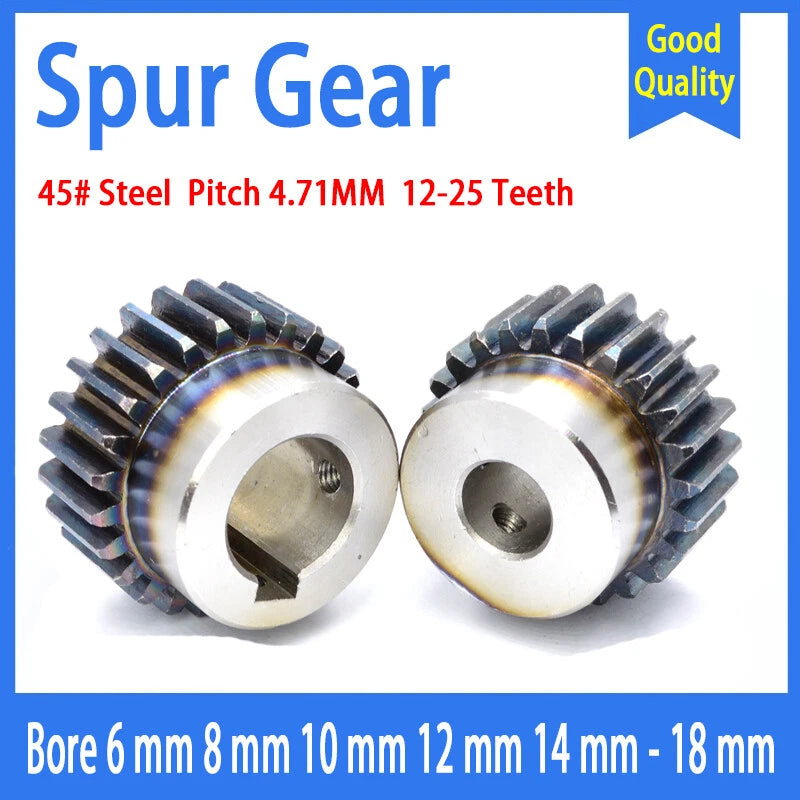
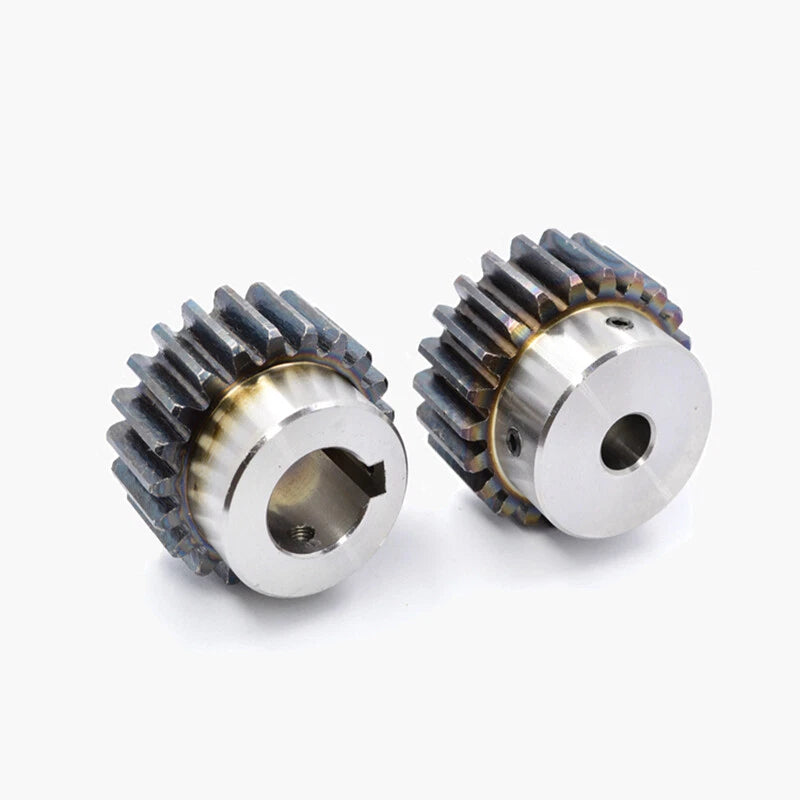
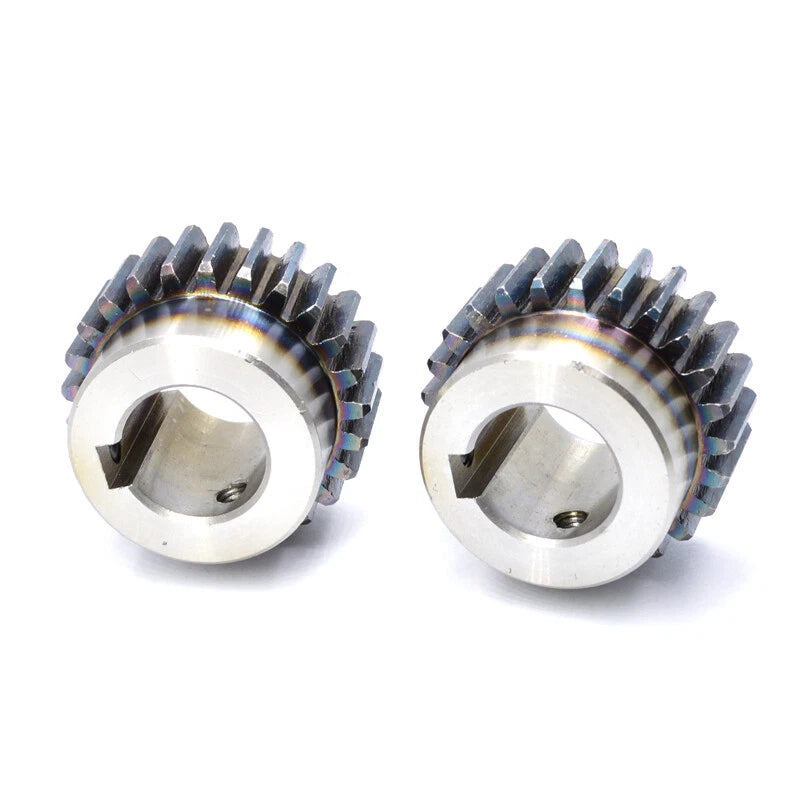
1.5 Mod 45# Steel Spur Gear 12-25T Bore 6-18mm Pinion Gear with Step Motor Gear

No reviews

Price:
Sale price$10.17 USD
Stock:
In stock (500 units), ready to be shipped

Payment & Security

Ach Direct Debit Amazon American Express Apple Pay Bancontact BLIK Diners Club Discover EPS Google Pay iDEAL Wero JCB Maestro Mastercard Multibanco MobilePay PayPal Przelewy24 Shop Pay Twint Union Pay USDC Visa

Your payment information is processed securely. We do not store credit card details nor have access to your credit card information.

Limited Offer — Spend More, Save More
Spend $55+
Save $5
Spend $100+
Save $10
Spend $200+
Save $25
HomeDIYer DIY Expert Support

DIY Expert Support

Get fitment advice & recommendations

Mon–Fri  8:30 AM – 8:00 PM
24-Hour Fast Ship
Arrives in 3–14 Days
Worldwide Shipping
30-Day Returns
1 tree planted with every purchase

Description

Module 1.5 Steel Spur Gear — Precision Pinion for Stepper Motors & CNC Drives

When a loose or undersized gear causes missed steps, vibration, or premature wear in your motion system, the root cause is almost always a mismatch between gear modulus, bore, and shaft material. Engineers, robotics builders, and CNC hobbyists who need a reliable Module 1.5 spur gear with a confirmed bore fit will find this listing covers the widest practical range in one place.

Each gear is machined from 45# medium-carbon steel, heat-treated for surface hardness while retaining a tough core. The tooth profile follows the standard Module 1.5 involute form. Bore options span 6 mm to 18 mm (approximately 0.24 in to 0.71 in), with plain-bore and keyway variants available. Tooth counts run from 12 T to 27 T, giving pitch circle diameters from 18 mm to 40.5 mm (0.71 in to 1.59 in). Overall gear width is typically 15–20 mm depending on tooth count.

Typical use cases include stepper motor pinion drives in 3D printers and laser cutters, rack-and-pinion linear actuators for CNC router Z-axes, and reduction stage gearing in small robotic arm joints where a compact Module 1.5 spur gear pair keeps backlash low and torque transfer efficient.

⚙️ Compatible with: Module 1.5 gear racks, pinions, and mating spur gears. Keyway variants suit standard DIN 6885 keys. Verify bore diameter and shaft size before ordering.

✅ Key Features of These Module 1.5 Steel Spur Gears

🔩 45# Medium-Carbon Steel Construction

Machined from 45# carbon steel with surface hardening for wear resistance and a tough core that absorbs shock loads without fracturing.

📐 Standard Module 1.5 Involute Tooth Profile

Conforms to the Module 1.5 standard, ensuring direct interchangeability with any mating M1.5 rack, pinion, or spur gear from any compliant source.

🎯 Wide Bore Range: 6–18 mm Plain & Keyway

Plain bores from 6 mm to 16 mm and keyway bores from 12 mm (4 mm key) to 18 mm (6 mm key) cover the most common stepper and servo shaft diameters.

12 T to 27 T Tooth Count Selection

Fifteen tooth-count options let you dial in the exact gear ratio needed for your drive stage without custom machining.

🛡️ Single or Twin-Pack Quantity Options

Available as 1 PCS or 2 PCS per order, making it straightforward to source matched pairs for parallel-shaft or idler configurations.

🔧 Drop-In Fit for Stepper Motor Shafts

Bore tolerances are machined to H7 fit class (typically ±0.01–0.02 mm), providing a snug slip fit on standard NEMA stepper motor shafts without additional reaming.

📐 Technical Specifications — Module 1.5 Spur Gear

Gear Module 1.5
Material 45# Medium-Carbon Steel
Tooth Count Range 12 T – 27 T (see variant options)
Pitch Circle Diameter Range 18 mm – 40.5 mm (0.71 in – 1.59 in)
Bore Diameter Range 6 mm – 18 mm (0.24 in – 0.71 in)
Keyway Options 4 mm key (12 mm bore), 5 mm key (14–16 mm bore), 6 mm key (18 mm bore)
Bore Tolerance H7 fit class (typically ±0.01–0.02 mm)
Gear Face Width See variant options
Pressure Angle 20°
Surface Treatment Heat-treated (surface hardened)
Quantity per Order 1 PCS or 2 PCS (see variant options)
Tooth Profile Standard Module 1.5 involute (DIN / ISO)

❓ Frequently Asked Questions

How do I choose the right tooth count for my application?

The tooth count determines the pitch circle diameter (PCD = Module × Teeth = 1.5 × T mm) and your gear ratio when paired with a mating gear. For a stepper motor pinion driving a rack, a 20 T gear gives a PCD of 30 mm. For a reduction pair, divide the driven gear tooth count by the driver tooth count to get the ratio. Select the tooth count that achieves your target ratio and fits within your available center distance.

Do I need a keyway bore, or will a plain bore work?

A plain bore is sufficient when the gear is secured with a set screw against a flat on the shaft, which is standard for most NEMA stepper motor shafts. A keyway bore is recommended when transmitting higher torque, when the gear must be precisely indexed angularly, or when the shaft already has a machined keyway. Check your shaft specification before selecting.

What is the strength of a 45# steel gear compared to other materials?

45# medium-carbon steel has a tensile strength of approximately 600–800 MPa in the normalized condition and higher after heat treatment. This makes it significantly stronger than brass or aluminum gears and suitable for moderate-to-high torque drives. It is not stainless and will surface-rust if left unprotected in humid environments — apply a light oil film if the gear is exposed.

Will this gear rust or corrode?

45# carbon steel is not corrosion-resistant. In dry indoor environments (typical for 3D printers, CNC machines, and robotics), surface oxidation is minimal. For outdoor or high-humidity applications, apply a thin coat of machine oil or grease to the gear teeth and bore. If corrosion resistance is a hard requirement, consider a stainless steel or brass gear instead.

Is this gear compatible with Module 1.5 racks and other M1.5 gears from different brands?

Yes. The Module 1.5 involute tooth profile is an internationally standardized form (DIN 867 / ISO 53). Any Module 1.5 gear or rack with a 20° pressure angle will mesh correctly with this gear regardless of brand, as long as the center distance is set to (PCD₁ + PCD₂) / 2. Verify the pressure angle of your existing components before mixing.

How do I select the correct bore diameter for my stepper motor shaft?

Measure your motor shaft diameter with a caliper. Common NEMA 17 shafts are 5 mm; NEMA 23 shafts are typically 6.35 mm or 8 mm; NEMA 34 shafts are often 12.7 mm or 14 mm. Choose the bore option that is equal to or slightly larger than your shaft diameter, then secure with a set screw or key. If your shaft has a flat, a plain bore with a set screw is the standard approach.

Can I use these gears in a gear pair to build a reduction stage?

Yes. Select a small-tooth driver gear (e.g., 12 T) and a larger driven gear (e.g., 24 T) for a 2:1 reduction. Both must be Module 1.5 with the same pressure angle. The center distance between shafts should equal (12 × 1.5 / 2) + (24 × 1.5 / 2) = 9 + 18 = 27 mm. Order both tooth counts from this listing to ensure material and profile consistency.

🛒 Select your Modulus, Number of Teeth, and Bore Diameter & Amount above, then add to cart.

You may also like

Recently viewed