10Pcs Wire Dia.0.3/0.4/0.5mm OD 3mm-10mm Small Springs Compression Spring Steel

No reviews

Price:
Sale price$4.01 USD
Stock:
In stock (500 units), ready to be shipped

Payment & Security

Ach Direct Debit Amazon American Express Apple Pay Bancontact BLIK Diners Club Discover EPS Google Pay iDEAL Wero JCB Maestro Mastercard Multibanco MobilePay PayPal Przelewy24 Shop Pay Twint Union Pay USDC Visa

Your payment information is processed securely. We do not store credit card details nor have access to your credit card information.

Limited Offer — Spend More, Save More
Spend $55+
Save $5
Spend $100+
Save $10
Spend $200+
Save $25
HomeDIYer DIY Expert Support

DIY Expert Support

Get fitment advice & recommendations

Mon–Fri  8:30 AM – 8:00 PM
24-Hour Fast Ship
Arrives in 3–14 Days
Worldwide Shipping
30-Day Returns
1 tree planted with every purchase

Description

Small Compression Springs — Precision Steel Coils for Tight-Tolerance DIY Applications

When a standard spring is too large for your project, finding a reliable miniature compression spring becomes a real challenge. Whether you are a hobbyist repairing a mechanical pen, an engineer prototyping a sensor housing, or a maker building a custom switch mechanism, these small-diameter steel compression springs give you the exact elastic force you need in a compact form factor.

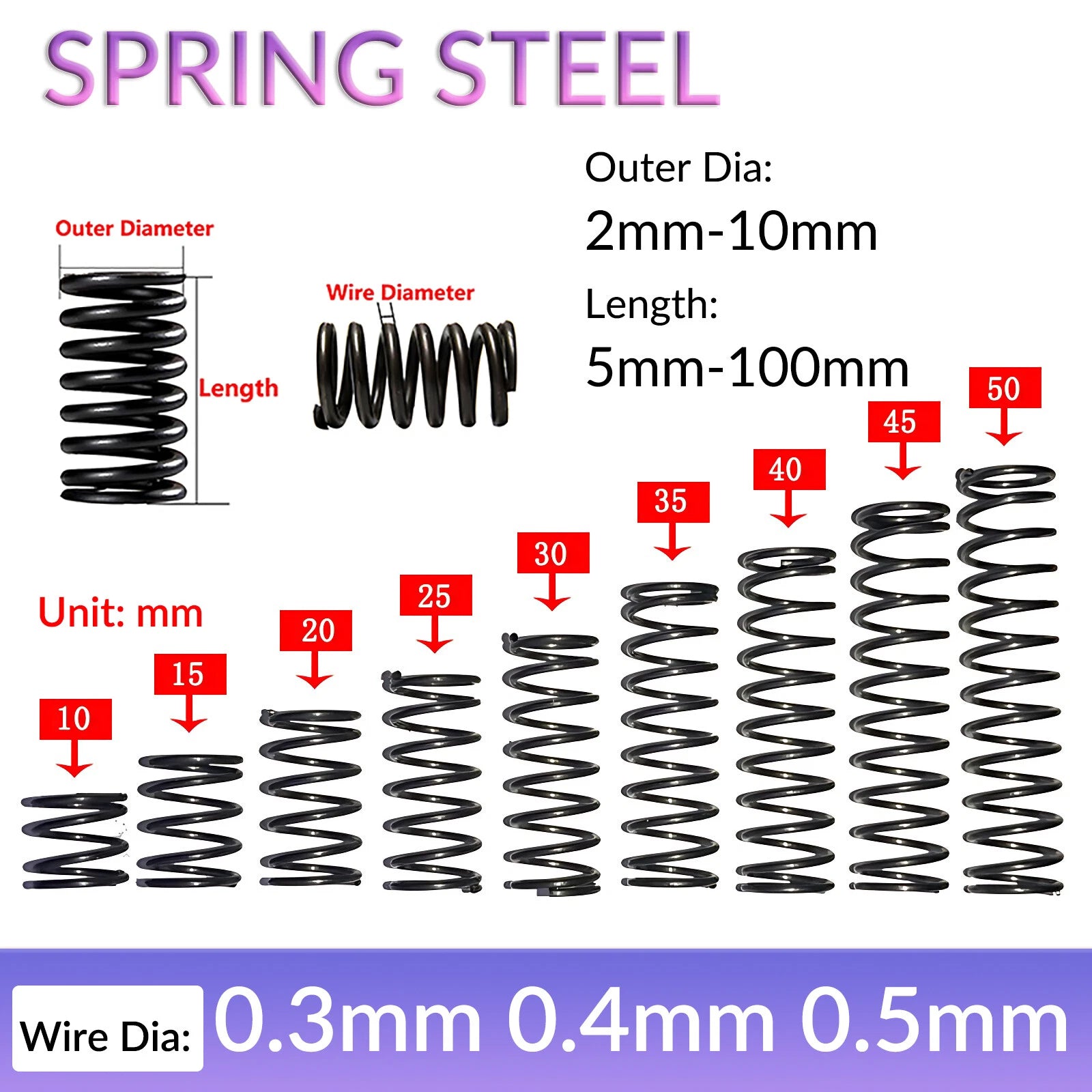
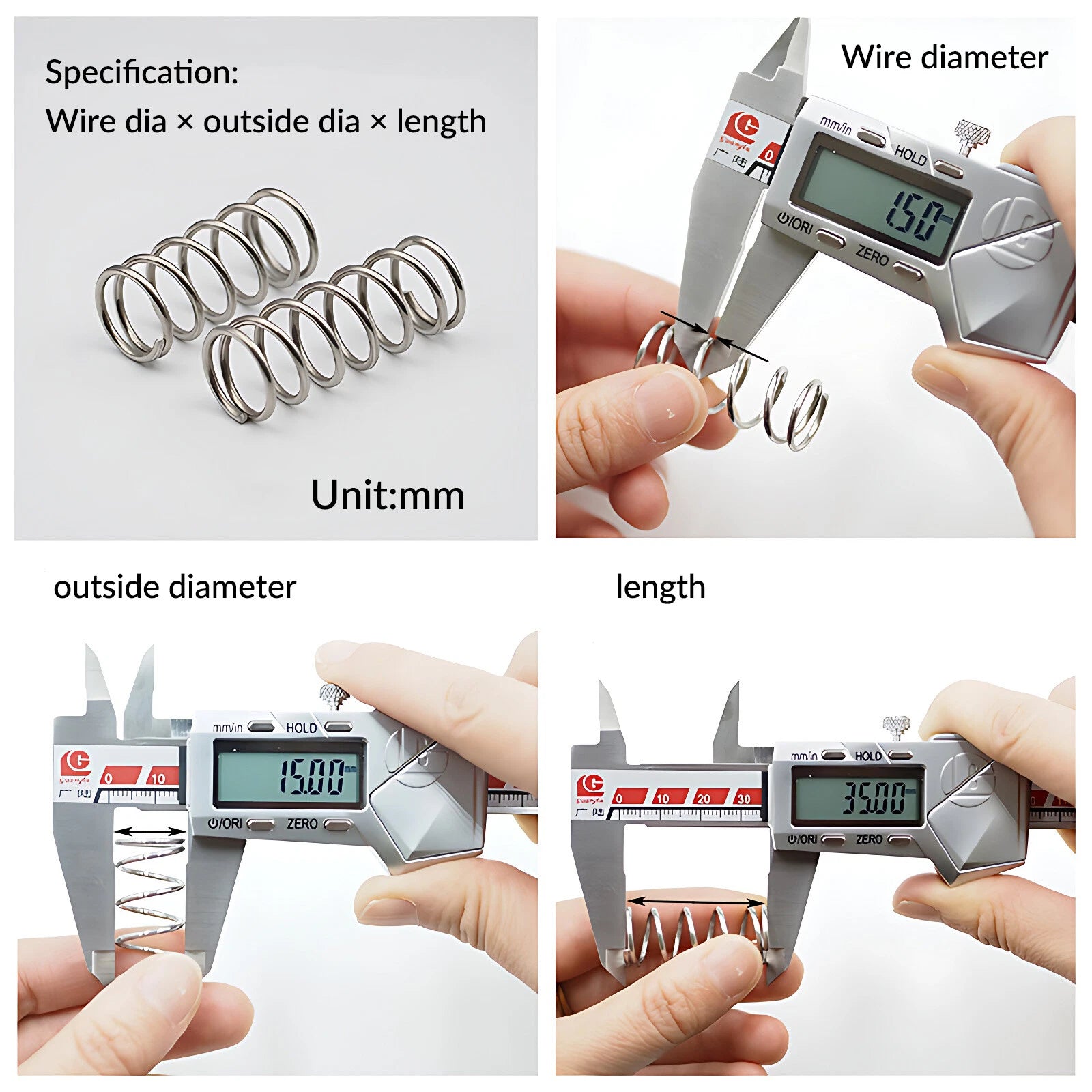
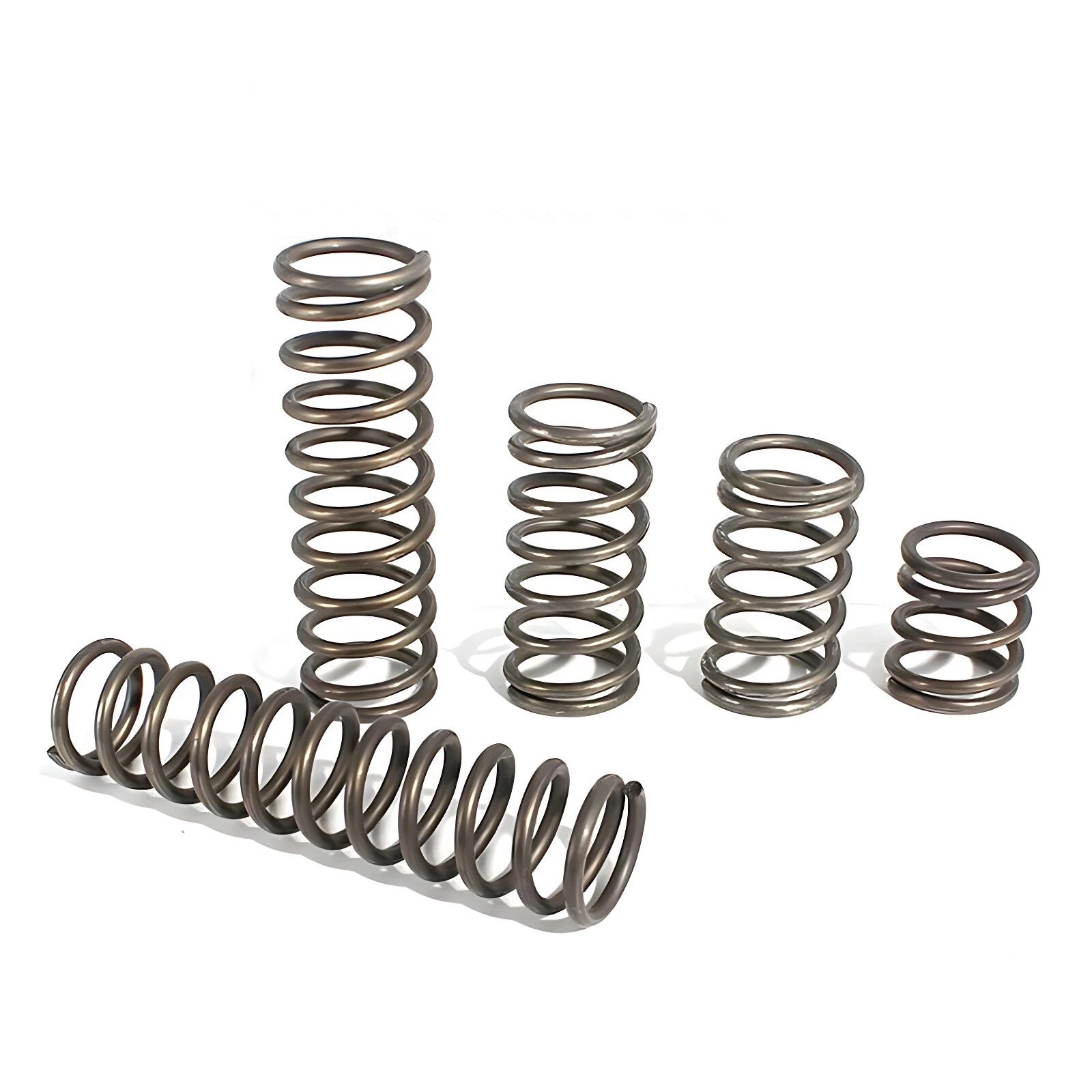
Each spring is wound from carbon steel wire with a diameter of 0.3 mm, 0.4 mm, or 0.5 mm (approximately 0.012–0.020 in). The outer diameter ranges from 3 mm to 10 mm (approximately 0.12–0.39 in), and free lengths span from 5 mm to 100 mm (approximately 0.20–3.94 in) depending on the variant selected. Springs are sold in packs of 5 or 10 pieces per order.

These miniature compression springs are well suited for small electronics repair and PCB spring contacts, precision mechanical models and scale assemblies, and custom jig or fixture designs requiring consistent return force in a confined space.

⚙️ Compatibility: Suitable for general-purpose DIY, hobby, and light mechanical applications. Verify inner bore diameter and free length against your design before ordering.

✅ Key Features of These Small Compression Springs

  • 🔩Micro Wire Diameters — Available in 0.3 mm, 0.4 mm, and 0.5 mm wire gauges to match fine-tolerance spring seats and bores.
  • 📐Wide OD Range — Outer diameters from 3 mm to 10 mm cover a broad range of miniature mechanical applications in a single product listing.
  • 📏Multiple Free Lengths — Free lengths from 5 mm to 100 mm let you select the exact travel and spring rate needed for your design.
  • 🛡️Carbon Steel Construction — Wound from carbon steel wire for consistent elastic return force and resistance to deformation under repeated compression cycles.
  • 📦Convenient Pack Quantities — Shorter lengths ship in packs of 10; longer lengths (60 mm and above) ship in packs of 5, reducing waste and keeping costs manageable.
  • 🔁Closed Ends — Closed (ground or plain) end coils provide a flat seating surface for stable load transfer in spring pockets and plunger assemblies.

📐 Technical Specifications — Compression Springs

Material Carbon steel
Wire Diameter 0.3 mm / 0.4 mm / 0.5 mm (approx. 0.012–0.020 in)
Outer Diameter (OD) 2 mm – 10 mm (approx. 0.08–0.39 in) — see variant options
Free Length 5 mm – 100 mm (approx. 0.20–3.94 in) — see variant options
Spring Type Compression (closed ends)
Coil Direction Right-hand wound
Surface Finish See variant options
Spring Rate See variant options
Pack Quantity 5 Pcs (lengths ≥60 mm) / 10 Pcs (lengths ≤50 mm)
Weight (per pack) See variant options

❓ Frequently Asked Questions

How do I choose the right outer diameter for my application?

Measure the inner diameter of the bore or pocket where the spring will sit. The spring's outer diameter should be 0.1–0.3 mm smaller than the bore to allow free movement without binding. For a shaft-guided spring, the inner diameter of the spring (OD minus twice the wire diameter) should be 0.1–0.3 mm larger than the shaft.

What is the difference between the 0.3 mm, 0.4 mm, and 0.5 mm wire diameter options?

A thicker wire diameter produces a stiffer spring with a higher spring rate, meaning more force is required to compress it by the same distance. Choose 0.3 mm wire for very light loads and delicate mechanisms, 0.4 mm for moderate loads, and 0.5 mm when you need a firmer return force in the same outer diameter envelope.

Are these springs corrosion-resistant?

These springs are made from carbon steel, which offers good mechanical properties but limited corrosion resistance compared to stainless steel. For indoor, dry, or low-humidity environments they perform reliably. For outdoor, wet, or chemically exposed environments, consider applying a light coat of oil or selecting a stainless steel alternative.

What free length should I select?

The free length is the uncompressed length of the spring. Select a free length that is longer than your required working length by at least 20–30% to ensure the spring operates within its elastic range and does not reach solid height (coil bind) during normal use. For example, if your mechanism compresses the spring by 10 mm, choose a free length of at least 13–15 mm.

Can I use these springs in electronics or PCB assemblies?

Yes. The small wire diameters (0.3–0.5 mm) and outer diameters (as small as 2–3 mm) make these springs suitable for spring-loaded PCB contacts, battery terminals, push-button mechanisms, and similar low-load electronic applications. Ensure the spring material is compatible with any soldering or conformal coating processes in your assembly.

How do I decide between a 5-piece and a 10-piece pack?

Shorter springs (5–50 mm free length) are sold in packs of 10, which is ideal for prototyping or small batch production where you need spares. Longer springs (60–100 mm free length) are sold in packs of 5. If you need a larger quantity for production runs, simply add multiple units to your cart.

What is the inner diameter of these springs?

The inner diameter equals the outer diameter minus twice the wire diameter. For example, a spring with OD 5 mm and wire diameter 0.5 mm has an inner diameter of approximately 4 mm (5 mm − 2 × 0.5 mm). Use this formula to verify shaft clearance before ordering.

🛒 Select your wire diameter, outer diameter, and length above, then add to cart.

You may also like

Recently viewed