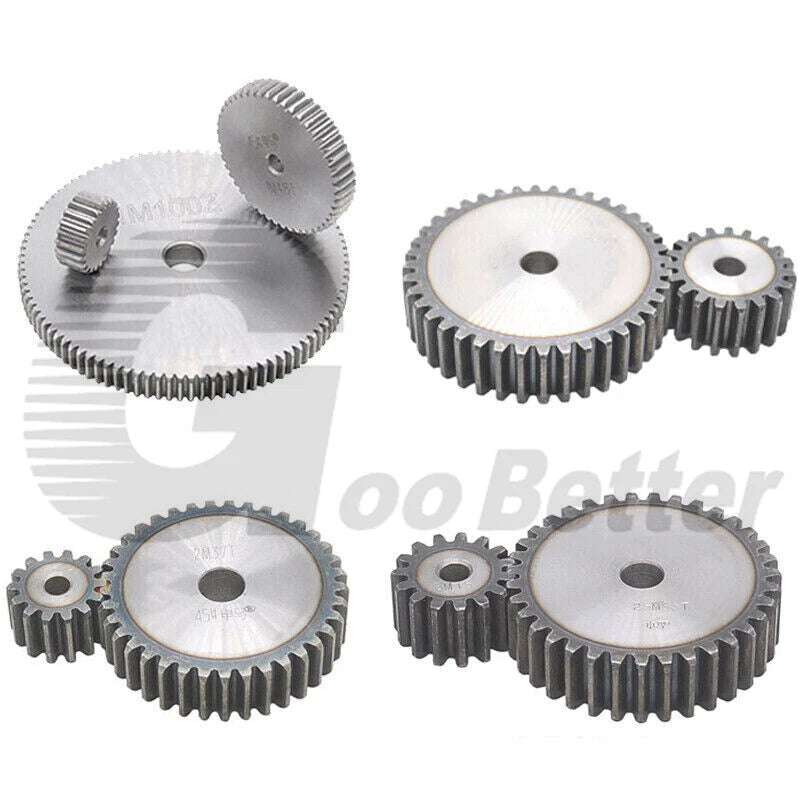
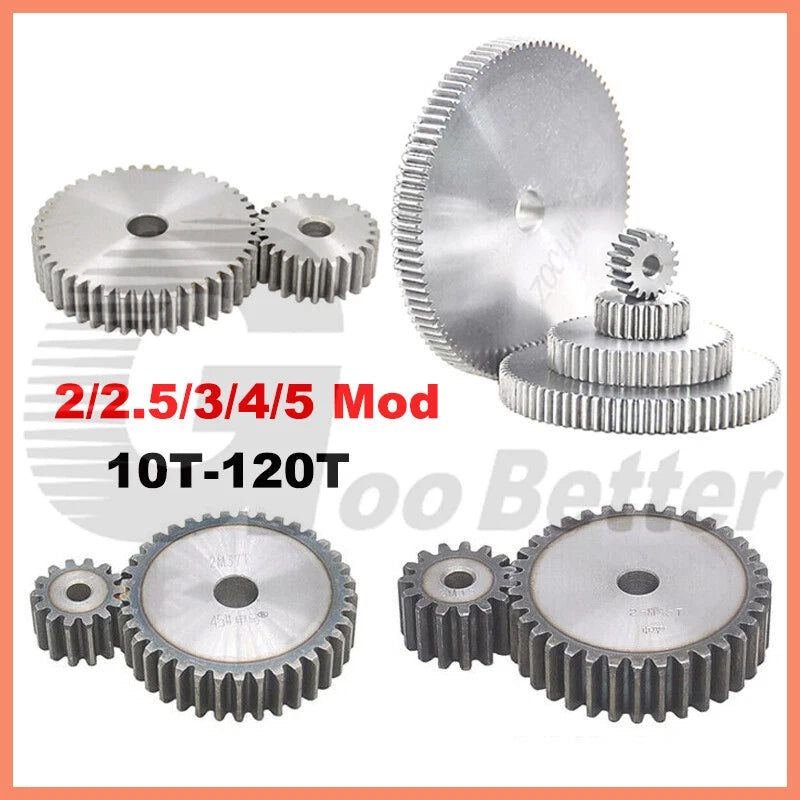
Mod 2–5 Steel Spur Gear — Precision Pinion Gears for Demanding Drive Systems
When a stripped plastic gear or an out-of-spec pinion brings your build to a halt, you need a drop-in replacement that holds tolerance under load. These 45# steel spur gears are designed for engineers, robotics builders, and serious DIYers who cannot afford slop in their drive train — whether that is a CNC router, an automated conveyor, or a custom gearbox.
Each gear is CNC-hobbed from 45# medium-carbon steel and is available in five metric modulus values — Mod 2, 2.5, 3, 4, and 5 — with tooth counts spanning 10 T to 127 T. Face width (thickness) ranges from 20 mm (0.79 in) to 40 mm (1.57 in) depending on the selected variant, giving you the contact area needed for your torque requirement.
Typical applications include spur gear reduction stages in robotics and automation equipment, replacement pinion gears for CNC axis drives, and custom gearbox assemblies in small-batch manufacturing rigs where off-the-shelf plastic gears lack the durability for continuous-duty cycles.
⚙️
Compatible with standard metric module gear systems. Verify modulus, tooth count, bore diameter, and face width against your mating gear before ordering.
✅ Key Features of These Mod 2–5 Steel Spur Gears
🔩
45# Medium-Carbon Steel Construction — Offers a solid balance of hardness and machinability, resisting wear under sustained mesh loads without becoming brittle.
📐
Wide Modulus Selection (Mod 2 / 2.5 / 3 / 4 / 5) — Five standard metric module sizes in a single listing let you match the exact pitch of your existing gear train without custom ordering.
🦷
Broad Tooth-Count Range (10 T – 127 T) — Fine-tune your gear ratio from high-speed, low-torque pinion configurations up to large-diameter ring-gear equivalents within one product family.
📏
Face Width 20–40 mm (0.79–1.57 in) — Thicker face widths distribute load across more tooth surface area, reducing contact stress in high-torque or continuous-duty applications.
⚡
CNC-Hobbed Tooth Profile — Machine-cut involute teeth maintain consistent pressure angle and pitch accuracy across the full tooth count range, ensuring smooth mesh and minimal backlash.
🔧
Standard Bore — Ready for Keyway or Set-Screw Modification — Bore diameter varies by modulus and tooth count; the steel grade machines cleanly for keyway broaching or set-screw tapping to suit your shaft interface.
📐 Technical Specifications — Metric Spur Gear
| Material |
45# Medium-Carbon Steel |
| Gear Type |
Spur Gear (Involute Tooth Profile) |
| Modulus Options |
Mod 2 / Mod 2.5 / Mod 3 / Mod 4 / Mod 5 |
| Tooth Count Range |
10 T – 127 T (varies by modulus) |
| Face Width (Thickness) |
20–40 mm (0.79–1.57 in) — see variant options |
| Bore Diameter |
See variant options |
| Pressure Angle |
20° |
| Surface Finish |
Natural steel (uncoated) |
| Quantity per Order |
1 pc (multi-pack options available) |
| Weight |
See variant options |
❓ Frequently Asked Questions
How do I choose the correct modulus for my application?
Modulus (Mod) is the fundamental size parameter of a metric gear. Two gears must share the same modulus to mesh correctly. Measure the pitch diameter of your existing gear and divide by its tooth count — the result is the modulus in millimetres. Select the matching Mod value (2, 2.5, 3, 4, or 5) from the variant selector above.
What is the pressure angle of these spur gears?
All gears in this listing use the standard 20° pressure angle, which is the most widely adopted value in modern metric gear systems. This ensures compatibility with the vast majority of commercially available mating gears and rack-and-pinion sets that follow ISO or DIN standards.
How strong are these gears under continuous load?
45# steel (equivalent to C45 / SAE 1045) has a tensile strength of approximately 600–800 MPa in the as-machined condition. For high-cycle or shock-load applications, consider whether heat treatment (quench and temper) is needed for your specific torque and speed requirements. Contact us if you need material certification details.
Are these gears corrosion-resistant?
The gears are supplied with a natural steel finish and are not coated or plated. For environments with moisture or mild chemical exposure, apply a light machine oil or grease to the tooth surfaces and bore. For highly corrosive environments, consider stainless steel or coated alternatives.
What bore diameter should I expect, and can I modify it?
Bore diameter varies by modulus and tooth count — please check the variant detail or contact us to confirm the bore for your specific selection before ordering. The 45# steel grade machines cleanly, so the bore can be enlarged, keyway-broached, or tapped for a set screw by a competent machine shop to match your shaft diameter.
Can I use these gears in a robotics or automation project?
Yes. These spur gears are well-suited for robotics drive trains, servo-driven axis systems, conveyor reduction stages, and small-batch automation equipment. The wide modulus and tooth-count range allows you to design custom gear ratios without sourcing from multiple suppliers. Pair with a matching pinion or rack of the same modulus for a complete drive stage.
How do I calculate the gear ratio for my drive system?
Gear ratio = (tooth count of driven gear) ÷ (tooth count of driving pinion). For example, a 60-tooth gear driven by a 20-tooth pinion gives a 3:1 reduction — the output shaft turns at one-third the input speed with three times the torque (minus efficiency losses). Use the tooth-count options in this listing to dial in your target ratio.
🛒 Select your Modulus, Number of Teeth, and Qty above, then add to cart.