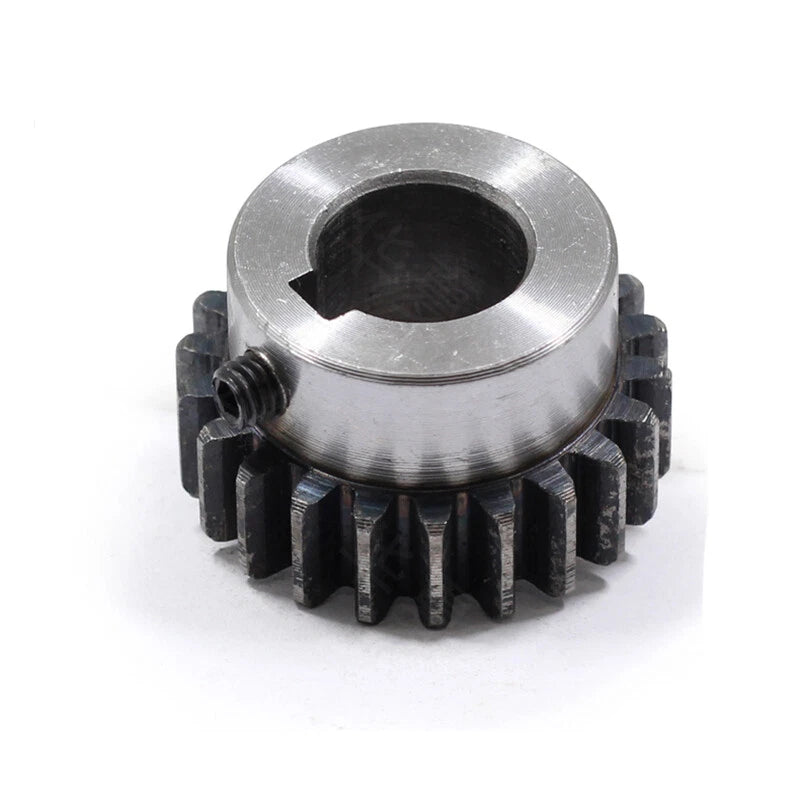
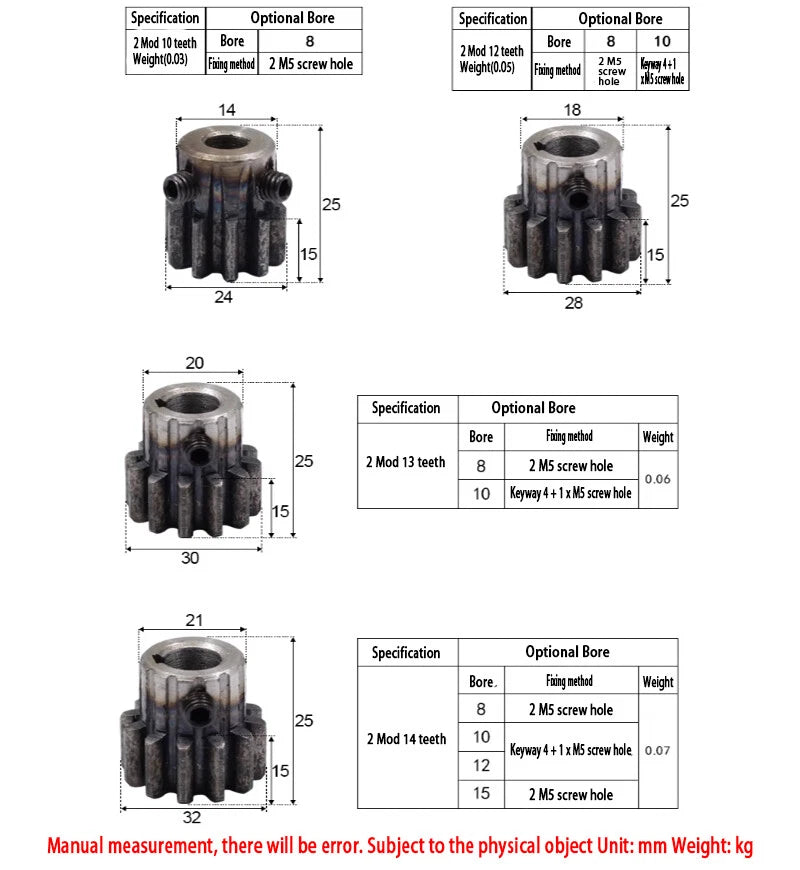
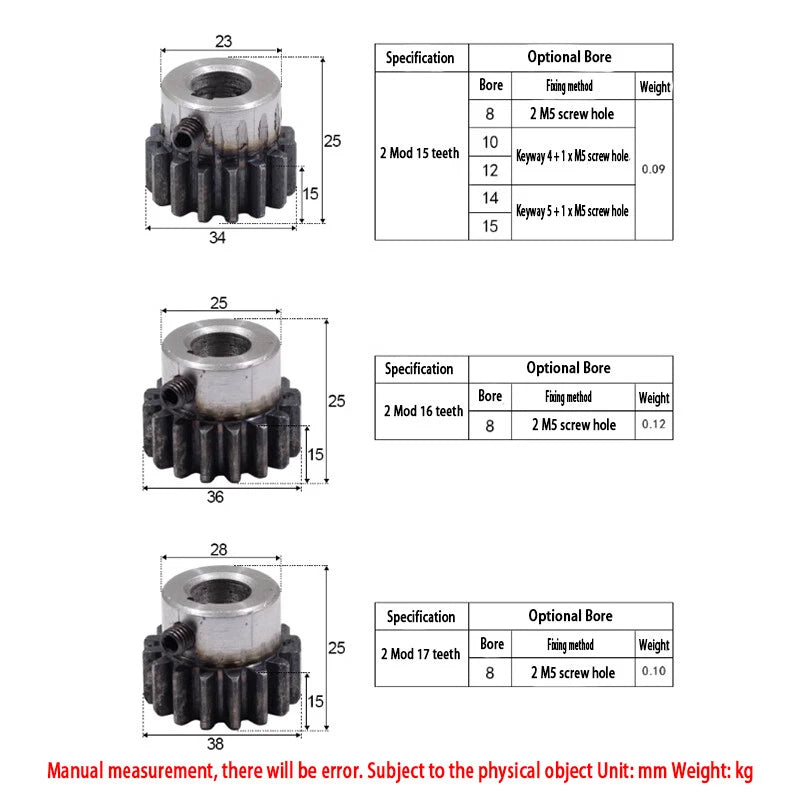
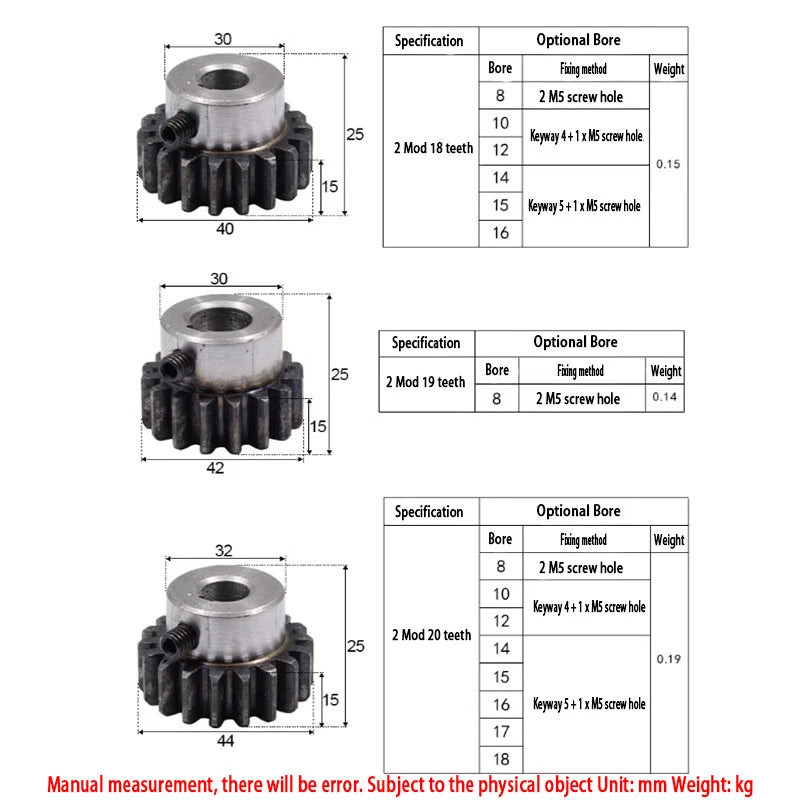
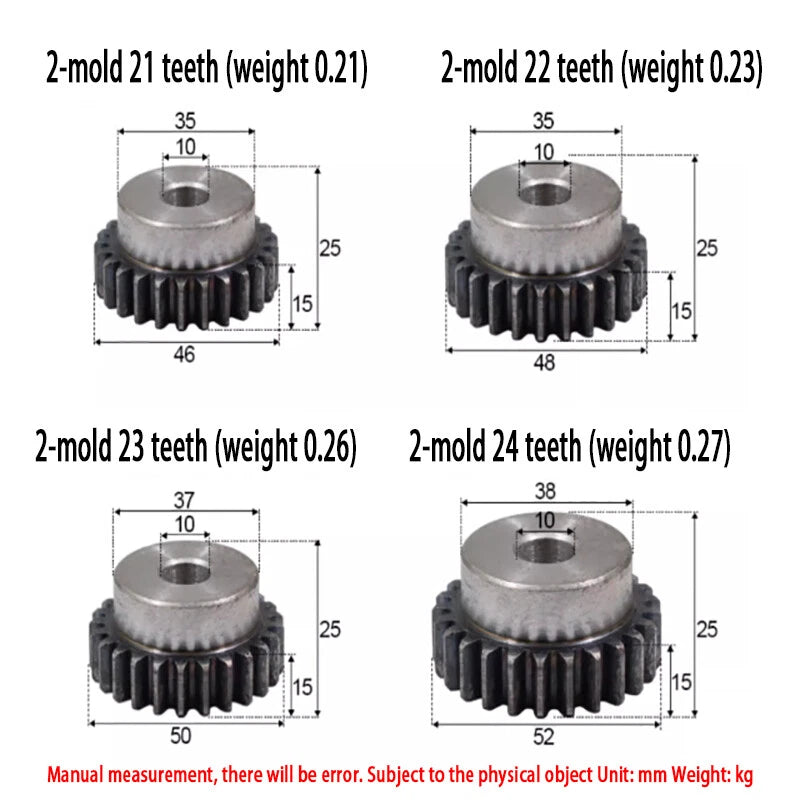
2 Mod 10-60 Teeth Precision Spur Pinion Gear With Step 45# Steel Motor Gear

No reviews

Price:
Sale price$10.17 USD
Stock:
In stock (500 units), ready to be shipped

Payment & Security

Ach Direct Debit Amazon American Express Apple Pay Bancontact BLIK Diners Club Discover EPS Google Pay iDEAL Wero JCB Maestro Mastercard Multibanco MobilePay PayPal Przelewy24 Shop Pay Twint Union Pay USDC Visa

Your payment information is processed securely. We do not store credit card details nor have access to your credit card information.

Limited Offer — Spend More, Save More
Spend $55+
Save $5
Spend $100+
Save $10
Spend $200+
Save $25
HomeDIYer DIY Expert Support

DIY Expert Support

Get fitment advice & recommendations

Mon–Fri  8:30 AM – 8:00 PM
24-Hour Fast Ship
Arrives in 3–14 Days
Worldwide Shipping
30-Day Returns
1 tree planted with every purchase

Description

2 Mod Spur Pinion Gear — Precision 45# Steel for Robotics, CNC & DIY Drive Systems

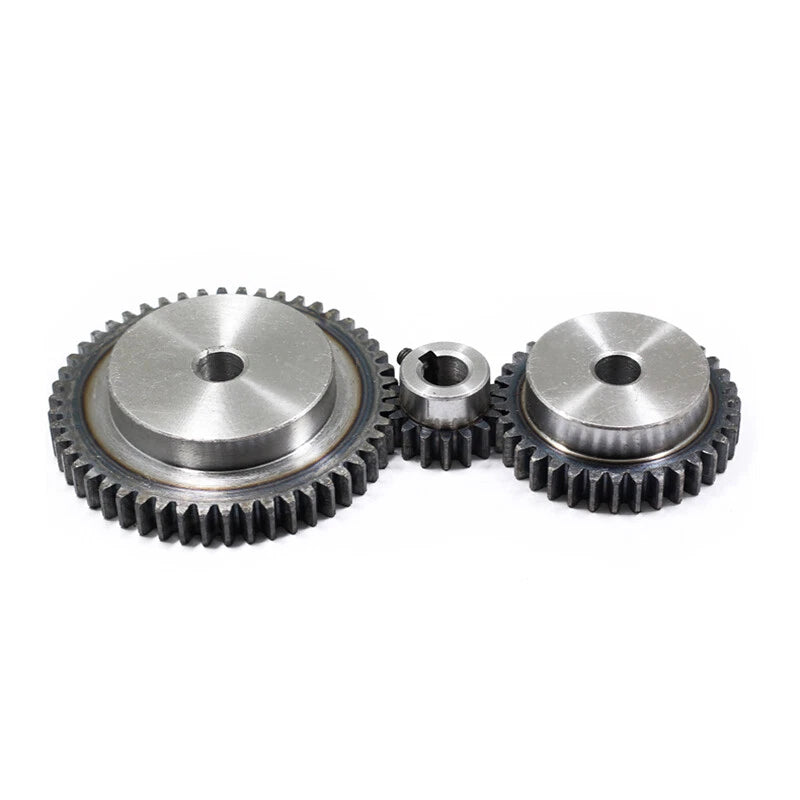
When a mismatched or undersized gear causes skipped teeth, vibration, or premature wear in your build, the entire mechanism pays the price. Engineers, robotics builders, and hands-on makers who need a reliable, dimensionally consistent spur gear in a wide tooth-count range will find this 2 Modulus pinion gear a dependable solution for demanding drive-train applications.

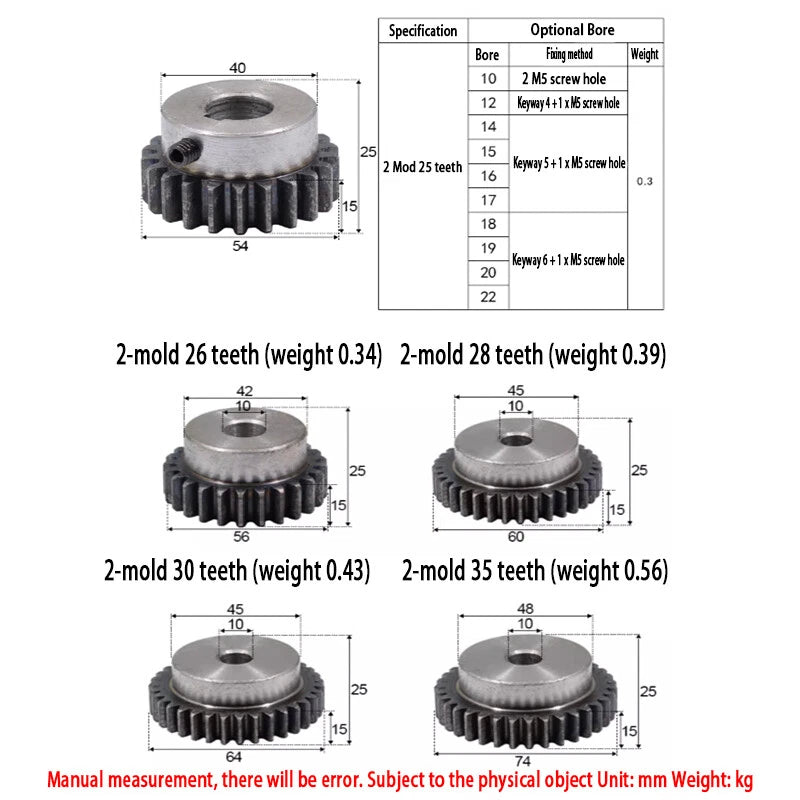
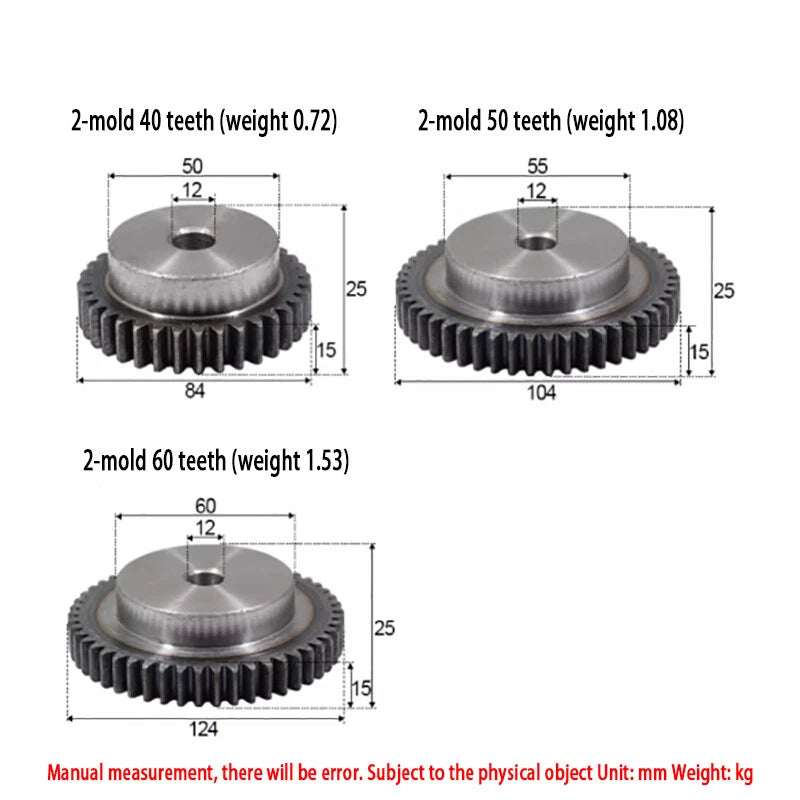
Each gear is machined from 45# medium-carbon steel — a material known for its balance of hardness and toughness — and features a stepped bore hub for secure shaft retention. The tooth range spans 10 to 60 teeth, with bore options from 8 mm (~0.31 in) to 22 mm (~0.87 in), covering the most common motor and shaft diameters used in small-to-medium mechanical assemblies.

Typical use cases include DC motor pinion drives in robotic arm joints, lead-screw reduction stages in desktop CNC routers, and custom gearbox prototypes where a standard 2 Mod pitch is required. Long-tail applications such as "2 mod spur gear for NEMA 17 motor", "45 steel pinion gear robotics", and "stepped bore gear for 8mm shaft" are all well served by this range.

⚙️ Compatibility: Designed for Modulus 2 (Module 2) gear systems. Meshes with any M2 spur or rack gear of matching pressure angle (typically 20°). Verify bore diameter against your motor or shaft spec before ordering.

✅ Key Features of These 2 Mod Spur Pinion Gears

🔩 45# Medium-Carbon Steel Construction

Machined from 45# steel for a reliable combination of surface hardness and core toughness, resisting tooth deformation under cyclic load.

📐 Wide Tooth-Count Range (10–60T)

Twenty-two tooth-count options from 10 to 60 teeth let you dial in the exact gear ratio your drive system requires without custom machining.

🎯 Stepped Bore Hub Design

The integrated step hub provides a positive axial stop on the shaft, reducing the risk of axial migration during operation and simplifying assembly.

🔄 Precision-Cut Module 2 Teeth

Teeth are cut to Module 2 (M2) standard, ensuring smooth mesh with any compliant M2 mating gear or rack and minimising backlash in the drive train.

📏 Multiple Bore Sizes (8–22 mm)

Bore options from 8 mm to 22 mm accommodate a broad range of motor output shafts and lead-screw diameters common in robotics and automation builds.

🛠️ Drop-In Replacement Geometry

Standard M2 pitch diameter formula (PD = Teeth × Module) makes it straightforward to calculate centre distance and swap gears within an existing layout.

📐 Technical Specifications — 2 Mod Spur Pinion Gear

Module (Modulus) 2
Tooth Count Range 10 / 12 / 13 / 14 / 15 / 16 / 17 / 18 / 19 / 20 / 21 / 22 / 23 / 24 / 25 / 26 / 28 / 30 / 35 / 40 / 50 / 60 Teeth
Bore Diameter Options 8 mm / 10 mm / 12 mm / 14 mm / 15 mm / 16 mm / 17 mm / 18 mm / 19 mm / 20 mm / 22 mm
Pitch Diameter (PD) PD = Teeth × 2 mm (e.g., 20T → 40 mm / 1.57 in)
Pressure Angle 20° (standard)
Hub Style Stepped bore hub
Material 45# Medium-Carbon Steel
Surface Finish See variant options
Tooth Profile Involute spur
Quantity per Order 1 PCS
Weight See variant options

❓ Frequently Asked Questions

How do I choose the right tooth count for my application?

The tooth count determines the pitch diameter (PD = Teeth × Module). To find the correct gear ratio, divide the driven gear's tooth count by the driving gear's tooth count. For example, pairing a 10-tooth pinion with a 40-tooth gear gives a 4:1 reduction. Select the tooth count that achieves your target ratio while keeping the centre distance practical for your housing.

Which bore size should I select for my motor shaft?

Measure your motor or shaft diameter with a calliper before ordering. Available bores are 8, 10, 12, 14, 15, 16, 17, 18, 19, 20, and 22 mm. Choose the bore that matches your shaft diameter exactly — a loose fit will cause runout and noise, while an oversized shaft will not insert. If your shaft uses a keyway, confirm the hub depth is sufficient for your key.

What is the load capacity of 45# steel spur gears?

45# medium-carbon steel has a typical tensile strength of approximately 600–800 MPa after normalising. For light-to-medium duty robotics and automation loads this is generally adequate. For high-shock or continuous heavy-load applications, consider whether a heat-treated or alloy-steel variant would better suit your torque requirements. Contact us to confirm suitability for your specific load case.

Are these gears corrosion-resistant?

45# carbon steel has limited inherent corrosion resistance. For indoor, dry environments this is typically not a concern. If your application involves moisture, humidity, or occasional fluid exposure, applying a light machine oil or grease to the gear teeth will provide adequate protection for most workshop and robotics environments. For outdoor or wet environments, consider stainless steel or plastic alternatives.

Will this gear mesh with my existing M2 rack or spur gear?

Yes — provided your existing gear or rack is also Module 2 with a 20° pressure angle, these pinion gears will mesh correctly. Module (modulus) is the fundamental compatibility parameter for metric spur gears. Do not attempt to mesh M2 gears with M1, M1.5, M2.5, or other module gears, as the tooth geometry is incompatible and will result in interference or rapid wear.

What is the difference between the stepped bore hub and a plain bore gear?

A stepped bore hub has a shoulder machined into the bore, creating a positive axial stop when the gear is pressed or slid onto a shaft. This prevents the gear from migrating along the shaft axis during operation without requiring a separate thrust washer or collar in many setups. A plain bore gear has a uniform cylindrical hole and relies entirely on set screws, keys, or press-fit for axial retention.

Can I use these gears in a CNC router or 3D printer drive system?

Yes. Module 2 spur pinion gears are commonly used in desktop CNC router Z-axis drives, rotary axis attachments, and extruder gear trains where a robust metal gear is preferred over plastic. Verify that the bore matches your stepper or servo motor shaft, and confirm the tooth count gives you the desired steps-per-mm or gear ratio for your motion controller settings.

🛒 Select your Teeth count and Gear Bore size above, then add to cart.

You may also like

Recently viewed