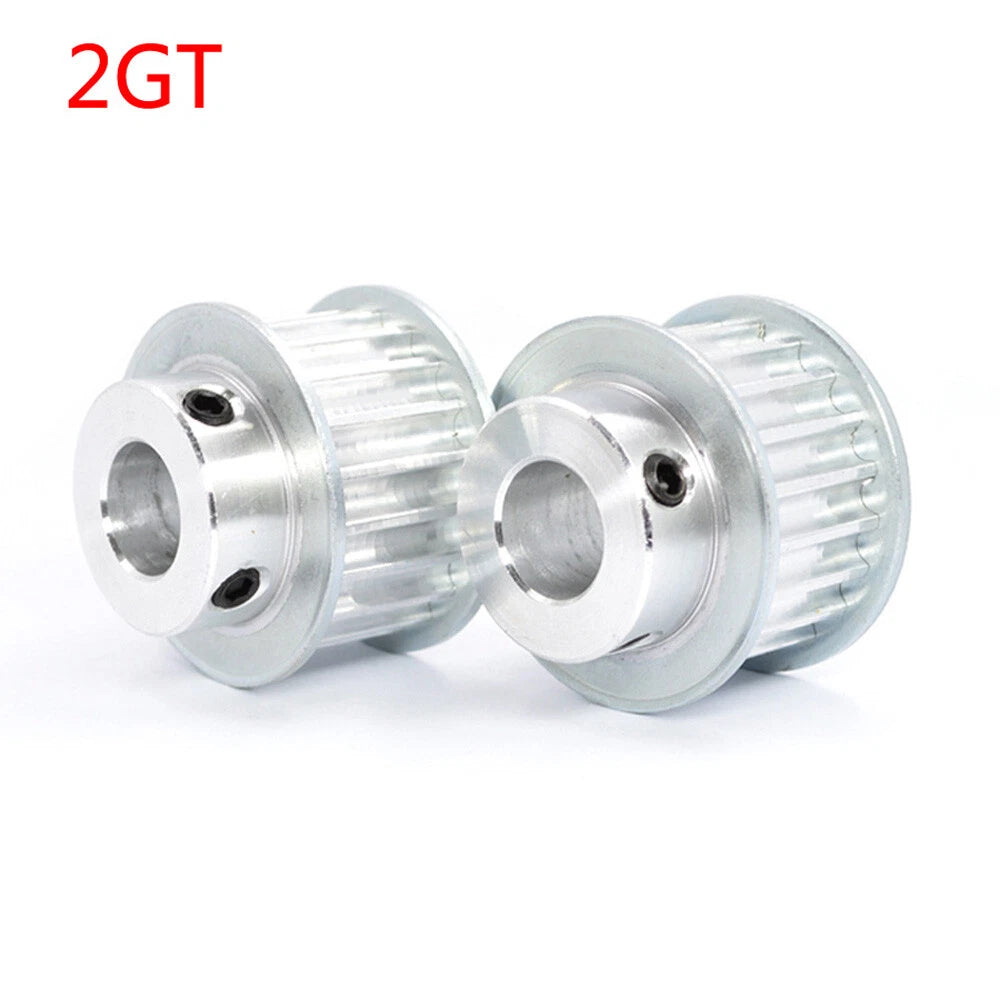
2GT 14T-64T Timing Belt Pulley Pitch 2mm With Step Width 11mm For 3D CNC Printer

No reviews

Price:
Sale price$4.90 USD
Stock:
In stock (500 units), ready to be shipped

Payment & Security

Ach Direct Debit Amazon American Express Apple Pay Bancontact BLIK Diners Club Discover EPS Google Pay iDEAL Wero JCB Maestro Mastercard Multibanco MobilePay PayPal Przelewy24 Shop Pay Twint Union Pay USDC Visa

Your payment information is processed securely. We do not store credit card details nor have access to your credit card information.

Limited Offer — Spend More, Save More
Spend $55+
Save $5
Spend $100+
Save $10
Spend $200+
Save $25
HomeDIYer DIY Expert Support

DIY Expert Support

Get fitment advice & recommendations

Mon–Fri  8:30 AM – 8:00 PM
24-Hour Fast Ship
Arrives in 3–14 Days
Worldwide Shipping
30-Day Returns
1 tree planted with every purchase

Description

2GT Timing Belt Pulley — Precise Motion Control for 3D Printers & CNC Machines

When your 3D printer skips steps or your CNC router loses position mid-cut, the culprit is often a worn or mismatched timing pulley. Makers, hobbyists, and small-workshop engineers who demand repeatable, slip-free motion need a pulley that fits exactly right — the first time. These 2GT timing belt pulleys are engineered for that job.

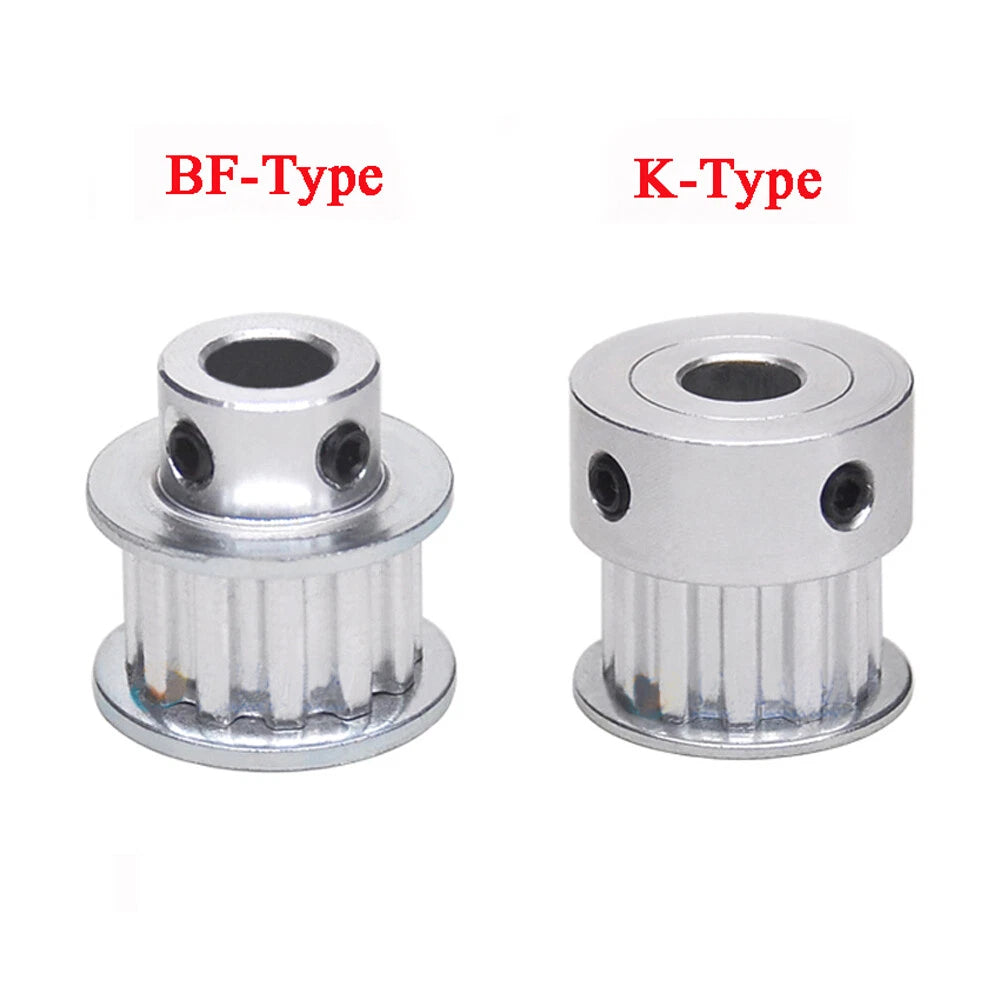
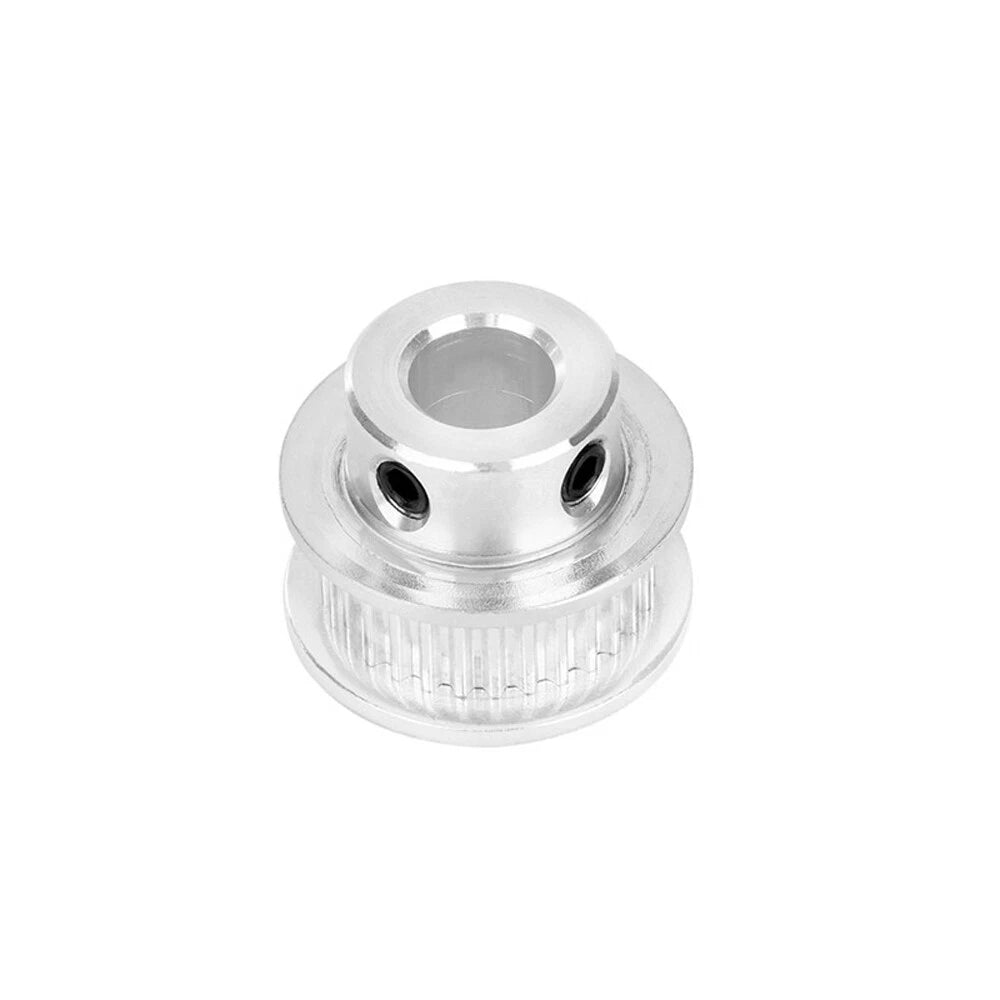
Each pulley is machined from aluminum alloy with a hard-anodized finish, featuring a 2mm pitch GT2 tooth profile and a 11mm (0.43 in) belt-contact width. The tooth count spans 14T through 64T, and bore options range from 3mm to 25mm (0.12–0.98 in), covering the most common motor shaft sizes used in desktop automation. Two flange styles are available: K-type (flanged on both sides) for smaller tooth counts, and BF-type (single-side flange with set-screw hub) for larger pulleys requiring shaft locking.

Typical use cases include GT2 belt drive systems on FDM 3D printers (X/Y axis), CNC router gantry drives, laser engraver motion stages, and custom linear-motion automation rigs where a 2GT timing belt pulley with 2mm pitch is the standard drive component.

⚙️ Compatible with: GT2 / 2GT timing belts, 10mm belt width — fits standard 3D printer, CNC, and automation drive systems using 2mm pitch belts.

✅ Key Features of These 2GT Timing Belt Pulleys

🦷 14T to 64T Tooth Range

Wide selection covers low-speed high-torque (large tooth count) and high-speed precision (small tooth count) applications in a single product family.

📐 2mm GT2 Pitch Profile

Standard 2mm pitch tooth geometry meshes cleanly with GT2 / 2GT belts, minimizing backlash and maintaining positional accuracy across the full speed range.

🔩 K-type & BF-type Flange Styles

K-type pulleys (14T–30T) feature dual flanges for belt retention. BF-type pulleys (28T–64T) include a single flange plus a set-screw hub for secure shaft locking without adhesive.

🕳️ Bore Sizes 3mm–25mm

Covers NEMA 17 (5mm), NEMA 23 (6.35mm / 8mm), and larger servo shafts up to 25mm — select your exact bore from the variant dropdown.

🏗️ 11mm Belt-Width Step

The 11mm step width matches standard 10mm GT2 belt with side clearance, keeping the belt centered and reducing edge wear during continuous operation.

⚖️ Lightweight Aluminum Construction

Aluminum alloy body keeps rotational inertia low for fast acceleration and deceleration cycles — critical for 3D printer and laser engraver motion systems.

📐 Technical Specifications — 2GT Timing Belt Pulley

Belt Profile GT2 / 2GT
Pitch 2mm
Tooth Count 14T – 64T (see variant options)
Belt Width (Step) 11mm (0.43 in)
Compatible Belt Width 10mm
Bore Diameter 3mm – 25mm (see variant options)
Flange Type K-type (dual flange) / BF-type (single flange + set screw)
Material Aluminum alloy
Quantity per Order 1 piece
Outer Diameter See variant options
Finish See variant options

❓ Frequently Asked Questions

How do I choose the right tooth count (14T vs 60T)?

Smaller tooth counts (14T–20T) are typically used on motor shafts where you want higher belt speed and lower torque multiplication. Larger tooth counts (40T–64T) are used on driven shafts or idlers where you need to reduce speed and increase torque. For standard 3D printer X/Y axes, 20T is the most common motor pulley choice.

What is the difference between K-type and BF-type pulleys?

K-type pulleys have flanges on both sides of the tooth section, which keeps the belt from slipping off laterally — ideal for smaller pulleys (14T–26T) where belt tension alone may not be sufficient. BF-type pulleys have a single flange on one side and a set-screw hub on the other, allowing the pulley to be locked onto a shaft at any position — preferred for larger pulleys (28T–64T) and driven-shaft applications.

Which bore size fits a NEMA 17 stepper motor shaft?

Standard NEMA 17 stepper motors have a 5mm output shaft. Select the 5mm bore variant. If your motor has a D-cut shaft, the set screw on BF-type pulleys will lock against the flat. For NEMA 23 motors, the shaft is typically 6.35mm (1/4 in) or 8mm — choose accordingly from the bore options.

Will this pulley work with standard GT2 belts sold for 3D printers?

Yes. These pulleys use the GT2 / 2GT tooth profile with 2mm pitch, which is the industry-standard geometry for desktop 3D printer and CNC belt drives. They are compatible with any GT2 or 2GT belt with 10mm width. The 11mm step width provides a small clearance margin to keep the belt centered.

How strong is the set screw on BF-type pulleys — will it slip under load?

BF-type pulleys include a grub (set) screw that threads into the hub and presses against the motor shaft. For typical 3D printer and light CNC loads, this provides adequate holding force. For higher-torque applications, ensure the shaft has a D-flat or a small flat ground into it so the set screw has a positive mechanical stop rather than relying on friction alone.

Are these pulleys corrosion-resistant for outdoor or humid environments?

The aluminum alloy construction offers natural corrosion resistance suitable for indoor workshop and laboratory environments. For prolonged exposure to moisture or outdoor conditions, a light coating of machine oil on the bore and hub is recommended. The tooth profile itself does not require lubrication when used with standard rubber GT2 belts.

Can I use these pulleys as idlers by removing the set screw?

BF-type pulleys can be used as idlers by mounting them on a shoulder bolt or smooth shaft through the bore, with the set screw loosened or removed. However, for dedicated idler use, a flanged bearing insert is recommended for lower friction and longer service life. K-type pulleys with dual flanges are also suitable as passive idlers in belt routing systems.

🛒 Select your tooth count, flange type, and bore size above, then add to cart.

You may also like

Recently viewed