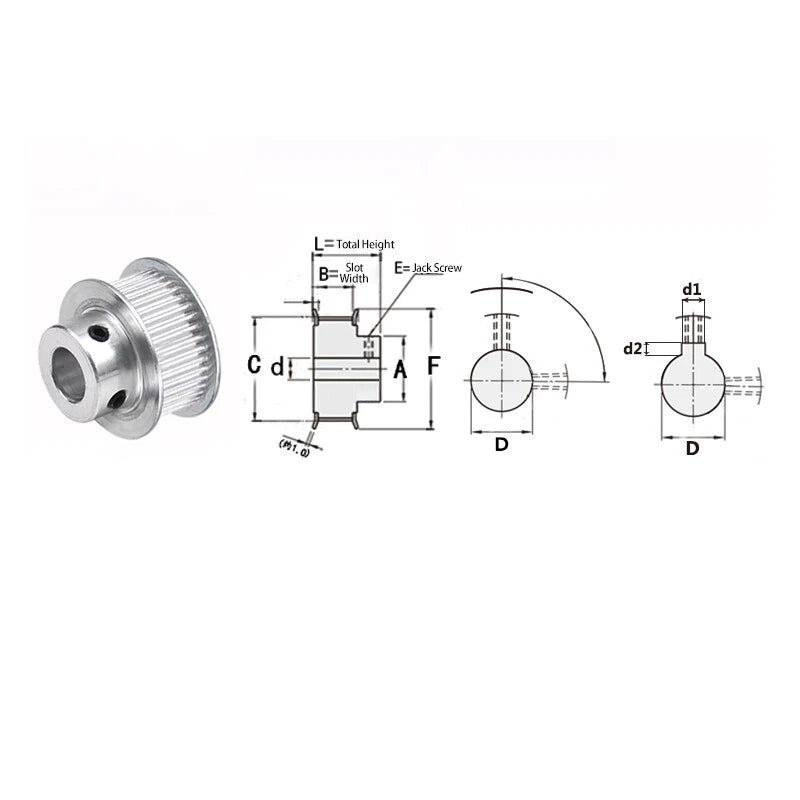
2GT Timing Belt Pulley 16-48 Teeth BF/K Type Synchronous Wheel Bore 4mm-14mm

No reviews

Price:
Sale price$8.84 USD
Stock:
In stock (500 units), ready to be shipped

Payment & Security

Ach Direct Debit Amazon American Express Apple Pay Bancontact BLIK Diners Club Discover EPS Google Pay iDEAL Wero JCB Maestro Mastercard Multibanco MobilePay PayPal Przelewy24 Shop Pay Twint Union Pay USDC Visa

Your payment information is processed securely. We do not store credit card details nor have access to your credit card information.

Limited Offer — Spend More, Save More
Spend $55+
Save $5
Spend $100+
Save $10
Spend $200+
Save $25
HomeDIYer DIY Expert Support

DIY Expert Support

Get fitment advice & recommendations

Mon–Fri  8:30 AM – 8:00 PM
24-Hour Fast Ship
Arrives in 3–14 Days
Worldwide Shipping
30-Day Returns
1 tree planted with every purchase

Description

2GT Timing Belt Pulley — Precision Synchronous Drive for 3D Printers, CNC & Robotics

When a slipping or misaligned drive pulley derails your build — whether mid-print on a CoreXY machine or mid-cut on a CNC router — the root cause is almost always a pulley that wasn't spec'd correctly from the start. Engineers, makers, and motion-system integrators who demand repeatable, zero-slip positioning need a 2GT synchronous wheel they can trust across a wide range of shaft sizes and tooth counts.

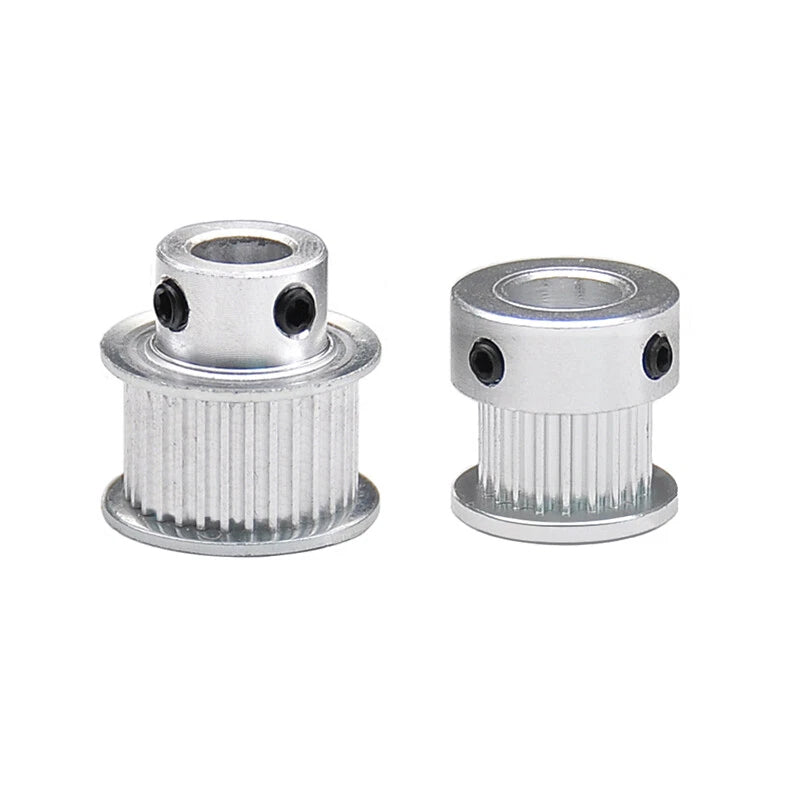
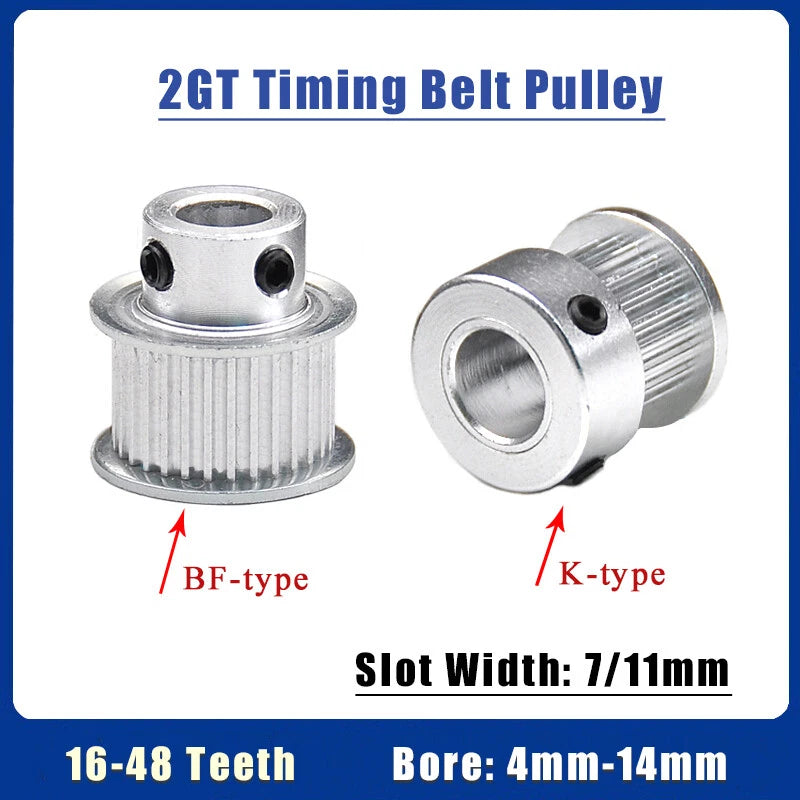
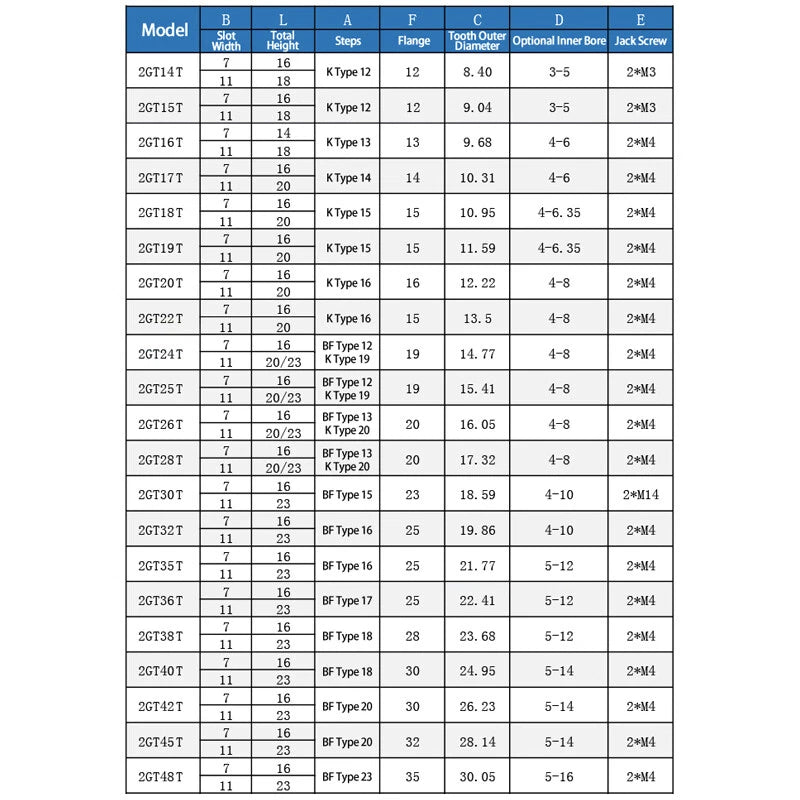
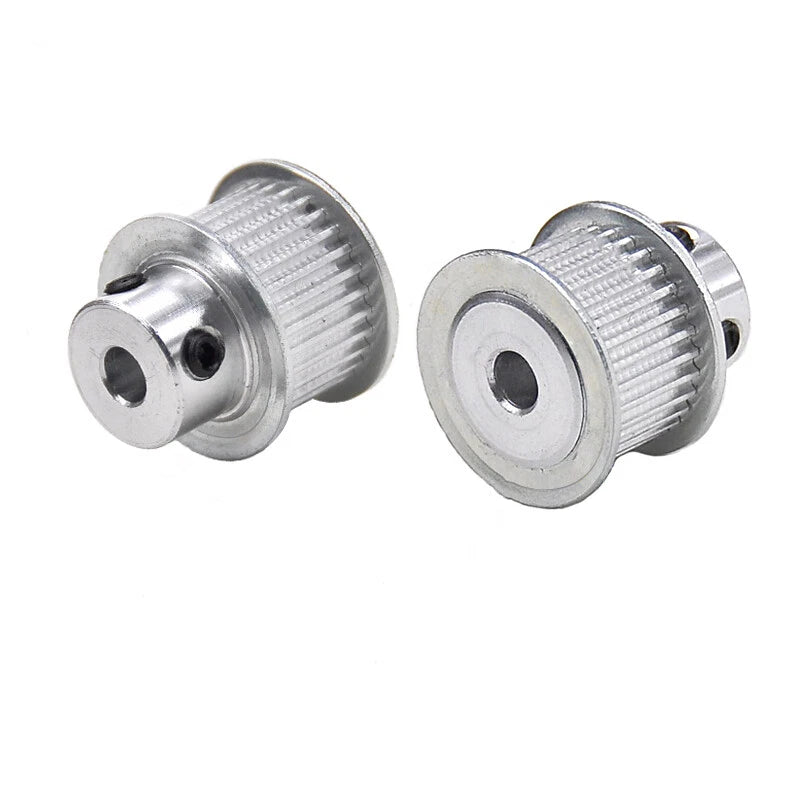
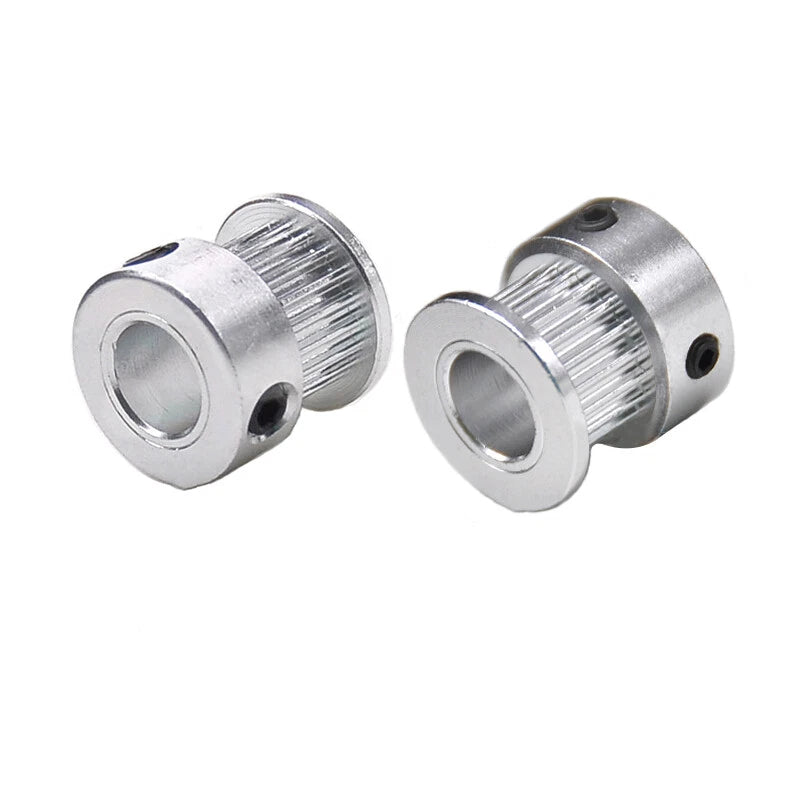
These 2GT timing belt pulleys are machined from aluminum alloy and are available in two flange configurations: BF-type (with dual flanges to retain the belt laterally) and K-type (flangeless, for applications where the belt is guided by the frame or tensioner). Tooth counts span 16T to 48T, and bore diameters range from 4 mm (≈ 0.157 in) to 14 mm (≈ 0.551 in), with slot widths of either 7 mm or 11 mm to accommodate standard 2GT belt widths.

Typical use cases include CoreXY and Cartesian 3D printer X/Y axis drives, belt-driven CNC router gantries, delta robot arm synchronization, and lightweight conveyor or pick-and-place automation. Long-tail applications such as "2GT pulley for NEMA 17 stepper" (5 mm bore) or "2GT 20T pulley for Ender 3" (5 mm bore, 20T) are directly covered by the available variant matrix.

⚙️ Compatibility: Designed for standard 2GT (GT2) open or closed-loop timing belts with 2 mm pitch. Slot width 7 mm fits GT2-6mm belt; slot width 11 mm fits GT2-10mm belt. Verify bore diameter matches your motor shaft before ordering.

✅ Key Features of These 2GT Timing Belt Pulleys

🔩Wide Tooth Count Range
Available in 16T, 20T, 24T, 25T, 26T, 28T, 30T, 32T, 35T, 36T, 38T, 40T, 42T, 45T, and 48T — covering virtually every 2GT drive ratio requirement.
📐Broad Bore Selection
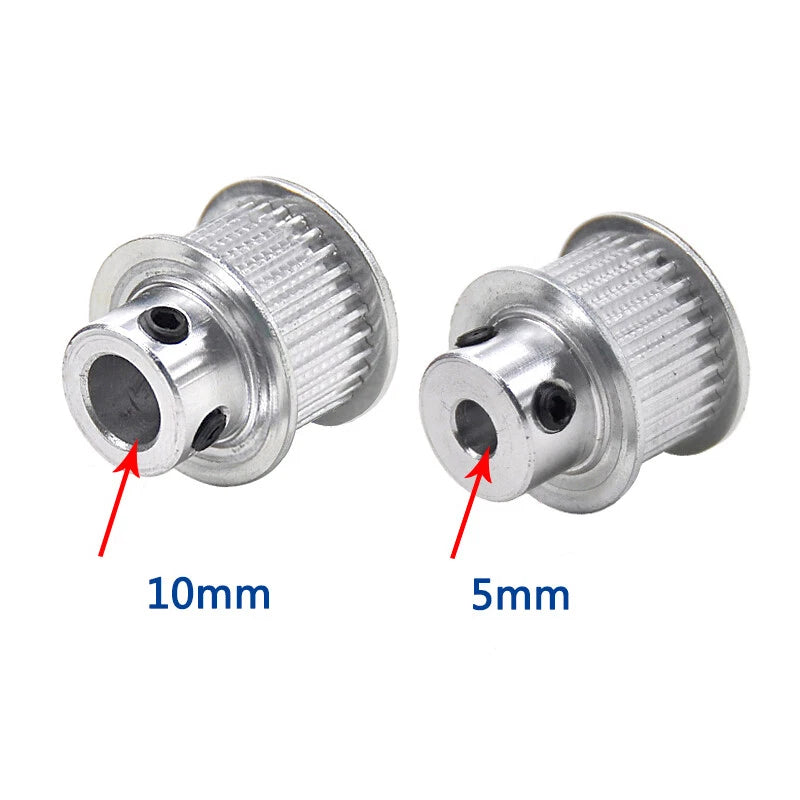
Bore diameters from 4 mm to 14 mm (4 / 5 / 6 / 6.35 / 7 / 8 / 10 / 12 / 12.7 / 14 mm) accommodate NEMA 17, NEMA 23, and custom shafts.
🔧BF-type & K-type Configurations
BF-type includes dual flanges for positive belt retention; K-type is flangeless for frame-guided or tensioner-guided belt paths.
Aluminum Alloy Construction
Lightweight yet rigid aluminum body keeps rotational inertia low — critical for high-acceleration motion systems like CoreXY 3D printers.
🎯2 mm Pitch Precision Profile
Tooth profile machined to 2GT (GT2) standard for accurate, backlash-minimized synchronous drive in positioning and automation applications.
🛠️Set-Screw Bore Retention
Each pulley includes a set-screw bore for secure shaft fixation, preventing rotational slip under load without requiring adhesives or press-fit tooling.

📐 Technical Specifications — 2GT Timing Belt Pulley

Belt Standard 2GT (GT2), 2 mm pitch
Tooth Count Options 16T, 20T, 24T, 25T, 26T, 28T, 30T, 32T, 35T, 36T, 38T, 40T, 42T, 45T, 48T
Bore Diameter Options 4 / 5 / 6 / 6.35 / 7 / 8 / 10 / 12 / 12.7 / 14 mm
Slot Width Options 7 mm (fits GT2-6mm belt) / 11 mm (fits GT2-10mm belt)
Flange Type BF-type (dual flange) / K-type (flangeless)
Material Aluminum alloy
Bore Retention Set-screw
Outer Diameter See variant options
Hub Length See variant options
Surface Finish See variant options

❓ Frequently Asked Questions

How do I choose between BF-type and K-type?

Choose BF-type if your belt has no external lateral guide — the dual flanges keep the belt centered on the pulley. Choose K-type (flangeless) when your machine frame, linear rail, or tensioner already constrains the belt laterally, or when you need to slide the belt on axially during assembly.

Which bore diameter fits a NEMA 17 stepper motor shaft?

Standard NEMA 17 stepper motors have a 5 mm output shaft. Select the 5 mm bore variant. If your motor has a D-cut shaft, ensure the set-screw aligns with the flat for a secure grip.

Which slot width should I choose — 7 mm or 11 mm?

Slot width corresponds to belt width: 7 mm slot is for GT2-6mm (6 mm wide) belts, which are standard on most desktop 3D printers. 11 mm slot is for GT2-10mm (10 mm wide) belts, used in higher-torque or wider-span CNC and robotics applications.

Are these pulleys compatible with Gates GT2 belts?

Yes. The 2GT tooth profile is dimensionally equivalent to the Gates GT2 profile (2 mm pitch, same tooth geometry). These pulleys are compatible with standard GT2 open-loop and closed-loop belts from any manufacturer.

What tooth count gives a 1:1 drive ratio?

A 1:1 ratio requires identical tooth counts on both the drive and driven pulleys — for example, two 20T pulleys. To increase torque (reduce speed), use a smaller tooth count on the motor pulley and a larger count on the driven pulley, such as 16T driving 32T for a 2:1 reduction.

How do I secure the pulley to the shaft?

Each pulley uses a set-screw for shaft retention. Tighten the set-screw against the shaft (or the D-flat if present) using the appropriate hex key. For high-torque applications, apply a small amount of thread-locking compound to the set-screw threads to prevent loosening under vibration.

Can I use a 6.35 mm bore pulley on a 1/4-inch shaft?

Yes. 6.35 mm is the metric equivalent of 1/4 inch (0.250 in), so the 6.35 mm bore variant is the correct choice for standard imperial quarter-inch motor or gearbox shafts.

What is the difference between 16T and 20T for a 3D printer?

A 16T pulley gives finer theoretical resolution per motor step (smaller belt advance per tooth), while a 20T pulley is the most common choice for Cartesian and CoreXY printers, balancing speed and resolution. Most Ender-series and Voron-style printers use 20T pulleys on NEMA 17 motors with 5 mm bores.

🛒 Select your tooth count, bore diameter, and slot width above, then add to cart.


You may also like

Recently viewed