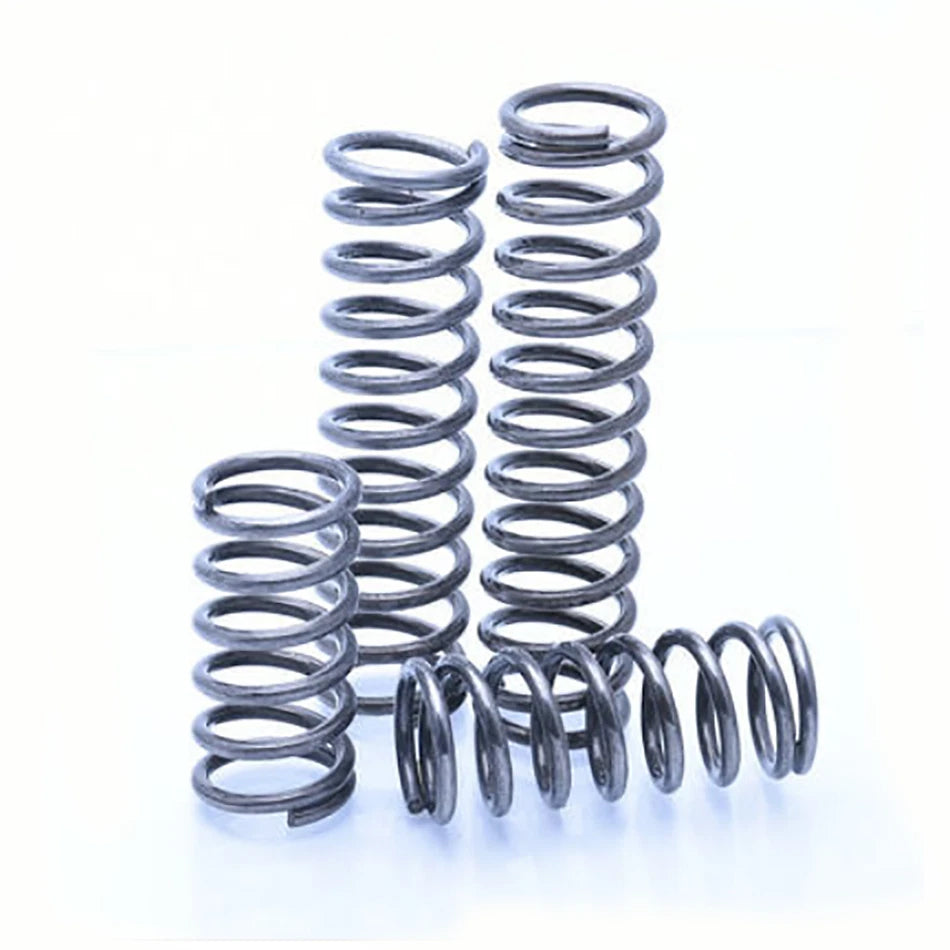
10pcs 304 Stainless Steel Compression Pressure Small Springs 0.3mm 0.4mm 0.5mm

No reviews

Price:
Sale price$2.71 USD
Stock:
In stock (500 units), ready to be shipped

Payment & Security

Ach Direct Debit Amazon American Express Apple Pay Bancontact BLIK Diners Club Discover EPS Google Pay iDEAL Wero JCB Maestro Mastercard Multibanco MobilePay PayPal Przelewy24 Shop Pay Twint Union Pay USDC Visa

Your payment information is processed securely. We do not store credit card details nor have access to your credit card information.

Limited Offer — Spend More, Save More
Spend $55+
Save $5
Spend $100+
Save $10
Spend $200+
Save $25
HomeDIYer DIY Expert Support

DIY Expert Support

Get fitment advice & recommendations

Mon–Fri  8:30 AM – 8:00 PM
24-Hour Fast Ship
Arrives in 3–14 Days
Worldwide Shipping
30-Day Returns
1 tree planted with every purchase

Description

304 Stainless Steel Compression Springs — Precision Micro Springs for Reliable Push-Back Force

When a mechanism fails because a tiny spring loses tension, corrodes, or snaps under repeated cycling, the whole assembly stops working. Engineers, hobbyists, and repair technicians who work with compact mechanisms need compression springs that hold their rated load cycle after cycle without rust or fatigue. These 304 stainless steel compression springs are designed for exactly that demand.

Each pack contains 10 pieces of compression springs made from 304 stainless steel wire. Wire diameters span 0.3 mm, 0.4 mm, and 0.5 mm (approximately 0.012"–0.020"). Outer diameters range from 3 mm to 12 mm (approx. 0.12"–0.47"), and free lengths run from 5 mm to 50 mm (approx. 0.20"–1.97"). Select the exact wire diameter × OD × free length combination from the variant options above.

Typical use cases include electronic button and switch return mechanisms, pen and stylus click assemblies, miniature valve and check-valve applications, precision instrument tensioning, model and RC component assemblies, and small appliance repair — anywhere a compact, corrosion-resistant compression spring is needed.

🔧 Compatibility: Suitable for general mechanical assemblies, electronics, instrumentation, model making, and DIY repair projects requiring a small-diameter compression spring with 304 stainless steel corrosion resistance.

✅ Key Features of These 304 Stainless Steel Compression Springs

🔩 304 Stainless Steel Construction

Formed from 304-grade stainless steel wire, these springs resist oxidation and surface corrosion in humid, mildly acidic, or outdoor-adjacent environments — maintaining consistent spring force over time.

📐 Wide Size Matrix

Wire diameters of 0.3 mm, 0.4 mm, and 0.5 mm combined with ODs from 3–12 mm and free lengths from 5–50 mm give you a broad selection to match your exact bore and travel requirements.

🔄 Consistent Compression Performance

Close-wound coil geometry and uniform wire cross-section deliver repeatable deflection characteristics, so the spring returns to free length reliably across thousands of compression cycles.

⚖️ Lightweight Micro Form Factor

With wire diameters starting at 0.3 mm and ODs as small as 3 mm, these springs fit into tight bores and cavities where standard springs are too large — ideal for miniaturized mechanisms.

📦 10-Piece Pack

Each order ships 10 identical springs of your chosen size, giving you spares for prototyping, batch repairs, or multi-unit builds without needing to reorder immediately.

🛠️ Versatile Application Range

From pen mechanisms and electronic switches to precision instruments and model assemblies, these springs cover a wide range of light-duty compression spring applications across industries and hobbies.

📐 Technical Specifications — Compression Springs

Material 304 Stainless Steel
Wire Diameter 0.3 mm / 0.4 mm / 0.5 mm (see variant options)
Outer Diameter (OD) 3–12 mm (see variant options)
Free Length 5–50 mm (see variant options)
Spring Type Compression (push)
Coil Direction See variant options
End Type See variant options
Surface Finish Natural stainless (no coating)
Quantity per Pack 10 pieces
Operating Temperature Contact us to confirm

❓ Frequently Asked Questions

How do I choose the right wire diameter for my application?

Wire diameter determines the spring's stiffness (spring rate) and load capacity. A 0.3 mm wire produces a softer, lighter spring suitable for very light return forces such as pen clicks or small switches. A 0.5 mm wire is stiffer and handles slightly higher loads. Match the wire diameter to the force your mechanism requires — if in doubt, start with 0.4 mm as a mid-range option and test deflection against your load.

What is the difference between OD and free length, and how do I measure my bore?

OD (outer diameter) is the widest measurement across the coil — this must be smaller than your bore or housing inner diameter to allow the spring to seat and compress freely. Free length is the uncompressed height of the spring. Measure your bore ID and subtract a small clearance (typically 0.2–0.5 mm) to find the maximum OD you can use. Measure the available travel depth to determine the free length you need.

Are these springs corrosion-resistant enough for outdoor or humid environments?

304 stainless steel offers good resistance to atmospheric corrosion, moisture, and mild chemical exposure. It is suitable for indoor humid environments, light outdoor use, and applications where occasional water contact occurs. For highly corrosive environments (saltwater immersion, strong acids, or chlorine-rich settings), 316 stainless steel would be a more appropriate choice. For typical DIY, electronics, and instrumentation use, 304 performs reliably.

Can I use these springs in electronic or PCB assemblies?

Yes. The small wire diameters (0.3–0.5 mm) and compact ODs (3–12 mm) make these springs well-suited for button return mechanisms, battery contact springs, connector retention, and similar PCB or electronic enclosure applications. The stainless steel material is non-magnetic (304 SS is austenitic) which is beneficial in sensitive electronic environments.

How do I confirm the spring rate or load capacity before ordering?

Spring rate depends on wire diameter, OD, free length, and number of active coils — all of which interact. Because this listing covers a wide size matrix, specific spring rate values vary by variant. If you need a confirmed spring rate for a load-critical application, please contact us with your required wire dia, OD, free length, and target load, and we can advise on the closest matching variant or provide additional data.

What should I check when replacing a broken spring with one of these?

Measure the original spring's wire diameter, outer diameter, and free length as accurately as possible — a digital caliper is recommended. Also note whether the original spring was wound left-hand or right-hand (usually interchangeable for compression springs). Select the variant that matches those three dimensions. If the original is slightly worn or compressed, add 5–10% to the free length measurement to account for set.

Is 304 stainless steel non-magnetic?

In its annealed (soft) state, 304 stainless steel is essentially non-magnetic. However, cold-working during the spring coiling process can induce a small degree of magnetism. For most DIY and mechanical applications this is not an issue, but if your application is highly sensitive to magnetic fields, please contact us to confirm suitability before ordering.

🛒 Select your wire diameter × OD × free length above, then add to cart.

You may also like

Recently viewed