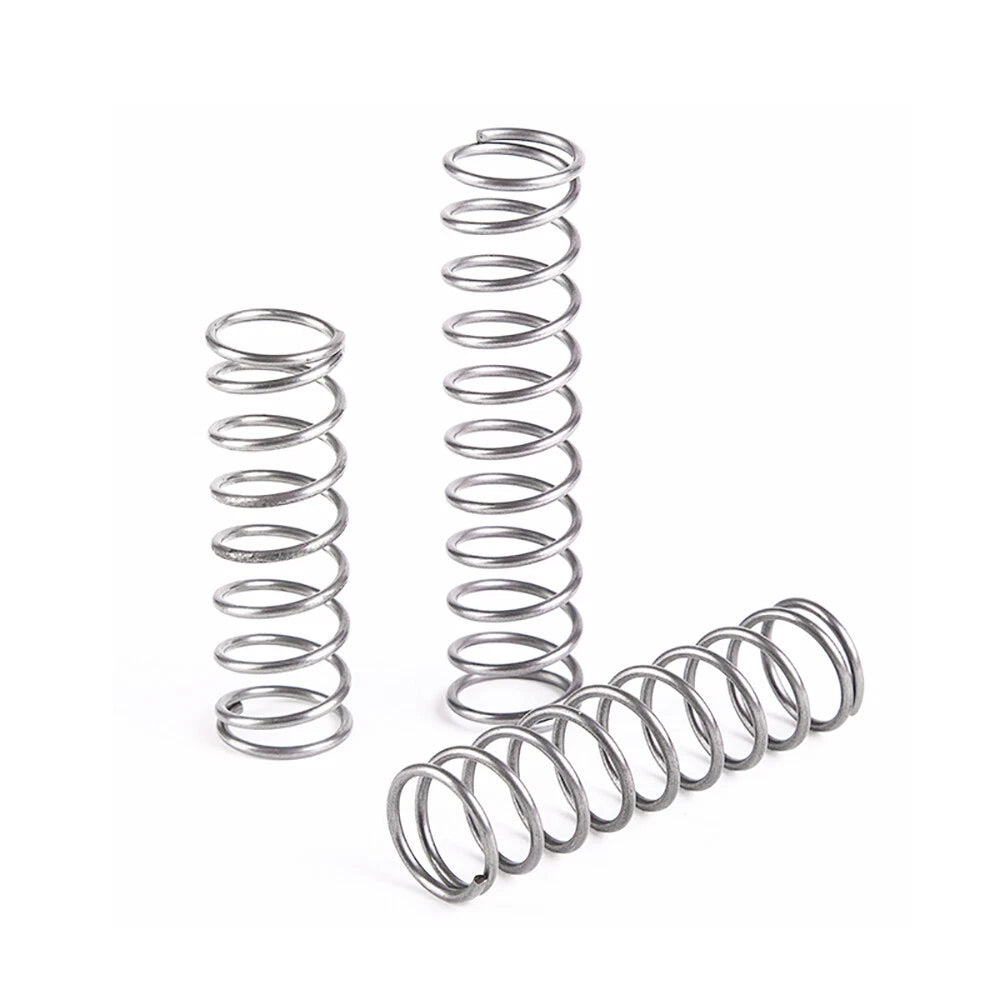
0.3/0.4/0.5/0.6/0.7/0.8/0.9mm 304 Stainless Steel Compression Springs L=60-100mm

No reviews

Price:
Sale price$3.74 USD
Stock:
In stock (500 units), ready to be shipped

Payment & Security

Ach Direct Debit Amazon American Express Apple Pay Bancontact BLIK Diners Club Discover EPS Google Pay iDEAL Wero JCB Maestro Mastercard Multibanco MobilePay PayPal Przelewy24 Shop Pay Twint Union Pay USDC Visa

Your payment information is processed securely. We do not store credit card details nor have access to your credit card information.

Limited Offer — Spend More, Save More
Spend $55+
Save $5
Spend $100+
Save $10
Spend $200+
Save $25
HomeDIYer DIY Expert Support

DIY Expert Support

Get fitment advice & recommendations

Mon–Fri  8:30 AM – 8:00 PM
24-Hour Fast Ship
Arrives in 3–14 Days
Worldwide Shipping
30-Day Returns
1 tree planted with every purchase

Description

304 Stainless Steel Compression Springs — Precise Force Control for Makers and Engineers

When a mechanism fails because a spring loses tension, corrodes, or simply doesn't fit the bore, the whole project stalls. Whether you're a hobbyist building a custom jig, a technician repairing precision instruments, or a small-batch manufacturer sourcing reliable motion-control components, you need springs that hold their spec across repeated cycles and resist the environment they work in.

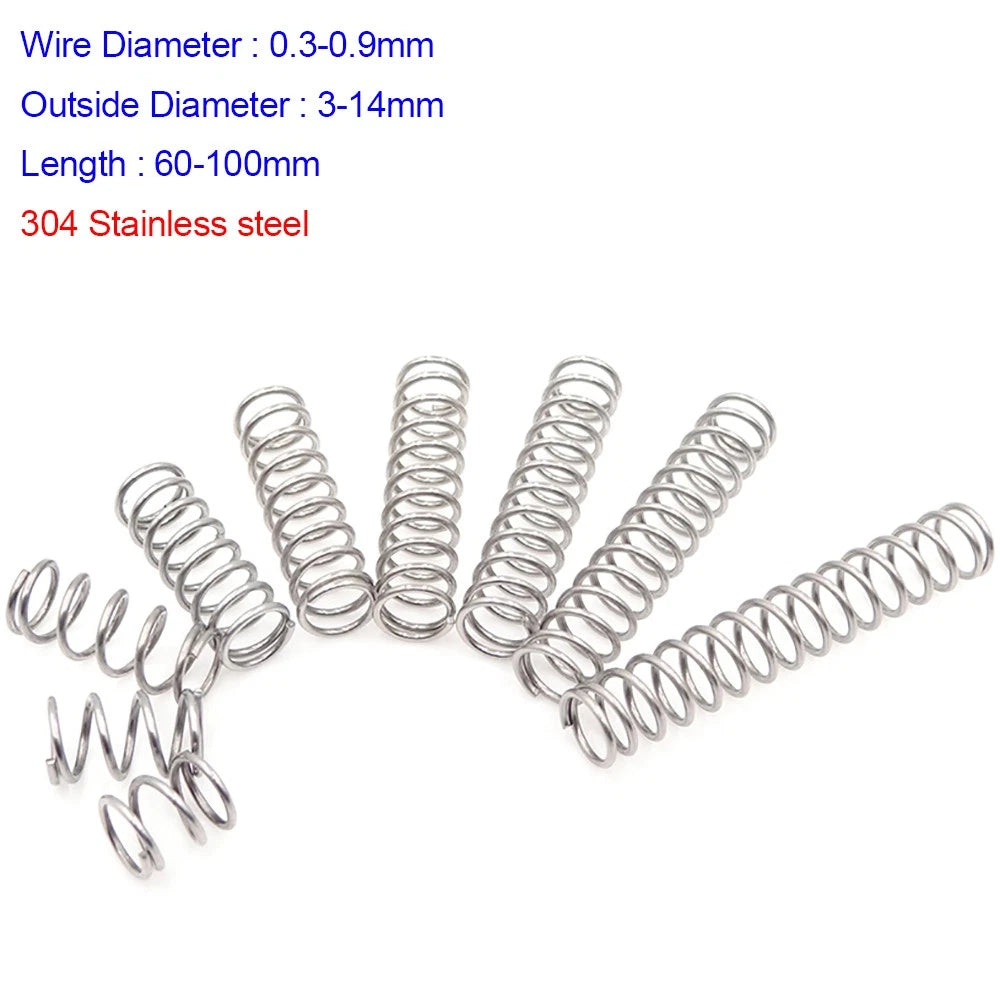
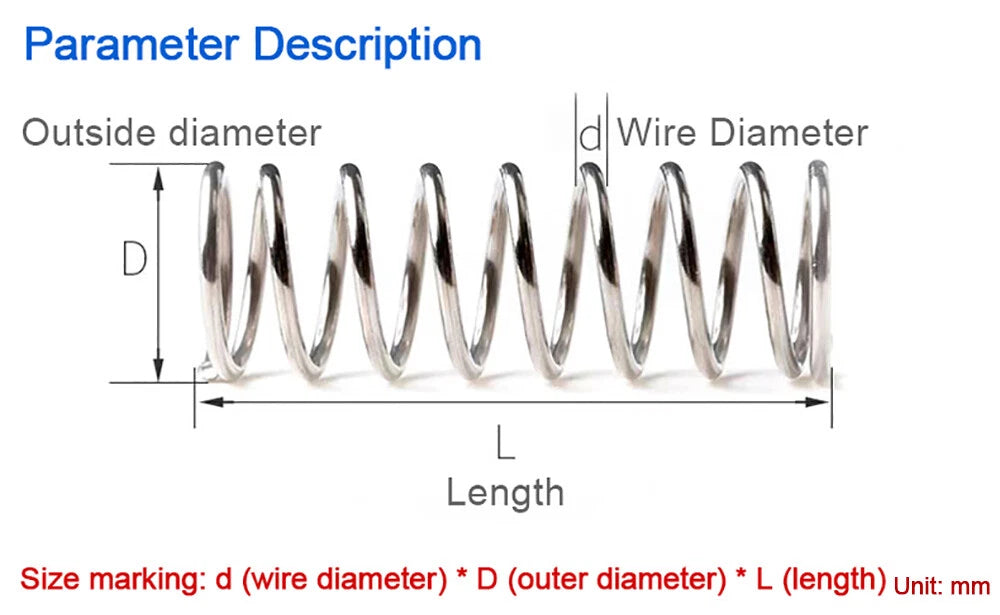
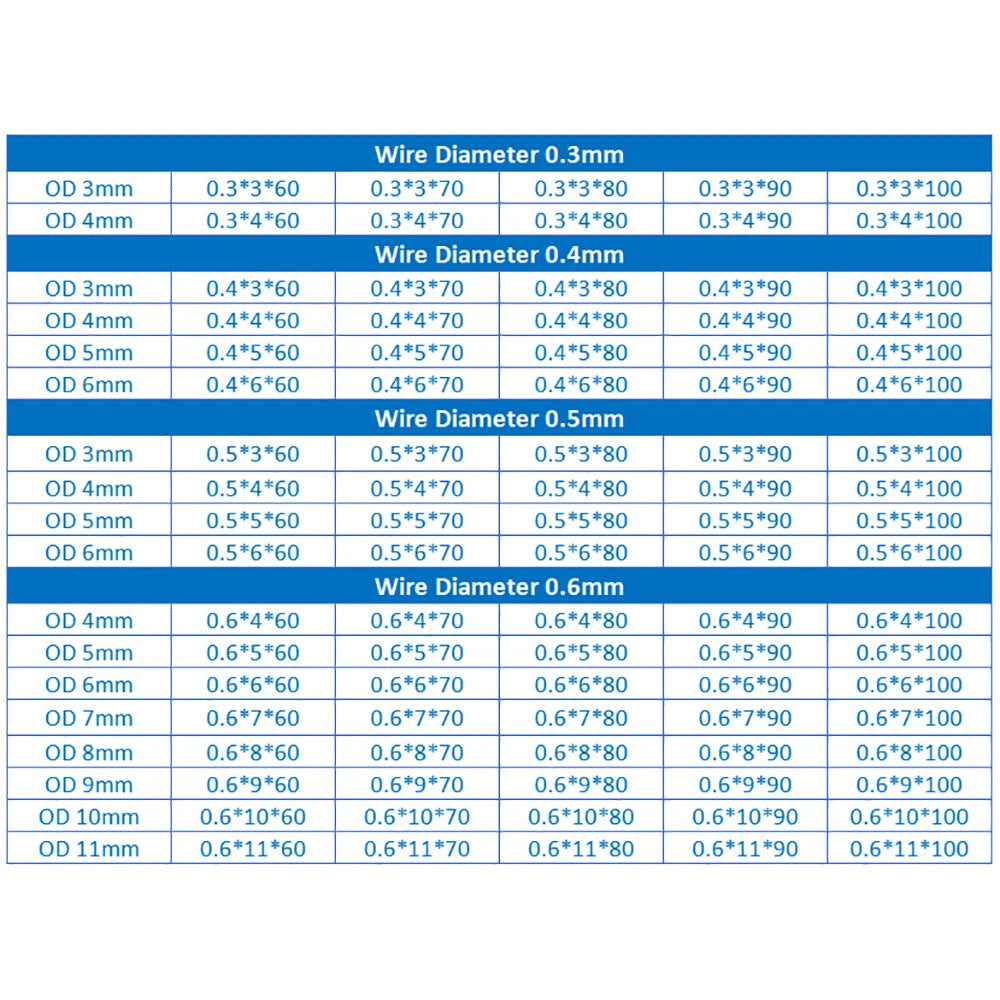
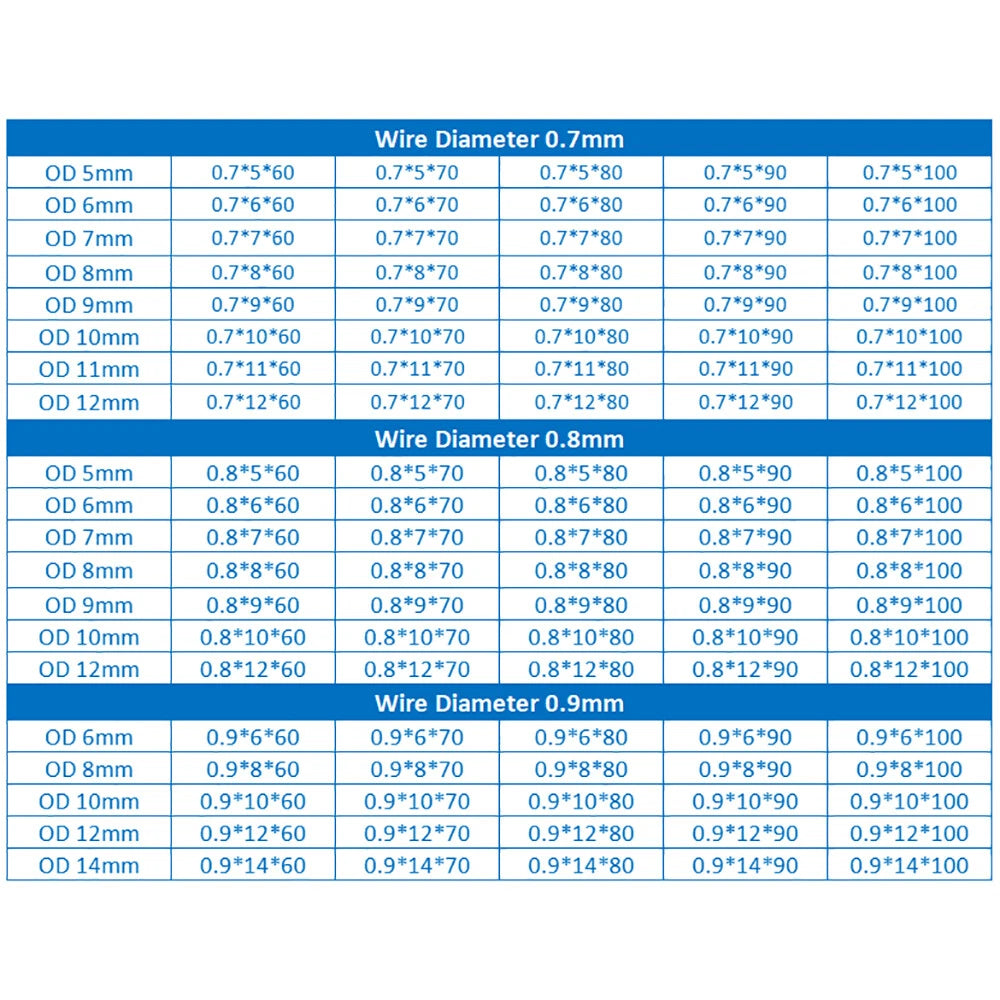
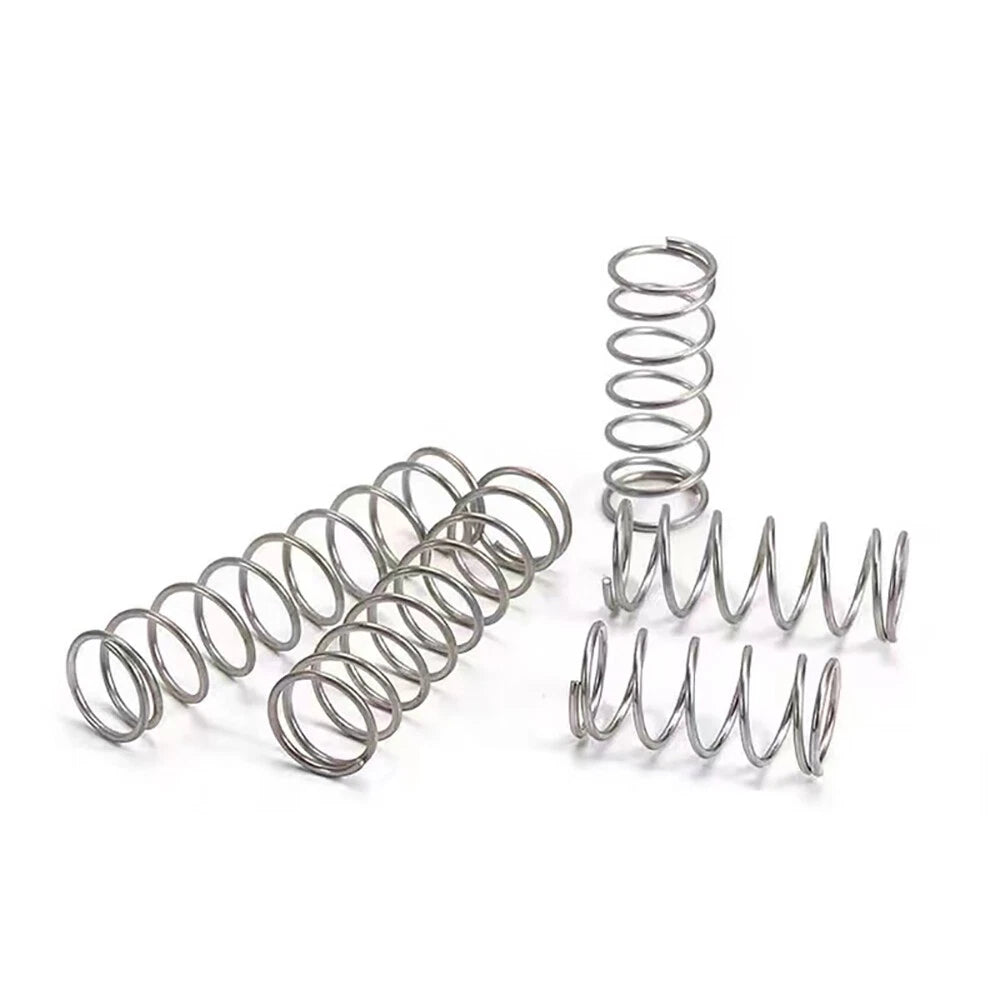
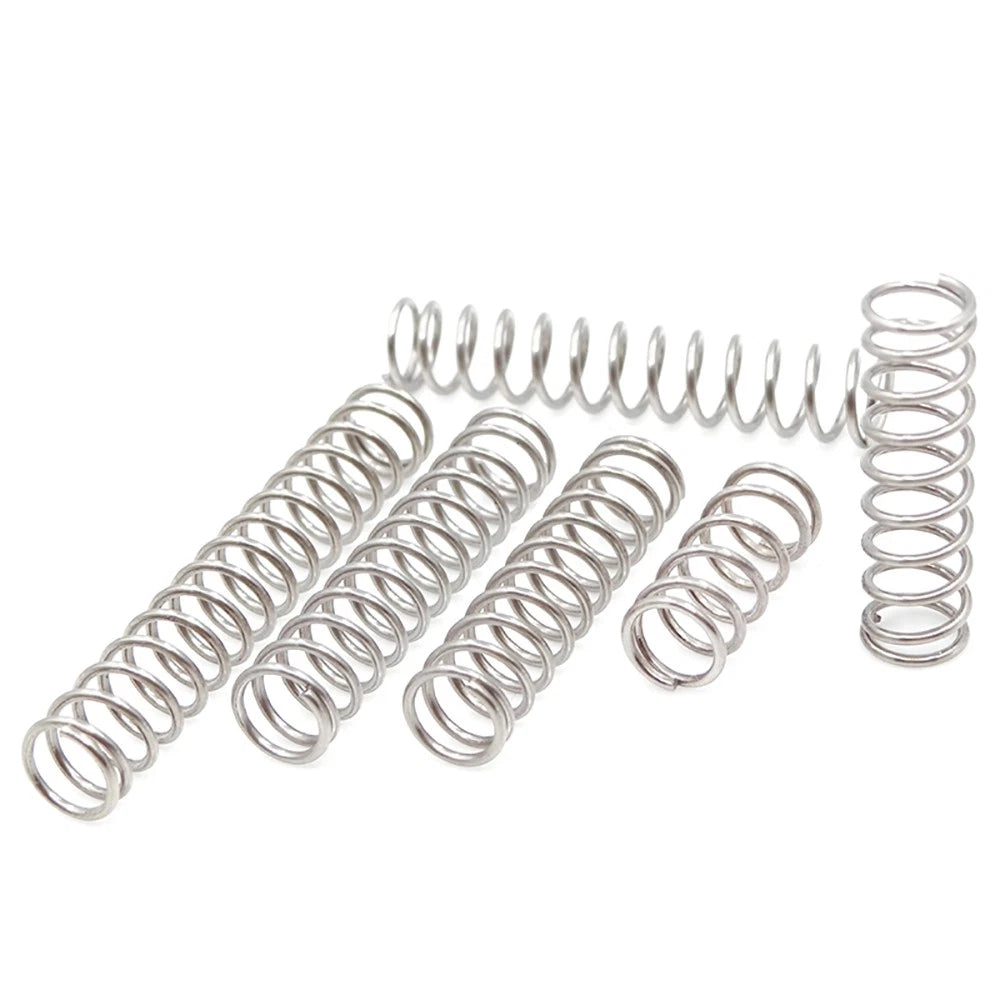
These compression springs are manufactured from 304 stainless steel wire in diameters ranging from 0.3 mm to 0.9 mm (~0.012"–0.035"), with outside diameters from 3 mm to 12 mm (~0.12"–0.47") and free lengths from 60 mm to 100 mm (~2.36"–3.94"). The closed-end coil geometry provides a flat seating surface for consistent load distribution, and the 304 alloy delivers solid corrosion resistance in humid, mildly acidic, or outdoor-adjacent environments.

Typical applications include return springs in electronic switches and push-button assemblies, preload springs in optical and measurement instruments, and light-duty compression elements in 3D-printer extruder mechanisms or custom CNC fixtures — anywhere a compact, corrosion-resistant compression spring for small mechanisms is required.

🔩 Compatible with standard spring pockets and bores sized to match the selected outside diameter. Verify bore clearance and free-length travel before ordering.

✅ Key Features of These 304 Stainless Steel Compression Springs

  • 🧲304 Stainless Steel Construction — Resists rust, oxidation, and mild chemical exposure, making these springs suitable for humid workshops, outdoor enclosures, and light industrial environments.
  • 📏Wide Size Matrix — Wire diameters 0.3–0.9 mm paired with outside diameters 3–12 mm and lengths 60–100 mm give you the flexibility to match exact bore and travel requirements without custom tooling.
  • ⚙️Closed-End Coil Design — Flat ground ends ensure square seating against mating surfaces, reducing lateral deflection and improving load consistency across the spring's travel range.
  • 🔄Consistent Spring Rate — Uniform wire diameter and coil pitch across the production run means predictable force curves, critical for precision instruments, switches, and repeatable mechanical assemblies.
  • 🛡️Fatigue-Resistant Alloy — 304 stainless maintains its mechanical properties through repeated compression cycles, reducing the risk of set (permanent deformation) under sustained or cyclic loading within rated deflection limits.
  • 📦Multi-Variant Selection — Choose your exact wire diameter, outside diameter, and free length from the variant selectors above to get the spring that fits your design — no cutting or bending required.

📐 Technical Specifications — Compression Springs

Material 304 Stainless Steel
Wire Diameter 0.3 mm / 0.4 mm / 0.5 mm / 0.6 mm / 0.7 mm / 0.8 mm / 0.9 mm
Outside Diameter (OD) 3 mm – 12 mm (0.12" – 0.47")
Free Length 60 mm – 100 mm (2.36" – 3.94")
End Type Closed (non-ground)
Coil Direction Right-hand
Spring Rate See variant options
Max Load Capacity See variant options
Surface Finish Natural (mill finish)
Corrosion Resistance Good — suitable for humid and mildly corrosive environments
Quantity per Pack See variant options

❓ Frequently Asked Questions

How do I choose the right wire diameter for my application?

Wire diameter directly affects spring rate and load capacity — thicker wire produces a stiffer spring. For light-duty return or preload applications (switches, sensors, small levers), 0.3–0.5 mm wire is typically sufficient. For applications requiring more force or resistance to set under sustained load, select 0.6–0.9 mm wire. If you know your required load and deflection, use a spring rate calculator with the OD and free length to confirm the wire size before ordering.

What outside diameter should I select to fit my bore or spring pocket?

The outside diameter of the spring should be slightly smaller than the bore or pocket it sits in — typically 0.2–0.5 mm clearance on the OD is a good starting point. For a shaft-guided spring, the inside diameter (OD minus 2× wire diameter) should be slightly larger than the shaft. Use the OD options (3–12 mm) in the variant selector and verify against your mechanical drawing before ordering.

Are these springs strong enough for repeated cycling without losing their shape?

304 stainless steel has good fatigue resistance for light-to-medium cyclic loads when the spring is not compressed beyond its solid height. To maximize service life, design your assembly so the spring operates within 80% of its maximum deflection range. Avoid compressing to solid height repeatedly, as this causes set (permanent length reduction) over time.

How corrosion-resistant are 304 stainless steel springs compared to carbon steel?

304 stainless steel offers significantly better corrosion resistance than standard carbon steel springs. It performs well in humid indoor environments, light outdoor exposure, and mild chemical contact (dilute acids, cleaning agents). It is not suitable for prolonged immersion in chloride-rich environments (e.g., saltwater) — for those conditions, 316 stainless would be more appropriate. For typical workshop, electronics, and instrument use, 304 is a reliable choice.

Will these springs fit standard spring pockets in 3D-printed or CNC-machined parts?

Yes — the OD range of 3–12 mm covers the most common spring pocket sizes used in FDM 3D-printed assemblies and CNC-machined fixtures. When designing a pocket for a 3D-printed part, add 0.3–0.5 mm clearance to the nominal OD to account for print tolerances. For CNC parts, standard H7 bore tolerances work well. Always confirm the free length (60–100 mm) fits within your available travel before selecting a variant.

Can I use these springs outdoors or in humid environments?

304 stainless steel provides good resistance to atmospheric corrosion and humidity, making these springs suitable for outdoor enclosures, garden equipment mechanisms, and marine-adjacent (but not direct saltwater) applications. For direct saltwater or highly corrosive chemical exposure, consider upgrading to 316 stainless steel springs. In typical outdoor or humid workshop conditions, 304 will outlast carbon steel springs significantly.

How do I decide between the different free lengths (60–100 mm)?

Select the free length based on your required working length plus the compression travel your assembly needs. A spring compressed to 70% of its free length is a common design target. For example, if you need 20 mm of travel and want to work at ~70% compression, a 100 mm free-length spring compressed to 80 mm gives you that range. Always leave at least 10–15% of the free length as a buffer above solid height to prevent coil clash.

🛒 Select your Wire Diameter, Outside Diameter, and Length above, then add to cart.

You may also like

Recently viewed