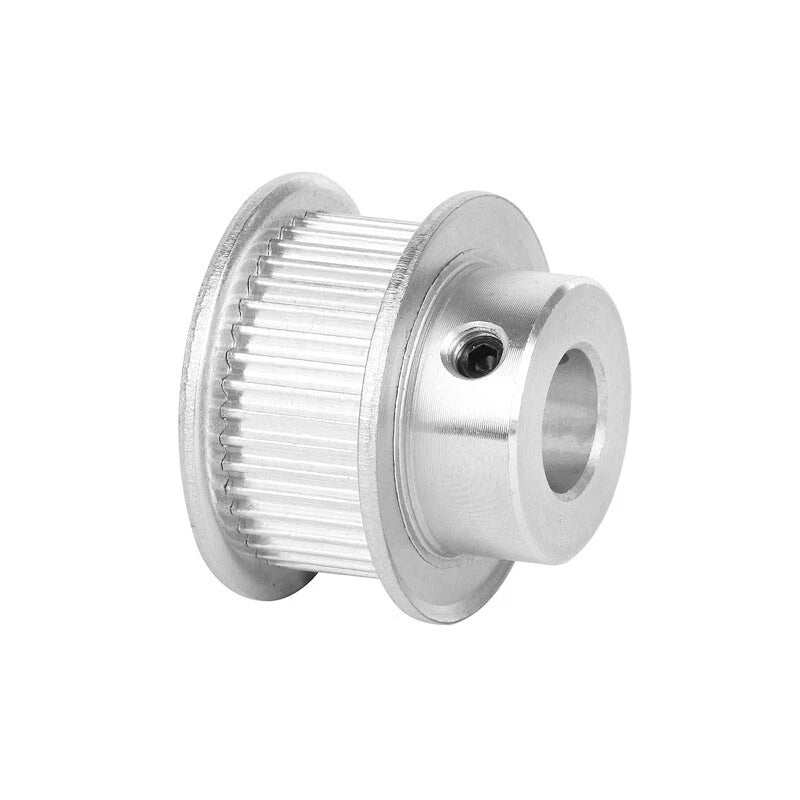
3M BF-Type Timing Belt Pulley — Precise Motion Control for Makers & Engineers
When a slipping or misaligned pulley throws off your entire build, every project stalls. Whether you're a 3D printer builder, CNC hobbyist, or automation engineer, you need a timing belt pulley that holds its pitch under load and fits your shaft without play. The 3M BF-Type Timing Belt Pulley is engineered for exactly that — reliable, repeatable motion in compact drive systems.
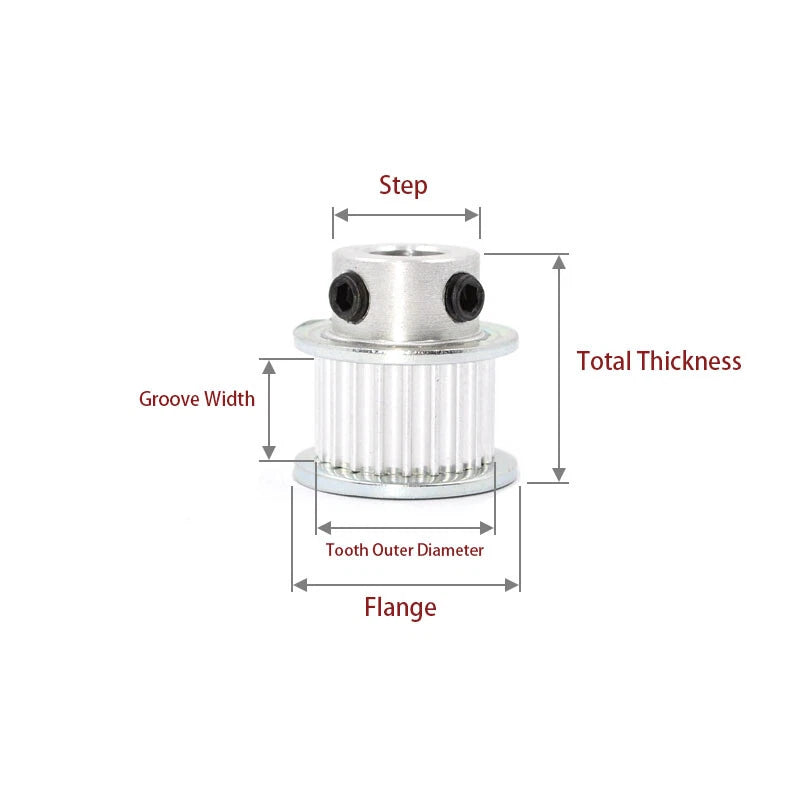
This pulley series features a BF-type flange design machined to accept 3M pitch timing belts with a 10mm applicable belt width. Bore diameters range from 5mm to 20mm (approx. 0.20" to 0.79"), and tooth counts span 32T to 44T, covering a wide range of gear-ratio and speed requirements. The body is typically machined from aluminum alloy, offering a balance of low rotational inertia and structural rigidity.
Typical use cases include open-loop stepper motor drives in desktop 3D printers, X/Y axis linear motion systems in DIY CNC routers, and compact conveyor or indexing mechanisms in light automation rigs — all applications where 3M pitch belt pulleys with a 10mm belt width deliver smooth, low-backlash transmission.
⚙️ Compatibility: Designed for 3M pitch timing belts with 10mm belt width. Verify your shaft diameter matches the selected bore before ordering. BF-type flanges retain the belt laterally — confirm your belt edge clearance.
✅ Key Features of These 3M BF-Type Timing Belt Pulleys
🎯
Wide Bore Range (5–20mm) — Covers the most common shaft diameters used in stepper motors, servo motors, and hobby CNC spindles, reducing the need for adapters or bushings.
🔢
7 Tooth-Count Options (32T–44T) — Select from 32T, 35T, 36T, 38T, 40T, 42T, or 44T to dial in your drive ratio and linear speed without changing your motor or belt.
🏗️
BF-Type Flanged Design — Dual flanges on both sides of the tooth profile keep the 10mm belt tracking straight, preventing lateral drift during high-cycle operation.
⚖️
Aluminum Alloy Construction — Lightweight yet rigid material keeps rotational inertia low for responsive acceleration and deceleration in motion-control applications.
📐
3M Pitch Tooth Profile — Machined to the 3M standard (3mm tooth pitch), ensuring positive engagement with standard 3M timing belts and minimal backlash across the full tooth range.
🔩
Set-Screw Bore Retention — Bore hub typically includes a set-screw flat or keyway-ready bore for secure shaft locking without slippage under torque loads.
📐 Technical Specifications — 3M Timing Belt Pulley
| Belt Type |
3M (3mm pitch) |
| Pulley Type |
BF-type (flanged both sides) |
| Applicable Belt Width |
10mm |
| Number of Teeth |
32T / 35T / 36T / 38T / 40T / 42T / 44T |
| Bore Diameter |
5mm / 6mm / 6.35mm / 7mm / 8mm / 10mm / 12mm / 12.7mm / 14mm / 15mm / 16mm / 17mm / 19mm / 20mm |
| Material |
Aluminum alloy |
| Finish |
See variant options |
| Outer Diameter |
See variant options |
| Hub Length |
See variant options |
| Weight (per piece) |
See variant options |
❓ Frequently Asked Questions
How do I choose the right tooth count (32T vs 44T) for my application?
Tooth count determines your drive ratio and output speed. A lower tooth count (e.g., 32T) on the drive pulley paired with a larger driven pulley gives you torque multiplication and slower output speed — useful for precision positioning. A higher tooth count (e.g., 44T) increases linear belt speed for the same motor RPM. Match your tooth count to your target linear speed and the tooth count of your driven pulley to achieve the desired ratio.
What bore diameter should I select for my motor shaft?
Measure your motor or drive shaft diameter with a caliper before ordering. Common stepper motor shaft sizes are 5mm, 6.35mm (1/4"), and 8mm. Servo motors often use 6mm, 8mm, or larger. Select the bore that matches your shaft exactly — a loose bore causes runout and belt skip, while an undersized bore cannot be installed without machining.
Is this pulley compatible with any 3M timing belt, or only specific brands?
These pulleys are machined to the standard 3M tooth profile (3mm pitch, trapezoidal or curvilinear depending on belt type). They are compatible with any 3M-pitch timing belt with a 10mm width from any manufacturer, provided the belt profile matches (MXL-3M or HTD-3M are different — confirm your belt's profile designation before ordering).
What does "BF-type" mean, and why does it matter?
"BF-type" refers to a flanged pulley design where flanges are present on both sides of the tooth section. These flanges act as lateral guides that keep the timing belt centered on the pulley during operation. Without flanges, belts can walk sideways under load, especially in vertical or high-speed drive configurations. BF-type pulleys are the standard choice for most open-loop motion systems.
How strong is the aluminum pulley under continuous load?
Aluminum alloy pulleys are well-suited for light-to-medium duty applications such as 3D printers, desktop CNC machines, and small automation systems. For continuous high-torque or heavy industrial loads, consider whether a steel pulley is more appropriate. In typical maker and hobbyist applications running 3M belts, aluminum pulleys provide adequate strength and significantly lower rotational inertia compared to steel alternatives.
Will this pulley corrode or oxidize over time?
Aluminum alloy naturally forms a thin oxide layer that provides moderate corrosion resistance in dry indoor environments. For applications exposed to moisture, cutting fluids, or outdoor conditions, consider applying a light coating of machine oil or selecting an anodized variant if available. Avoid prolonged contact with strong acids or alkalis.
Can I use this pulley as both the drive and driven pulley in the same system?
Yes. You can use the same tooth-count pulley on both the drive (motor) shaft and the driven shaft for a 1:1 ratio, or mix different tooth counts from this series to achieve your desired drive ratio. Ensure both pulleys share the same 3M pitch and 10mm belt width for proper belt engagement.
🛒 Select your Number of Teeth and Bore Diameter above, then add to cart.