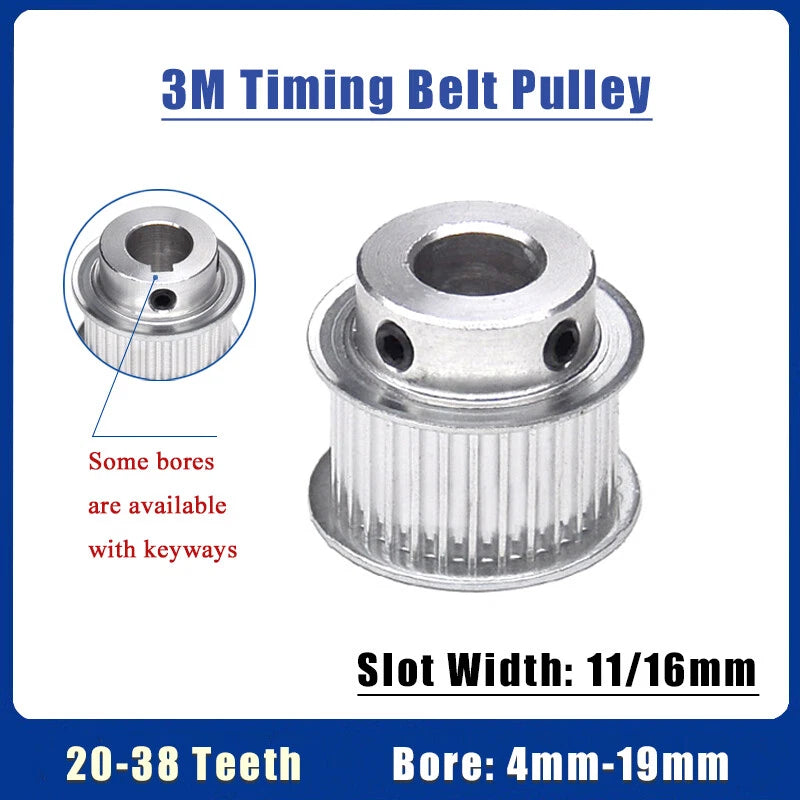
3M Timing Belt Pulley 20-38 Teeth BF/K Type Synchronous Wheel Bore 4mm-19mm

No reviews

Price:
Sale price$12.80 USD
Stock:
In stock (500 units), ready to be shipped

Payment & Security

Ach Direct Debit Amazon American Express Apple Pay Bancontact BLIK Diners Club Discover EPS Google Pay iDEAL Wero JCB Maestro Mastercard Multibanco MobilePay PayPal Przelewy24 Shop Pay Twint Union Pay USDC Visa

Your payment information is processed securely. We do not store credit card details nor have access to your credit card information.

Limited Offer — Spend More, Save More
Spend $55+
Save $5
Spend $100+
Save $10
Spend $200+
Save $25
HomeDIYer DIY Expert Support

DIY Expert Support

Get fitment advice & recommendations

Mon–Fri  8:30 AM – 8:00 PM
24-Hour Fast Ship
Arrives in 3–14 Days
Worldwide Shipping
30-Day Returns
1 tree planted with every purchase

Description

3M Timing Belt Pulley — Precision Synchronous Drive for CNC, Robotics & Automation

When a slipping or misaligned drive pulley causes positioning errors in your CNC router, 3D printer, or automated conveyor, every lost step costs time and accuracy. Engineers, makers, and machine builders who demand repeatable motion need a synchronous wheel that holds its pitch under load — and that is exactly what these 3M timing belt pulleys are designed to deliver.

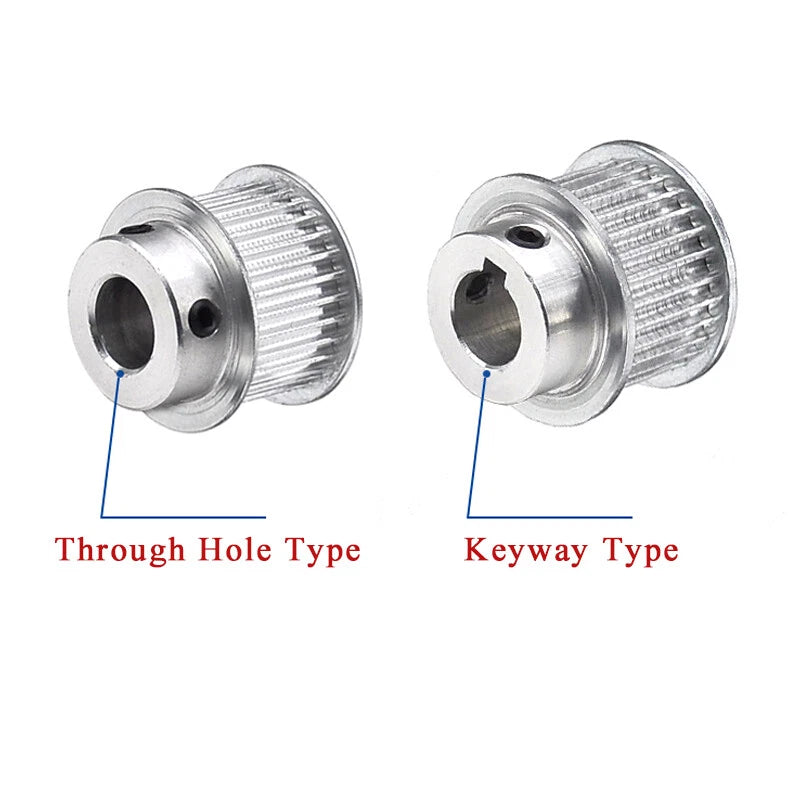
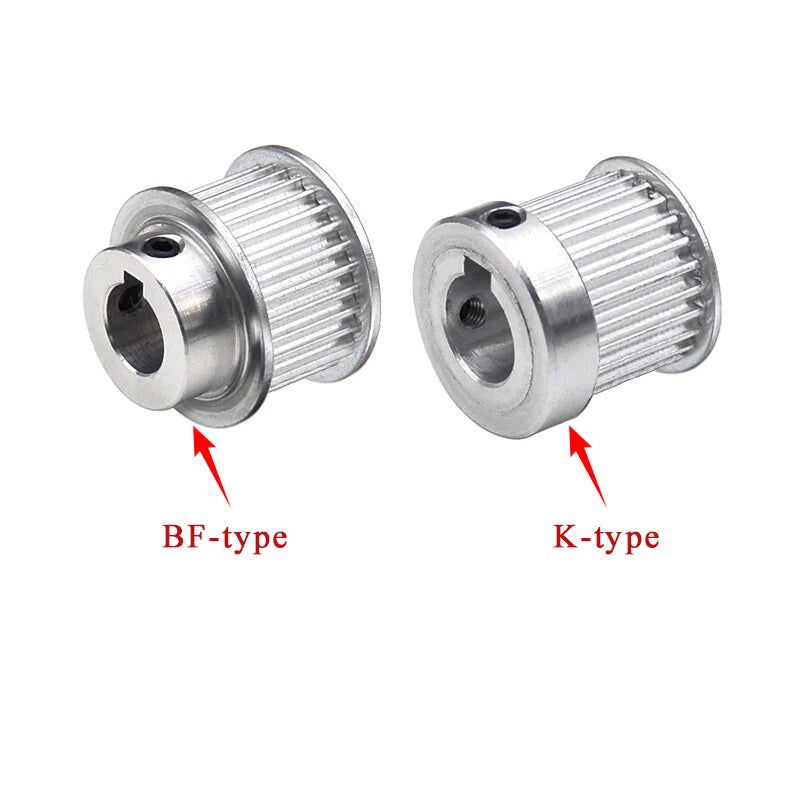
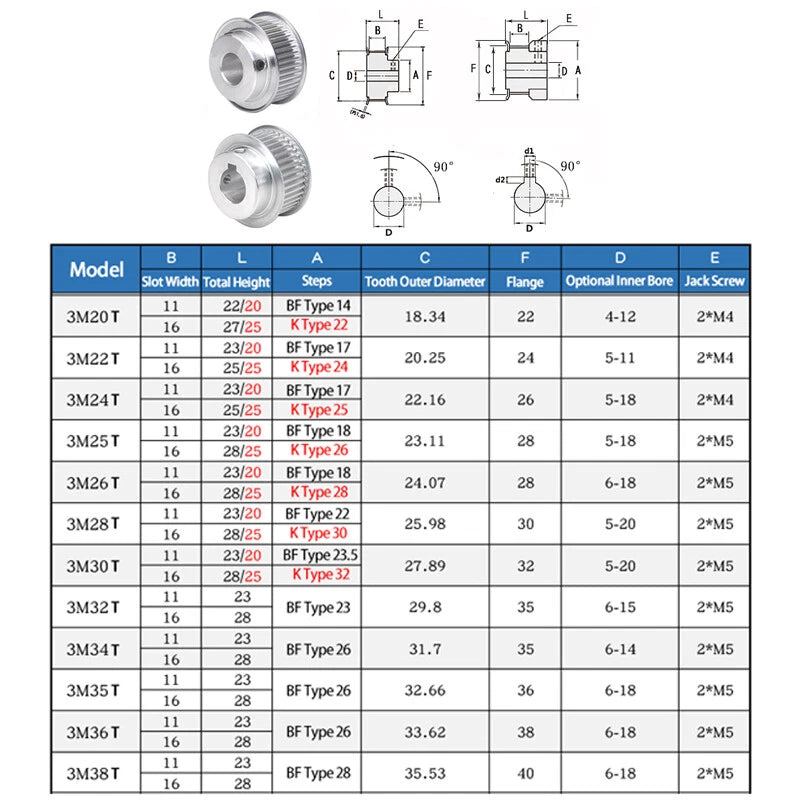
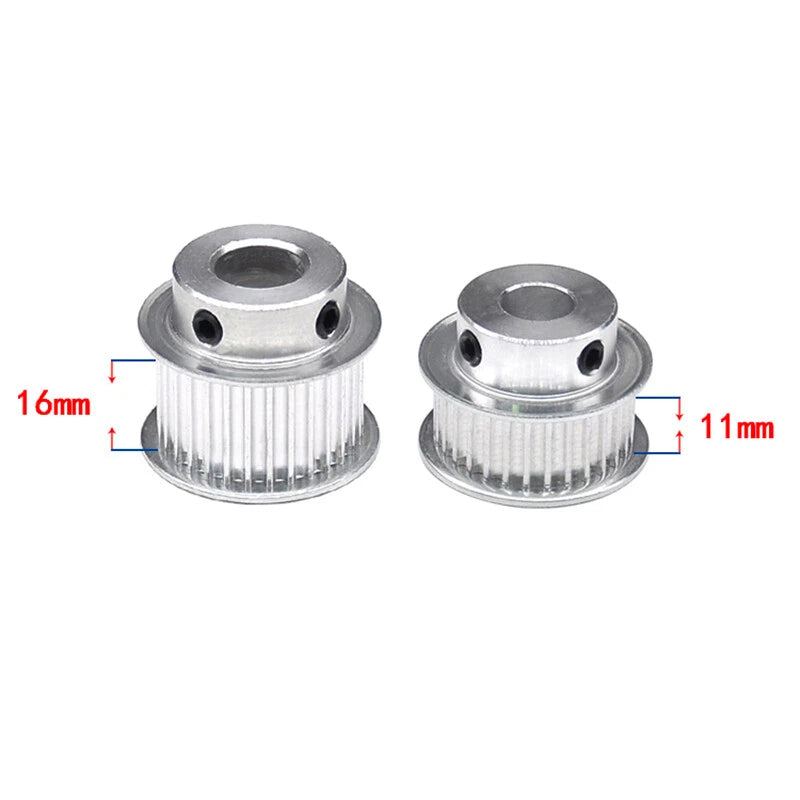
Each pulley is machined from aluminum alloy and features a 3M tooth profile (3 mm pitch). The range covers 20 to 38 teeth across two flange styles — BF-type (double-flanged) and K-type (single-flanged) — with bore diameters from 4 mm to 19 mm (approximately 0.16 in to 0.75 in) and keyway slot widths of 11 mm or 16 mm to suit standard set-screw or key-shaft assemblies.

Typical applications include 3M timing belt drive systems for desktop CNC machines and laser cutters, stepper-motor shaft couplings in 3D printer X/Y axes, and light-duty conveyor or indexing table synchronous drives where low backlash and consistent tooth engagement are critical.

⚙️ Compatible with standard 3M open-end and closed-loop timing belts (3 mm pitch). Verify bore diameter and keyway slot width against your shaft spec before ordering.

✅ Key Features of These 3M Timing Belt Pulleys

  • 🦷 Wide tooth count range (20–38T): Ten tooth-count options in a single listing let you dial in the exact gear ratio your drive system requires without sourcing from multiple suppliers.
  • 🔩 Dual flange styles — BF & K type: BF-type double flanges keep the belt centered under lateral loads; K-type single flange suits constrained-space assemblies where one side must remain open.
  • 📐 Broad bore selection (4–19 mm): Bore options cover the most common stepper and servo motor shaft diameters, including fractional sizes such as 6.35 mm (1/4 in) and 12.7 mm (1/2 in) for mixed metric/imperial builds.
  • 🔑 Keyway slot included: Each variant ships with a machined keyway slot (11 mm or 16 mm width) for positive torque transmission — no slipping under reversing loads.
  • ⚖️ Aluminum alloy construction: Lightweight yet rigid material keeps rotational inertia low, which matters for high-acceleration stepper and servo axes.
  • 🔄 3M pitch compatibility: Designed to mesh with standard 3 mm pitch timing belts, ensuring consistent tooth engagement and minimal backlash across the full speed range of your drive.

📐 Technical Specifications — 3M Timing Belt Pulley

Belt Pitch 3M (3 mm)
Tooth Profile 3M synchronous (trapezoidal)
Number of Teeth 20T / 22T / 24T / 25T / 28T / 30T / 32T / 35T / 36T / 38T
Flange Type BF-type (double flange) / K-type (single flange)
Bore Diameter 4 mm – 19 mm (see variant options)
Keyway Slot Width 11 mm or 16 mm (see variant options)
Material Aluminum alloy
Outer Diameter See variant options
Hub Width See variant options
Surface Finish Natural anodized / machined
Compatible Belt Standard 3M open-end or closed-loop timing belt
Quantity 1 piece per order

❓ Frequently Asked Questions

How do I choose between BF-type and K-type?

BF-type pulleys have flanges on both sides of the tooth face, which keeps the timing belt tracking centrally and prevents it from walking off under lateral forces — ideal for horizontal or multi-axis drives. K-type pulleys have a flange on one side only, which is useful when space constraints prevent a double-flanged pulley from fitting, or when the mating pulley already provides the opposing flange. If you are unsure, BF-type is the safer default for most desktop CNC and 3D printer applications.

Which tooth count should I select for my drive ratio?

Drive ratio equals the tooth count of the driven pulley divided by the tooth count of the driving pulley. For example, pairing a 20T driver with a 40T driven pulley gives a 2:1 reduction. Choose your tooth counts based on the speed and torque requirements of your axis. Smaller tooth counts produce higher belt wrap angles on small-diameter shafts, which can reduce tooth-skip risk at high torque. Larger tooth counts spread load across more teeth and suit higher-speed, lower-torque applications.

What bore diameter should I order for my stepper motor shaft?

Measure your motor shaft diameter with calipers before ordering. Common stepper motor shaft sizes are 5 mm, 6.35 mm (1/4 in), 8 mm, and 10 mm. NEMA 17 motors typically use a 5 mm shaft; NEMA 23 motors commonly use 6.35 mm or 8 mm. Select the bore that matches your shaft exactly — a bore that is too large will require shimming and will introduce runout. If your shaft has a flat (D-cut), confirm the keyway slot width matches the flat dimension.

What is the difference between the 11 mm and 16 mm keyway slot widths?

The keyway slot width refers to the width of the machined slot cut into the bore wall. An 11 mm slot suits narrower set-screw or key assemblies, while a 16 mm slot accommodates wider keys for higher-torque applications. Match the slot width to the key or flat on your shaft. If your shaft has no key, either slot width works — the set screw bears against the shaft directly. Check your shaft specification sheet or measure the flat width if present.

Are these pulleys compatible with any 3M timing belt, or only specific brands?

These pulleys are designed to the standard 3M tooth profile (3 mm pitch, trapezoidal tooth form) and will mesh correctly with any 3M-pitch timing belt that conforms to that standard, regardless of brand. Verify that your belt is labeled 3M or 3 mm pitch — do not confuse it with GT2 (2 mm pitch) or HTD 3M (a different tooth profile). If you are replacing an existing belt-and-pulley system, match the pitch of the existing belt.

How strong are aluminum timing belt pulleys compared to steel?

Aluminum alloy pulleys offer a favorable strength-to-weight ratio for most light-to-medium duty synchronous drive applications, including CNC routers, 3D printers, laser cutters, and small conveyor systems. They are significantly lighter than steel, which reduces rotational inertia and improves acceleration response on servo and stepper axes. For heavy industrial loads exceeding the rated torque of the belt itself, steel pulleys may be warranted — but for the applications these pulleys are sized for, aluminum alloy is the standard material of choice.

Do I need to purchase a matching belt separately?

Yes — this listing covers the pulley only. You will need to source a compatible 3M pitch timing belt separately. When selecting a belt, specify the pitch (3M), the belt width (match to your pulley tooth face width), and the length or number of teeth for closed-loop belts. Open-end belts can be cut to length. Ensure the belt width does not exceed the pulley tooth face width to avoid edge loading.

🛒 Select your tooth count, flange type, and bore diameter above, then add to cart.


You may also like

Recently viewed