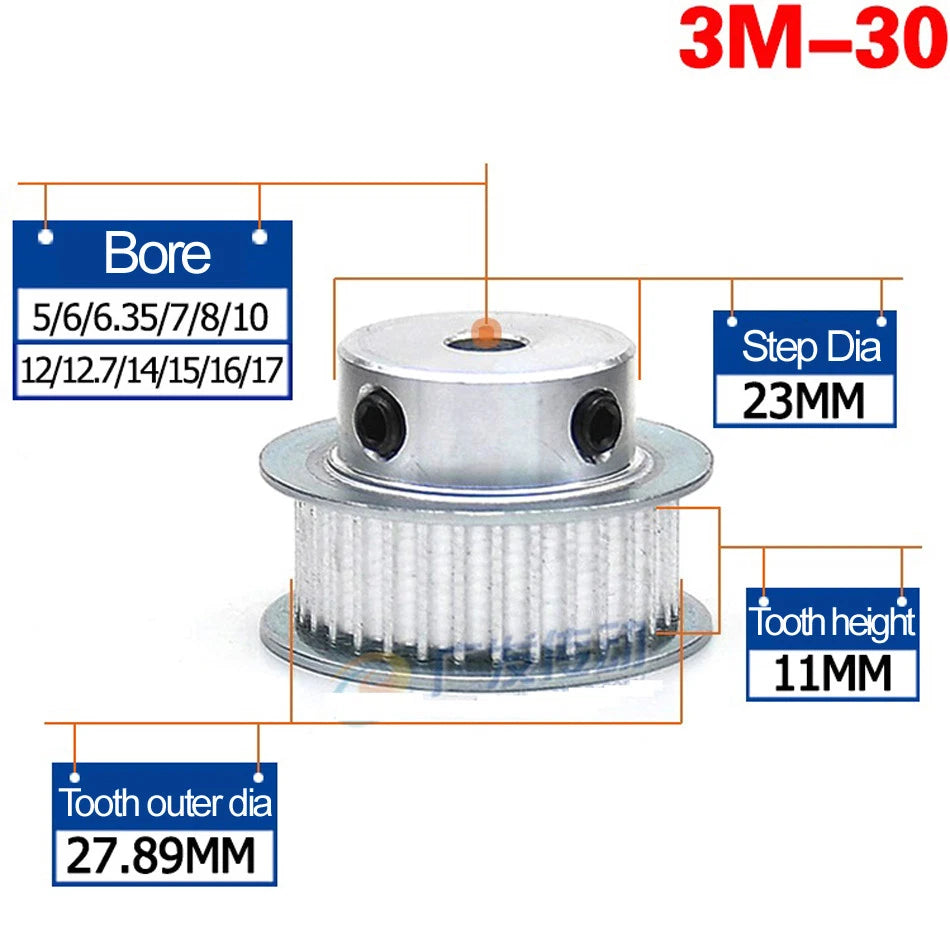
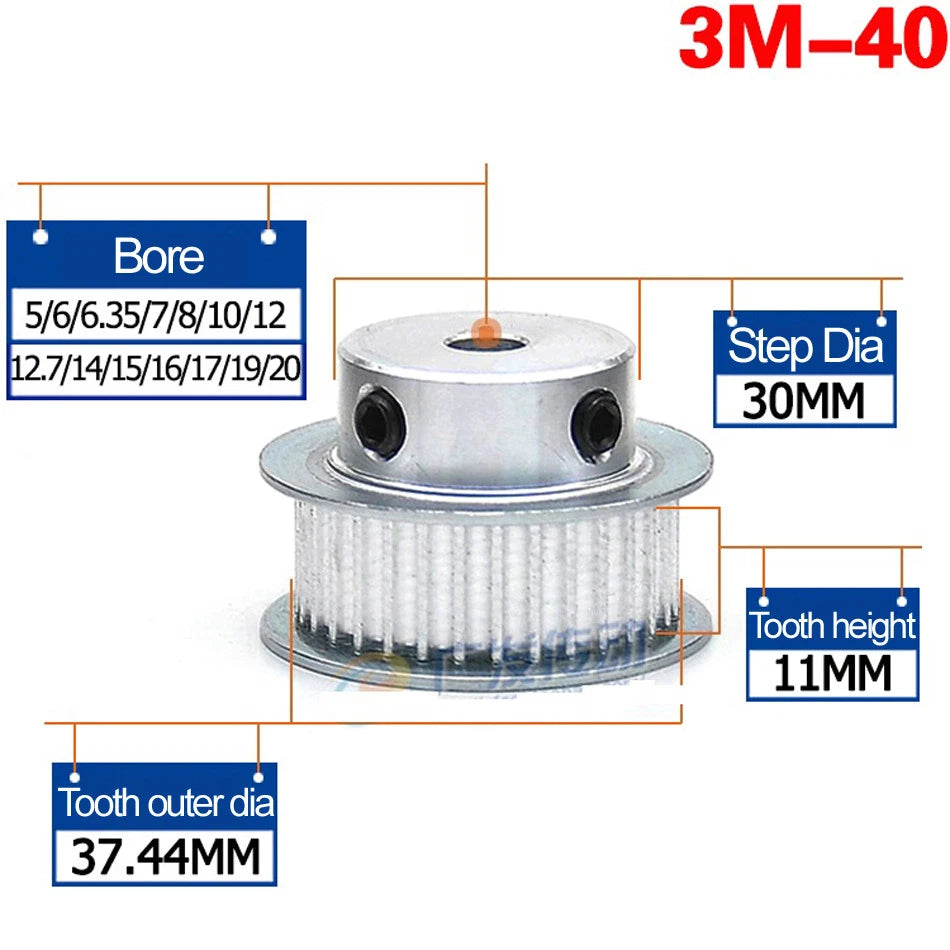
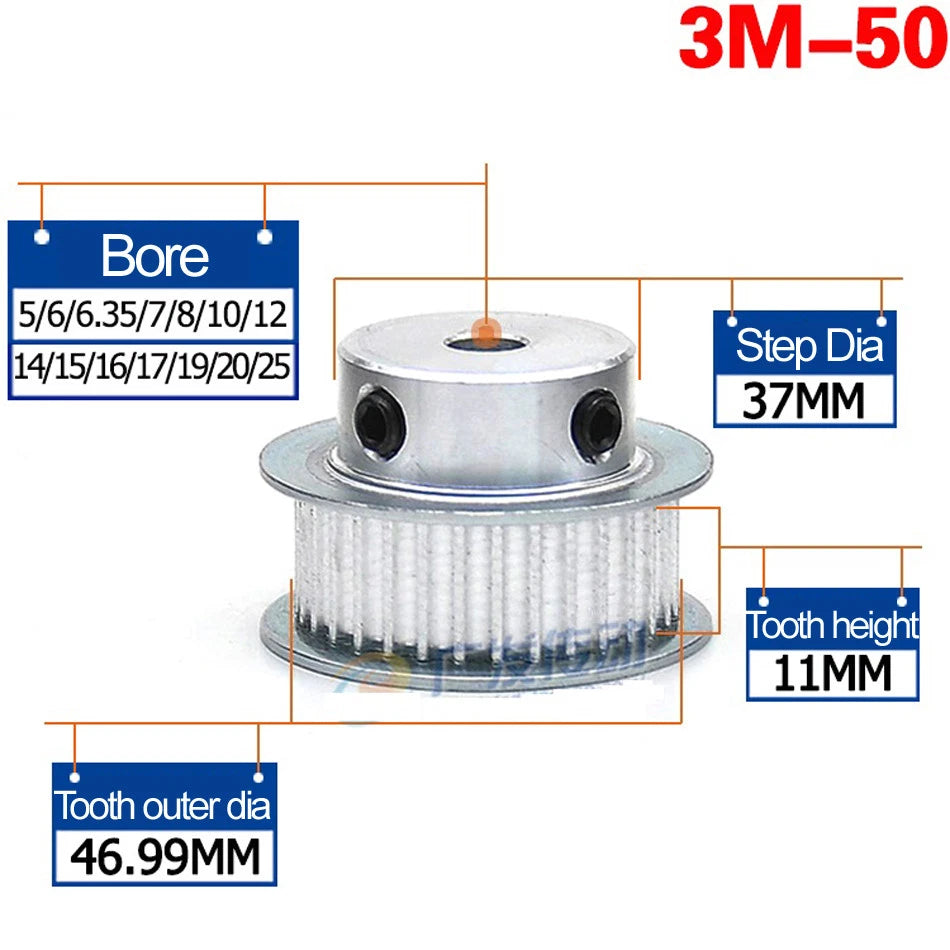
3M 15T-60T Timing Belt Pulley Synchronous Wheel Sprockets For 10mm Width Belt

No reviews

Price:
Sale price$3.11 USD
Stock:
In stock (500 units), ready to be shipped

Payment & Security

Ach Direct Debit Amazon American Express Apple Pay Bancontact BLIK Diners Club Discover EPS Google Pay iDEAL Wero JCB Maestro Mastercard Multibanco MobilePay PayPal Przelewy24 Shop Pay Twint Union Pay USDC Visa

Your payment information is processed securely. We do not store credit card details nor have access to your credit card information.

Limited Offer — Spend More, Save More
Spend $55+
Save $5
Spend $100+
Save $10
Spend $200+
Save $25
HomeDIYer DIY Expert Support

DIY Expert Support

Get fitment advice & recommendations

Mon–Fri  8:30 AM – 8:00 PM
24-Hour Fast Ship
Arrives in 3–14 Days
Worldwide Shipping
30-Day Returns
1 tree planted with every purchase

Description

3M Timing Belt Pulley — Precision Synchronous Wheel Sprockets for 10mm Width Belts

When your DIY automation project demands slip-free, repeatable motion, a mismatched or worn pulley is the first thing that breaks your build. Whether you are a maker building a CNC router, a hobbyist assembling a 3D printer, or an engineer prototyping a conveyor system, these 3M pitch timing belt pulleys give you the exact tooth count and bore size you need to keep your drive train running true.

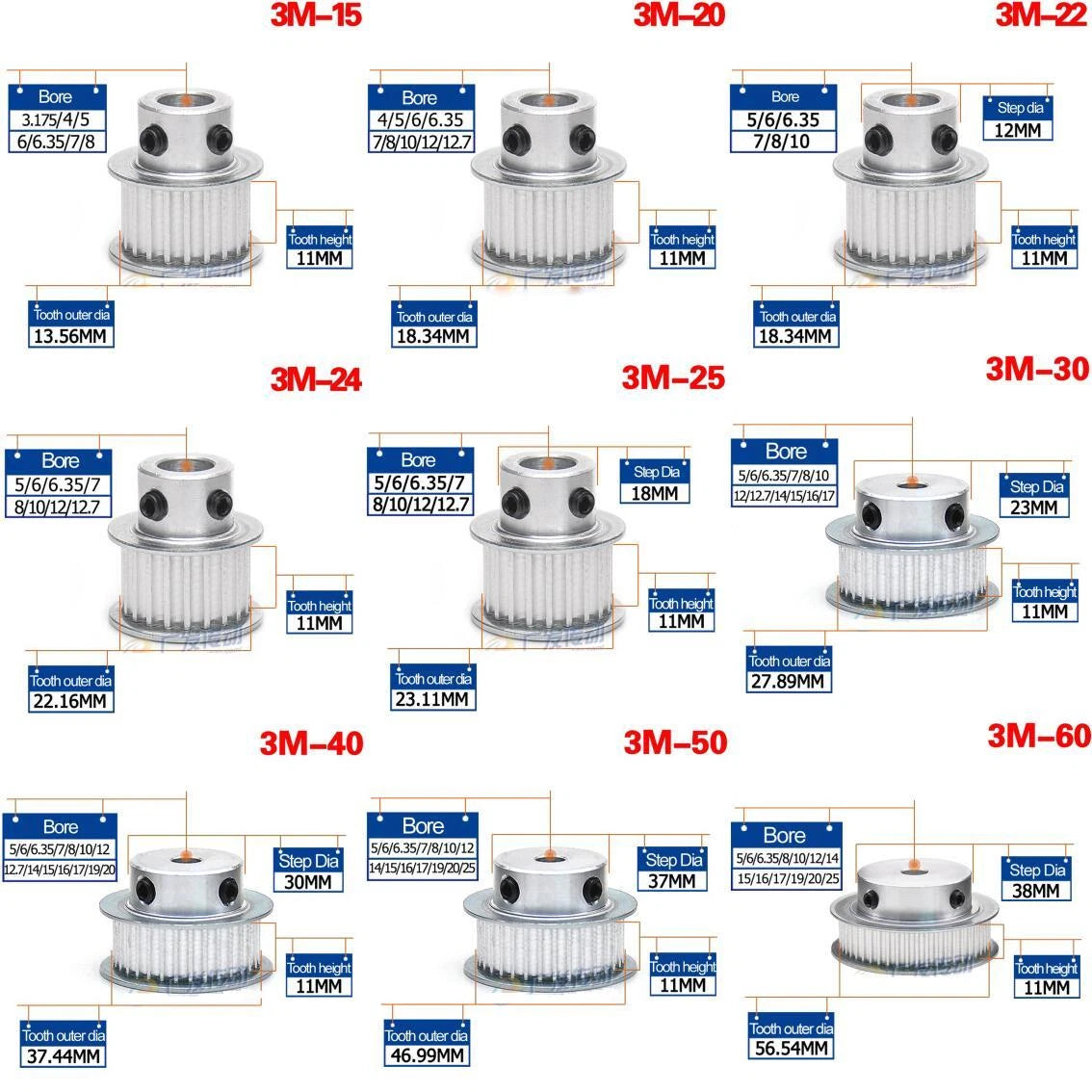
Each pulley is machined from aluminum alloy with a natural silver finish, designed to accept 10mm wide 3M pitch synchronous belts. Tooth counts span from 15T to 60T, and bore diameters range from 3.175mm (~0.125 in) up to 25mm (~0.984 in), covering the most common shaft sizes used in light-to-medium automation hardware. A set screw secures the pulley to the shaft for positive, no-slip engagement.

Typical use cases include open-loop stepper motor drives in desktop CNC machines, belt-driven Z-axis and extruder assemblies in FDM 3D printers, and compact conveyor or pick-and-place mechanisms in educational robotics labs. The wide tooth-count range lets you dial in your gear ratio without sourcing custom parts.

⚙️ Compatibility: Designed for 3M pitch (3mm tooth spacing) synchronous timing belts, 10mm width. Verify your belt pitch and width before ordering. Bore size must match your motor or drive shaft diameter — select from 3.175mm to 25mm options above.

✅ Key Features of These 3M Timing Belt Pulley Synchronous Wheel Sprockets

🦷
Wide Tooth Count Range

Available from 15T to 60T, letting you configure drive ratios from 1:1 up to 4:1 without custom machining.

🔩
Multiple Bore Sizes

Bore options from 3.175mm to 25mm cover standard stepper motor shafts, servo shafts, and common metric rod diameters.

🏗️
Aluminum Alloy Construction

Lightweight yet rigid aluminum body keeps rotational inertia low — important for responsive acceleration in CNC and 3D printer applications.

📐
3M Pitch Tooth Profile

3mm tooth pitch matches standard 3M synchronous belts for zero-slip, backlash-controlled power transmission in precision motion systems.

🔐
Set Screw Retention

Integrated set screw bore locks the pulley firmly to the shaft, preventing axial or rotational slippage under load.

🔄
10mm Belt Width Compatibility

Flanged groove profile keeps 10mm wide 3M belts tracking straight, reducing edge wear and extending belt service life.

📐 Technical Specifications — 3M Timing Belt Pulley

Belt Pitch 3M (3mm tooth pitch)
Belt Width 10mm
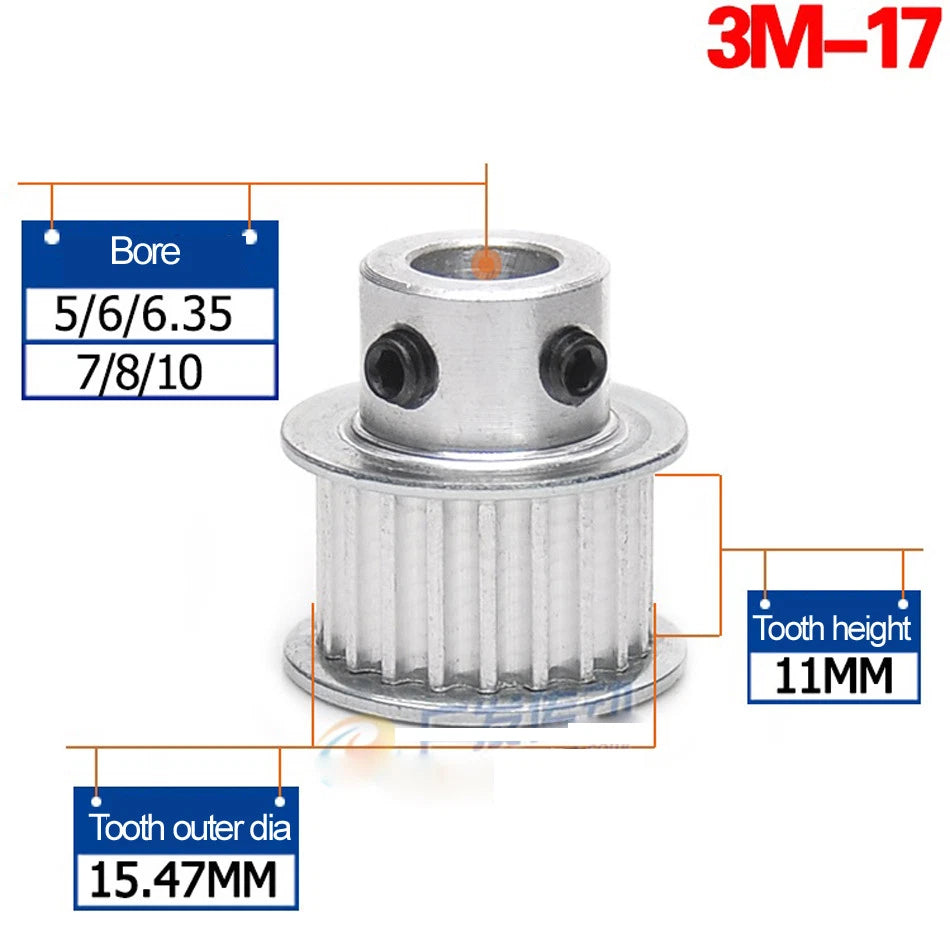
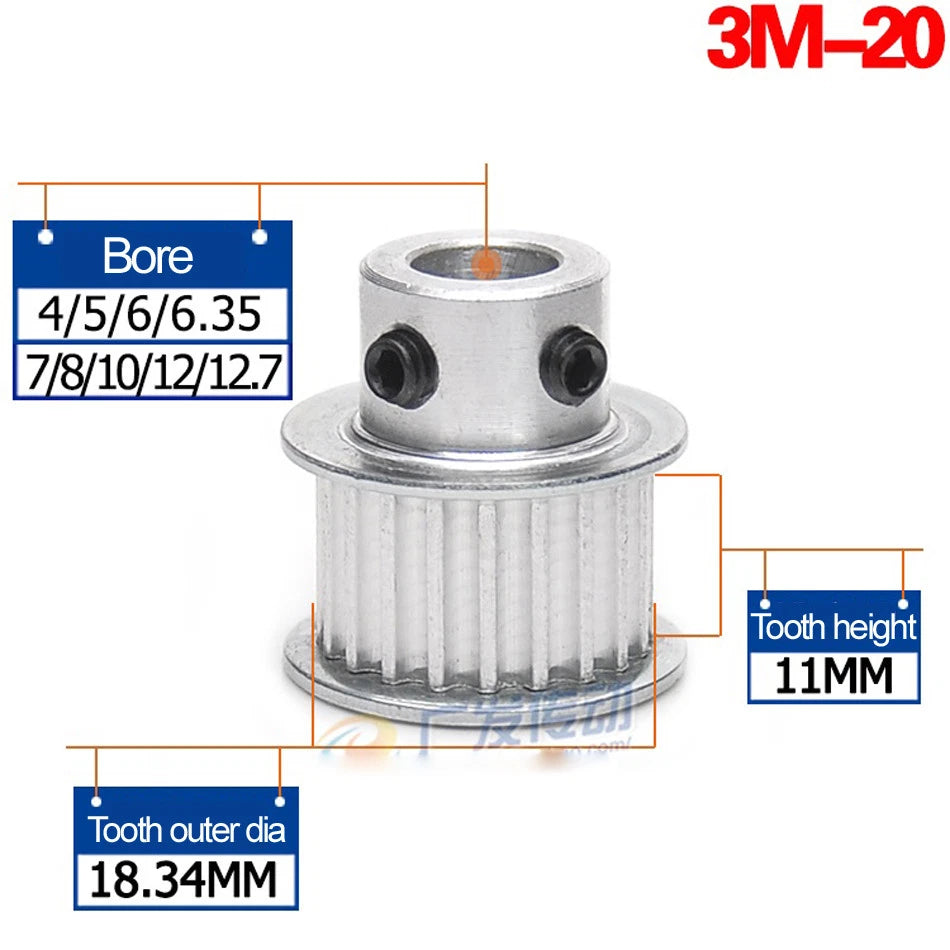
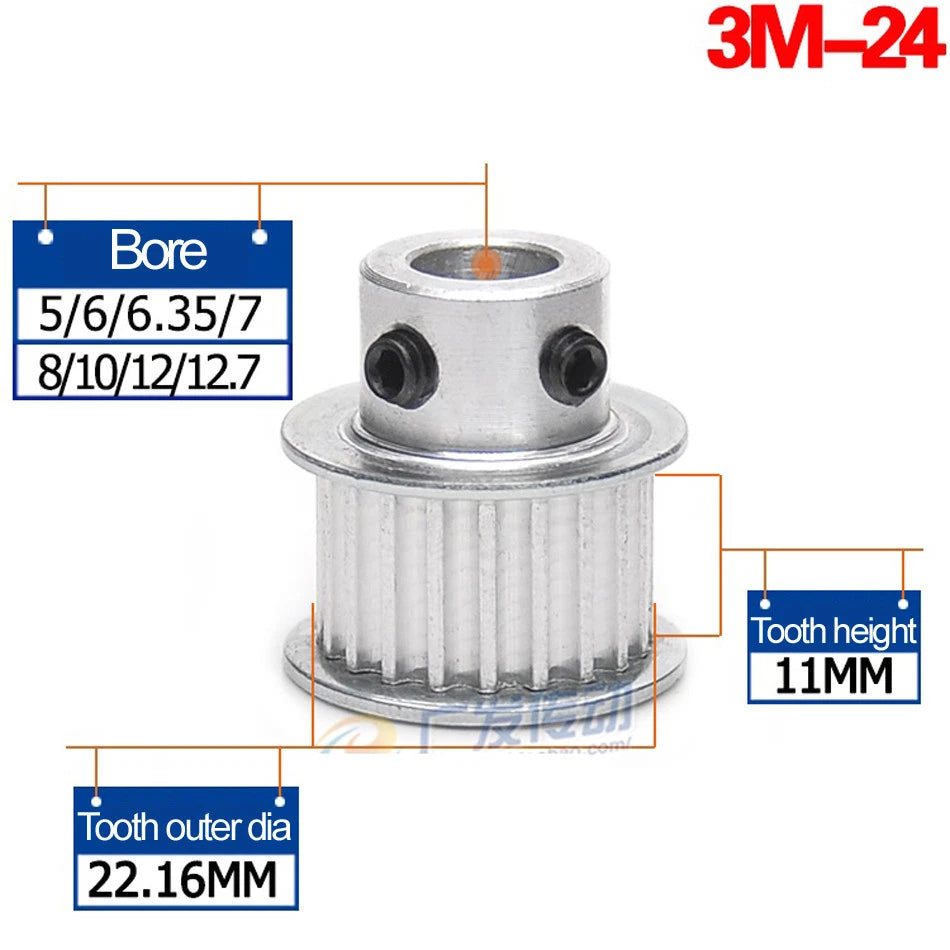
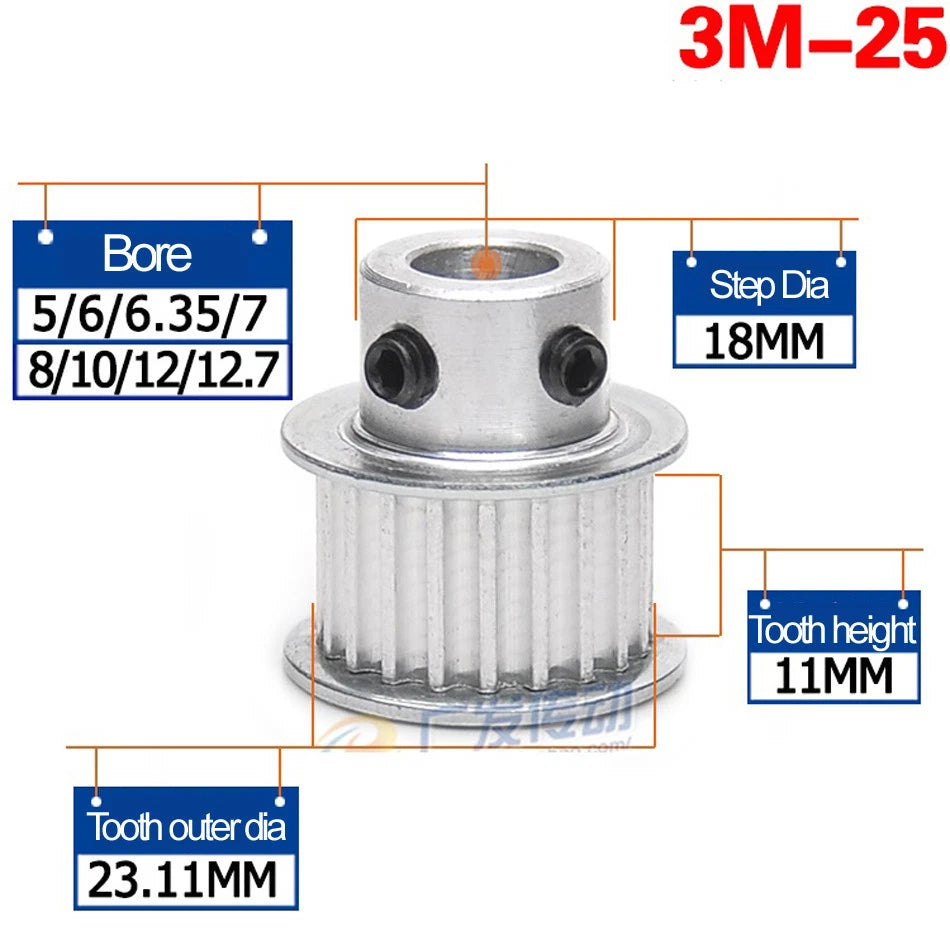
Tooth Count (Types) 15T, 17T, 20T, 22T, 24T, 25T, 30T, 40T, 50T, 60T
Bore Diameter 3.175mm / 4mm / 5mm / 6mm / 6.35mm / 7mm / 8mm / 10mm / 12mm / 12.7mm / 14mm / 15mm / 16mm / 17mm / 19mm / 20mm / 25mm
Material Aluminum alloy
Finish Natural anodized / silver
Shaft Retention Set screw
Outer Diameter See variant options
Hub Length See variant options
Weight (per piece) See variant options

❓ Frequently Asked Questions

How do I choose the right tooth count for my application?

Select your tooth count based on the drive ratio you need. Divide the driven pulley teeth by the driver pulley teeth to get your ratio. For example, a 15T driver paired with a 30T driven pulley gives a 2:1 reduction. Higher tooth counts on the driven side slow the output and increase torque; lower tooth counts increase speed. For most desktop CNC and 3D printer builds, 20T–30T on the motor shaft is a common starting point.

Which bore size should I order for a NEMA 17 stepper motor?

Standard NEMA 17 stepper motors have a 5mm output shaft diameter. Select the 5mm bore option. If your motor has a flat (D-cut) shaft, the set screw will engage the flat for a more secure fit. Always measure your shaft with calipers before ordering to confirm the diameter.

Will this pulley work with any 3M timing belt, or only 10mm wide belts?

The flanged groove on this pulley is sized for 10mm wide 3M pitch belts. While the tooth profile will mesh with any 3M pitch belt regardless of width, using a narrower belt risks the belt riding off the flange, and a wider belt will not seat correctly. Always match belt width to pulley groove width for reliable tracking.

Is the aluminum body strong enough for my load?

Aluminum alloy pulleys are well-suited for light-to-medium duty automation loads typical of CNC routers, 3D printers, and small conveyor systems. For heavy industrial loads with high belt tension or shock loading, consider steel pulleys. If you are unsure whether your application falls within the aluminum rating, contact us with your load and speed requirements.

Does the pulley resist corrosion in humid or outdoor environments?

Aluminum alloy naturally forms a thin oxide layer that provides moderate corrosion resistance in typical indoor environments. For humid, wet, or outdoor applications, an additional anodizing or coating treatment is advisable. These pulleys are intended for indoor automation and workshop use. Contact us to confirm suitability for your specific environment.

Can I use this pulley as both the driver and driven wheel in the same belt loop?

Yes. You can use two pulleys from this range — one on the motor shaft and one on the driven shaft — as long as both share the same 3M pitch and the belt width is 10mm. Mix different tooth counts to achieve your desired gear ratio, or use matching tooth counts for a 1:1 drive.

How do I install the pulley onto the shaft?

Slide the pulley onto the shaft until it is positioned at the desired axial location. Use an appropriate hex key (Allen wrench) to tighten the set screw against the shaft. If the shaft has a D-flat, align the set screw with the flat before tightening for maximum grip. Ensure the pulley is aligned with the mating pulley in the same plane to prevent belt tracking issues.

🛒 Select your tooth count (Types) and bore diameter above, then add to cart.

You may also like

Recently viewed