CNC 3D Printer 5M Timing Belt Pulley Gear Bore 5mm-25mm 10T-100T 15mm Belt Wide

No reviews

Price:
Sale price$10.05 USD
Stock:
In stock (500 units), ready to be shipped

Payment & Security

Ach Direct Debit Amazon American Express Apple Pay Bancontact BLIK Diners Club Discover EPS Google Pay iDEAL Wero JCB Maestro Mastercard Multibanco MobilePay PayPal Przelewy24 Shop Pay Twint Union Pay USDC Visa

Your payment information is processed securely. We do not store credit card details nor have access to your credit card information.

Limited Offer — Spend More, Save More
Spend $55+
Save $5
Spend $100+
Save $10
Spend $200+
Save $25
HomeDIYer DIY Expert Support

DIY Expert Support

Get fitment advice & recommendations

Mon–Fri  8:30 AM – 8:00 PM
24-Hour Fast Ship
Arrives in 3–14 Days
Worldwide Shipping
30-Day Returns
1 tree planted with every purchase

Description

5M Timing Belt Pulley for CNC Machines and 3D Printers — Precise, Reliable Motion Control

When a slipping or mismatched pulley throws off your CNC router or 3D printer's axis accuracy, every print layer and every cut suffers. Engineers, makers, and machine builders who need repeatable, low-backlash motion control rely on correctly spec'd 5M timing belt pulleys to keep their systems running true. Whether you're building from scratch or replacing a worn component, selecting the right tooth count and bore diameter is the first step to consistent results.

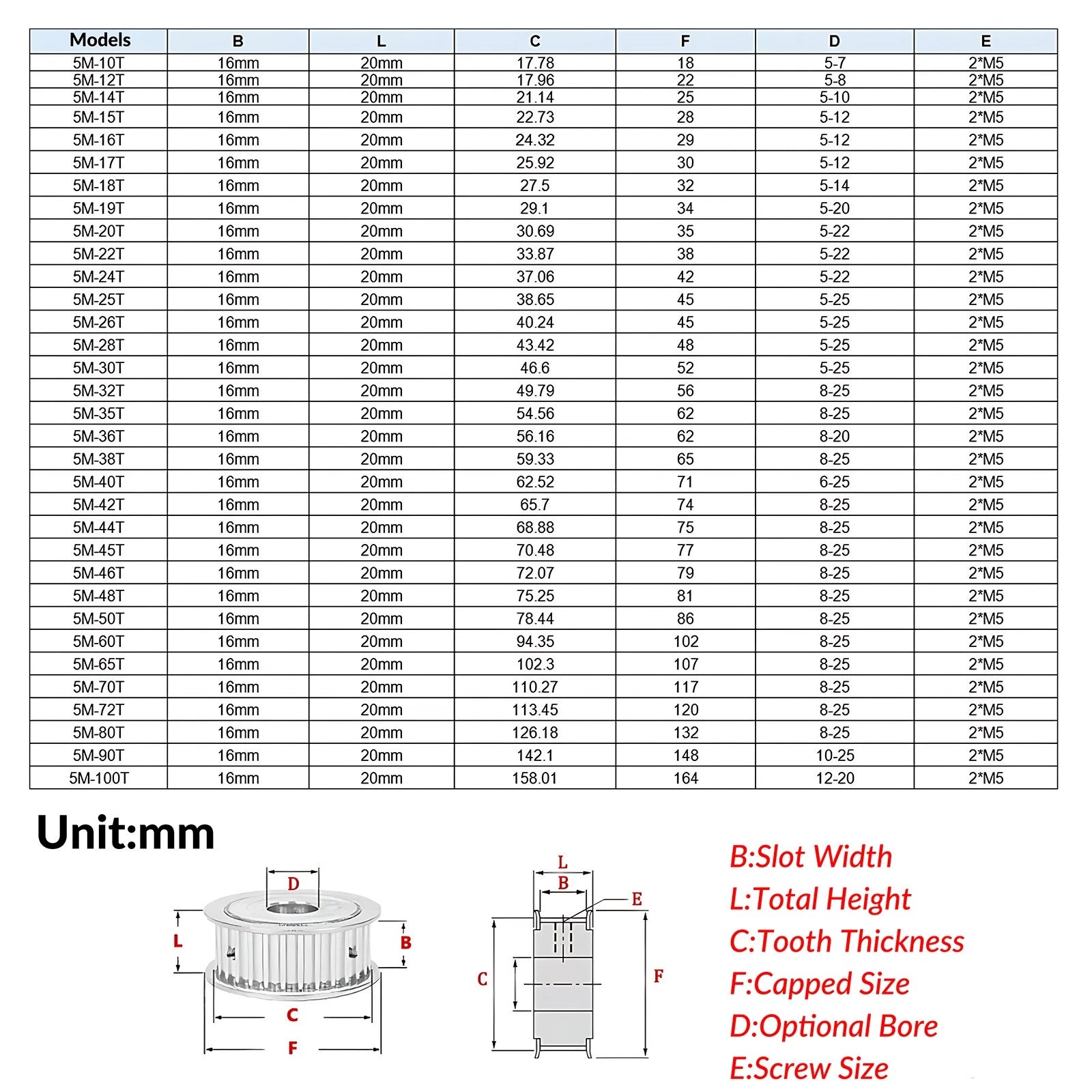
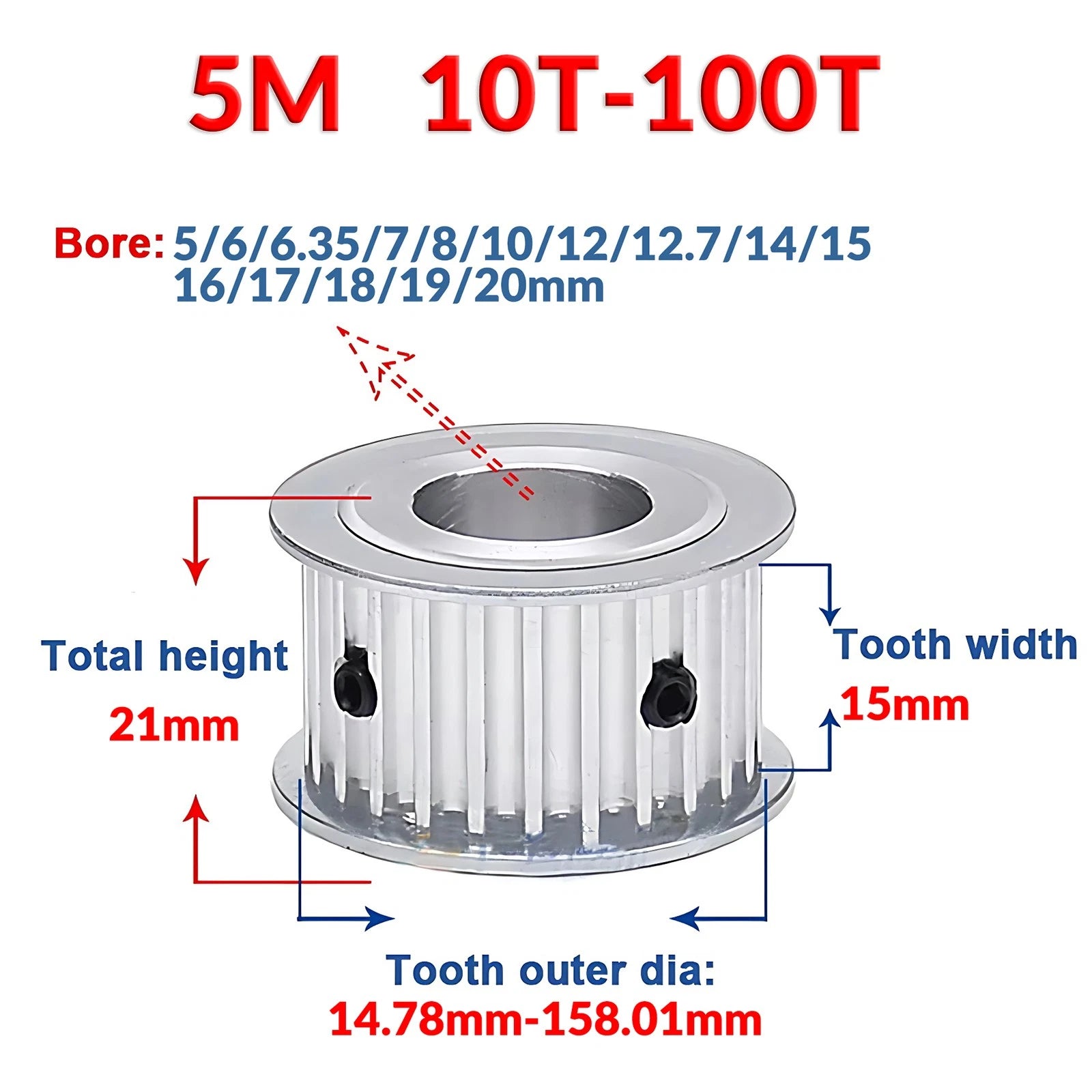
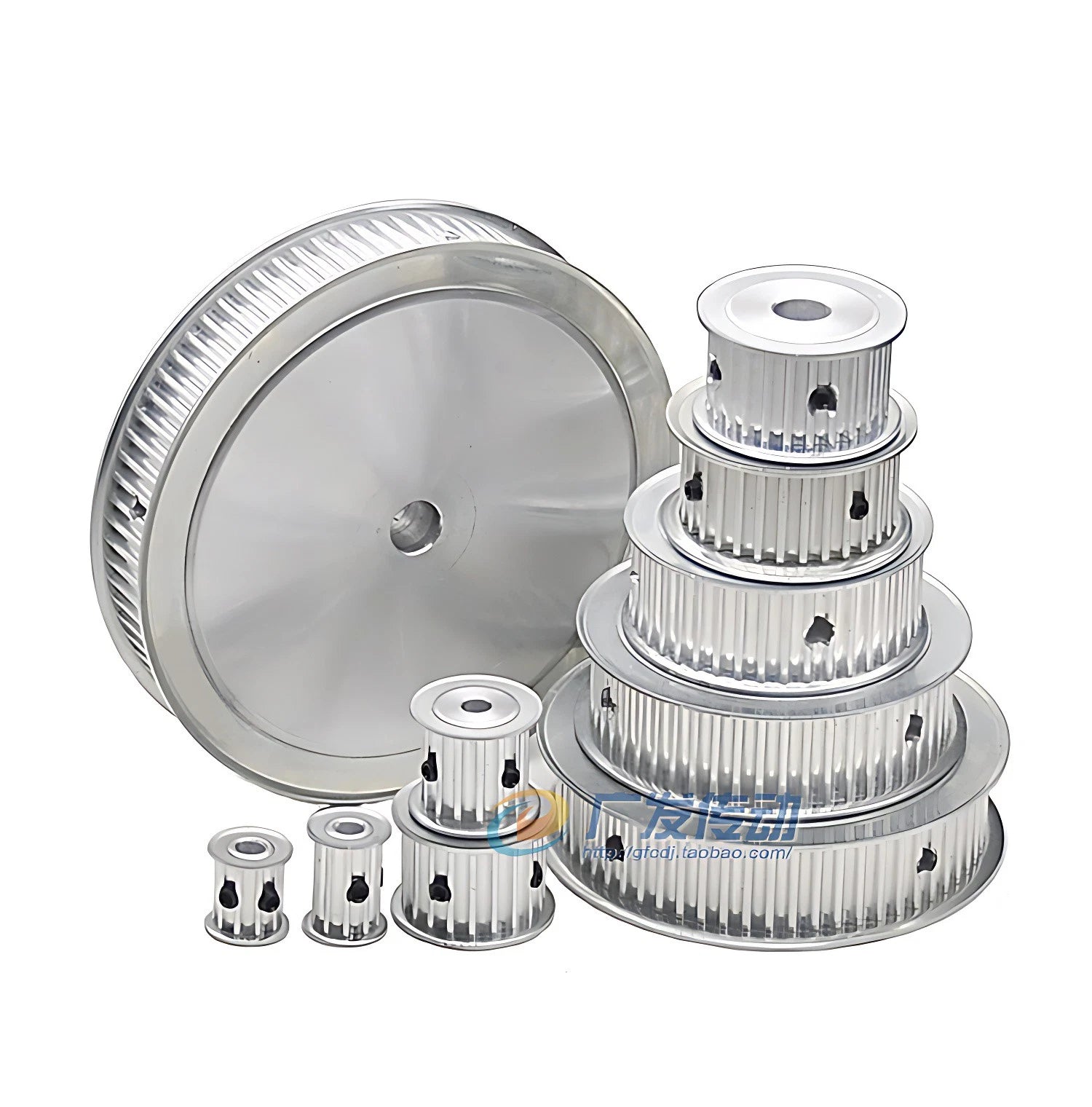
These 5M timing belt pulleys are machined from aluminum alloy with a set-screw bore for secure shaft mounting. The 5M pitch (5mm tooth spacing) suits medium-duty synchronous drive applications. Tooth counts range from 10T to 100T, bore diameters span 5mm to 25mm (approximately 0.20" to 0.98"), and the pulley groove is sized for 15mm wide 5M belts. Each listing ships as 1 piece.

Typical use cases include CNC router X/Y/Z axis drives, FDM 3D printer extruder and motion systems, laser engraver gantry drives, and custom automation or robotics belt-drive assemblies requiring a 5M synchronous belt.

⚙️ Compatibility: Designed for 5M (HTD 5M) synchronous timing belts with 15mm belt width. Verify your shaft diameter matches the selected bore before ordering.

✅ Key Features of These 5M Timing Belt Pulleys

  • 🔩Wide Tooth Count Range (10T–100T): Covers a broad gear ratio spectrum for both high-speed and high-torque drive configurations in CNC and 3D printer builds.
  • 📐Multiple Bore Sizes (5mm–25mm): Available in bore diameters from 5mm to 25mm to fit standard stepper motor shafts, servo shafts, and custom drive axles without additional machining.
  • 🏗️Aluminum Alloy Construction: Lightweight yet rigid material keeps rotational inertia low while maintaining dimensional stability under continuous cyclic loading.
  • 🎯HTD 5M Tooth Profile: The rounded HTD tooth form distributes belt load across a larger contact area, reducing tooth wear and improving torque transmission compared to trapezoidal profiles.
  • 🔧Set-Screw Bore Retention: Includes a radial set screw for positive shaft locking, preventing axial and rotational slippage during operation without requiring keyways.
  • 📦Single-Piece Listing: Each variant ships as 1 pulley, allowing you to order exactly the quantity needed for your build or replacement without overstocking.

📐 Technical Specifications — 5M Timing Belt Pulley

Belt Pitch 5M (HTD 5M, 5mm tooth spacing)
Tooth Count 10T – 100T (see variant options)
Bore Diameter 5mm – 25mm (see variant options)
Compatible Belt Width 15mm
Material Aluminum alloy
Bore Retention Set screw
Tooth Profile HTD (rounded)
Quantity per Order 1 piece
Finish See variant options
Flange See variant options

❓ Frequently Asked Questions

How do I choose the right tooth count for my CNC or 3D printer?

The tooth count determines your drive ratio. Pair a smaller pulley on the motor shaft with a larger pulley on the driven shaft to reduce speed and increase torque, or use equal tooth counts for a 1:1 ratio. For most 3D printer motion systems (CoreXY, Cartesian), 20T pulleys on stepper shafts are a common starting point. For CNC routers, match the tooth count to your desired steps-per-mm calculation based on your controller's microstepping setting.

What bore diameter should I select for a standard NEMA 17 stepper motor?

NEMA 17 stepper motors typically have a 5mm output shaft. Select the 5mm bore variant for a direct fit. If your motor has a D-cut shaft, the set screw will engage the flat to prevent rotation. For NEMA 23 motors, the shaft is commonly 6.35mm (1/4") or 8mm — check your motor's datasheet and select the matching bore.

Are these pulleys compatible with both HTD 5M and standard 5M belts?

These pulleys use the HTD 5M tooth profile, which features a rounded tooth form. They are designed for HTD 5M belts. While the pitch (5mm) is the same as some trapezoidal 5M belts, the tooth profiles differ and mixing profiles can cause accelerated wear or skipping under load. Use HTD 5M belts for reliable engagement.

How strong is the set-screw connection — will it slip under load?

The set screw provides adequate retention for typical CNC and 3D printer torque levels when properly tightened against the shaft. For applications with D-cut or flat-keyed shafts, the set screw engages the flat for additional anti-rotation security. For very high-torque applications, consider using thread-locking compound on the set screw and verify the bore-to-shaft fit is snug (H7 tolerance or similar).

Will aluminum pulleys corrode or degrade over time?

Aluminum alloy naturally forms a thin oxide layer that provides good corrosion resistance in typical indoor workshop and machine environments. For humid or chemically aggressive environments, a light coating of machine oil on the bore and set-screw area is sufficient protection. The tooth surface does not require lubrication when used with standard rubber or polyurethane HTD 5M belts.

Can I use these pulleys for a belt-driven Z-axis on a 3D printer?

Yes. Belt-driven Z-axis designs (common on CoreXZ and some bed-slinger printers) use 5M or 2GT belts depending on the design. Confirm your printer's belt specification is 5M HTD before ordering. Select a tooth count that matches your existing drive pulley or achieves your target Z-axis resolution based on your lead screw or direct-drive ratio.

What is the difference between the various tooth counts in terms of pulley diameter?

The pitch diameter of a 5M pulley increases proportionally with tooth count: approximately PD (mm) = (Tooth Count × 5) ÷ π. For example, a 20T pulley has a pitch diameter of roughly 31.8mm (~1.25"), while a 60T pulley is approximately 95.5mm (~3.76"). Larger tooth counts result in larger pulleys, which affects the physical envelope of your drive system and the achievable gear ratio.

🛒 Select your tooth count (Models) and bore diameter above, then add to cart.


You may also like

Recently viewed