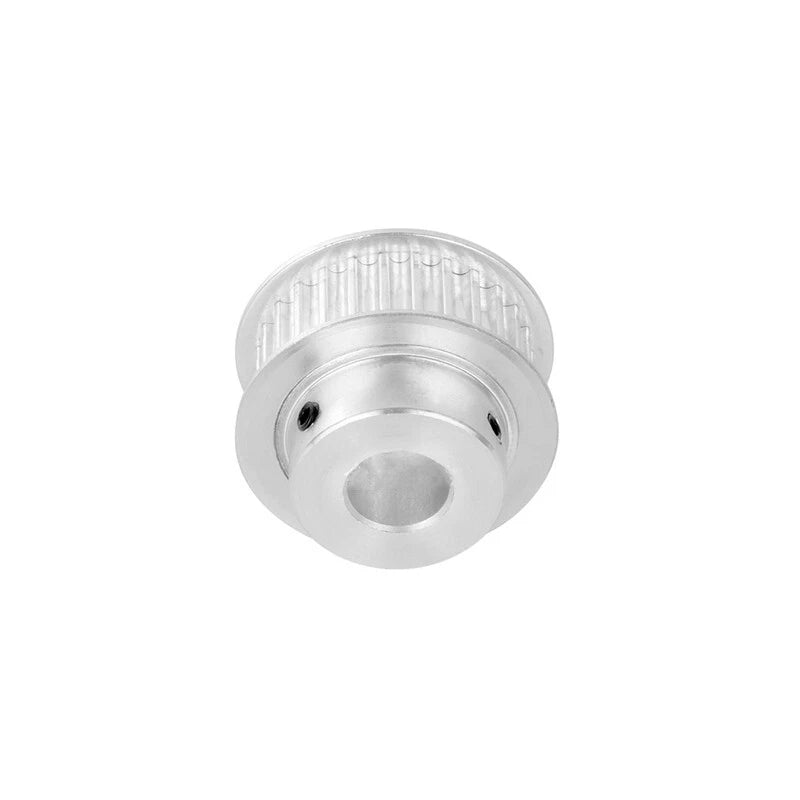
5M 14-29T Timing Pulley 20mm Belt Synchronous Wheel Gear 3D Printer Bore 5-19mm

No reviews

Price:
Sale price$10.13 USD
Stock:
In stock (500 units), ready to be shipped

Payment & Security

Ach Direct Debit Amazon American Express Apple Pay Bancontact BLIK Diners Club Discover EPS Google Pay iDEAL Wero JCB Maestro Mastercard Multibanco MobilePay PayPal Przelewy24 Shop Pay Twint Union Pay USDC Visa

Your payment information is processed securely. We do not store credit card details nor have access to your credit card information.

Limited Offer — Spend More, Save More
Spend $55+
Save $5
Spend $100+
Save $10
Spend $200+
Save $25
HomeDIYer DIY Expert Support

DIY Expert Support

Get fitment advice & recommendations

Mon–Fri  8:30 AM – 8:00 PM
24-Hour Fast Ship
Arrives in 3–14 Days
Worldwide Shipping
30-Day Returns
1 tree planted with every purchase

Description

5M Timing Pulley 14–29T — Precision Synchronous Drive for CNC, 3D Printers & Robotics

When your motion-control build demands slip-free, repeatable positioning, a mismatched or worn pulley becomes the weakest link in the entire drivetrain. Engineers, makers, and automation integrators working on CNC routers, 3D printers, laser cutters, and robotic arms rely on correctly specified 5M timing pulleys to maintain tooth engagement and eliminate backlash under load.

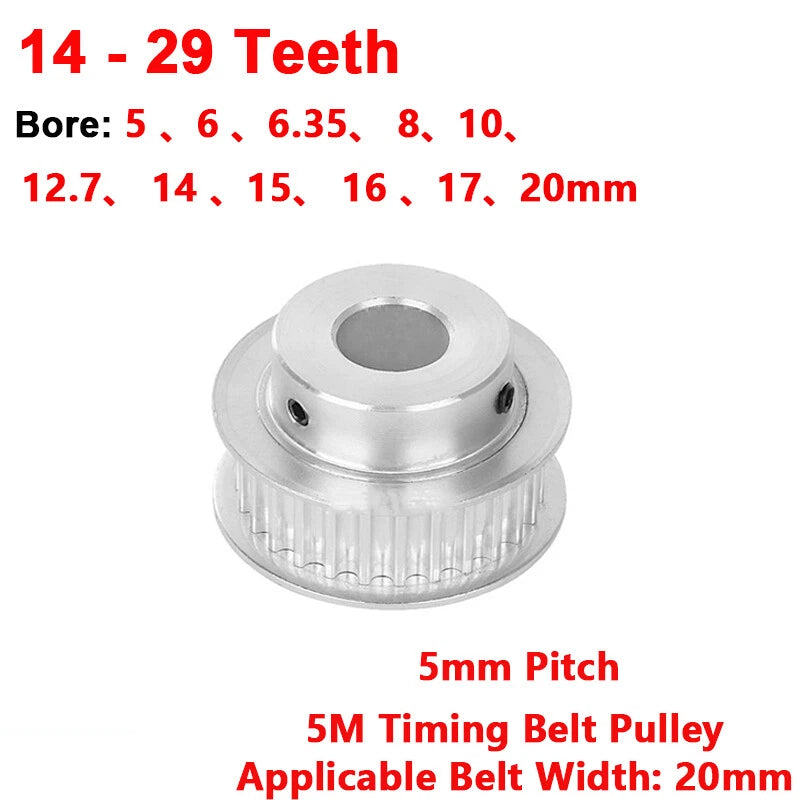
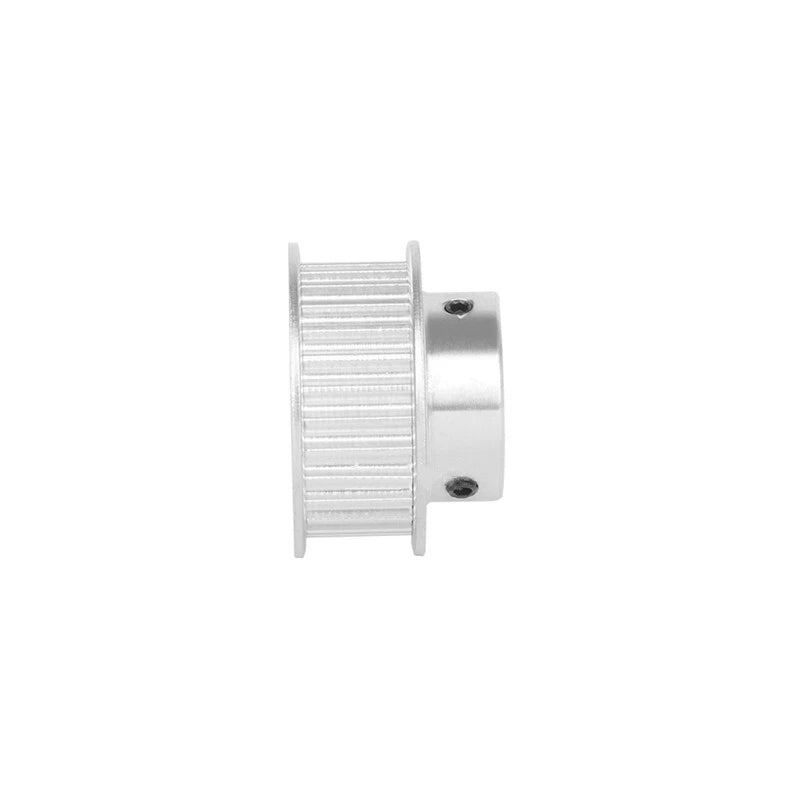
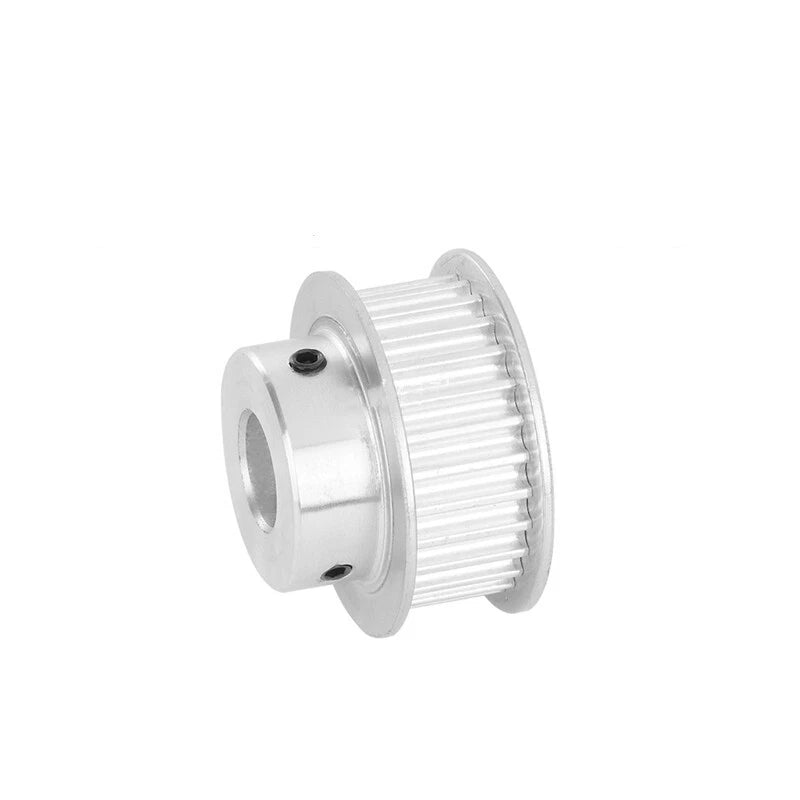
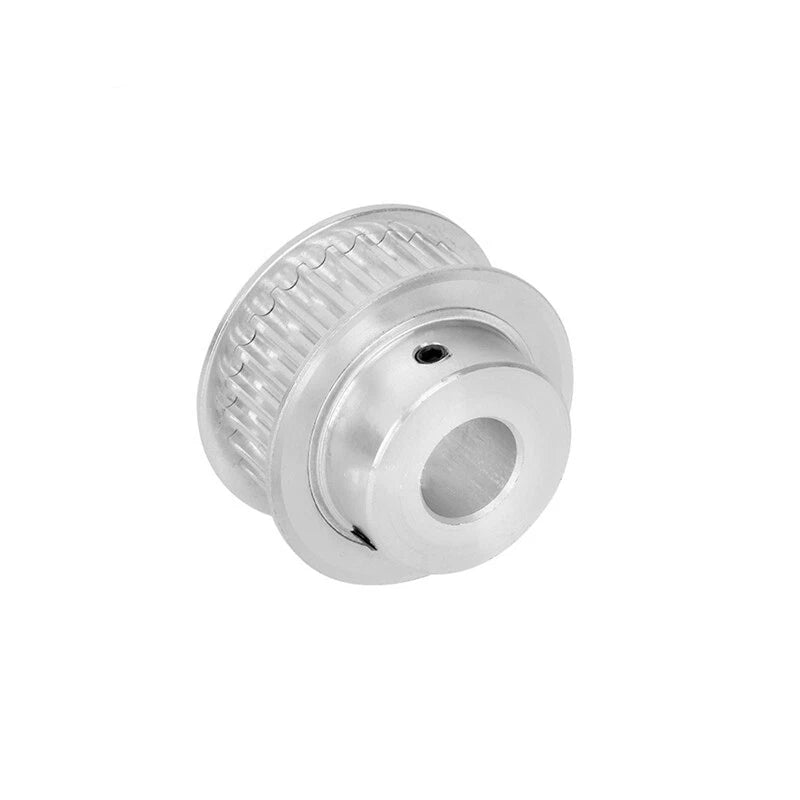
These 5M synchronous wheel gears feature a 5 mm pitch profile and a 20 mm (0.79 in) belt-contact width. The bore range spans 5 mm to 20 mm (0.20–0.79 in), and tooth counts run from 14 T to 29 T, giving pitch diameters of approximately 22.3 mm to 46.2 mm (0.88–1.82 in). Each pulley is machined from aluminum alloy with an anodized finish for corrosion resistance and reduced rotating mass.

Typical use cases include X/Y-axis drives on desktop CNC mills, extruder and Z-axis assemblies on FDM 3D printers, conveyor indexing systems requiring precise step counts, and servo-driven robotic joint actuators where tooth-count ratio determines gear reduction.

⚙️ Compatibility: Designed for standard 5M (5 mm pitch) synchronous belts with 20 mm width. Verify your belt pitch, width, and shaft diameter before ordering.

✅ Key Features of These 5M Timing Pulleys

🦷
14–29 Tooth Range

Wide tooth-count selection lets you dial in the exact pitch diameter and gear ratio your drivetrain requires without custom machining.

📏
20 mm Belt Width

The 20 mm (0.79 in) tooth-contact width distributes belt load evenly, reducing tooth stress and extending belt service life in continuous-duty applications.

🔩
Bore 5–20 mm

Available bore sizes from 5 mm to 20 mm (including 6.35 mm / ¼ in and 12.7 mm / ½ in imperial sizes) fit stepper motors, servo shafts, and standard round stock directly.

🛡️
Aluminum Alloy Construction

Machined aluminum body keeps rotating inertia low while providing the rigidity needed for accurate positioning in CNC and 3D-printer applications.

🔄
Synchronous / Zero-Slip Drive

Positive tooth engagement eliminates the slip and stretch associated with V-belts, ensuring consistent step-to-distance calibration on motion-control axes.

🏭
Broad Application Fit

Suitable for CNC routers, FDM 3D printers, laser engravers, conveyor indexers, and servo-driven robotic joints — anywhere a 5M belt drive is specified.

📐 Technical Specifications — 5M Timing Pulley

Belt Pitch 5M (5 mm pitch)
Belt Width 20 mm (0.79 in)
Number of Teeth 14 T – 29 T (see variant options)
Bore Diameter 5 / 6 / 6.35 / 8 / 10 / 12 / 12.7 / 14 / 15 / 16 / 17 / 18 / 19 / 20 mm (see variant options)
Pitch Diameter (approx.) 22.3 mm – 46.2 mm (0.88–1.82 in), varies by tooth count
Material Aluminum alloy
Finish Anodized
Tooth Width 21 mm
Quantity per Order 1 piece
Weight See variant options

❓ Frequently Asked Questions

How do I choose the right tooth count for my application?

The tooth count determines the pulley's pitch diameter and, combined with the driven pulley's tooth count, sets your gear ratio. For a 1:1 drive (same speed on both shafts) use identical tooth counts. To reduce speed and increase torque, use a larger tooth count on the driven shaft. A common starting point for 3D-printer X/Y axes is 20 T, which gives a pitch diameter of approximately 31.8 mm with a 5M belt.

Which bore size should I select for a NEMA 17 stepper motor?

NEMA 17 stepper motors typically have a 5 mm output shaft. Select the 5 mm bore variant. If your motor has a flat (D-cut) shaft, you will need to add a set screw or use a shaft coupler — the pulley bore itself is round.

Is this pulley compatible with any 5M belt, or only 20 mm wide belts?

The tooth profile is standard 5M (5 mm pitch) and will mesh correctly with any 5M synchronous belt. However, the pulley flange and tooth-contact width are sized for 20 mm wide belts. Using a narrower belt (e.g., 15 mm) is possible but reduces load capacity; using a wider belt is not recommended as it may ride over the flanges.

How corrosion-resistant is the aluminum pulley?

The anodized aluminum finish provides good resistance to oxidation and mild chemical exposure, making these pulleys suitable for indoor automation, 3D printing, and light industrial environments. For high-humidity or outdoor applications, consider adding a light coating of dry lubricant to the bore and shaft interface.

Can I use these pulleys on a laser cutter or engraver?

Yes. Laser cutters and engravers commonly use 5M belt drives on their gantry axes. Select the tooth count that matches your existing pulley or the ratio specified in your machine's BOM. Verify the bore matches your motor shaft diameter before ordering.

What is the difference between the 6 mm and 6.35 mm bore options?

6 mm is a metric bore size common on metric stepper and servo motors. 6.35 mm (¼ inch) is the imperial equivalent used on many North American servo motors and DC gear motors. Measure your shaft with calipers before selecting — the 0.35 mm difference means the wrong bore will either be too loose or will not fit at all.

Do these pulleys include set screws or keyways?

Set screw inclusion varies by variant. Please check the product images or contact us to confirm whether your selected variant includes a set screw. Keyways are not standard on these pulleys; shaft retention is typically achieved via set screw against the shaft flat or a friction fit.

🛒 Select your tooth count, bore size, and tooth width above, then add to cart.


You may also like

Recently viewed