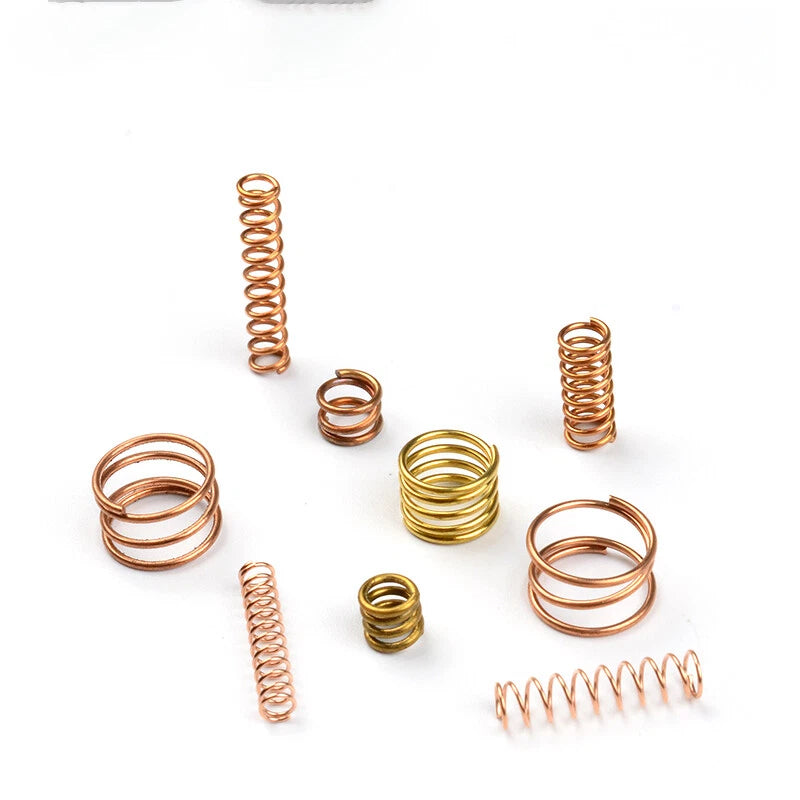
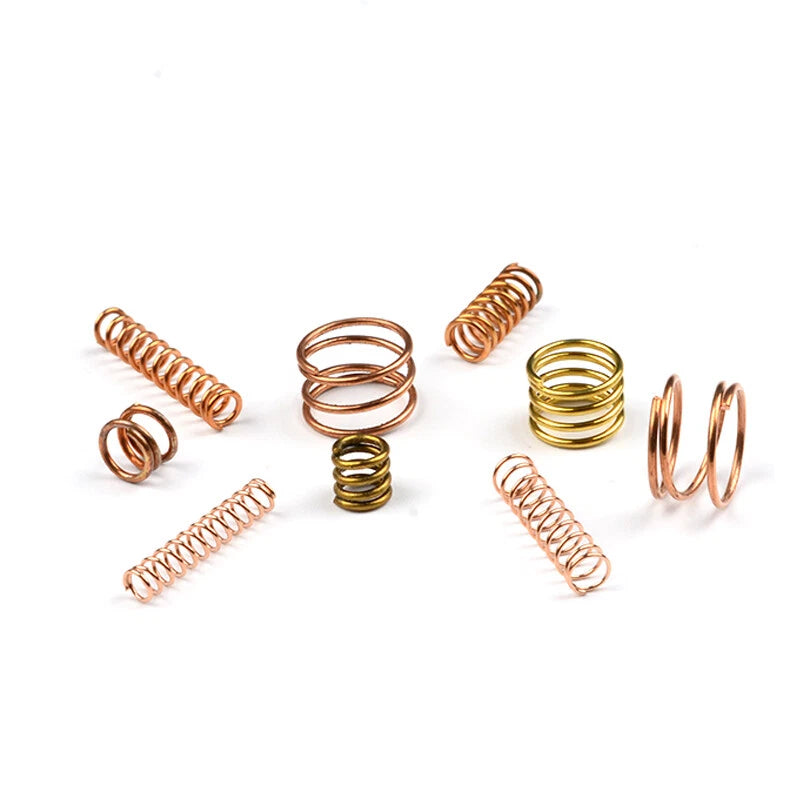
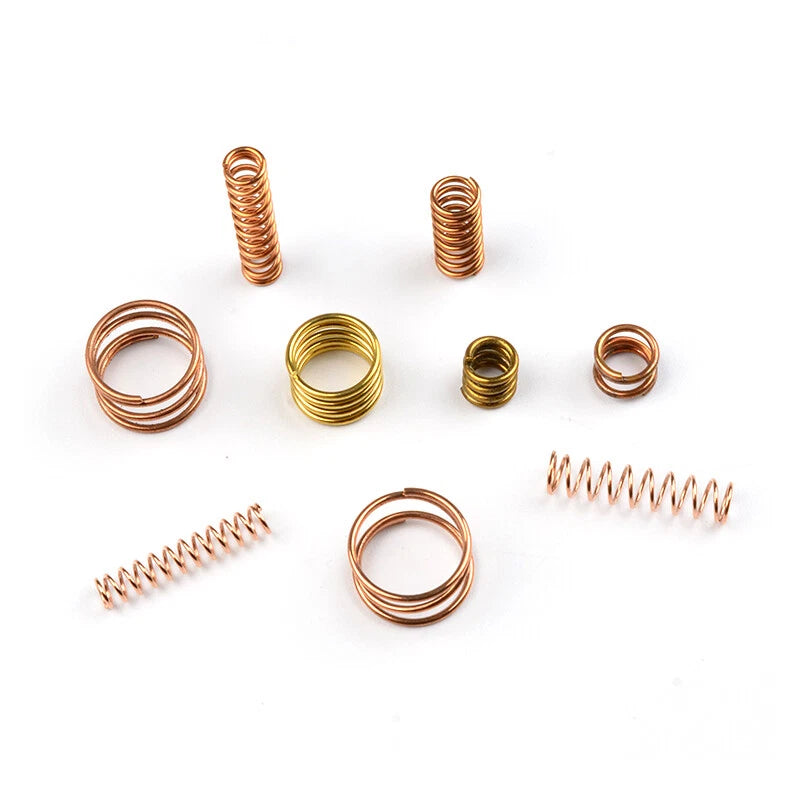
10 Pcs Brass Compression Spring Pressure Springs Wire Diameter 0.2mm to 1.2mm

No reviews

Price:
Sale price$5.85 USD
Stock:
In stock (500 units), ready to be shipped

Payment & Security

Ach Direct Debit Amazon American Express Apple Pay Bancontact BLIK Diners Club Discover EPS Google Pay iDEAL Wero JCB Maestro Mastercard Multibanco MobilePay PayPal Przelewy24 Shop Pay Twint Union Pay USDC Visa

Your payment information is processed securely. We do not store credit card details nor have access to your credit card information.

Limited Offer — Spend More, Save More
Spend $55+
Save $5
Spend $100+
Save $10
Spend $200+
Save $25
HomeDIYer DIY Expert Support

DIY Expert Support

Get fitment advice & recommendations

Mon–Fri  8:30 AM – 8:00 PM
24-Hour Fast Ship
Arrives in 3–14 Days
Worldwide Shipping
30-Day Returns
1 tree planted with every purchase

Description

Brass Compression Springs — Precision Pressure Springs for Mechanical & DIY Applications

When a loose mechanism rattles, a valve fails to seat, or a small assembly loses its return force, the culprit is almost always a worn or incorrectly sized compression spring. Engineers, hobbyists, watchmakers, and repair technicians who need a reliable, corrosion-resistant solution turn to brass compression springs — a material that combines dimensional stability with natural resistance to moisture and mild chemicals.

Each pack contains 10 pieces of brass compression springs. Wire diameters span 0.2 mm (approx. 0.008 in) to 1.2 mm (approx. 0.047 in), with outer diameters ranging from 1 mm to 13.8 mm (approx. 0.04 in to 0.54 in) and free lengths from 4.5 mm to 40 mm (approx. 0.18 in to 1.57 in) depending on the variant selected. The springs are wound from brass wire and feature open, ground-flat ends suited to standard spring seats.

Typical use cases include small appliance repair requiring miniature compression spring replacement, precision instrument assembly where a non-magnetic spring material is required, and electronics or PCB fixture work where a conductive yet corrosion-resistant return spring is needed for contact pins or test probes.

🔧 Compatible with standard spring seats, plunger assemblies, valve bodies, and PCB contact fixtures. Select Wire Diameter, Outer Diameter, and Length to match your application.

✅ Key Features of These Brass Compression Springs

🟡 Brass Material — Naturally resistant to corrosion and oxidation in humid or mildly corrosive environments, making these springs suitable for long-term use in exposed assemblies.
📐 Wide Size Range — Wire diameters from 0.2 mm to 1.2 mm paired with multiple outer diameter and length combinations let you match the exact spring geometry your project demands.
Non-Magnetic — Brass is non-ferrous and non-magnetic, making these springs ideal for sensitive electronic, optical, or magnetic-field-sensitive assemblies.
🔁 Consistent Return Force — Uniform wire winding delivers repeatable spring rates, ensuring reliable actuation in valves, plungers, latches, and contact mechanisms.
📦 10-Piece Pack — Each order includes 10 springs of the selected specification, giving you spares for prototyping, repair batches, or multi-unit builds.
🛠️ Versatile Application — Suited for small appliance repair, precision instruments, PCB test fixtures, model engineering, and general mechanical assemblies requiring a compact compression element.

📐 Technical Specifications — Brass Compression Springs

Material Brass
Wire Diameter Range 0.2 mm – 1.2 mm (approx. 0.008 in – 0.047 in)
Outer Diameter Range 1 mm – 13.8 mm (approx. 0.04 in – 0.54 in)
Free Length Range 4.5 mm – 40 mm (approx. 0.18 in – 1.57 in)
End Type Open ends (ground-flat style)
Spring Type Compression (push / pressure)
Finish Natural brass
Quantity per Pack 10 pieces
Spring Rate See variant options
Max Load See variant options

❓ Frequently Asked Questions

How do I choose the right wire diameter and outer diameter for my application?

Start with the bore or seat diameter your spring must fit into — the outer diameter of the spring should be slightly smaller than the bore. Then select a wire diameter that provides the stiffness you need: thicker wire (e.g., 1.0–1.2 mm) gives a stiffer spring, while thinner wire (e.g., 0.2–0.3 mm) gives a softer, more compliant spring. Use the variant selector above to match Wire Diameter, Outer Diameter, and Length to your assembly.

Are these springs strong enough for load-bearing mechanical assemblies?

These are miniature precision springs intended for light-duty applications such as contact pins, small valves, latches, and instrument mechanisms. They are not designed for heavy structural or high-load industrial use. For load-critical applications, please verify the spring rate and maximum load against your design requirements before ordering.

Will brass springs corrode or rust over time?

Brass does not rust (rust is specific to iron-based metals). It can develop a patina (surface oxidation) over time when exposed to air and moisture, but this does not significantly affect mechanical performance in most applications. For highly corrosive environments, consider whether a stainless steel spring might be more appropriate.

Are these springs compatible with PCB test fixtures and electronic assemblies?

Yes. Brass is electrically conductive and non-magnetic, making these springs well-suited for PCB contact pins, spring-loaded test probes, and electronic fixture applications where a conductive return element is needed without introducing magnetic interference.

What is the difference between the various outer diameter options for the same wire diameter?

For a given wire diameter, a larger outer diameter results in a lower spring rate (softer spring) and a smaller outer diameter results in a higher spring rate (stiffer spring). Choose the outer diameter that fits your housing bore and delivers the deflection and force characteristics your application requires.

Can I use these springs as replacements for worn springs in small appliances or tools?

Yes, these are commonly used as replacement springs in small appliances, mechanical pencils, clickers, valves, and hand tools. Measure the wire diameter, outer diameter, and free length of the original spring, then select the matching variant from the options above.

Why does the price vary between some variants?

Larger outer diameters and longer free lengths require more brass wire per spring, which increases the material cost per pack. Variants with larger OD (e.g., 10 mm and above) or longer lengths (e.g., 35–40 mm) are priced slightly higher to reflect this difference.

🛒 Select your Wire Diameter, Outer Diameter, and Length above, then add to cart.

You may also like

Recently viewed