Compression Spring Various Size 28-32mm Diameter& 20-305mm Length Pressure Small

No reviews

Price:
Sale price$13.53 USD
Stock:
In stock (500 units), ready to be shipped

Payment & Security

Ach Direct Debit Amazon American Express Apple Pay Bancontact BLIK Diners Club Discover EPS Google Pay iDEAL Wero JCB Maestro Mastercard Multibanco MobilePay PayPal Przelewy24 Shop Pay Twint Union Pay USDC Visa

Your payment information is processed securely. We do not store credit card details nor have access to your credit card information.

Limited Offer — Spend More, Save More
Spend $55+
Save $5
Spend $100+
Save $10
Spend $200+
Save $25
HomeDIYer DIY Expert Support

DIY Expert Support

Get fitment advice & recommendations

Mon–Fri  8:30 AM – 8:00 PM
24-Hour Fast Ship
Arrives in 3–14 Days
Worldwide Shipping
30-Day Returns
1 tree planted with every purchase

Description

Compression Spring 28–32mm OD — Reliable Pressure Control for DIY & Automation Projects

When a loose mechanism rattles, a valve fails to seat, or a jig loses its return force, the culprit is almost always a worn or incorrectly sized compression spring. Makers, workshop technicians, and automation hobbyists who need a dependable, drop-in replacement will find this compression spring range covers the most common metric sizes in one place.

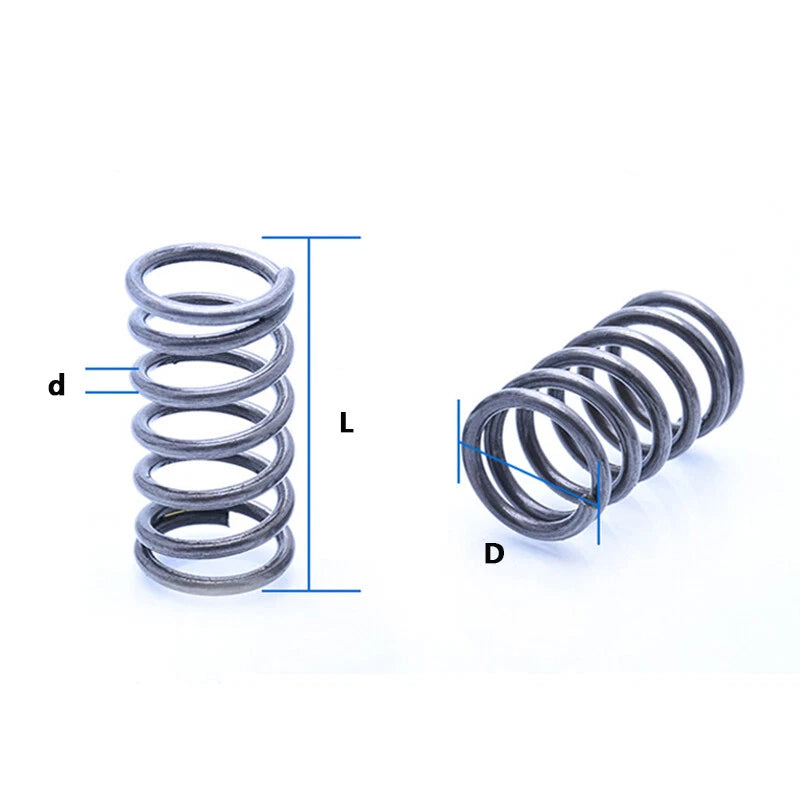
Each spring is formed from 3 mm wire diameter steel, with outer diameters spanning 28 mm, 29 mm, 30 mm, and 32 mm (approximately 1.10–1.26 in). Free lengths range from 20 mm to 305 mm (approximately 0.79–12.0 in), giving you the flexibility to match the exact travel and load requirements of your application. The close-wound coil geometry provides consistent spring rate and reliable axial compression across the full stroke.

Typical use cases include DIY automation jigs requiring repeatable return force, small pneumatic valve assemblies needing a compact compression spring for seating, and custom mechanical fixtures in 3D-printer frames, CNC routers, or robotics platforms where a 3 mm wire compression spring in the 28–32 mm OD range is the standard specification.

⚙️ Compatibility: Suitable for spring seats, guide rods, and bores sized for 28–32 mm outer diameter. Verify free length and spring rate against your application before ordering.

✅ Key Features of These Compression Springs

📐 Wide Size Range

Outer diameters of 28, 29, 30, and 32 mm paired with free lengths from 20 mm to 305 mm — one listing covers dozens of standard metric compression spring sizes.

🔩 3 mm Wire Diameter

Consistent 3 mm wire gauge across all variants ensures predictable spring rate and load capacity, making cross-size substitution straightforward.

🔄 Axial Compression Design

Close-wound coil geometry delivers uniform compression along the spring axis, minimising lateral buckling in guided applications.

🛡️ Corrosion-Resistant Finish

Surface treatment helps resist oxidation in typical indoor workshop and light-industrial environments, extending service life.

📦 Flexible Pack Quantities

Available in packs of 1 or 2 pieces — order exactly what your project needs without overstocking.

🔧 Drop-In Replacement Ready

Metric dimensions match common spring seats in automation hardware, pneumatic valves, and DIY mechanical assemblies for a straightforward swap.

📐 Technical Specifications — Compression Spring

Wire Diameter 3 mm (0.118 in)
Outer Diameter (OD) 28 mm / 29 mm / 30 mm / 32 mm
Free Length Range 20 mm – 305 mm (0.79 in – 12.0 in)
Spring Type Compression (axial load)
Coil Style Close-wound
Material See variant options
Surface Finish See variant options
Spring Rate See variant options
Max Load Capacity See variant options
Pack Quantity 1 pc or 2 pcs (select above)
End Type See variant options

❓ Frequently Asked Questions

How do I choose the right outer diameter for my application?

Measure the inner diameter of the spring seat or guide bore in your assembly. The spring's outer diameter should be 0.5–1.5 mm smaller than the bore to allow free movement without binding. For example, if your bore is 30 mm, a 28 mm or 29 mm OD spring is typically the correct fit.

How do I select the correct free length?

Free length should be long enough to maintain contact force at maximum extension, yet short enough to avoid coil bind at full compression. As a starting point, choose a free length roughly 1.5–2× the desired compressed (working) length. Refer to your mechanism's travel specification for the exact figure.

Are these springs strong enough for my load?

Load capacity depends on wire diameter, outer diameter, free length, and number of active coils — all of which interact. The 3 mm wire diameter used here is suited to light-to-medium duty applications. If you have a specific load requirement in Newtons or pounds-force, please contact us to confirm suitability before ordering.

Will these springs rust or corrode in my workshop environment?

The springs carry a surface treatment that provides resistance to light moisture and humidity typical of indoor workshop conditions. For outdoor, high-humidity, or chemical-exposure environments, additional protective measures (such as a light coat of oil) are recommended. Contact us to confirm the specific finish for your chosen variant.

Are these compatible with standard metric spring seats and guide rods?

Yes. The outer diameters (28, 29, 30, 32 mm) and 3 mm wire diameter conform to common metric spring standards, making them compatible with most metric spring seats, guide rods, and pneumatic valve bodies designed for this OD range. Always verify the bore clearance and end-type requirements of your specific assembly.

Should I order 1 pc or 2 pcs?

If you need a single replacement spring, the 1 pc option is the most economical choice. The 2 pc pack is ideal when you need a matched pair (e.g., symmetrical jig fixtures or dual-spring valve assemblies) or simply want a spare on hand. Note that longer lengths (120 mm and above) are available in the 1 pc pack only.

Can I use these springs in a 3D printer, CNC router, or robotics project?

Absolutely. The 28–32 mm OD range and 3 mm wire diameter are commonly specified in DIY automation platforms, CNC Z-axis counterbalance assemblies, and robotic gripper return mechanisms. Select the free length that matches your axis travel and preload requirements.

What is the difference between the 28 mm, 29 mm, 30 mm, and 32 mm outer diameter options?

All four share the same 3 mm wire diameter, so the primary differences are the inner diameter (ID), the spring rate, and the bore size they fit. A larger OD with the same wire diameter generally yields a lower spring rate (softer feel). Choose based on your bore size and the load-deflection curve your application requires.

🛒 Select your size (Wire Diameter × Outer Diameter × Length) and quantity above, then add to cart.

You may also like

Recently viewed