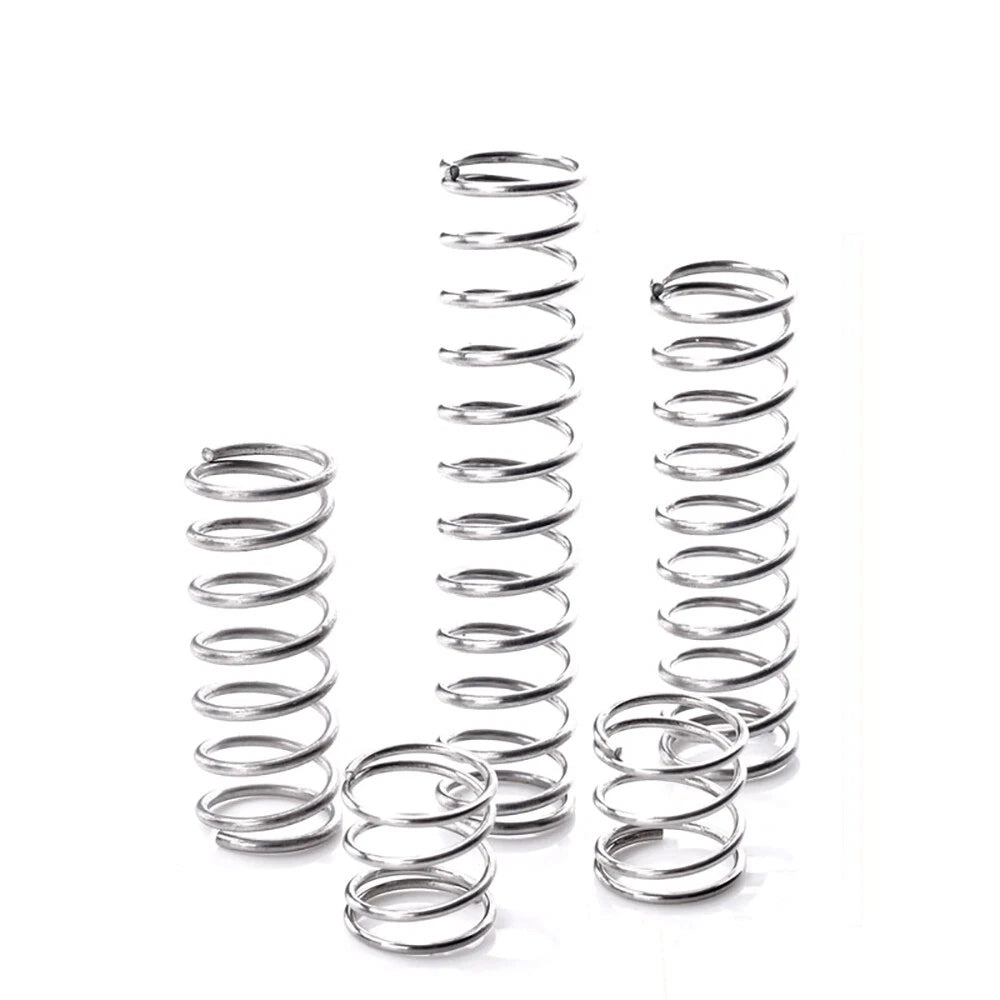
Compression Spring Various 0.6-0.8mm Diameter & 5-14mm Length Pressure Small

No reviews

Price:
Sale price$3.93 USD
Stock:
In stock (500 units), ready to be shipped

Payment & Security

Ach Direct Debit Amazon American Express Apple Pay Bancontact BLIK Diners Club Discover EPS Google Pay iDEAL Wero JCB Maestro Mastercard Multibanco MobilePay PayPal Przelewy24 Shop Pay Twint Union Pay USDC Visa

Your payment information is processed securely. We do not store credit card details nor have access to your credit card information.

Limited Offer — Spend More, Save More
Spend $55+
Save $5
Spend $100+
Save $10
Spend $200+
Save $25
HomeDIYer DIY Expert Support

DIY Expert Support

Get fitment advice & recommendations

Mon–Fri  8:30 AM – 8:00 PM
24-Hour Fast Ship
Arrives in 3–14 Days
Worldwide Shipping
30-Day Returns
1 tree planted with every purchase

Description

Miniature Compression Springs — Precision Wire Diameters 0.6–0.9mm for Tight-Tolerance Applications

When a project demands consistent return force in a confined space, undersized or mismatched springs cause misfires, binding, and premature failure. Engineers, hobbyists, and repair technicians working on small mechanisms — from pen clickers and valve assemblies to sensor housings and precision instruments — need springs that hold exact tolerances across every cycle. These miniature compression springs are stocked in a broad matrix of wire diameters, outer diameters, and free lengths so you can match the right spring to the right bore without compromise.

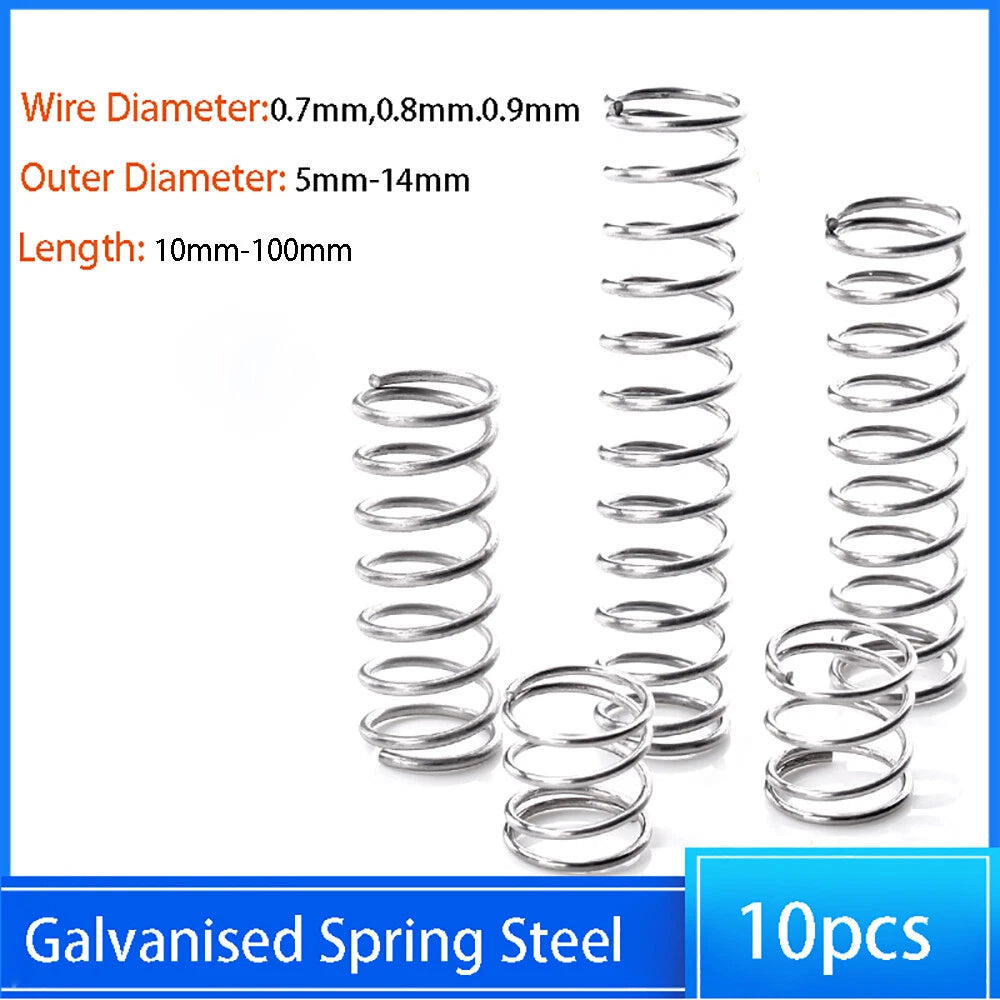
Each spring is formed from round steel wire with wire diameters ranging from 0.6 mm to 0.9 mm (approximately 0.024 in to 0.035 in), outer diameters from 5 mm to 14 mm (approximately 0.20 in to 0.55 in), and free lengths from 10 mm to 100 mm (approximately 0.39 in to 3.94 in). The coil ends are closed and ground flat for stable seating. Sold in packs of 10 per variant.

Typical use cases include miniature valve and actuator return springs, electronic component retention in PCB fixtures, small appliance and tool trigger mechanisms, and model-making or robotics projects requiring repeatable spring force in tight bores.

⚙️ Compatibility: Suitable for bore diameters slightly larger than the listed outer diameter. Verify free length, outer diameter, and wire diameter against your assembly drawings before ordering. Packing quantity: 10 pieces per pack.

✅ Key Features of These Miniature Compression Springs

  • 📐Wide Size Matrix — Wire diameters 0.6, 0.7, 0.8, and 0.9 mm combined with outer diameters 5–14 mm and free lengths 10–100 mm give you over 190 size combinations in one listing.
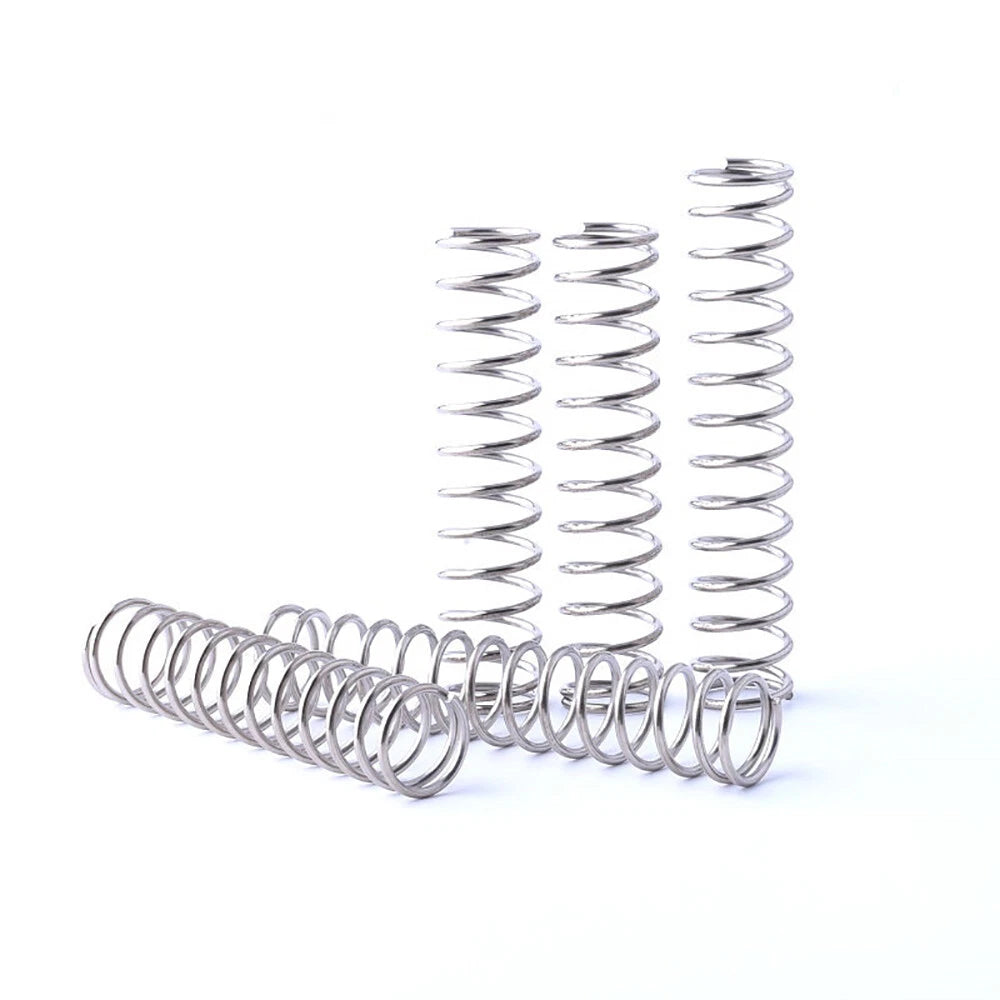
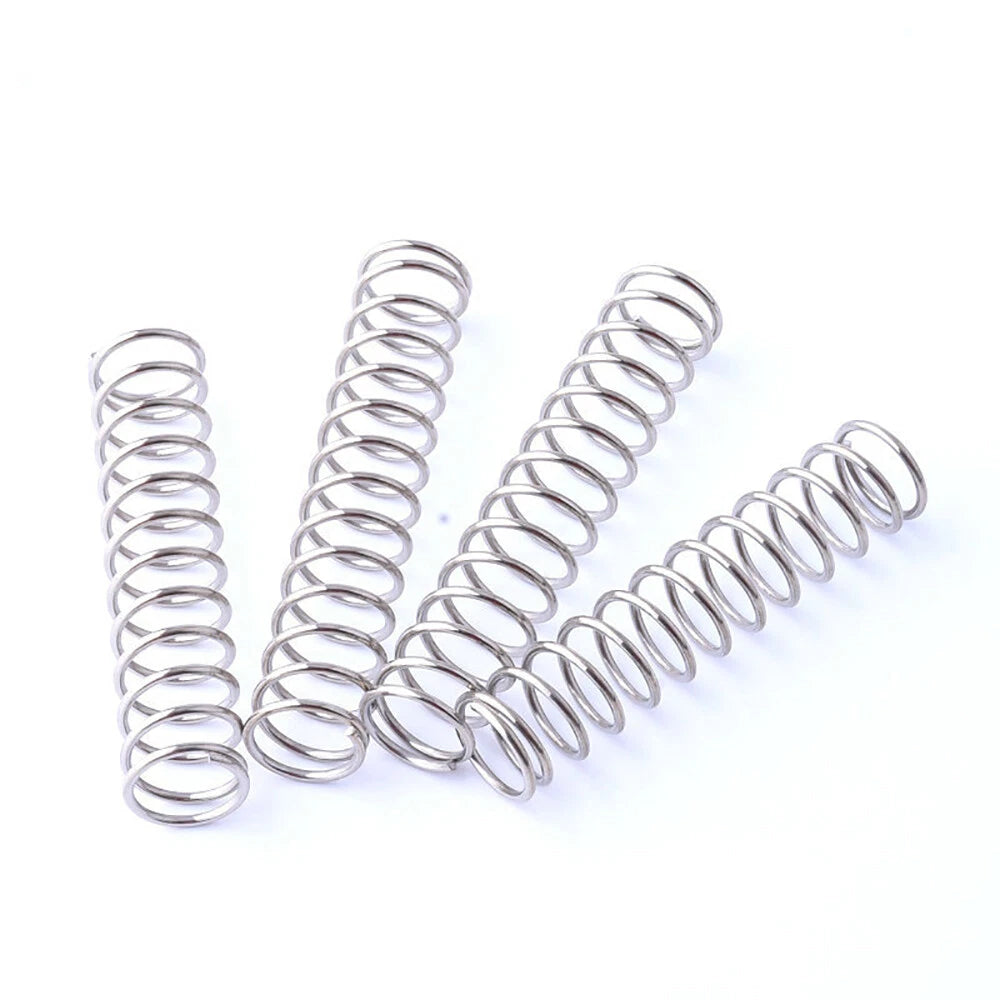
  • 🔩Closed & Ground Ends — Flat-ground end coils provide a stable, perpendicular seating surface, reducing lateral deflection under load and improving load-bearing consistency.
  • Consistent Spring Rate — Uniform wire diameter and coil pitch across each batch deliver repeatable force characteristics, critical for precision mechanisms and calibrated assemblies.
  • 🛡️Steel Construction — Formed from round steel wire suited to general-purpose compression applications; provides adequate tensile strength for the wire gauge across the listed free-length range.
  • 📦Pack of 10 — Each order ships 10 identical springs per selected size, giving you spares for prototyping, repair stock, or multi-unit builds without over-ordering.
  • 🔍Precise Dimensional Coding — Variant names follow the format Wire Diameter × Outer Diameter × Free Length (mm), making it straightforward to cross-reference against engineering drawings or caliper measurements.

📐 Technical Specifications — Miniature Compression Springs

Wire Diameter Range 0.6 mm – 0.9 mm (0.024 in – 0.035 in)
Outer Diameter Range 5 mm – 14 mm (0.20 in – 0.55 in)
Free Length Range 10 mm – 100 mm (0.39 in – 3.94 in)
End Type Closed and ground
Coil Direction See variant options
Material Steel wire (round cross-section)
Surface Finish See variant options
Spring Rate See variant options
Load at Solid Height See variant options
Packing Quantity 10 pieces per pack
Variant Naming Format Wire Ø × Outer Ø × Free Length (mm)

❓ Frequently Asked Questions

How do I read the size code in the variant name?

The variant name follows the format Wire Diameter × Outer Diameter × Free Length, all in millimeters. For example, 0.7×8×50mm means a wire diameter of 0.7 mm, an outer diameter of 8 mm, and a free length of 50 mm. Measure your bore inner diameter, the available axial space, and the wire gauge you need, then match those three numbers to the correct variant.

What bore diameter should I use with a given outer diameter?

As a general guideline, the bore (hole) inner diameter should be approximately 0.2–0.5 mm larger than the spring's outer diameter to allow free movement without excessive lateral play. For example, a spring with a 8 mm outer diameter typically fits a bore of 8.2–8.5 mm. Always verify with your specific assembly tolerances.

What is the spring rate, and how do I estimate the force for my application?

Spring rate (stiffness) depends on wire diameter, outer diameter, number of active coils, and material modulus. Because these springs span a wide size range, the rate varies by variant. If you need a specific force at a defined deflection, contact us with your wire diameter, outer diameter, free length, and required load so we can confirm suitability or recommend an alternative size.

Are these springs corrosion-resistant or suitable for wet environments?

These springs are formed from standard steel wire and are not inherently corrosion-resistant. For applications exposed to moisture, mild chemicals, or outdoor conditions, consider applying a light coating of oil or grease, or contact us to confirm whether a coated or stainless variant is available for your required size. For dry, indoor, or enclosed mechanisms they perform reliably without additional treatment.

Can I use these springs in high-temperature environments?

Standard steel compression springs are generally suitable for temperatures up to approximately 120°C (248°F) before significant loss of spring properties occurs. For applications above this range — such as engine bays, industrial ovens, or high-heat tooling — a heat-resistant alloy spring would be more appropriate. Contact us to confirm operating temperature requirements before ordering.

How do I choose between the 0.6, 0.7, 0.8, and 0.9 mm wire diameters?

Thicker wire diameters produce stiffer springs with higher load capacity for a given outer diameter and free length. Choose a thinner wire (0.6–0.7 mm) when you need a light, gentle return force in a very small bore. Choose a thicker wire (0.8–0.9 mm) when you need more resistance or the spring must support a heavier component. If you are replacing an existing spring, measure the wire diameter with calipers before selecting.

Are these sold individually or in packs?

Each variant is sold in a pack of 10 identical springs. This gives you spares for prototyping, multi-unit production runs, or repair stock. The pack quantity is fixed at 10 per order line; if you need larger quantities, simply increase the order quantity at checkout.

🛒 Select your wire diameter, outer diameter, and free length above, then add to cart.

You may also like

Recently viewed