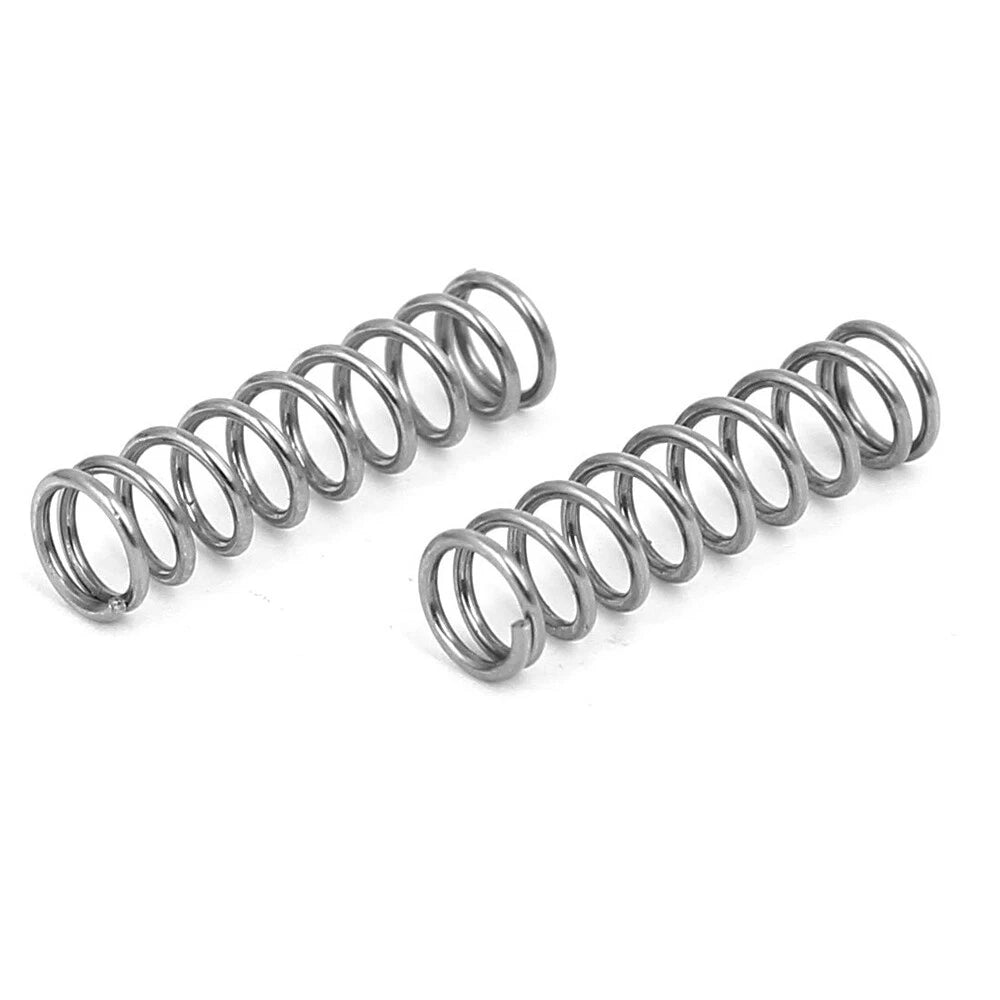
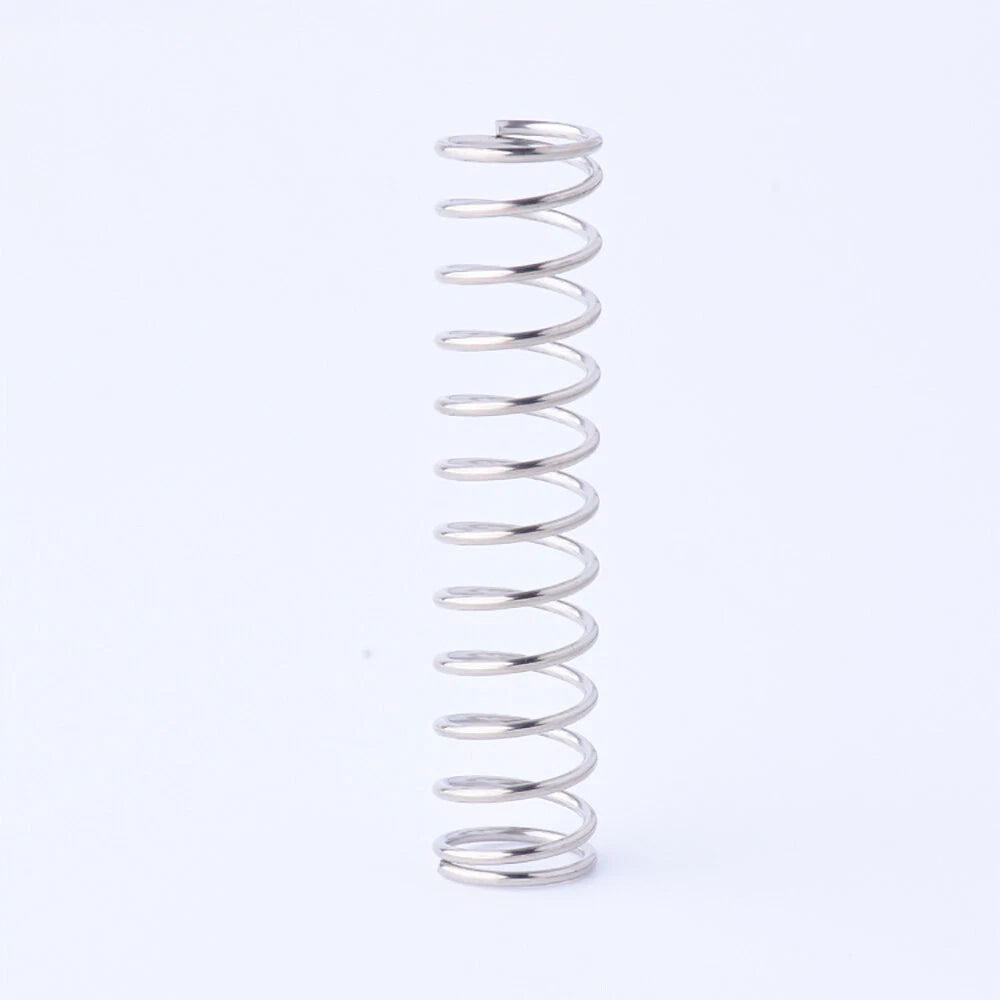
Compression Spring Various 0.6mm-0.7mm Diameter & 5-305mm Length Pressure Small

No reviews

Price:
Sale price$2.98 USD
Stock:
In stock (500 units), ready to be shipped

Payment & Security

Ach Direct Debit Amazon American Express Apple Pay Bancontact BLIK Diners Club Discover EPS Google Pay iDEAL Wero JCB Maestro Mastercard Multibanco MobilePay PayPal Przelewy24 Shop Pay Twint Union Pay USDC Visa

Your payment information is processed securely. We do not store credit card details nor have access to your credit card information.

Limited Offer — Spend More, Save More
Spend $55+
Save $5
Spend $100+
Save $10
Spend $200+
Save $25
HomeDIYer DIY Expert Support

DIY Expert Support

Get fitment advice & recommendations

Mon–Fri  8:30 AM – 8:00 PM
24-Hour Fast Ship
Arrives in 3–14 Days
Worldwide Shipping
30-Day Returns
1 tree planted with every purchase

Description

Compression Spring 0.6–0.7mm Wire Diameter — Reliable Elastic Force for Precision DIY Projects

When your mechanism needs consistent, repeatable push-back force in a compact space, finding the right small compression spring can be frustrating. Undersized springs collapse under load; oversized ones won't fit the bore. These compression springs are engineered for makers, hobbyists, and small-workshop technicians who need reliable elastic performance in tight assemblies — from electronics enclosures to precision jigs.

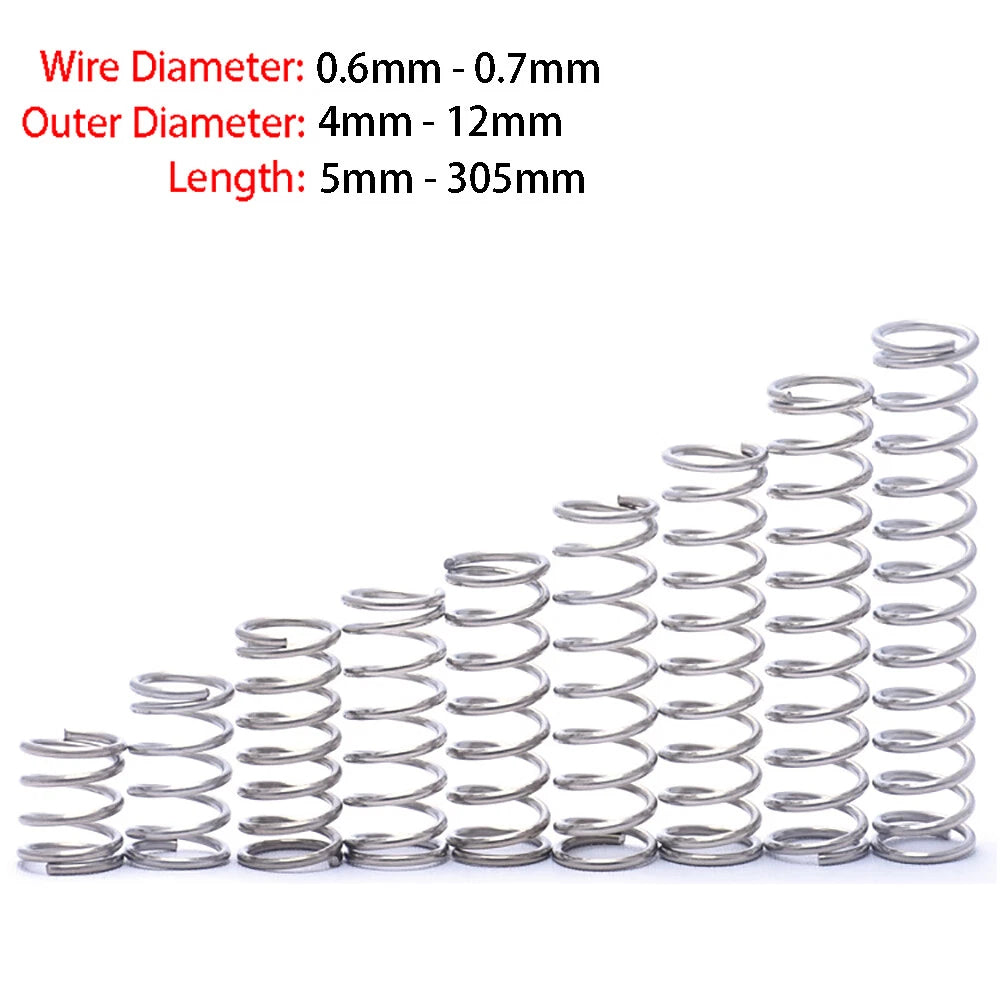
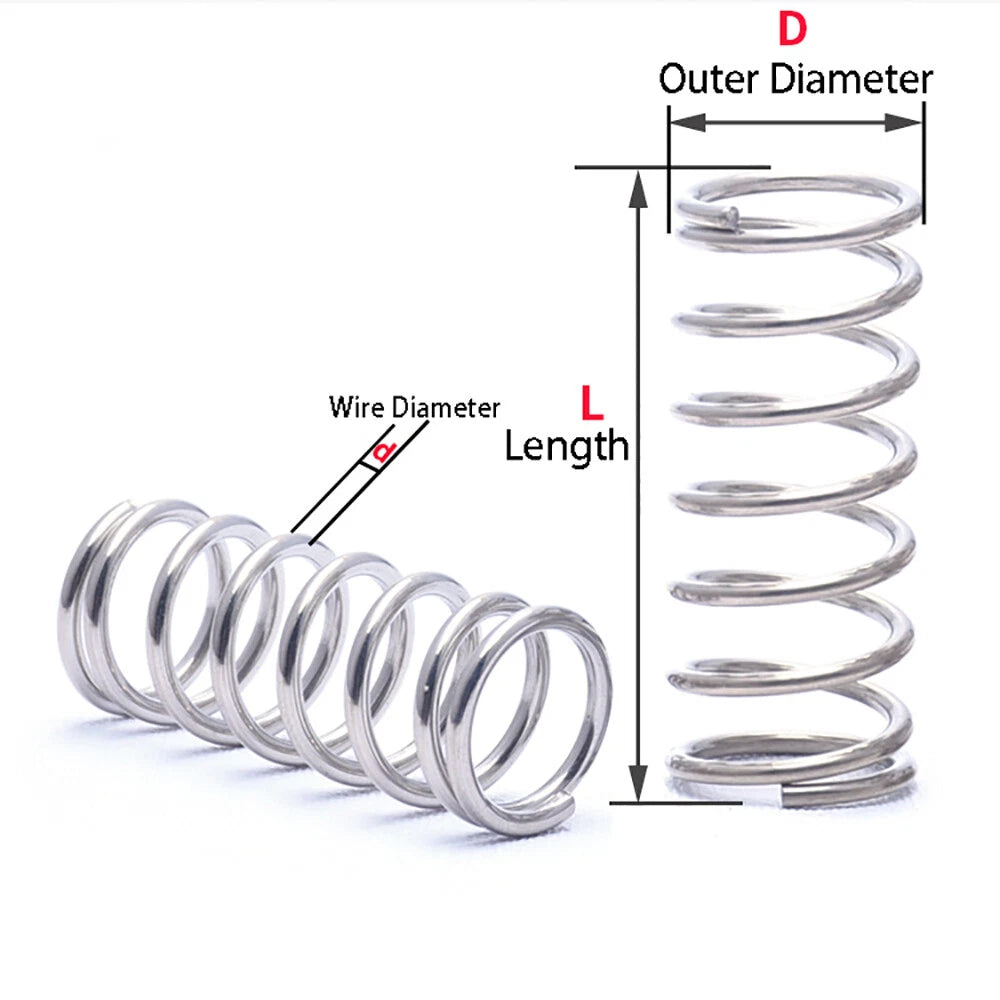
Each spring is wound from round steel wire with a wire diameter of 0.6mm or 0.7mm, an outer diameter ranging from 4mm to 12mm (approximately 0.16–0.47 in), and a free length spanning 5mm to 305mm (approximately 0.20–12.01 in). Springs are sold in packs of 10, making it easy to stock multiple sizes for ongoing projects.

Typical use cases include button-return mechanisms in consumer electronics, plunger assemblies in small pneumatic or hydraulic fixtures, spring-loaded contact pins in test jigs, and tensioning elements in lightweight automation rigs — all scenarios where a small compression spring with consistent spring rate is critical to reliable operation.

⚙️ Compatibility: Suitable for spring bores with inner diameter ≥ outer diameter of selected spring. Verify free length, outer diameter, and wire diameter against your assembly before ordering. Each pack contains 10 springs of the selected size.

✅ Key Features of These Compression Springs

🔩 Wide Size Range — Wire diameters of 0.6mm and 0.7mm, outer diameters from 4–12mm, and free lengths from 5–305mm (0.20–12.01 in) cover a broad spectrum of small-spring applications.
📦 Pack of 10 — Each order ships as a pack of 10 identical springs, giving you spares for prototyping, replacements, or multi-unit builds without reordering.
🔄 Consistent Spring Rate — Uniform wire diameter and coil pitch across each batch ensure repeatable elastic force, reducing variability between units in production or repair work.
🛠️ Versatile Application Fit — Designed for button returns, plunger mechanisms, contact pins, and lightweight tensioning assemblies across electronics, tooling, and DIY automation.
📐 Precision Wound Coils — Closed and ground ends (typical for this wire diameter range) provide flat seating surfaces, improving load distribution and reducing lateral deflection in guided bores.
🔍 Easy Size Selection — Variant options are labeled as Wire Dia × OD × Free Length (mm), so you can match your spec sheet directly without unit conversion guesswork.

📐 Technical Specifications — Compression Spring

Wire Diameter 0.6mm or 0.7mm (see variant options)
Outer Diameter (OD) 4mm – 12mm (approx. 0.16–0.47 in) — see variant options
Free Length 5mm – 305mm (approx. 0.20–12.01 in) — see variant options
Spring Type Compression (push)
Material Steel wire (carbon spring steel, typical for this diameter range)
End Type See variant options
Surface Finish See variant options
Spring Rate See variant options
Packing Quantity 10 pcs per pack
Weight (per pack) See variant options

❓ Frequently Asked Questions

How do I choose the right compression spring size for my project?

Match three key dimensions to your assembly: (1) wire diameter — determines load capacity and stiffness; (2) outer diameter — must fit inside your bore with clearance; (3) free length — should be longer than your required working length to allow compression travel. Use the variant label format Wire Dia × OD × Free Length (e.g., 0.6×6×30mm) to cross-reference your spec sheet directly.

What material are these springs made from?

These springs are wound from steel wire typical of carbon spring steel used in small-diameter compression springs. This material provides good elastic recovery and consistent spring rate for light-duty to moderate-duty applications. For corrosive environments, consider whether a coated or stainless variant is needed — contact us to confirm material specifics for your use case.

Are these springs corrosion resistant?

Standard carbon spring steel has limited corrosion resistance without surface treatment. For indoor, dry environments these springs perform reliably. For humid, wet, or chemically exposed environments, we recommend verifying the surface finish of your selected variant or contacting us to confirm suitability before ordering.

What is the difference between the 0.6mm and 0.7mm wire diameter options?

A thicker wire diameter (0.7mm vs 0.6mm) generally produces a stiffer spring with a higher spring rate for the same OD and free length. If you need more push-back force in the same space, choose 0.7mm wire. If you need a softer, more compliant spring, 0.6mm wire is the better choice. Always verify the spring rate against your load requirement.

Can I use these springs in electronics or PCB assemblies?

Yes. The small outer diameters (4–12mm) and short free lengths available (as short as 5mm) make these springs well-suited for button-return mechanisms, spring-loaded contact pins, battery contacts, and similar electronics applications. Ensure the OD fits your housing bore and the free length provides adequate travel for your switch or contact design.

Why should I buy a pack of 10 instead of individual springs?

Small compression springs are easy to lose during assembly and often need replacement over the life of a product. Buying in packs of 10 gives you spares for prototyping iterations, multi-unit production runs, and future repairs — all at a lower per-unit cost than sourcing singles. It also reduces reorder frequency for ongoing workshop or lab use.

How do I measure my existing spring to find a replacement?

Use a digital caliper to measure: (1) wire diameter — measure the cross-section of a single coil; (2) outer diameter — measure across the widest point of the coil; (3) free length — measure the spring at rest, uncompressed. Match these three values to the variant label (Wire Dia × OD × Free Length in mm) to find your replacement. If your spring is slightly compressed in its housing, add the compressed travel distance to the free length measurement.

🛒 Select your size (Wire Dia × OD × Free Length) above, then add to cart.

You may also like

Recently viewed