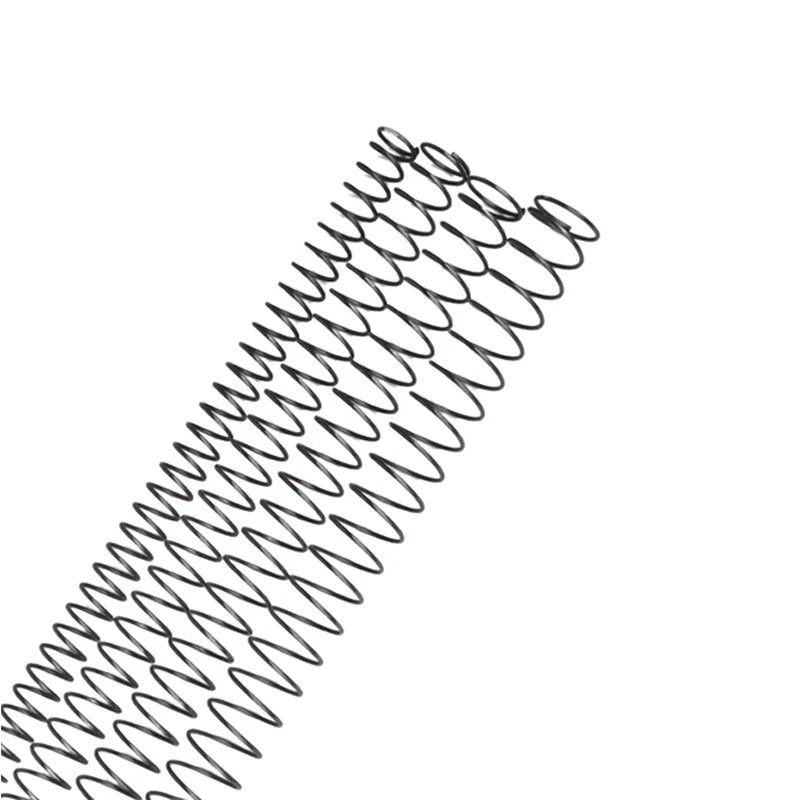
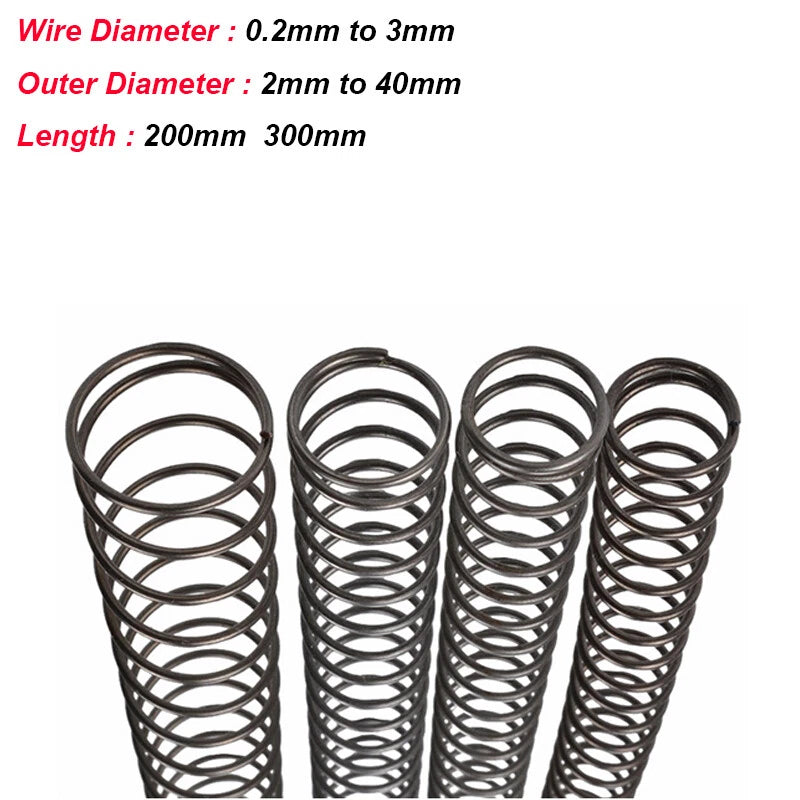
300mm Length Compression Springs Pressure Spring Stainless Steel,Steel 0.2mm-3mm

No reviews

Price:
Sale price$6.23 USD
Stock:
In stock (500 units), ready to be shipped

Payment & Security

Ach Direct Debit Amazon American Express Apple Pay Bancontact BLIK Diners Club Discover EPS Google Pay iDEAL Wero JCB Maestro Mastercard Multibanco MobilePay PayPal Przelewy24 Shop Pay Twint Union Pay USDC Visa

Your payment information is processed securely. We do not store credit card details nor have access to your credit card information.

Limited Offer — Spend More, Save More
Spend $55+
Save $5
Spend $100+
Save $10
Spend $200+
Save $25
HomeDIYer DIY Expert Support

DIY Expert Support

Get fitment advice & recommendations

Mon–Fri  8:30 AM – 8:00 PM
24-Hour Fast Ship
Arrives in 3–14 Days
Worldwide Shipping
30-Day Returns
1 tree planted with every purchase

Description

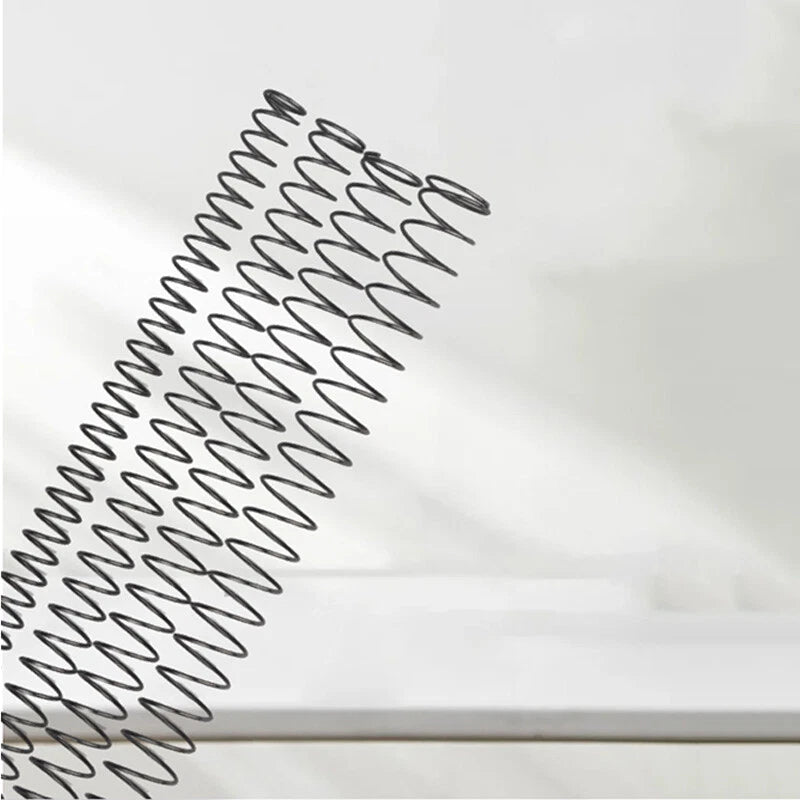
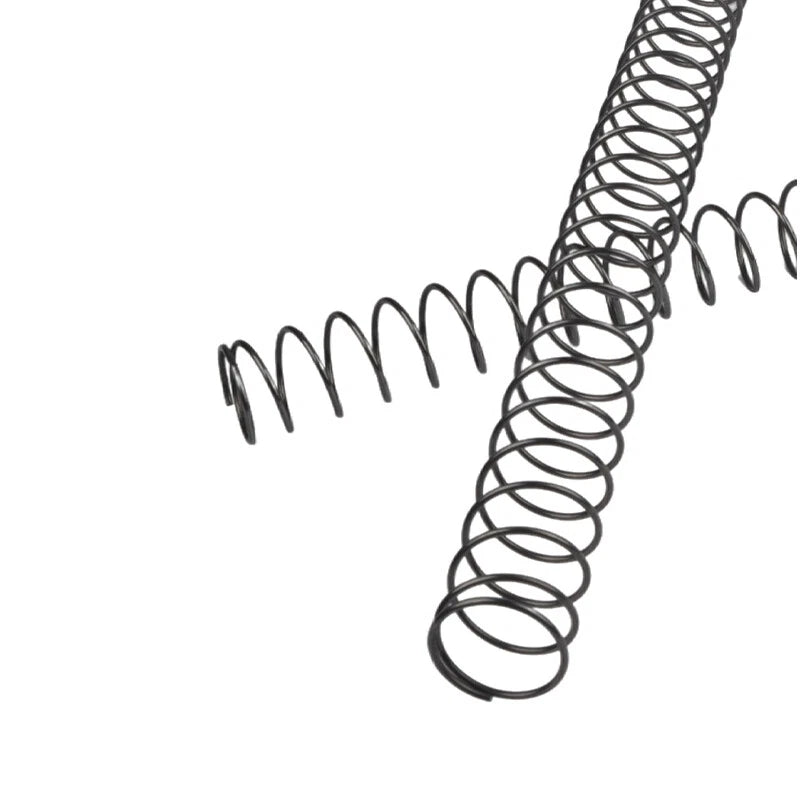
Compression Springs 0.2–3mm Wire Diameter — Precision Coil Springs for Mechanical & DIY Applications

When a project demands reliable, repeatable push-back force — whether you are repairing a mechanism that keeps losing tension or prototyping a new actuator that needs consistent spring rate — finding a compression spring in exactly the right wire diameter and outer diameter can be the difference between a working assembly and a frustrating rework. These compression springs are designed for engineers, hobbyists, and repair technicians who need a broad selection of precisely wound coil springs without ordering custom tooling.

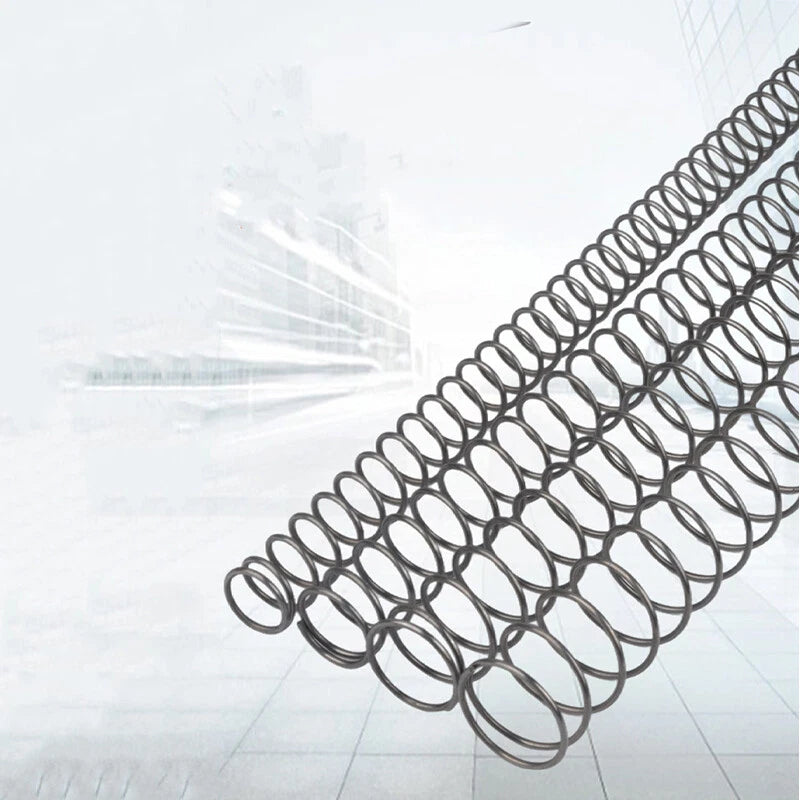
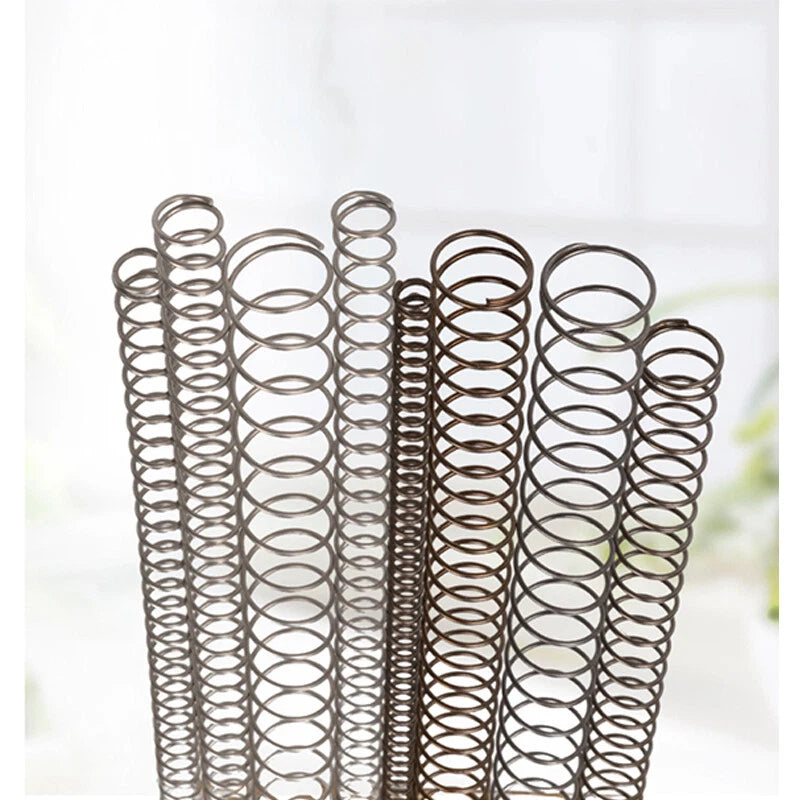
Each spring is wound from round wire ranging from 0.2 mm to 3 mm in diameter, with outer diameters spanning 1.2 mm to 40 mm and free lengths of 120 mm, 200 mm, or 300 mm (approximately 4.7 in, 7.9 in, or 11.8 in). Material options include carbon spring steel, 304 stainless steel, and galvanized steel, covering a wide range of load, corrosion, and temperature requirements.

Typical use cases include compression spring replacement in consumer electronics and appliances, return-force elements in jigs and fixtures for small-batch manufacturing, load-bearing springs in 3D-printer extruder assemblies, and tension-balancing components in custom robotics and automation rigs.

🔧 Compatibility: Suitable for standard spring seats, guide pins, and bores sized to match the selected outer diameter. Verify bore clearance and seat depth against the free length before ordering. Inner diameter (ID) is approximately OD minus 2× wire diameter.

✅ Key Features of These Compression Coil Springs

📐 Wide Size Matrix

Wire diameters from 0.2 mm to 3 mm paired with outer diameters from 1.2 mm to 40 mm give you over 200 size combinations to match your exact bore and load spec.

🔩 Three Material Grades

Carbon spring steel for general-purpose load cycling, 304 stainless steel for corrosion-sensitive environments, and galvanized steel for outdoor or humid conditions.

📏 Multiple Free Lengths

Available in 120 mm (~4.7 in), 200 mm (~7.9 in), and 300 mm (~11.8 in) free lengths, allowing you to cut-to-length or use as-is depending on your travel requirement.

⚙️ Consistent Pitch Winding

Uniform coil pitch throughout the body ensures even load distribution and predictable deflection behavior across the full compression stroke.

🛡️ Corrosion-Resistant Options

Stainless steel and galvanized variants resist oxidation in wet, marine, or chemically active environments where bare carbon steel would degrade.

🔄 Broad Application Range

From micro-springs in electronics (0.2 mm wire / 1.2 mm OD) to heavy-duty return springs (3 mm wire / 40 mm OD), one listing covers prototyping through production needs.

📐 Technical Specifications — Compression Coil Springs

Spring Type Cylindrical Compression Spring
Wire Diameter Range 0.2 mm – 3 mm (0.008 in – 0.118 in)
Outer Diameter Range 1.2 mm – 40 mm (0.047 in – 1.575 in)
Free Length Options 120 mm / 200 mm / 300 mm (4.7 in / 7.9 in / 11.8 in)
Material Options Carbon Spring Steel / 304 Stainless Steel / Galvanized Steel
End Type See variant options
Surface Finish Natural (spring steel & stainless) / Zinc-galvanized
Spring Rate See variant options
Load Capacity See variant options
Operating Temperature Spring Steel: typically –40 °C to +120 °C; Stainless: typically –60 °C to +200 °C
Coil Direction Right-hand wound (standard)
Quantity per Order 1 piece per variant

❓ Frequently Asked Questions

How do I choose the right wire diameter and outer diameter for my application?

Start with the bore or guide-pin diameter in your assembly. The spring's outer diameter should be 0.5 mm – 1 mm smaller than the bore ID to allow free movement without binding. Then select a wire diameter that delivers the spring rate you need — thicker wire produces a stiffer spring for the same OD and free length. If you are unsure, select a mid-range wire diameter (0.5 mm – 1 mm) and test deflection before committing to a larger order.

What is the difference between spring steel and stainless steel for compression springs?

Carbon spring steel offers a higher tensile strength-to-cost ratio and is ideal for dry, indoor environments where corrosion is not a concern. Stainless steel (304 grade) provides significantly better corrosion resistance and is suitable for wet, marine, food-adjacent, or mildly acidic environments. Stainless springs also maintain their properties at slightly higher temperatures. If your application involves moisture or chemical exposure, choose stainless steel.

What does the galvanized option offer compared to plain spring steel?

Galvanized springs have a zinc coating applied over carbon spring steel, providing a moderate level of corrosion protection at a lower cost than stainless steel. They are a practical choice for outdoor or humid environments where full stainless steel is not required. Note that the zinc coating adds a small amount to the outer diameter — typically 0.02 mm – 0.05 mm — so account for this when fitting into tight bores.

Can I cut these springs to a shorter free length?

Yes. Compression springs can be cut to a shorter free length using a rotary tool or spring cutter. After cutting, the end coil may need to be ground flat to restore a closed-end profile for stable seating. Keep in mind that cutting changes the number of active coils and therefore alters the spring rate — a shorter spring from the same wire and OD will be stiffer. Plan your cut length with this in mind.

Are these springs compatible with 3D-printed spring seats and guide pins?

Yes, provided the printed bore or guide-pin diameter matches the selected spring OD with appropriate clearance (typically 0.3 mm – 0.8 mm). FDM-printed seats may have slight dimensional variation, so we recommend selecting a spring OD 0.5 mm – 1 mm smaller than your nominal bore to ensure smooth travel. Stainless steel variants are recommended for applications near heated beds or enclosures above 60 °C.

How do I calculate the approximate spring rate for a given variant?

Spring rate (k) can be estimated using the formula: k = (G × d⁴) / (8 × D³ × n), where G is the shear modulus (~80 GPa for spring steel, ~70 GPa for stainless), d is wire diameter, D is mean coil diameter (OD minus wire diameter), and n is the number of active coils. For a quick estimate, contact us with your selected variant's wire diameter, OD, and free length and we can provide a calculated spring rate range.

What is the inner diameter (ID) of each spring?

The inner diameter is approximately equal to the outer diameter minus twice the wire diameter. For example, a spring with a 10 mm OD and 1 mm wire diameter has an ID of approximately 8 mm. Use this to verify that your guide pin will fit inside the spring with a small clearance (typically 0.2 mm – 0.5 mm) to prevent binding during compression.

How many pieces are included per order?

Each order includes 1 piece of the selected variant (wire diameter × outer diameter × length & material combination). If you need multiple pieces, simply increase the quantity in your cart. For bulk or wholesale inquiries, please contact us directly.

🛒 Select your Wire Diameter, Outer Diameter, and Length & Spring Material above, then add to cart.


You may also like

Recently viewed