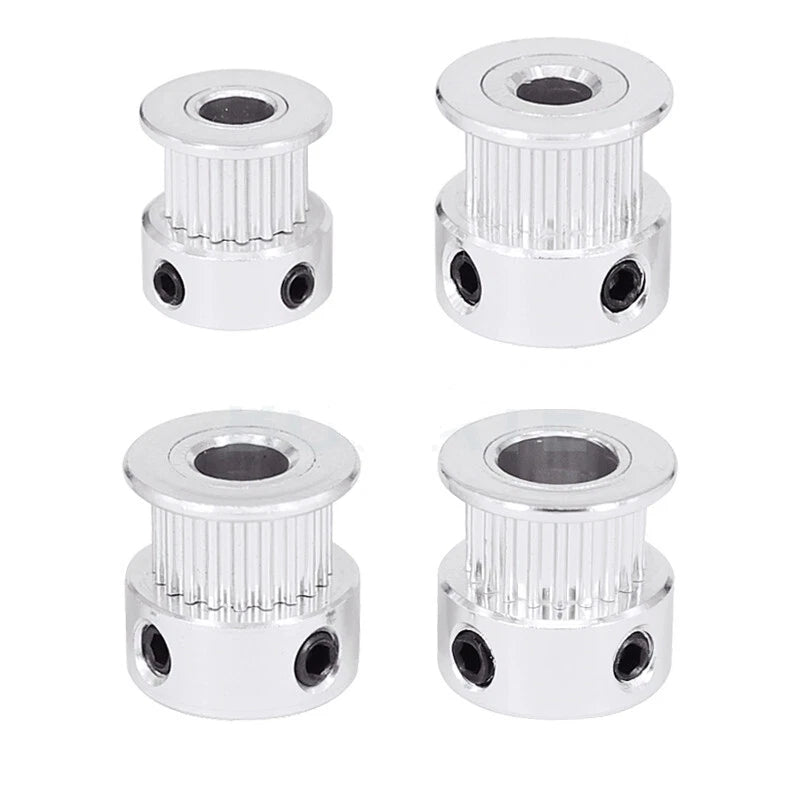
GT2 Aluminum Timing Belt Pulley — Precise Motion Control for 3D Printers & CNC Machines
When your 3D printer skips steps or your CNC axis drifts, the culprit is often a worn or mismatched pulley. Engineers, makers, and repair technicians who demand repeatable, backlash-free motion need a pulley that holds its geometry under continuous load — and that's exactly what these GT2 aluminum timing belt pulleys are built for.
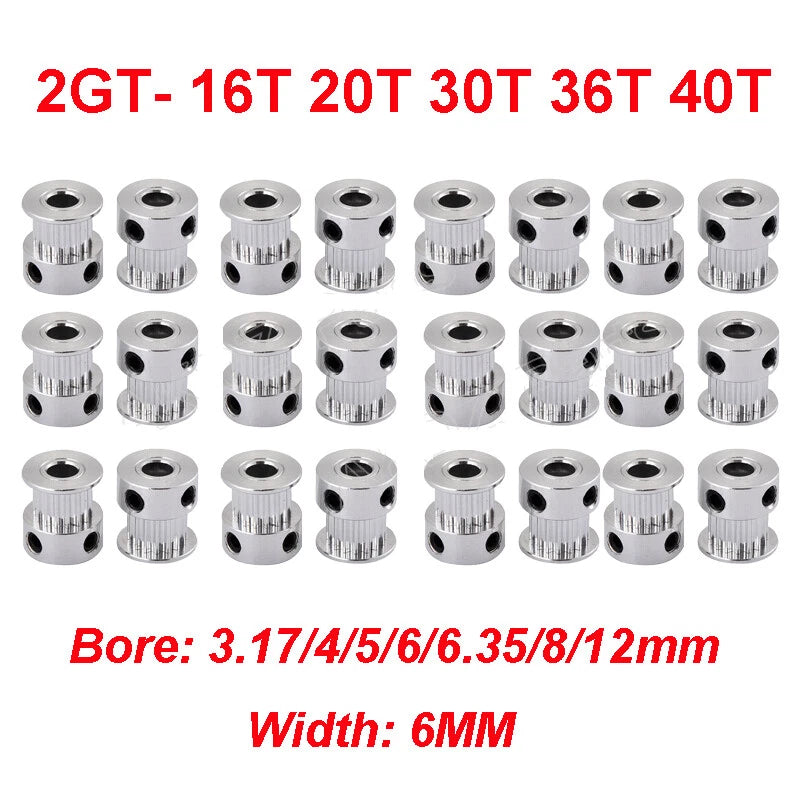
Each pulley is machined from aluminum alloy, delivering a lightweight yet rigid body that resists deformation under belt tension. The GT2 tooth profile (2mm pitch) mates cleanly with standard GT2 belts. Available in 16, 20, 30, and 40 tooth counts with a fixed 6mm belt width, bore diameters range from 3.17mm (~0.125 in) up to 12mm (~0.47 in) to suit a wide variety of motor shaft sizes. Heights vary by variant, typically 14–16mm for flanged versions.
Typical use cases include FDM 3D printer X/Y axis drives (GT2 belt-driven Cartesian and CoreXY systems), desktop CNC router feed axes, and lightweight robotics joint actuators where a low-profile GT2 timing pulley replacement is needed without re-engineering the belt path.
🔧 Compatibility: Fits standard GT2 open-loop and closed-loop timing belts with 6mm width and 2mm pitch. Verify your motor shaft diameter before ordering — bore options include 3.17mm, 4mm, 5mm, 6mm, 6.35mm, 7mm, 8mm, 10mm, and 12mm.
✅ Key Features of These GT2 Aluminum Timing Belt Pulleys
⚙️ GT2 2mm Pitch Tooth Profile
Engineered to the GT2 standard for zero-backlash engagement with GT2 timing belts, maintaining positional accuracy across thousands of cycles.
🪶 Aluminum Alloy Construction
Machined aluminum body keeps rotating mass low — critical for high-acceleration 3D printer axes — while providing the rigidity needed to resist belt-induced flex.
📐 Multiple Tooth Counts: 16 / 20 / 30 / 36 / 40T
Select the tooth count that matches your existing drive ratio. More teeth increase belt contact and reduce tooth load; fewer teeth tighten the drive ratio for faster axis travel.
🔩 Wide Bore Range: 3.17mm – 12mm
Covers the most common stepper motor shaft diameters used in desktop 3D printers and CNC machines, including NEMA 17 (5mm), NEMA 23 (6.35mm / 8mm), and metric variants.
📦 Single or 5-Pack Packing Options
Order one for a quick replacement or a 5-pack for a full machine build or spare parts inventory — both options available for every tooth/bore combination.
🏭 6mm Belt Width — Industry-Standard Fit
The 6mm belt width is the dominant standard in desktop motion systems. These pulleys drop straight into existing belt paths without spacers or modifications.
📐 Technical Specifications — GT2 Timing Belt Pulley
| Belt Type |
GT2 (2mm pitch) |
| Belt Width |
6mm |
| Number of Teeth |
16 / 20 / 30 / 36 / 40 (see variant options) |
| Bore Diameter |
3.17 / 4 / 5 / 6 / 6.35 / 7 / 8 / 10 / 12mm (see variant options) |
| Pulley Height |
See variant options (typically 14–16mm for flanged variants) |
| Material |
Aluminum alloy |
| Finish |
Natural machined aluminum |
| Set Screw |
Included (M3, hex socket) |
| Flange |
Flanged (belt-retaining rim on both sides) |
| Packing Quantity |
1 pc or 5 pcs (see variant options) |
❓ Frequently Asked Questions
Which tooth count should I choose for my 3D printer?
Most Cartesian and CoreXY 3D printers use 20-tooth GT2 pulleys on the motor shafts as the standard drive ratio. If you are replacing a worn pulley, match the tooth count of the original. If you are redesigning your drive system, a 20T pulley paired with a 2mm pitch belt gives approximately 40mm of belt travel per motor revolution — a common baseline for tuning steps/mm.
How do I measure my motor shaft to select the correct bore?
Use a digital caliper to measure the shaft diameter at the point where the pulley will sit. NEMA 17 steppers typically have a 5mm shaft; NEMA 23 steppers commonly use 6.35mm (1/4 inch) or 8mm shafts. If your shaft has a D-cut flat, measure across the round portion. The set screw will clamp onto the flat for a secure, non-slip fit.
Are these pulleys compatible with GT2 closed-loop belts?
Yes. The GT2 2mm pitch tooth profile on these pulleys is compatible with both open-loop GT2 timing belts and GT2 closed-loop belts, provided the belt width is 6mm. Do not use these pulleys with GT3 or HTD belts, as the tooth profiles are not interchangeable.
Will aluminum pulleys wear out faster than steel ones?
In typical 3D printer and light CNC applications, aluminum pulleys offer a practical service life measured in thousands of operating hours. Aluminum is softer than steel, so pairing with a fiberglass-reinforced GT2 belt (rather than a plain rubber belt) reduces tooth wear. For heavy-duty industrial applications with continuous high-tension loads, a steel pulley may be more appropriate.
Do these pulleys come with set screws?
Yes, an M3 hex socket set screw is included with each pulley. Tighten it against the motor shaft flat (D-cut) using a 1.5mm hex key. Apply a small amount of thread-locking compound if the pulley will be subject to vibration or frequent direction reversals.
Can I use a 20T pulley on one axis and a 30T pulley on another?
Yes, but you will need to recalibrate the steps/mm for each axis independently in your firmware (e.g., Marlin, Klipper). A 30T pulley moves 60mm of belt per revolution versus 40mm for a 20T pulley at the same pitch, so the axes will have different motion ratios. This is intentional in some machine designs to achieve different speed or torque characteristics per axis.
What is the difference between the flanged and non-flanged variants?
All variants in this listing are flanged — they have a raised rim on both sides of the tooth section that keeps the GT2 belt centered on the pulley and prevents it from walking off during operation. This is the standard configuration for 3D printer and CNC drive pulleys. Non-flanged pulleys are typically used as idlers, not drive pulleys.
🛒 Select your Number of Teeth, Bore Height, and Width & Packing Quantity above, then add to cart.