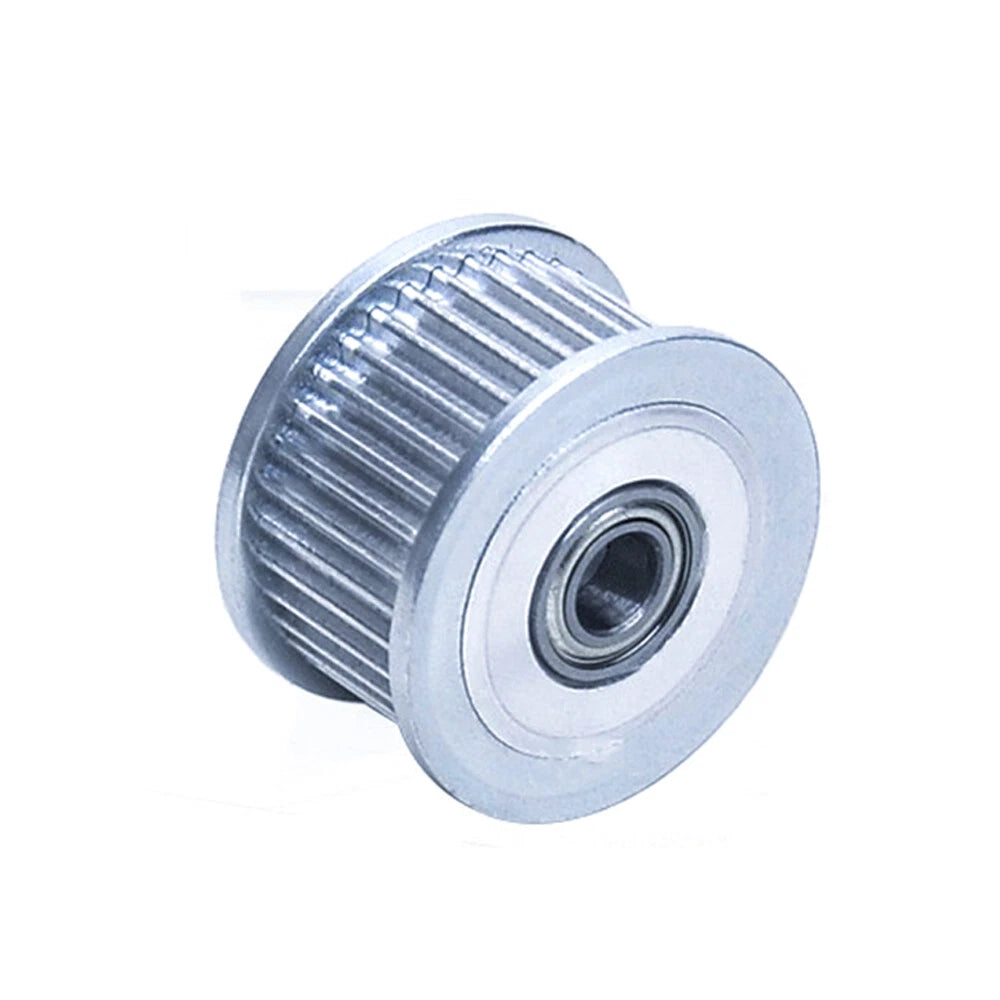
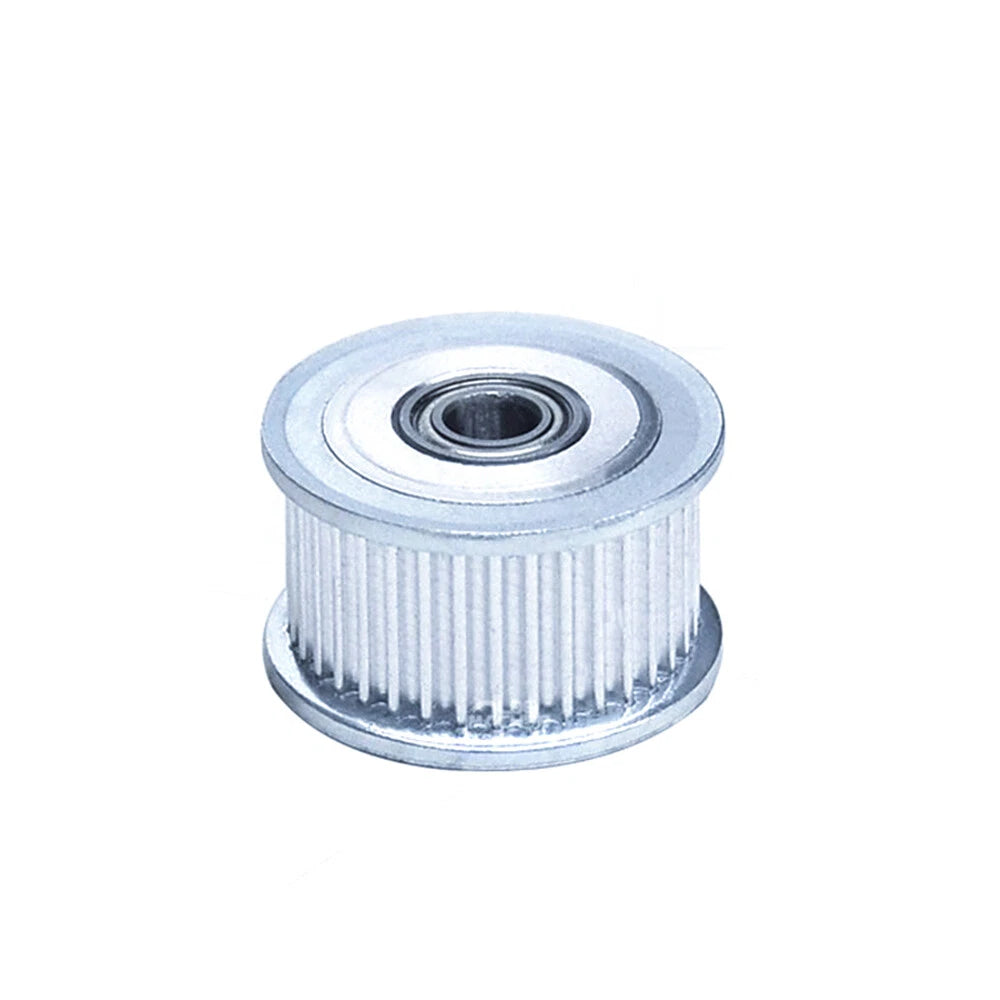
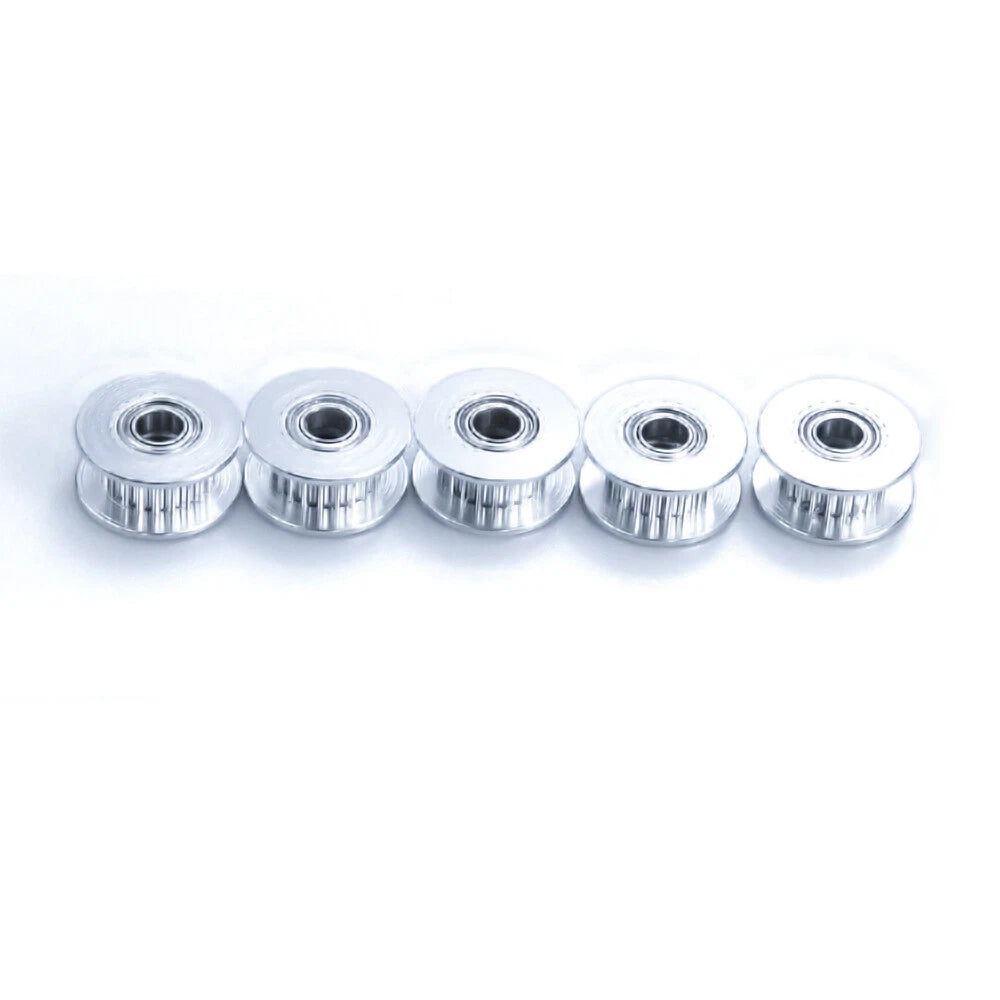
GT2 Idler Timing Drive Pulleys 20/22/24/25/26~60 Tooth,For 6mm Belt 3D Printer

No reviews

Price:
Sale price$11.91 USD
Stock:
In stock (500 units), ready to be shipped

Payment & Security

Ach Direct Debit Amazon American Express Apple Pay Bancontact BLIK Diners Club Discover EPS Google Pay iDEAL Wero JCB Maestro Mastercard Multibanco MobilePay PayPal Przelewy24 Shop Pay Twint Union Pay USDC Visa

Your payment information is processed securely. We do not store credit card details nor have access to your credit card information.

Limited Offer — Spend More, Save More
Spend $55+
Save $5
Spend $100+
Save $10
Spend $200+
Save $25
HomeDIYer DIY Expert Support

DIY Expert Support

Get fitment advice & recommendations

Mon–Fri  8:30 AM – 8:00 PM
24-Hour Fast Ship
Arrives in 3–14 Days
Worldwide Shipping
30-Day Returns
1 tree planted with every purchase

Description

GT2 Idler Timing Drive Pulleys — Precise Motion Control for 6mm Belt Systems

When your 3D printer or CNC build suffers from belt skip, layer shifting, or inconsistent tension, the culprit is often an undersized or mismatched idler pulley. Makers, hobbyists, and small-workshop engineers who demand repeatable accuracy need a GT2 idler timing drive pulley that fits their exact shaft and tooth count — without compromise.

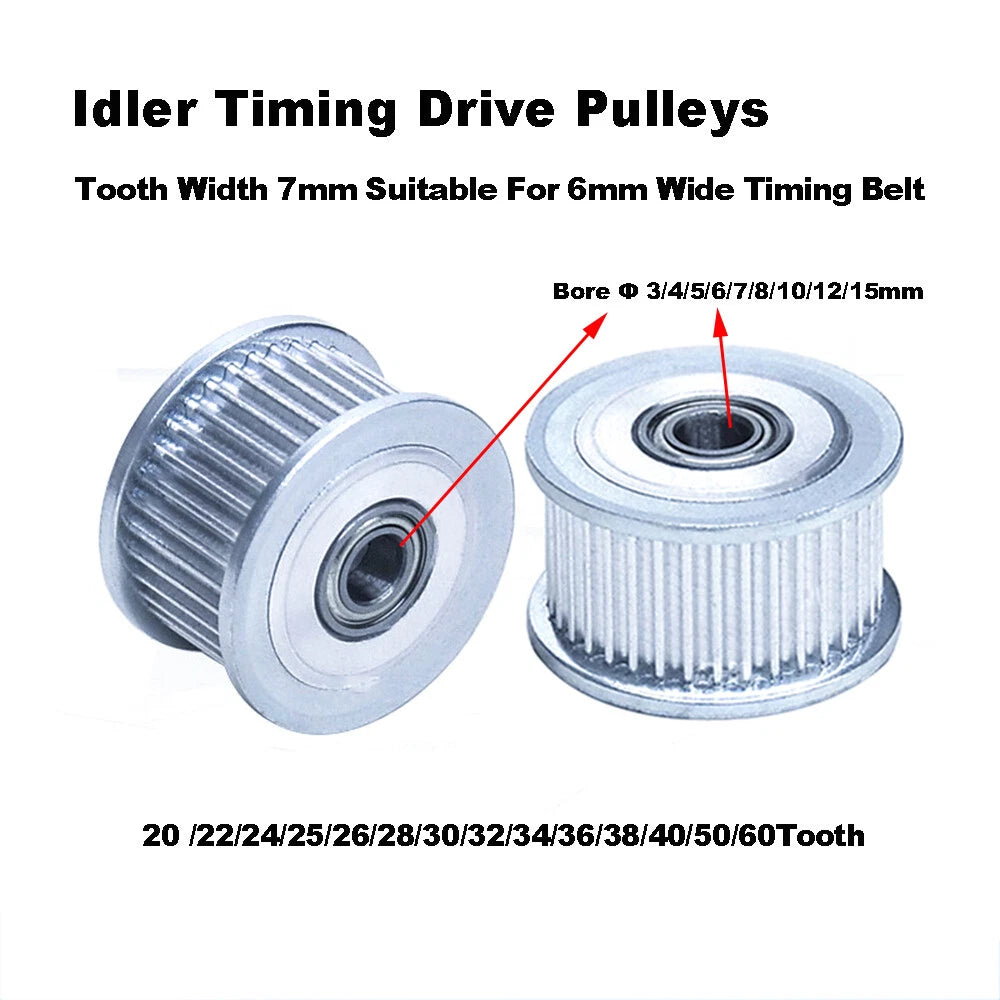
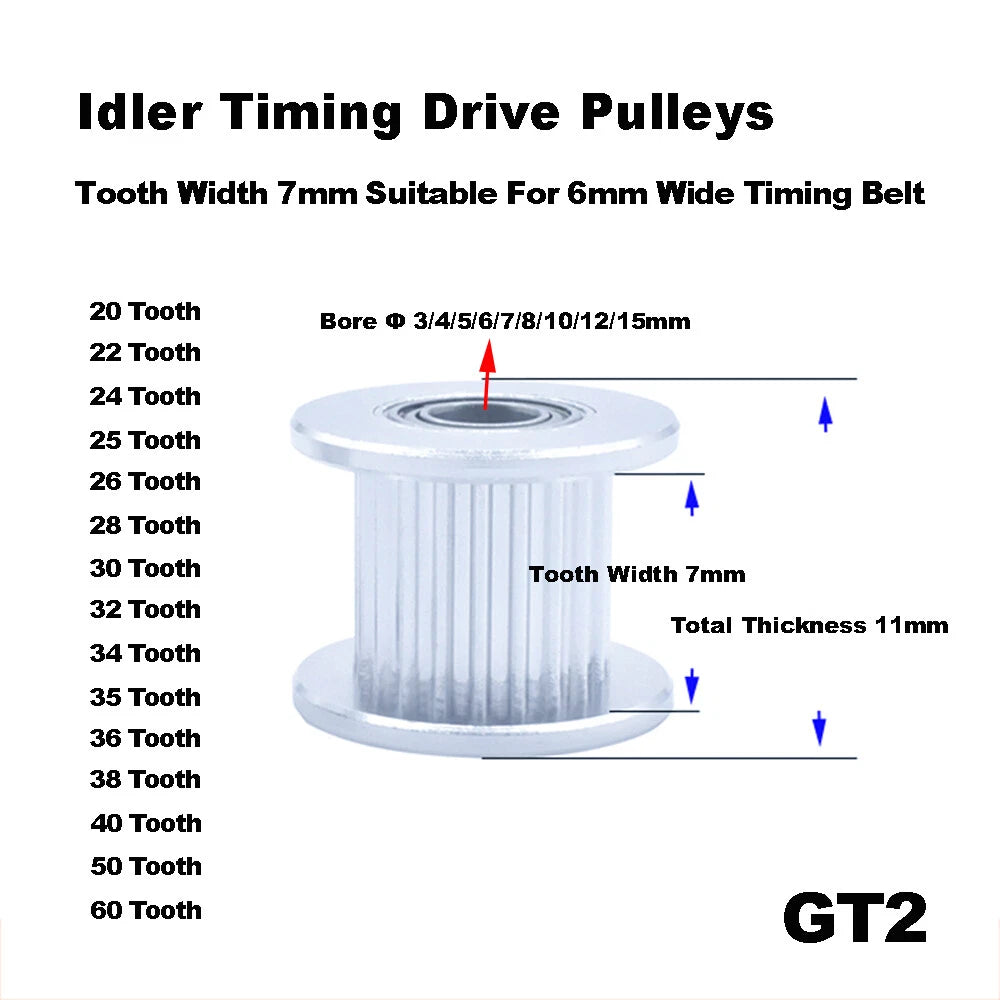
These GT2 idler timing drive pulleys are machined to the 2mm pitch GT2 profile and are available in tooth counts from 20T to 60T with a consistent 7mm belt-contact width. Bore diameters range from Φ3mm (~0.12 in) to Φ15mm (~0.59 in), and outer diameters scale from approximately 14mm (~0.55 in) for the 20T up to approximately 40mm (~1.57 in) for the 60T. The body is typically aluminum alloy with a smooth or flanged running surface suited to 6mm-wide GT2 belts.

Typical use cases include Cartesian and CoreXY 3D printer belt path routing, DIY CNC router axis tensioning, desktop laser engraver belt guides, and lightweight robotic arm drive trains — anywhere a compact, low-friction GT2 idler pulley for 6mm belt is required.

⚙️ Compatibility: GT2 2mm pitch belt, 6mm belt width. Fits standard Φ3 / Φ4 / Φ5 / Φ6 / Φ7 / Φ8 / Φ9 / Φ10 / Φ12 / Φ15mm shafts or bolts. Compatible with Ender 3, CR-10, Voron, RatRig, and most open-frame 3D printer platforms.

✅ Key Features of These GT2 Idler Timing Drive Pulleys

🦷
Wide Tooth Range: 20T – 60T

Choose from 20, 22, 24, 25, 26, 28, 30, 32, 34, 35, 36, 38, 40, 50, or 60 teeth to match your exact gear ratio and belt path geometry.

📐
GT2 2mm Pitch Profile

Machined to the GT2 standard 2mm tooth pitch, ensuring zero-slip engagement with GT2 open-loop and closed-loop belts used across 3D printing and CNC platforms.

🔩
Multiple Bore Sizes: Φ3 – Φ15mm

Available bore diameters cover Φ3, Φ4, Φ5, Φ6, Φ7, Φ8, Φ9, Φ10, Φ12, and Φ15mm — select the bore that matches your shaft or M-bolt diameter directly from the variant menu.

📏
7mm Belt-Contact Width

The 7mm hub width accommodates standard 6mm GT2 belts with lateral clearance on each side, reducing edge wear and keeping the belt tracking true over long print runs.

⚖️
Lightweight Aluminum Alloy Body

The aluminum alloy construction keeps rotating mass low, which matters for high-acceleration motion systems where inertia directly affects print quality and positioning speed.

🔄
Idler-Ready Design

Smooth bore accepts standard bearings (e.g., 623, 624, 625 series) or mounts directly on a bolt/shaft as a tensioner idler — no keyway required for most 3D printer idler applications.

📐 Technical Specifications — GT2 Idler Timing Pulley

Belt Profile GT2 (2mm pitch)
Belt Width Compatibility 6mm
Hub Width 7mm
Number of Teeth 20T / 22T / 24T / 25T / 26T / 28T / 30T / 32T / 34T / 35T / 36T / 38T / 40T / 50T / 60T
Bore Diameter Φ3 / Φ4 / Φ5 / Φ6 / Φ7 / Φ8 / Φ9 / Φ10 / Φ12 / Φ15mm (see variant options)
Outer Diameter (approx.) ~14mm (20T) to ~40mm (60T) — see variant options
Material Aluminum alloy
Finish See variant options
Keyway None (smooth bore)
Flange See variant options
Application 3D printer, CNC router, laser engraver, DIY automation

❓ Frequently Asked Questions

How do I choose the right tooth count for my 3D printer?

Match the tooth count to your printer's belt path design. Most Cartesian printers (Ender 3, CR-10) use 20T drive pulleys and pair them with 20T idlers for a 1:1 ratio. CoreXY machines like Voron or RatRig may use larger idlers (e.g., 20T–40T) at corners to reduce belt wrap angle. Check your printer's BOM or belt routing diagram to confirm the correct tooth count before ordering.

Which bore size should I select for my printer's idler bolt?

Select the bore that matches your idler bolt or shaft diameter. M3 bolts → Φ3mm bore; M4 → Φ4mm; M5 → Φ5mm; M8 → Φ8mm. If you plan to press-fit a bearing (e.g., 625ZZ with 5mm inner diameter), choose the Φ5mm bore. Always verify your hardware size before selecting a variant.

Are these pulleys compatible with standard GT2 open-loop and closed-loop belts?

Yes. These pulleys are machined to the GT2 2mm pitch profile and are compatible with both open-loop GT2 belts (sold by the meter) and closed-loop GT2 belts. The 6mm belt width is the most common width used in desktop 3D printers and small CNC routers.

Can I use these as tensioner idlers without a bearing?

Yes, for low-speed or light-duty applications the smooth bore can mount directly on a bolt as a sliding idler. For continuous high-speed use (e.g., 3D printer motion systems running at 100mm/s+), we recommend pressing in a compatible bearing (623, 624, or 625 series depending on bore size) to reduce friction and extend service life.

How strong are these pulleys — will they strip teeth under belt tension?

The aluminum alloy body provides sufficient strength for typical 3D printer and light CNC belt tensions (generally under 20N per belt side). The GT2 tooth profile distributes load across multiple teeth simultaneously, which significantly reduces the risk of tooth stripping compared to older trapezoidal profiles. For heavy-duty CNC applications with high belt pre-tension, contact us to confirm suitability.

Will these pulleys corrode or oxidize over time?

Aluminum alloy naturally forms a thin oxide layer that protects against further corrosion in typical indoor environments. For humid or mildly corrosive workshop conditions, the anodized or natural aluminum finish provides adequate protection. These pulleys are not recommended for outdoor or marine environments without additional protective coating.

What is the difference between a drive pulley and an idler pulley?

A drive pulley is attached to a motor shaft and transmits torque to the belt. An idler pulley has no motor connection — it redirects, guides, or tensions the belt. These pulleys are listed as idler pulleys (smooth bore, no set screw) and are intended for tensioning and routing roles. If you need a drive pulley with a set screw and D-bore for a stepper motor, please see our separate drive pulley listings.

🛒 Select your tooth count and bore diameter above, then add to cart.

You may also like

Recently viewed