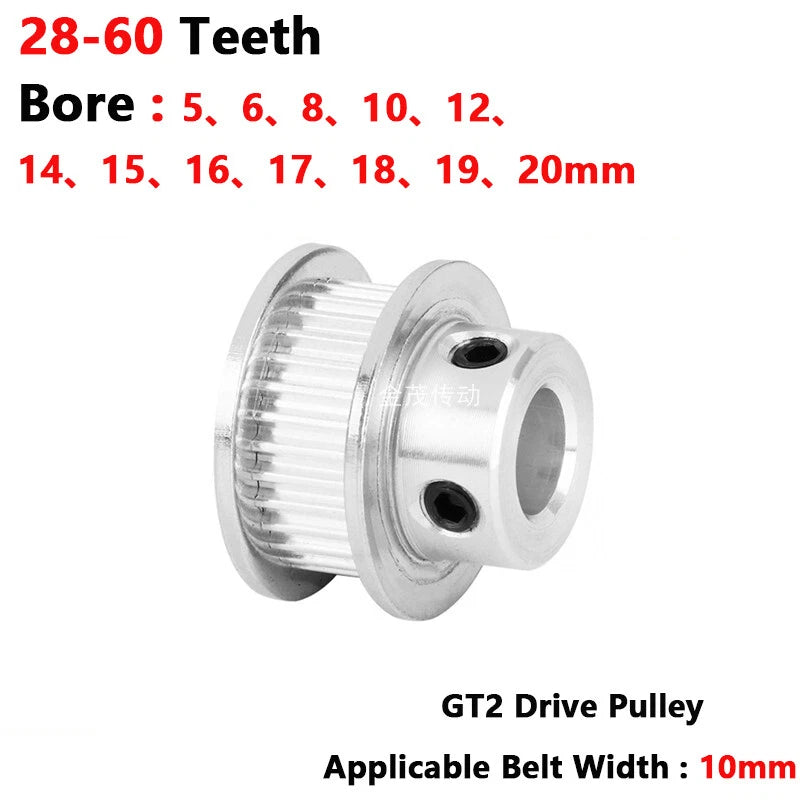
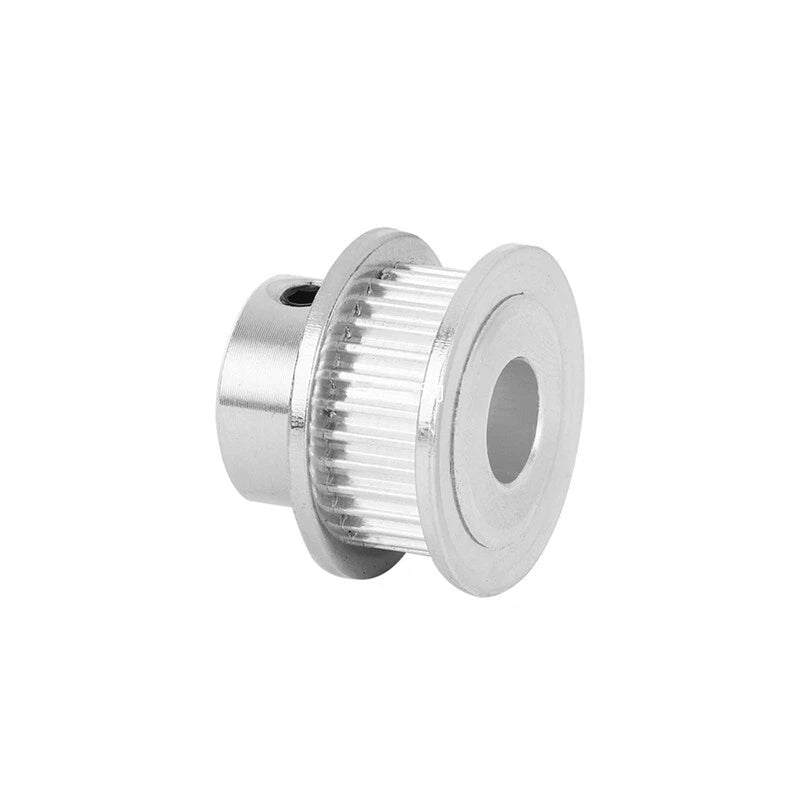
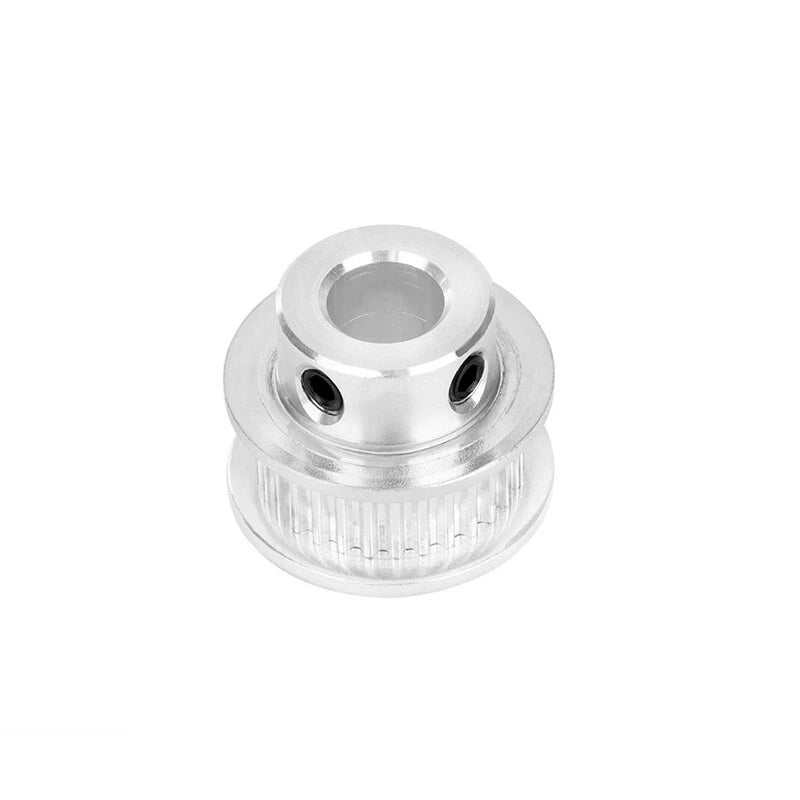
GT2 Timing Pulley 28-60 Teeth Bore 4mm-25mm Width 10mm Synchronous Wheels Gear

No reviews

Price:
Sale price$8.58 USD
Stock:
In stock (500 units), ready to be shipped

Payment & Security

Ach Direct Debit Amazon American Express Apple Pay Bancontact BLIK Diners Club Discover EPS Google Pay iDEAL Wero JCB Maestro Mastercard Multibanco MobilePay PayPal Przelewy24 Shop Pay Twint Union Pay USDC Visa

Your payment information is processed securely. We do not store credit card details nor have access to your credit card information.

Limited Offer — Spend More, Save More
Spend $55+
Save $5
Spend $100+
Save $10
Spend $200+
Save $25
HomeDIYer DIY Expert Support

DIY Expert Support

Get fitment advice & recommendations

Mon–Fri  8:30 AM – 8:00 PM
24-Hour Fast Ship
Arrives in 3–14 Days
Worldwide Shipping
30-Day Returns
1 tree planted with every purchase

Description

GT2 Timing Pulley 28–60 Teeth — Precision Synchronous Drive for CNC, 3D Printers & Robotics

When your motion-control build demands repeatable, slip-free power transfer, a mismatched or worn pulley becomes the weakest link in the chain. Engineers, makers, and automation builders who rely on GT2 belt drives need a pulley that holds tight tolerances across every cycle. These GT2 timing pulleys are machined to mesh cleanly with standard 2mm-pitch GT2/2GT belts, eliminating backlash and keeping your axis or drive system on target.

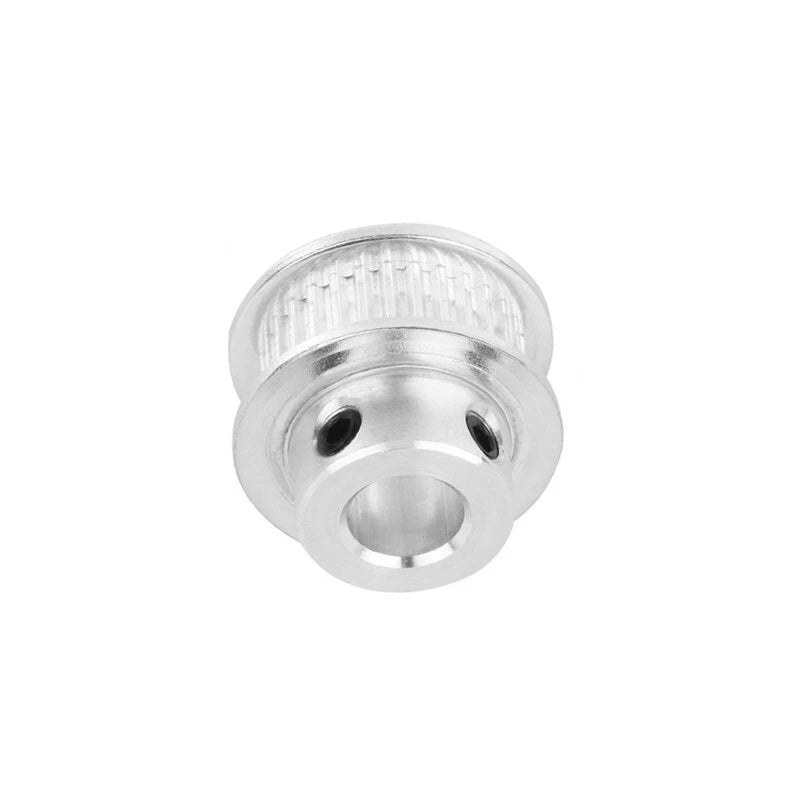
Each pulley is machined from aluminum alloy with a natural silver finish. The tooth profile follows the GT2 (2mm pitch) standard. Tooth counts span 28 to 60 teeth; bore diameters range from 4mm to 25mm (approximately 0.16 in to 0.98 in); tooth width is 10mm (approximately 0.39 in) with an 11mm belt-contact width. A set-screw hub secures the pulley to the shaft.

Typical applications include CNC router X/Y axis drives, FDM 3D printer extruder and motion systems, desktop laser cutter gantries, robotic arm joint drives, and custom linear-motion stages where a GT2 synchronous belt pulley with a precise bore-to-shaft fit is required.

⚙️ Compatibility: Designed for standard 2mm-pitch GT2 / 2GT open or closed-loop timing belts with 6mm or 10mm belt width. Verify your belt width and bore diameter before ordering.

✅ Key Features of These GT2 Timing Pulleys

🔩 Wide Tooth Count Range

Available in 28, 30, 32, 34, 35, 36, 38, 40, 42, 44, 45, 46, 48, 50, 52, 54, 56, 58, and 60 teeth — covering a broad gear-ratio range for speed or torque tuning in GT2 belt drive systems.

🎯 Broad Bore Selection

Bore options from 4mm to 25mm (including 5, 6, 6.35, 8, 10, 12, 12.7, 14, 15, 16, 17, 18, 19, 20, and 25mm) accommodate stepper motor shafts, servo shafts, and custom drive shafts without adapter sleeves.

📐 2mm GT2 Tooth Profile

The GT2 (2GT) 2mm-pitch tooth geometry provides smooth, low-noise engagement with GT2 timing belts, reducing vibration in high-speed CNC and 3D printer motion systems.

🏗️ Aluminum Alloy Construction

Machined from aluminum alloy for a balance of light weight and structural rigidity. The material resists corrosion in typical indoor workshop and lab environments.

🔧 Set-Screw Hub Retention

Each pulley includes a set-screw hub for secure shaft mounting. The screw locks the pulley axially and rotationally, preventing slippage under load during continuous operation.

🔄 10mm Tooth Width for Belt Tracking

The 10mm tooth width (11mm belt-contact width) keeps the GT2 belt centered and reduces edge wear, extending belt service life in long-running automation and robotics applications.

📐 Technical Specifications — GT2 Timing Pulley

Belt Type GT2 / 2GT, 2mm pitch
Tooth Count 28 – 60 teeth (see variant options)
Bore Diameter 4mm – 25mm (see variant options)
Tooth Width 10mm (≈ 0.39 in)
Belt Contact Width 11mm (≈ 0.43 in)
Pitch 2mm (GT2 standard)
Material Aluminum alloy
Finish Natural / silver anodized
Hub Retention Set screw
Compatible Belt Width 6mm or 10mm GT2 belt
Quantity per Order 1 piece

❓ Frequently Asked Questions

How do I choose the right tooth count for my application?

The tooth count determines the pulley's pitch diameter and, combined with your motor's RPM, sets the linear speed of your belt drive. A smaller tooth count (e.g., 28T) on the drive pulley paired with a larger count on the driven pulley reduces speed and increases torque. For most CNC and 3D printer builds, a 20T driver and 40T driven ratio is common, but this listing covers 28–60T for custom ratios. Match the tooth count to your desired gear ratio and available center distance.

Which bore size should I select for my stepper motor shaft?

Measure your motor shaft diameter with calipers before ordering. Common NEMA 17 stepper shafts are 5mm; NEMA 23 shafts are typically 6.35mm (1/4 in) or 8mm. Servo and DC motor shafts vary widely. Select the bore that matches your shaft diameter exactly — the set screw provides clamping force, but an oversized bore will not grip reliably. If your shaft is between standard sizes, choose the next smaller bore and consult a machinist for light reaming.

Is this pulley compatible with GT2 belts of different widths?

These pulleys have a 10mm tooth width and an 11mm belt-contact width, making them compatible with both 6mm-wide and 10mm-wide GT2 / 2GT timing belts. A 6mm belt will run centered in the tooth groove; a 10mm belt fills the groove fully. Do not use belts wider than 10mm, as they will contact the flanges and cause premature wear.

What material are these pulleys made from, and will they corrode?

The pulleys are machined from aluminum alloy with a natural or lightly anodized finish. Aluminum forms a passive oxide layer that resists corrosion in typical indoor environments — workshops, labs, and enclosed machine enclosures. Avoid prolonged exposure to salt spray, strong acids, or alkaline solutions. For outdoor or high-humidity environments, consider applying a light coat of dry lubricant or corrosion inhibitor to the bore and set-screw area.

Can I use these pulleys in a closed-loop GT2 belt system?

Yes. These pulleys are compatible with both open-ended GT2 belts (cut to length) and closed-loop GT2 belt loops, provided the loop circumference matches the pulley's pitch diameter and center distance. Closed-loop belts are common in 3D printer extruder drives and small robotic joints. Verify the belt loop length against the pulley's pitch circumference (tooth count × 2mm pitch) before purchasing a closed-loop belt.

How do I install and secure the pulley on the shaft?

Slide the pulley onto the shaft so the set-screw hole aligns with a flat on the shaft (if present) or positions the screw over a clean shaft surface. Use an appropriate hex key (typically M3 or M4) to tighten the set screw firmly. For shafts without a flat, tighten the set screw against the round shaft surface and check for slippage under load. For critical applications, apply a small amount of thread-locking compound to the set screw threads before final tightening.

What is the pitch diameter for a given tooth count?

For GT2 pulleys, the pitch diameter is calculated as: Pitch Diameter = (Tooth Count × Pitch) ÷ π. For example, a 40-tooth GT2 pulley has a pitch diameter of (40 × 2mm) ÷ π ≈ 25.46mm. Use this value when calculating center distances and belt lengths for your drive system. Refer to a GT2 belt drive calculator for precise center-distance and belt-length computations.

🛒 Select your Number of Teeth and Bore diameter above, then add to cart.


You may also like

Recently viewed