Heavy Load Duty Compression Die Spring ISO - 22mm Diameter & Up To 300mm Long

No reviews

Price:
Sale price$3.05 USD
Stock:
In stock (500 units), ready to be shipped

Payment & Security

Ach Direct Debit Amazon American Express Apple Pay Bancontact BLIK Diners Club Discover EPS Google Pay iDEAL Wero JCB Maestro Mastercard Multibanco MobilePay PayPal Przelewy24 Shop Pay Twint Union Pay USDC Visa

Your payment information is processed securely. We do not store credit card details nor have access to your credit card information.

Limited Offer — Spend More, Save More
Spend $55+
Save $5
Spend $100+
Save $10
Spend $200+
Save $25
HomeDIYer DIY Expert Support

DIY Expert Support

Get fitment advice & recommendations

Mon–Fri  8:30 AM – 8:00 PM
24-Hour Fast Ship
Arrives in 3–14 Days
Worldwide Shipping
30-Day Returns
1 tree planted with every purchase

Description

Heavy Duty Compression Die Springs — ISO 22mm OD, Reliable Elastic Return Every Cycle

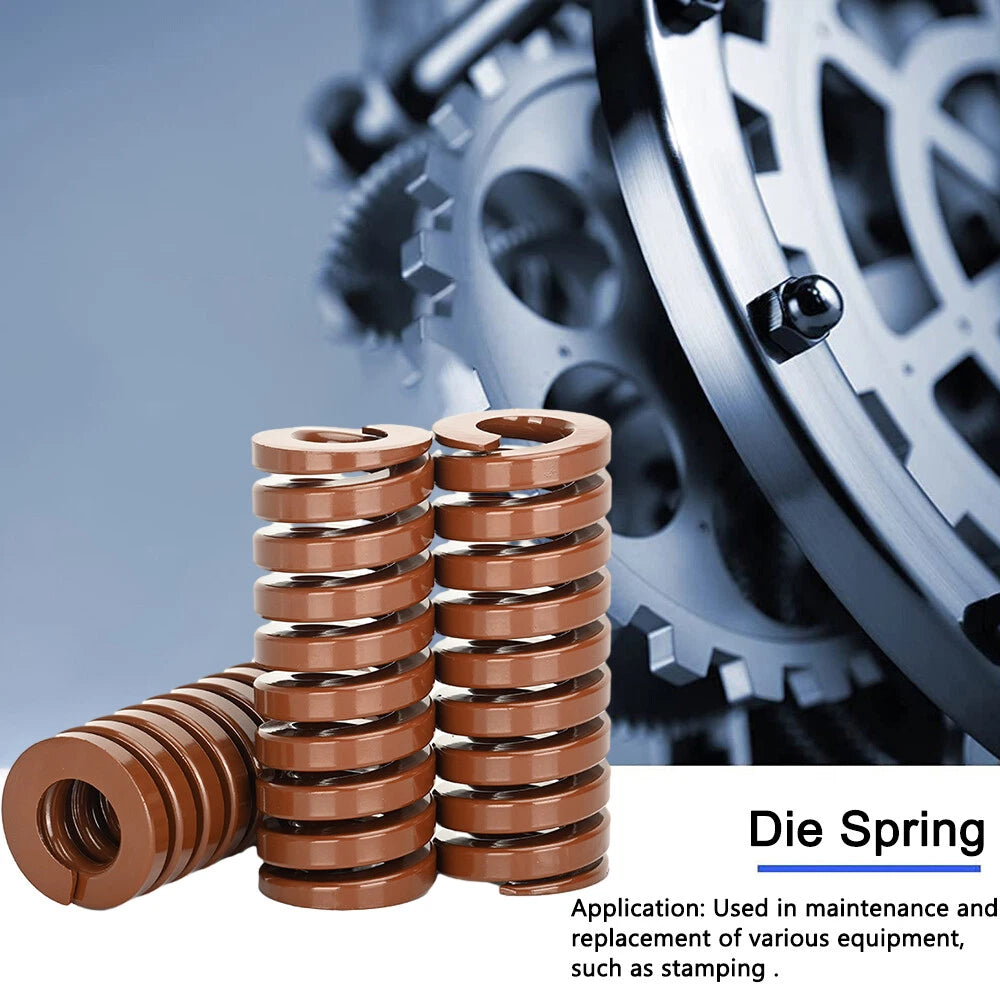
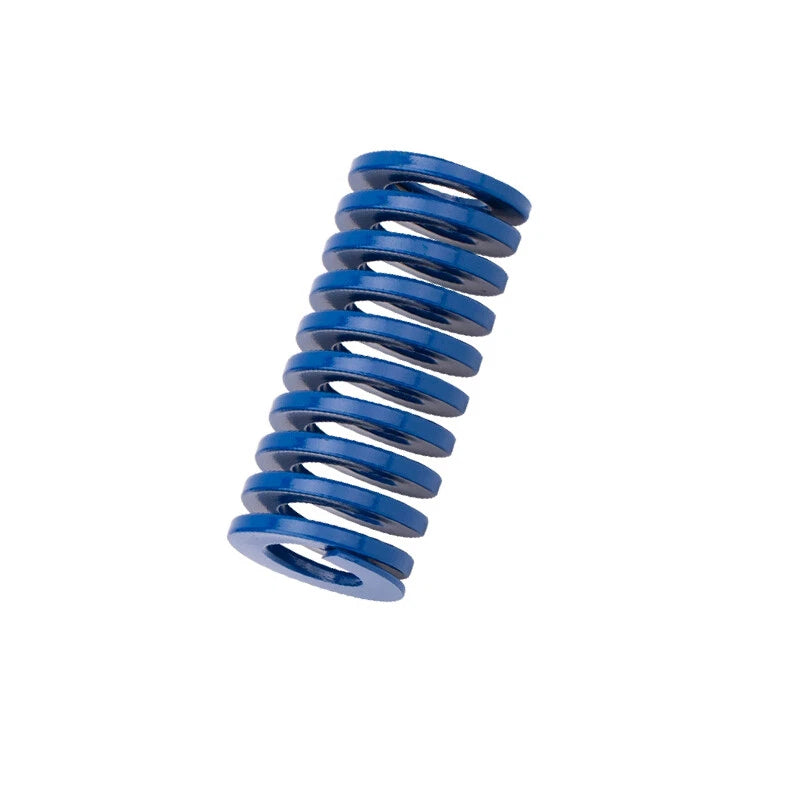
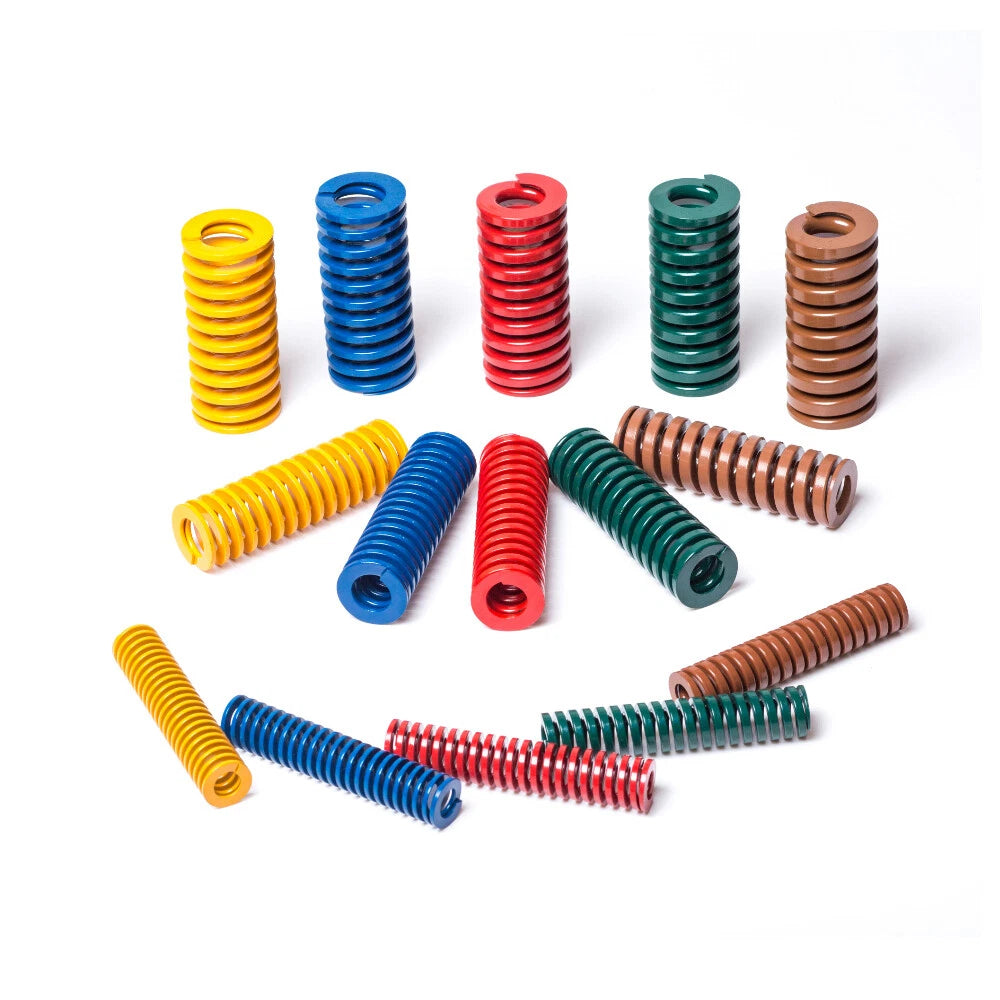
When a stamping die, injection mold, or industrial fixture loses its consistent return force, downtime follows fast. Engineers, toolmakers, and serious DIY fabricators who need a compression die spring that holds its load rating cycle after cycle will find this ISO-standard series purpose-built for the task. Available in five load grades — from light-duty TF-Yellow through extra-heavy TB-Brown — these springs are engineered to match the exact force requirement of your application without guesswork.

Each spring in this series features an outer diameter of 22 mm (0.87 in) and an inner diameter of 11 mm (0.43 in), fitting standard 11 mm guide pins. Free lengths span from 20 mm (0.79 in) up to 300 mm (11.81 in), giving you precise stroke and deflection control across a wide range of tooling depths. Material options include alloy steel (heat-treated), SWOSC-V (oil-tempered silicon-chrome wire for fatigue resistance), and 65Mn spring steel (manganese steel for cost-effective high-load applications).

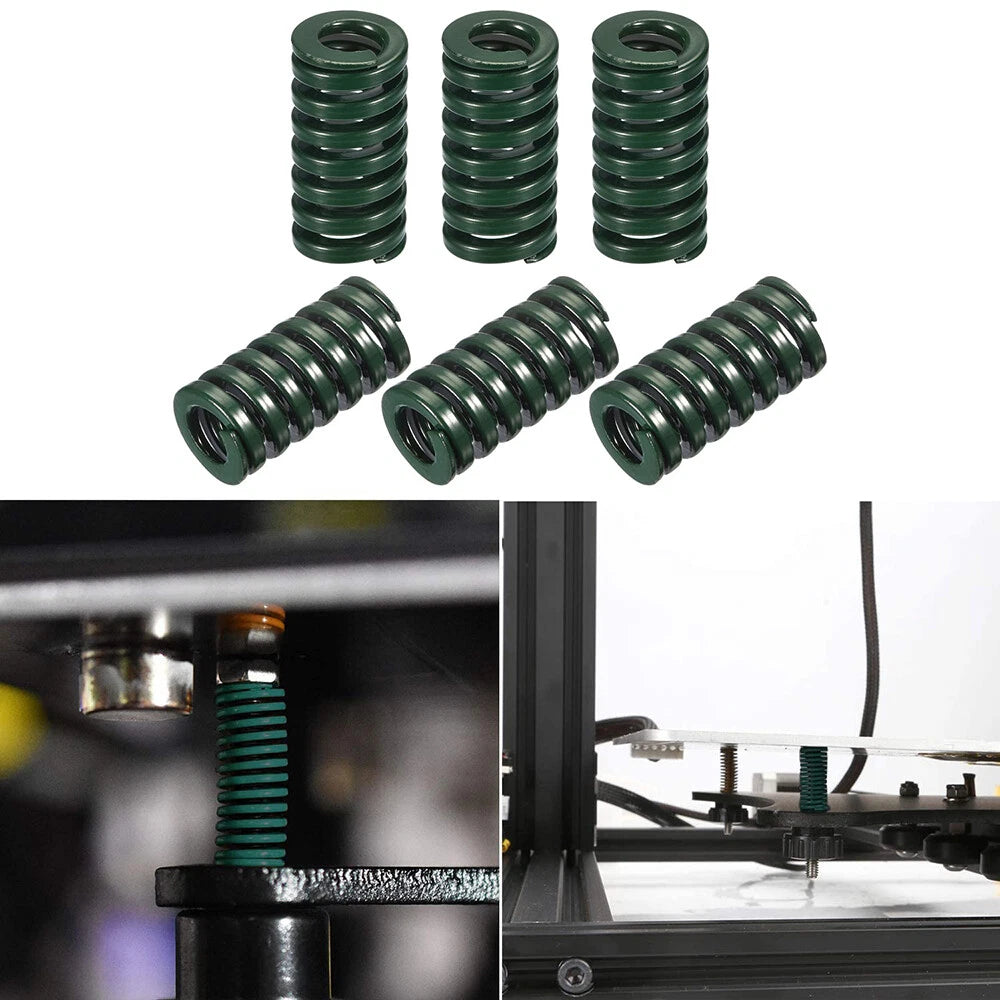
Typical use cases include progressive stamping dies requiring consistent stripping force, plastic injection mold ejector return systems, hydraulic press tooling with controlled pre-load, and custom jig-and-fixture assemblies where a compression die spring for mold tooling must maintain dimensional accuracy over extended production runs.

⚙️ Compatibility: Fits standard 11 mm guide pins. Conforms to ISO 10243 die spring dimensional standards. Suitable for use in stamping dies, injection molds, press tooling, and industrial fixtures requiring OD 22 mm / ID 11 mm spring seats.

✅ Key Features of These Heavy Duty Compression Die Springs

📐 ISO 22 × 11 mm Standard Dimensions

Outer diameter 22 mm, inner diameter 11 mm — drop-in compatible with ISO 10243 spring pockets and 11 mm guide pins across standard tooling platforms.

🎨 Five Load Grades, Color-Coded

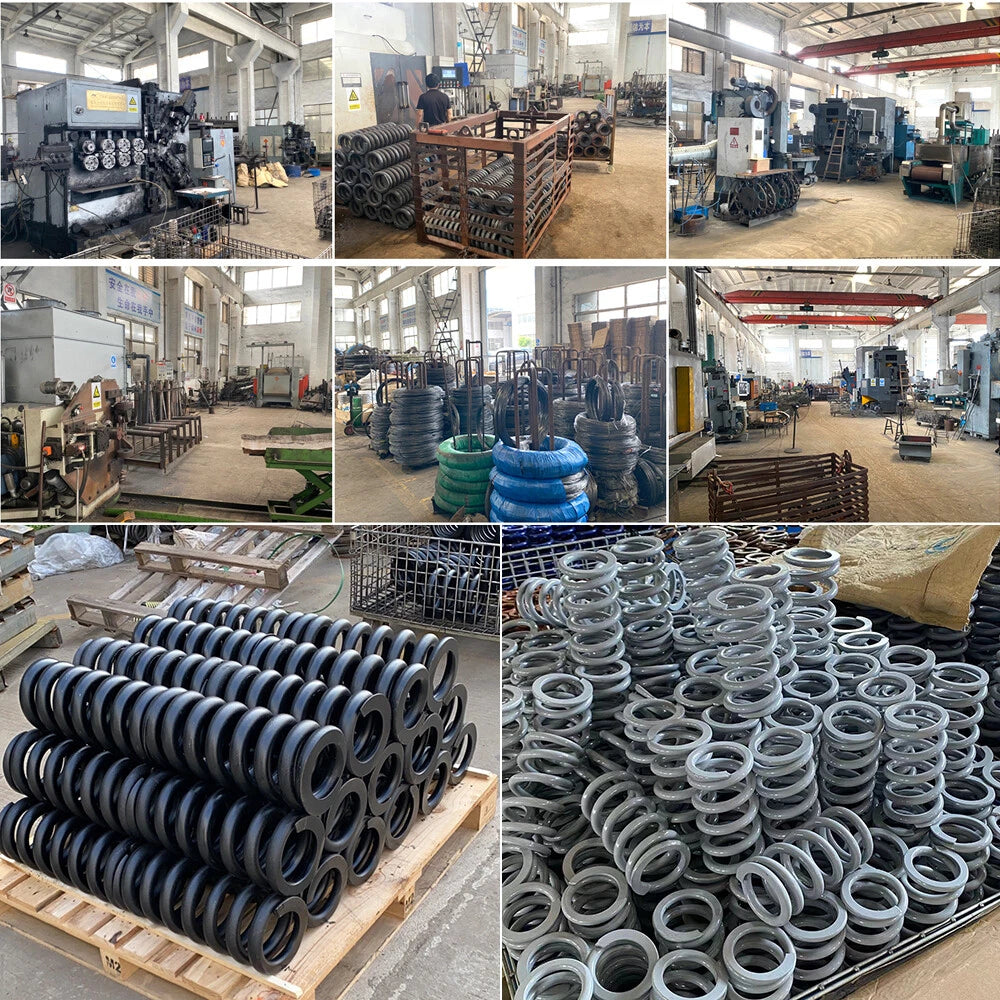
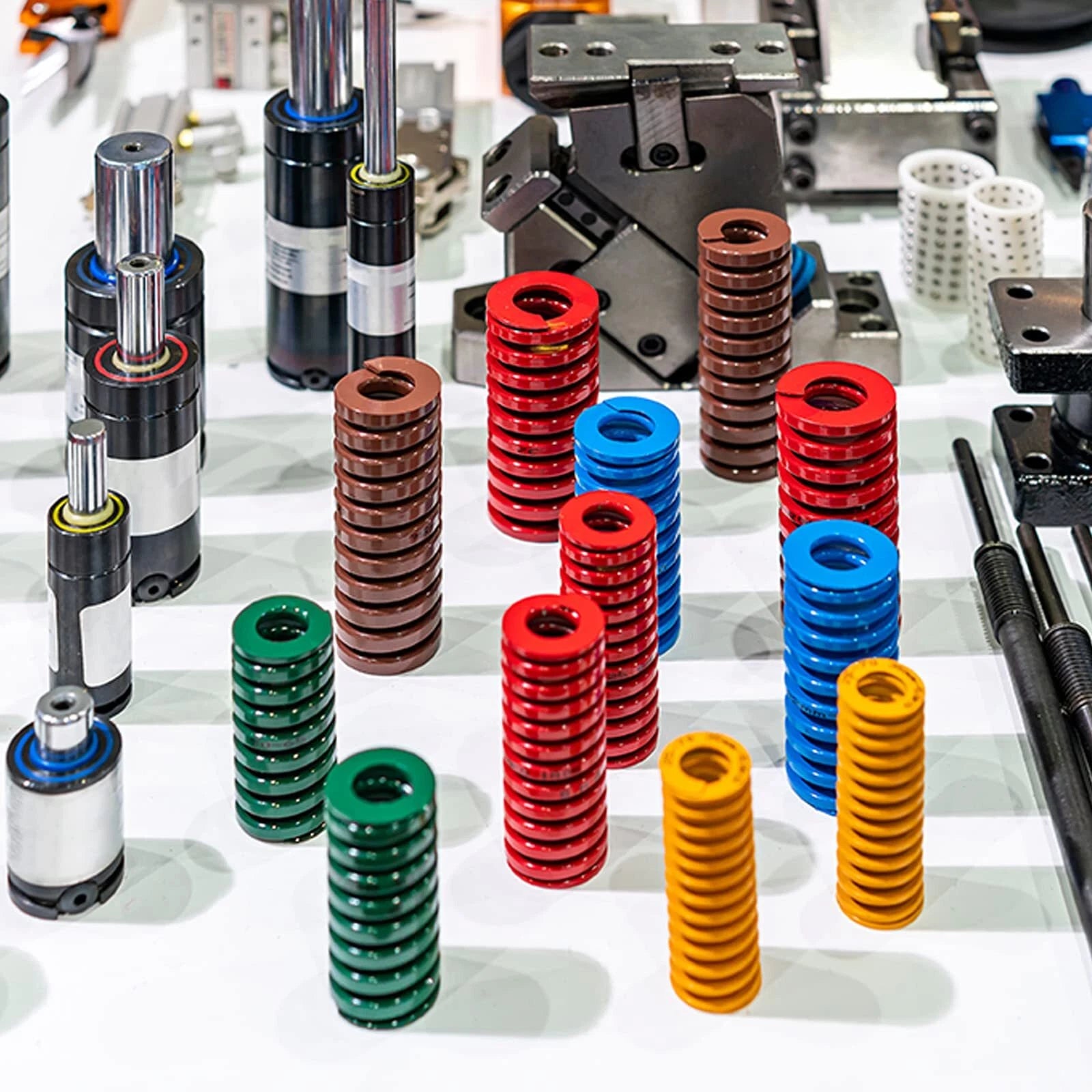
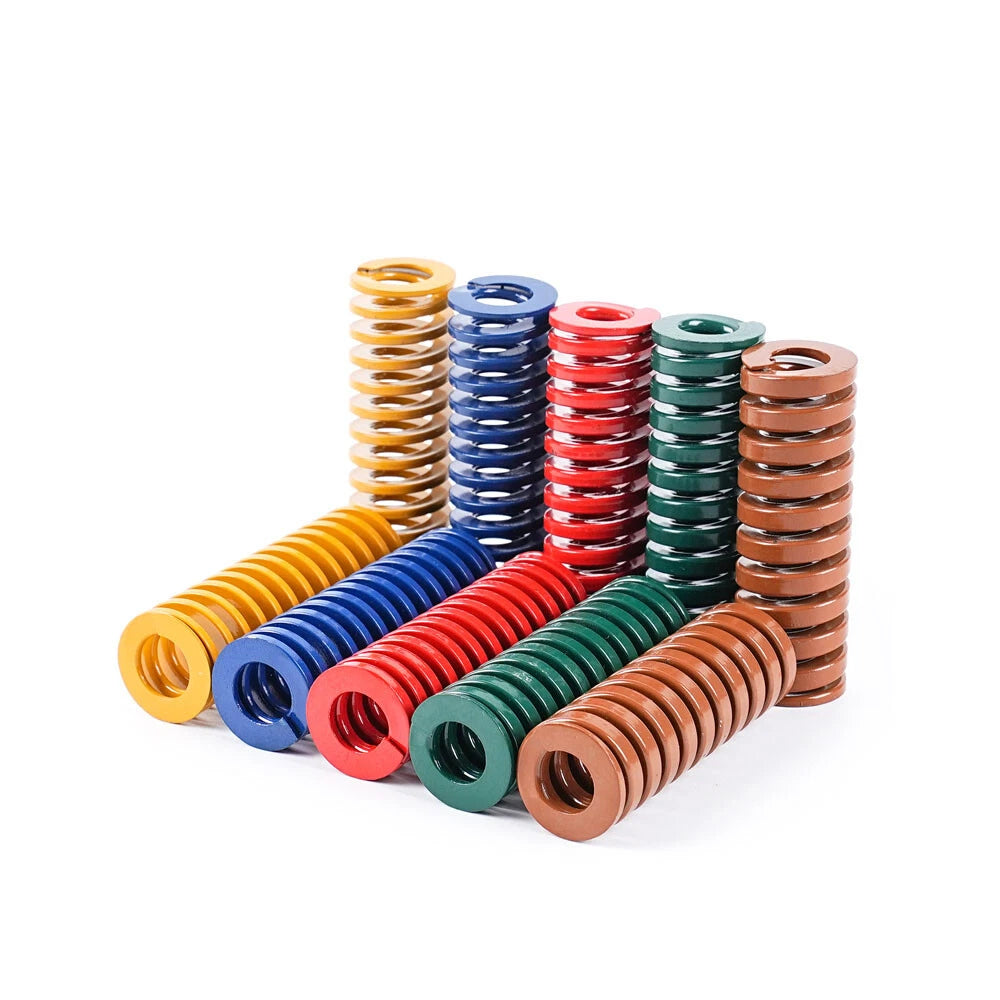
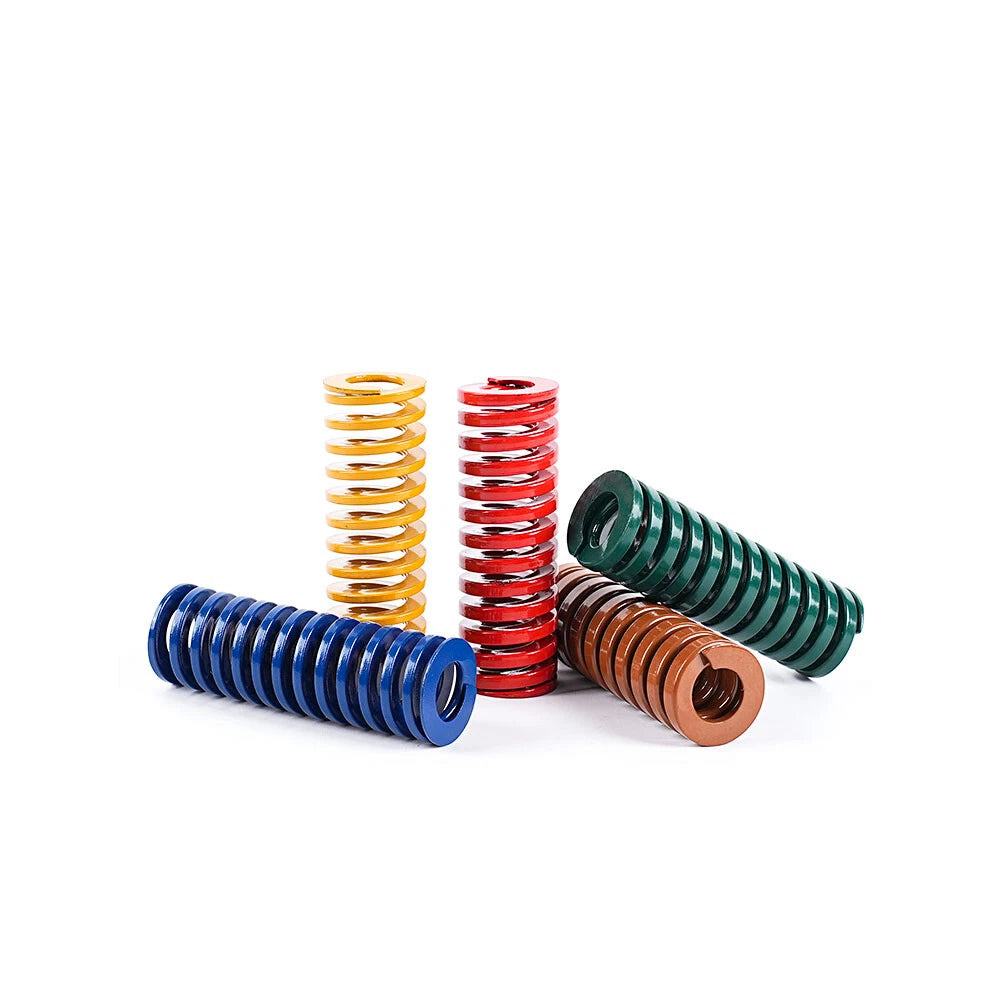
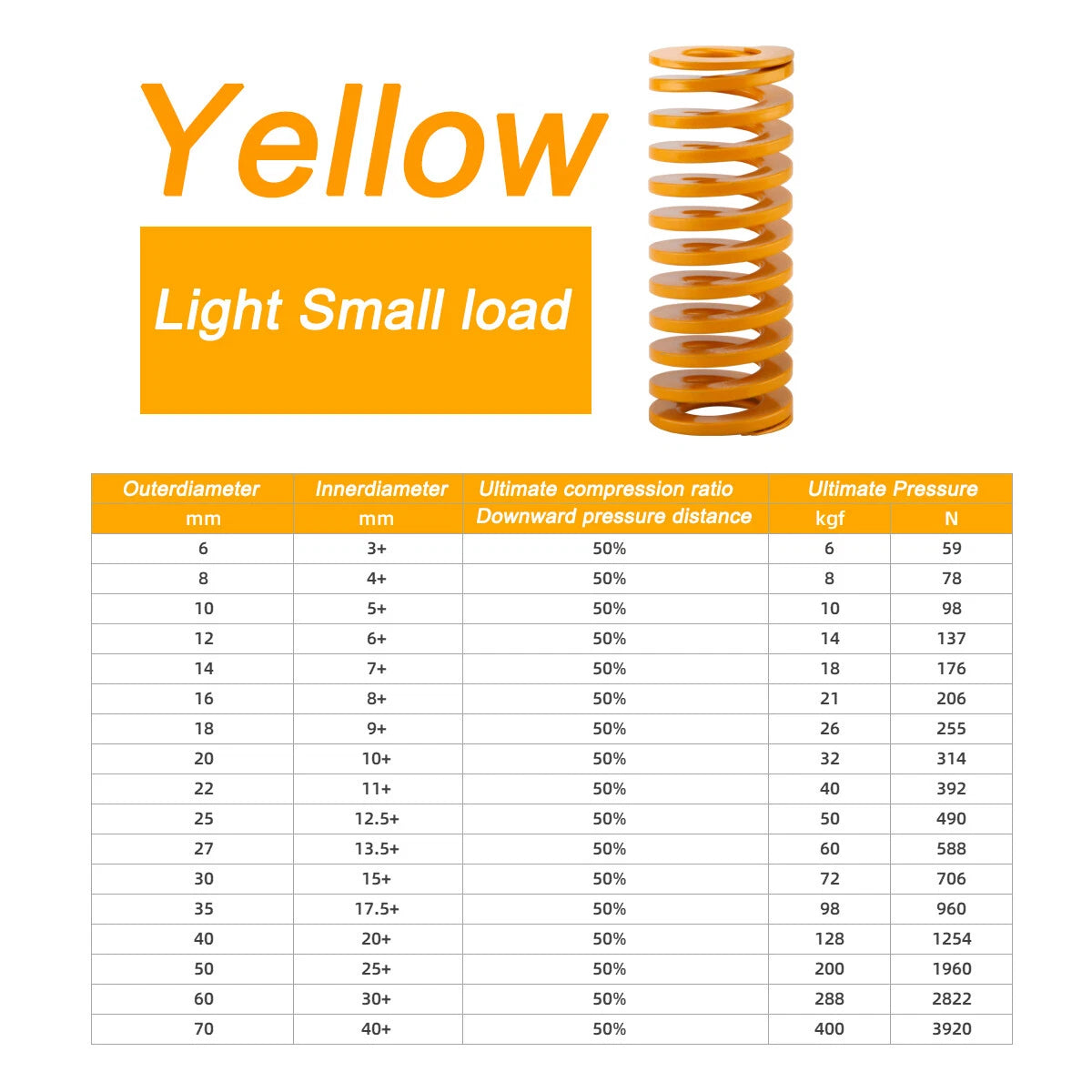
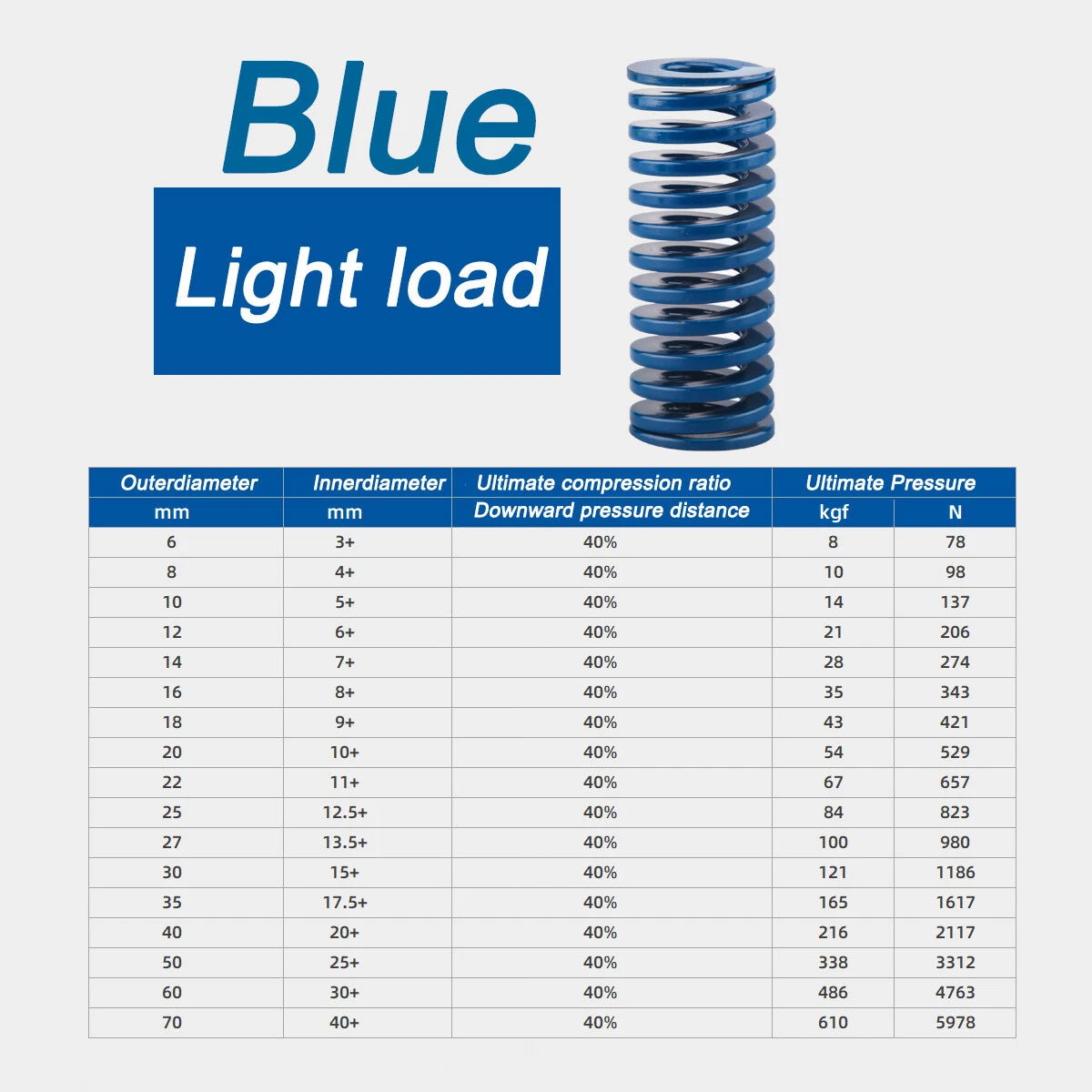
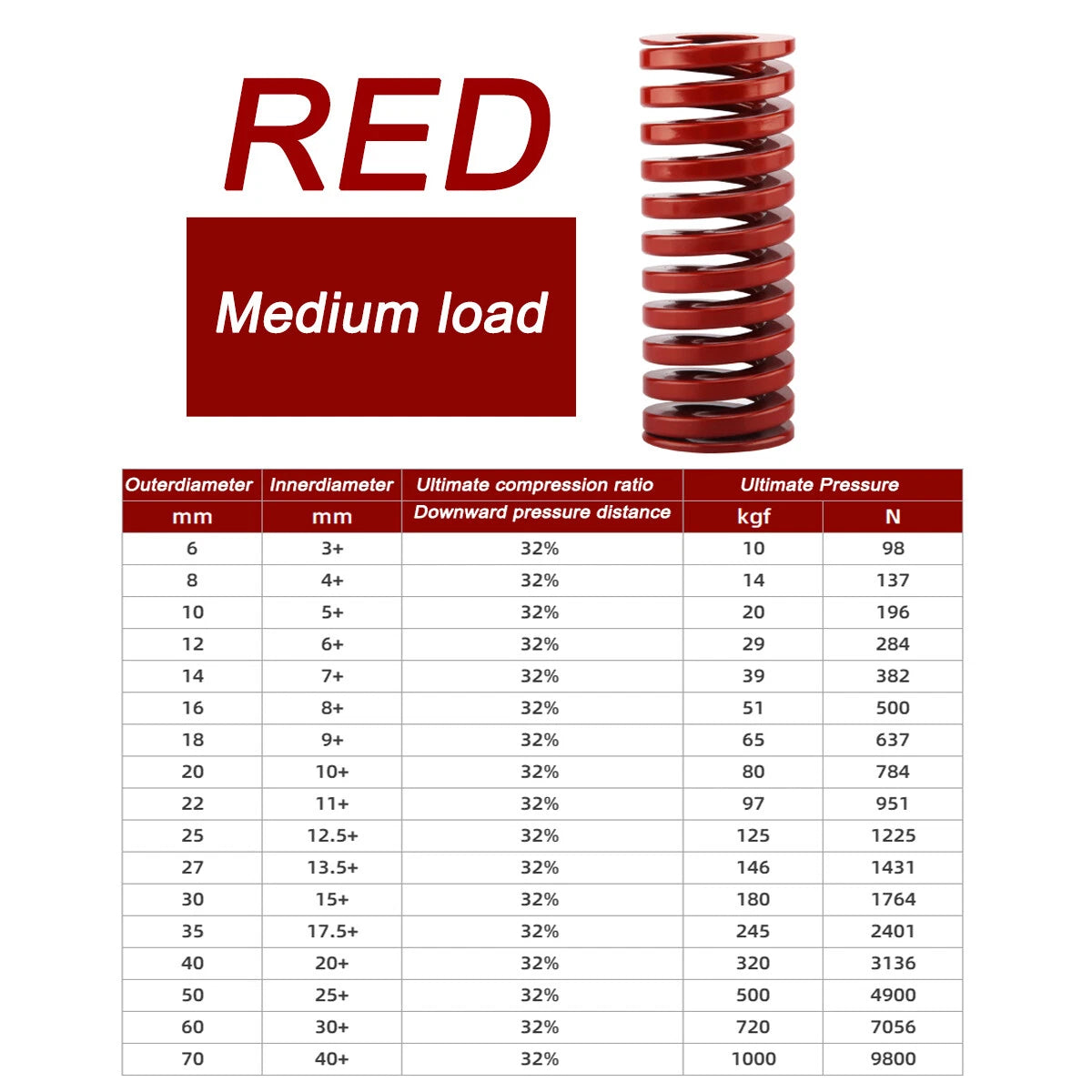
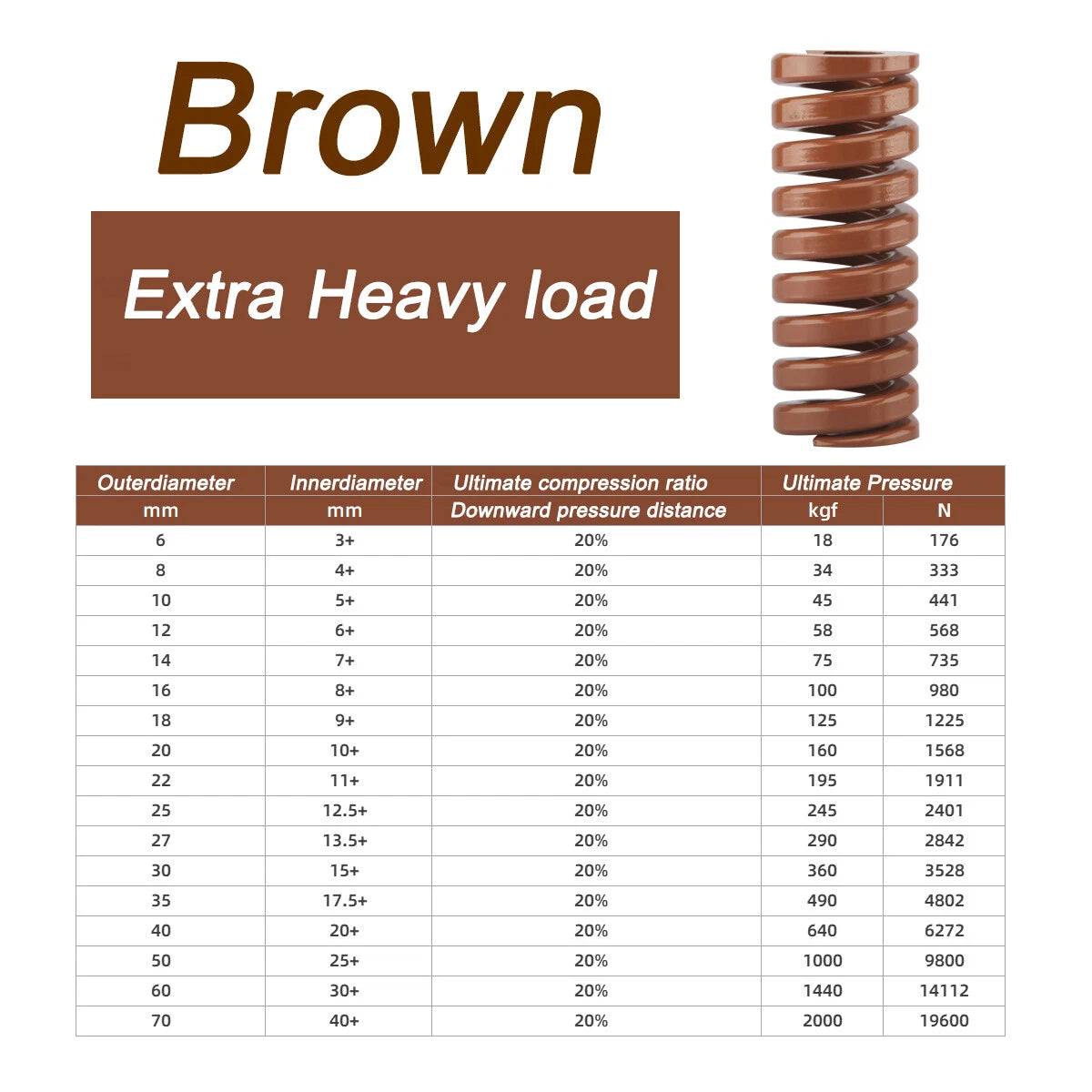
TF-Yellow (light), TL-Blue (medium-light), TM-Red (medium), TH-Green (heavy), TB-Brown (extra-heavy) — select the exact spring rate your application demands.

🔩 Three Material Options

Alloy steel for general tooling, SWOSC-V oil-tempered silicon-chrome wire for extended fatigue life, and 65Mn manganese steel for high-load cost-sensitive applications.

📏 Wide Length Range: 20–300 mm

Free lengths from 20 mm (0.79 in) to 300 mm (11.81 in) allow precise stroke and deflection matching for shallow punch pads to deep-draw tooling.

🔄 Consistent Return Force Over Long Run Life

Tightly controlled wire diameter and coil pitch deliver repeatable spring force, reducing die maintenance intervals and keeping part tolerances stable across production runs.

🛡️ Surface Finish for Corrosion Resistance

Springs are finished to resist oxidation in typical workshop and toolroom environments; SWOSC-V material provides additional resistance to stress-corrosion cracking under cyclic load.

📐 Technical Specifications — Compression Die Springs

Outer Diameter (OD) 22 mm (0.87 in)
Inner Diameter (ID) 11 mm (0.43 in)
Free Length Range 20 mm – 300 mm (0.79 in – 11.81 in)
Load Grades Available TF-Yellow / TL-Blue / TM-Red / TH-Green / TB-Brown
Material Options Alloy Steel / SWOSC-V / 65Mn
Standard ISO 10243
End Type Closed & ground ends
Deflection Rate See variant options
Max. Deflection (%) See variant options
Surface Treatment See variant options
Operating Temperature See variant options

❓ Frequently Asked Questions

How do I choose the right load grade (color) for my application?

Select the load grade based on the stripping or ejection force your tooling requires. TF-Yellow is the lightest and suits low-force stripping applications; TL-Blue and TM-Red cover medium-load presses; TH-Green and TB-Brown handle heavy and extra-heavy loads respectively. If you have a force calculation from your die design, match it to the spring rate listed in the variant specifications. When in doubt, choose one grade heavier than calculated to allow for wear over the spring's service life.

What is the difference between alloy steel, SWOSC-V, and 65Mn materials?

Alloy steel (heat-treated) is the standard choice for general-purpose die and mold tooling — it offers a good balance of strength and cost. SWOSC-V (oil-tempered silicon-chrome wire) is engineered for high-cycle fatigue applications where the spring is compressed and released millions of times; it resists stress-corrosion cracking better than plain alloy steel. 65Mn (manganese spring steel) provides high hardness and load capacity at a lower material cost, making it suitable for heavy-load applications where cycle count is moderate.

How do I select the correct free length for my die or mold?

The free length should be chosen so that the spring operates within its recommended deflection range — typically 20–30% of free length for long service life, and no more than the maximum rated deflection (usually 30–45% depending on load grade). Measure the available spring pocket depth and the required working stroke, then select a free length that keeps the spring within its safe operating deflection at both pre-load and full compression. Longer springs allow more total stroke but require deeper pockets.

Are these springs compatible with standard ISO die sets and spring pockets?

Yes. These springs conform to ISO 10243 dimensional standards with an OD of 22 mm and ID of 11 mm, making them direct replacements for ISO-standard spring pockets and compatible with 11 mm guide pins used in most European and internationally standardized die sets. They are also dimensionally equivalent to common JIS B 5012 and similar national standards that follow the same OD/ID series.

How long will these compression die springs last in production use?

Service life depends on the material grade, operating deflection, and cycle rate. SWOSC-V springs are rated for the highest cycle counts and are recommended for high-volume production tooling. Alloy steel springs provide reliable service in moderate-cycle applications. Operating springs at or below 25% of free length deflection significantly extends service life. Avoid exceeding the maximum rated deflection, as this causes permanent set and rapid fatigue failure. Regular inspection for coil cracking or measurable free-length loss is recommended.

Can I use these springs in corrosive or high-humidity environments?

These springs are finished to resist light oxidation in typical toolroom conditions. For environments with coolant exposure, high humidity, or chemical contact, SWOSC-V material offers better resistance to stress-corrosion cracking compared to plain alloy steel. For aggressive chemical environments, consider applying a compatible rust-inhibiting oil or grease to the spring surface. If your application involves prolonged immersion or strong acids/alkalis, contact us to confirm suitability before ordering.

What should I check when replacing a worn compression die spring?

When replacing a die spring, verify the OD (22 mm), ID (11 mm), and free length of the original spring. Also confirm the load grade by checking the color code on the worn spring. If the original spring shows permanent set (free length shorter than nominal), consider upgrading one load grade or switching to SWOSC-V material for longer life. Inspect the spring pocket and guide pin for wear or damage before installing the replacement, as a worn pocket can cause premature spring failure.

🛒 Select your size (OD × ID × Length), load grade, and material above, then add to cart.

You may also like

Recently viewed