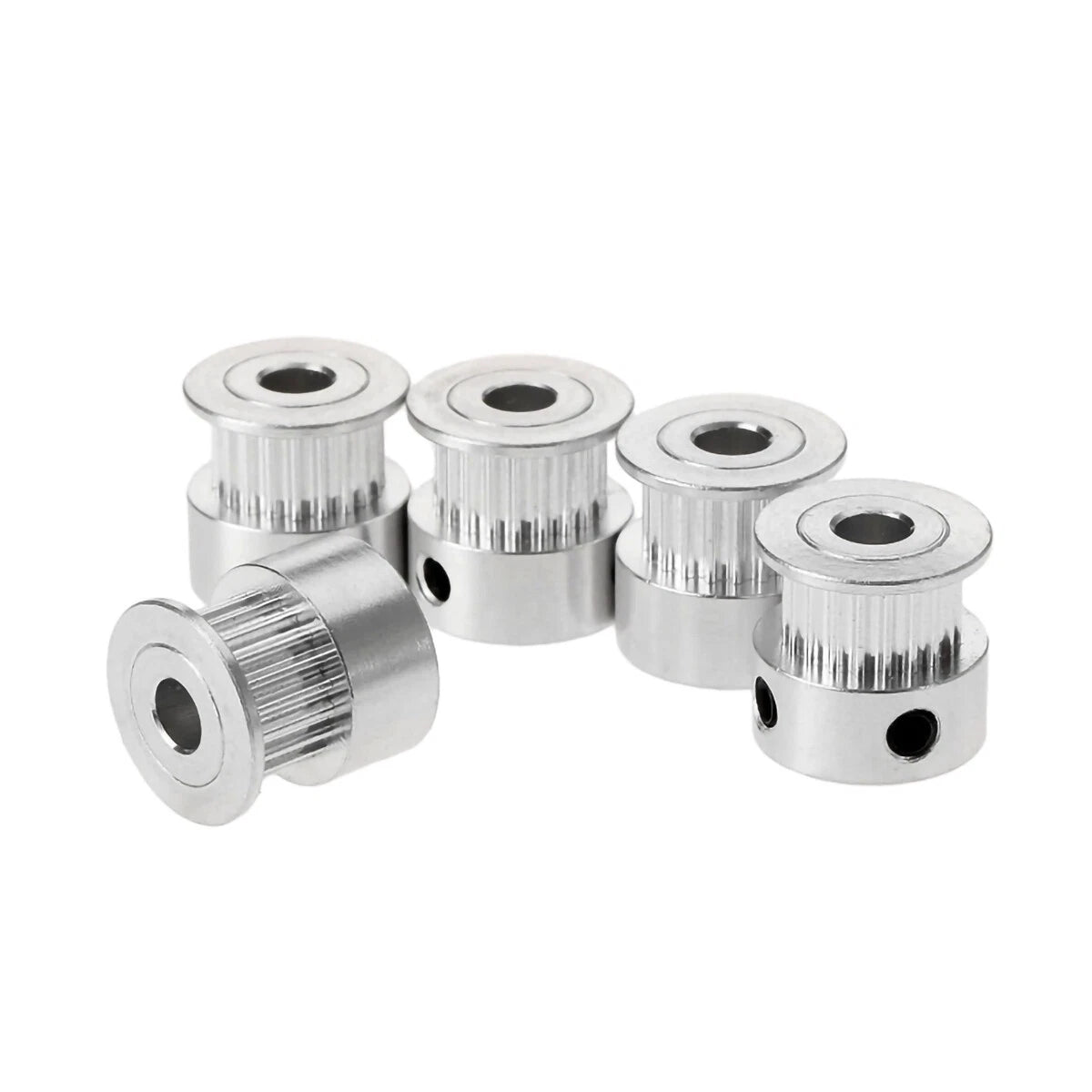
HTD3M Timing Belt Pulley — Precision Drive for CNC & Stepper Motor Systems
When your CNC router skips a step or your 3D printer loses positional accuracy, the culprit is often a mismatched or worn pulley. Engineers, makers, and machine builders who demand repeatable motion need a timing belt pulley that holds tolerance under load — and that's exactly what this HTD3M series delivers. Whether you're retrofitting a router, building a delta printer, or designing a custom linear actuator, getting the bore and tooth count right the first time saves hours of rework.
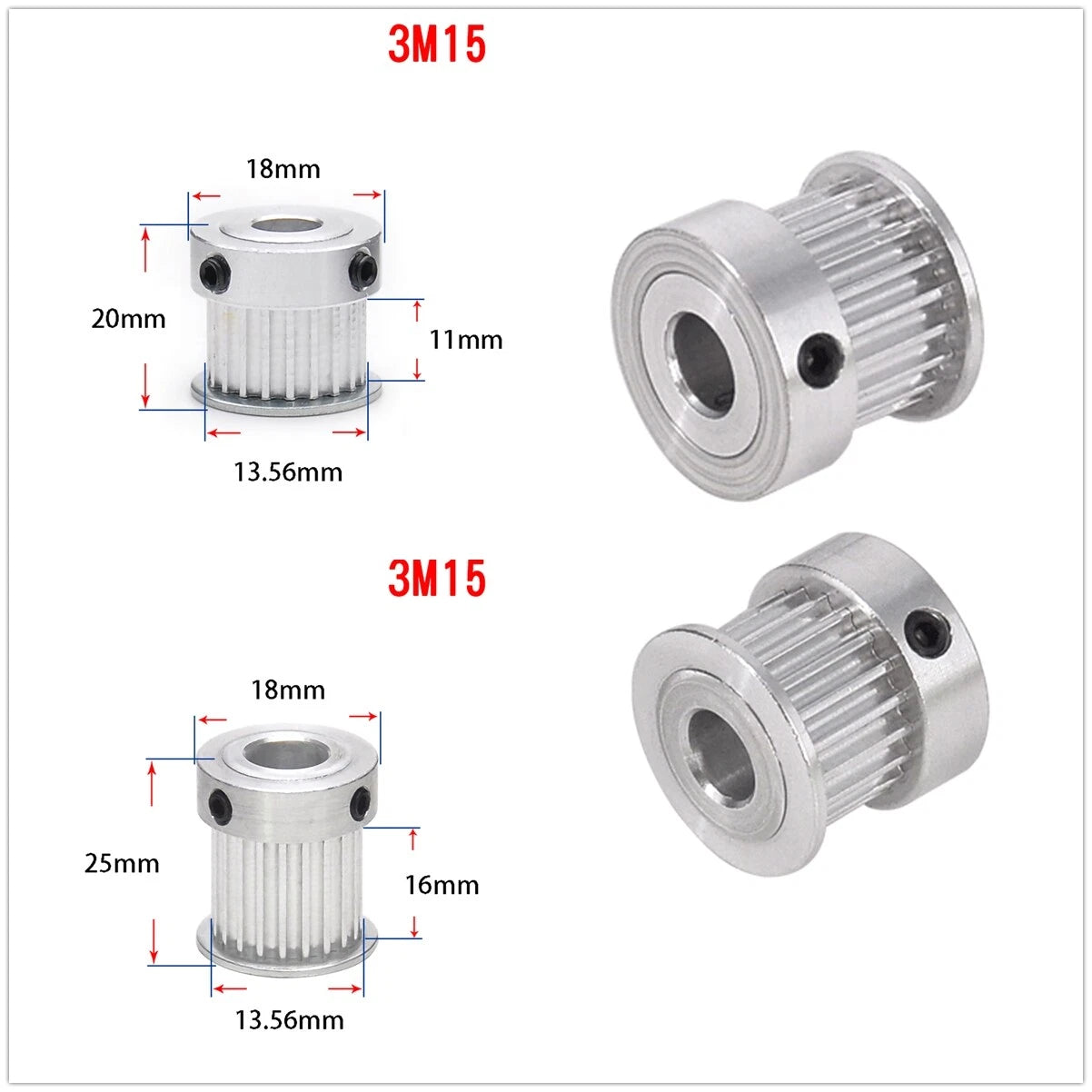
This listing covers HTD3M (3mm pitch) timing belt pulleys machined from aluminum alloy, available in tooth counts from 12 to 30 teeth and belt widths of 10mm or 15mm. Bore options span 3mm to 20mm (approximately 0.118" to 0.787"), including common imperial-adjacent sizes such as 3.175mm (1/8"), 6.35mm (1/4"), and 12.7mm (1/2"). Each pulley ships individually (1 pcs per order) unless a multi-pack variant is selected.
Typical applications include CNC router X/Y axis drives using HTD3M open-loop stepper systems, 3D printer extruder and motion systems requiring low-backlash synchronous drive, and custom linear motion stages where a specific bore-to-shaft fit is critical. Long-tail use cases include laser engraver gantry upgrades, pick-and-place machine drives, and educational robotics platforms.
⚙️ Compatibility: Fits HTD3M (3mm pitch) timing belts in 10mm or 15mm widths. Verify your shaft diameter before selecting bore size. Keyway bore variants (e.g., 8mm 3×1.4mm, 10mm 4×1.8mm, 12.7mm 5×2.3mm) require a matching keyed shaft.
✅ Key Features of These HTD3M Timing Belt Pulleys
🦷
Wide Tooth Range (12–30T): Choose the exact tooth count to match your drive ratio — from compact 12-tooth pinions for high-speed drives to 30-tooth pulleys for torque-optimized reduction stages.
📏
Multiple Bore Sizes (3–20mm): Bore options cover metric and common fractional sizes, including 3.175mm, 6.35mm, and 12.7mm, so you can match standard stepper motor shaft diameters without custom machining.
🔑
Keyway Bore Options Available: Select keyway variants (3×1.4mm, 4×1.8mm, 5×2.3mm) for positive torque transmission on keyed shafts — essential for high-load or reversing-direction applications.
📐
Dual Belt Width Support (10mm & 15mm): Available in both 10mm and 15mm belt widths to match your existing belt stock and load requirements without swapping belt profiles.
⚖️
Aluminum Alloy Construction: Lightweight yet rigid aluminum alloy body keeps rotational inertia low — important for responsive acceleration in CNC and 3D printing motion systems.
🔩
Set Screw Retention: Typically secured with one or two radial set screws (M3 or M4) for tool-free shaft locking during assembly and adjustment.
📐 Technical Specifications — HTD3M Timing Belt Pulley
| Belt Profile |
HTD3M (3mm pitch, curvilinear tooth) |
| Tooth Count Options |
12, 14, 15, 16, 17, 18, 20, 24, 25, 26, 28, 30 Tooth |
| Belt Width Options |
10mm / 15mm |
| Bore Size Options |
3, 3.175, 4, 5, 6, 6.35, 7, 8, 10, 12, 12.7, 14, 15, 16, 17, 18, 19, 20mm (see variant options for keyway bores) |
| Material |
Aluminum alloy |
| Retention Method |
Set screw (typically M3 or M4 radial) |
| Quantity per Order |
1 pcs (standard); see variant options for multi-pack |
| Compatible Belt |
HTD3M open or closed-loop timing belt |
| Keyway Variants |
See variant options (3×1.4mm, 4×1.8mm, 5×2.3mm available) |
| Weight |
See variant options |
❓ Frequently Asked Questions
How do I choose the right tooth count for my application?
The tooth count determines your drive ratio. Divide the driven pulley teeth by the driving pulley teeth to get the reduction ratio. For a 1:1 ratio (same speed), use identical tooth counts on both pulleys. For speed reduction (more torque), use a larger tooth count on the driven side. Common CNC and 3D printer setups use 20-tooth pulleys on NEMA 17 stepper motors for a balanced speed/torque profile.
What bore size should I select for a NEMA 17 stepper motor?
Standard NEMA 17 stepper motors have a 5mm output shaft diameter. Select the 5mm bore variant for a direct fit. If your motor has a flat (D-shaft), a set screw bore is sufficient. For a keyed shaft, choose the appropriate keyway bore variant.
What is the difference between a plain bore and a keyway bore?
A plain bore is secured solely by set screws pressing against the shaft. A keyway bore includes a machined slot that accepts a matching key on the shaft, providing a positive mechanical lock that prevents rotational slipping under high torque or reversing loads. Keyway variants in this listing are identified by their bore notation, e.g., 8mm(3×1.4mm), where 3×1.4mm is the key width × depth.
Is this pulley compatible with GT2 or T5 belts?
No. This pulley is designed specifically for HTD3M (3mm pitch, curvilinear tooth profile) timing belts. GT2 belts use a 2mm pitch and a different tooth geometry. T5 belts use a 5mm pitch trapezoidal profile. Using a mismatched belt will result in poor engagement, noise, and accelerated wear. Always match the pulley profile and pitch to your belt.
How strong is the aluminum alloy body — will it handle my load?
Aluminum alloy pulleys are well-suited for the torque levels produced by NEMA 17 and NEMA 23 stepper motors in typical CNC and 3D printing applications. For very high-torque industrial drives or continuous heavy-duty cycling, consider verifying the load against the belt's rated tension. The pulley body itself is not typically the limiting factor in standard maker and light industrial use cases.
Will the pulley corrode if used in a humid or outdoor environment?
Aluminum alloy naturally forms a thin oxide layer that provides moderate corrosion resistance in typical indoor environments. For humid, wet, or outdoor applications, applying a light coating of machine oil or using an anodized variant (if available) will extend service life. Avoid prolonged exposure to salt spray or strong acids without additional protection.
Can I use a 10mm belt width pulley with a 15mm wide belt?
No — the belt width must match the pulley flange width. A 15mm belt on a 10mm pulley will overhang the flanges, causing the belt to track incorrectly and potentially derail under load. Always select the pulley belt width that matches your belt stock exactly.
🛒 Select your tooth count, belt width, and bore size above, then add to cart.