KM3/KM4 Phillips Flat Head Triangle Tooth Screws | Carbon Steel, Zinc or Nickel Coated

No reviews

Price:
Sale price$6.95 USD
Stock:
In stock (500 units), ready to be shipped

Payment & Security

Ach Direct Debit Amazon American Express Apple Pay Bancontact BLIK Diners Club Discover EPS Google Pay iDEAL Wero JCB Maestro Mastercard Multibanco MobilePay PayPal Przelewy24 Shop Pay Twint Union Pay USDC Visa

Your payment information is processed securely. We do not store credit card details nor have access to your credit card information.

Limited Offer — Spend More, Save More
Spend $55+
Save $5
Spend $100+
Save $10
Spend $200+
Save $25
HomeDIYer DIY Expert Support

DIY Expert Support

Get fitment advice & recommendations

Mon–Fri  8:30 AM – 8:00 PM
24-Hour Fast Ship
Arrives in 3–14 Days
Worldwide Shipping
30-Day Returns
1 tree planted with every purchase

Description

KM3/KM4 Triangle Tooth Phillips Flat Head Screws — Thread-Forming Fasteners for Plastic & Metal

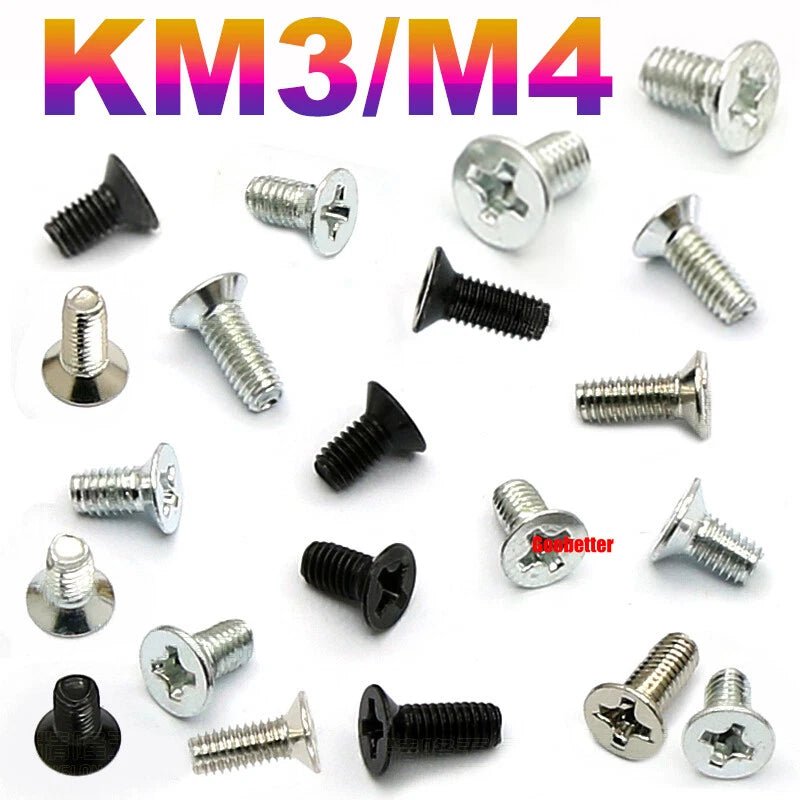
Standard machine screws require pre-tapped holes — an extra step that slows down production and adds tooling cost. For engineers, product assemblers, and DIY makers working with plastic enclosures, aluminum panels, or thin sheet metal, KM triangle tooth screws solve this problem by cutting their own mating threads as they are driven in. These KM3/KM4 Phillips countersunk flat head triangle tooth screws are made from carbon steel with your choice of White Zinc, Black Zinc, or Nickel-Plated finish, giving you both functional performance and finish flexibility in one listing.

Available in sizes KM3 and KM4, with lengths of 6mm (≈1/4") and 8mm (≈5/16"). The KM3 variants come in two head diameter options — D=5.5mm and D=6mm — to match different countersink hole sizes. The KM4 variant features a D=8mm head. All screws have a Phillips (cross) drive countersunk flat head that sits flush when installed in a properly countersunk hole. Packs are available in 100, 200, 300, 400, or 500 pieces to suit both small repairs and production-volume needs.

Typical applications include securing plastic injection-molded enclosures and electronics housings where thread-forming screws eliminate the need for brass inserts, assembling thin aluminum or sheet metal panels in appliances and fixtures, and fastening automotive interior trim panels and plastic brackets where a flush, low-profile head is required. The flat head countersunk profile is also widely used in consumer electronics assembly for a clean, snag-free finish.

🔩 Compatibility: KM metric thread profile (triangle tooth / tri-lobe). Designed to form threads in plastic, aluminum, and thin sheet metal. Not interchangeable with standard ISO metric machine thread (M3/M4) nuts or tapped holes.
⚠️ Note: Always drill a pilot hole of the correct diameter for your material before driving KM screws into harder substrates. The ‘D’ value in the size name refers to the head outer diameter — verify your countersink hole matches before ordering.

✅ Key Features of These KM Triangle Tooth Phillips Flat Head Screws

  • 🔺Triangle Tooth Thread Profile — The KM tri-lobe thread cuts or forms its own mating thread in plastic, aluminum, and thin sheet metal, eliminating the need for pre-tapped holes and reducing assembly steps in production environments.
  • 🦾Carbon Steel Construction — Carbon steel provides higher tensile strength than same-size stainless steel, making these screws well-suited for applications requiring strong thread engagement and reliable clamping force in plastic or metal housings.
  • 🎨Three Coating Options — Choose White Zinc (silver-gray, general-purpose), Black Zinc (matte-black, ideal for dark enclosures and electronics), or Nickel-Plated (bright finish, common in consumer appliances) to match your product’s aesthetic and environment.
  • 📐Countersunk Flat Head Design — The Phillips flat head sits flush with or below the surface when installed in a countersunk hole, keeping assemblies clean and snag-free — critical for consumer electronics, automotive trim, and panel mounting applications.
  • 🔢Multiple Head Diameter Options (D=5.5mm / D=6mm / D=8mm) — KM3 screws are available in two head diameters to match different countersink hole sizes, giving you flexibility when working with existing tooling or mold designs without redesigning the hole pattern.
  • 📦Bulk Pack Quantities (100–500 PCS) — Available in five pack sizes from 100 to 500 pieces, making these screws practical for both small-batch prototyping and higher-volume production runs without overstocking or running short mid-assembly.

📐 Technical Specifications — KM Triangle Tooth Countersunk Machine Screws

Material Carbon Steel
Surface Coating White Zinc / Black Zinc / Nickel-Plated (see variant options)
Drive Type Phillips (Cross / PH)
Head Style Countersunk Flat Head
Thread Type KM Triangle Tooth (tri-lobe thread-forming)
Thread Diameter KM3 (3mm / ≈0.118") or KM4 (4mm / ≈0.157")
Screw Length 6mm (≈1/4") or 8mm (≈5/16"); see variant options
Head Outer Diameter (D) D=5.5mm, D=6mm (KM3), or D=8mm (KM4); see variant options
Head Angle Typically 90° countersunk flat head
Quantity per Pack 100 / 200 / 300 / 400 / 500 PCS (see variant options)
Tensile Strength Contact us to confirm
Recommended Use Plastic, aluminum, thin sheet metal (thread-forming); pilot hole recommended for harder materials
Pre-Tapped Hole Required Generally not required in plastic/aluminum; pilot hole recommended

❓ Frequently Asked Questions

What does ‘KM’ or ‘triangle tooth’ mean, and how is it different from a standard machine screw?

KM screws (also called triangle tooth or tri-lobe thread screws) feature a triangular thread profile rather than a standard V-thread. This design allows the screw to cut or form its own mating thread as it is driven into softer materials such as plastic, aluminum, or thin sheet metal — reducing the need for pre-tapped holes. The triangular thread also generally provides better resistance to loosening under vibration compared to standard machine threads. Standard M3/M4 machine screws require a pre-tapped hole with matching thread pitch; KM screws do not, in most plastic and soft-metal applications.

How do I choose the right size — KM3 vs. KM4, and 6mm vs. 8mm length?

KM3 (3mm thread diameter, ≈0.118") is typically used for lighter-duty assemblies, thin panels, small enclosures, and electronics housings. KM4 (4mm thread diameter, ≈0.157") is generally suited for heavier panels, thicker plastic housings, and applications requiring more clamping force. For length: the screw should be long enough to engage at least 2× the thread diameter in the receiving material — so KM3 generally needs at least 6mm (1/4") of thread engagement, and KM4 at least 8mm (5/16"). Choose the shorter length for thin materials and the longer for thicker substrates.

What is the difference between D=5.5mm and D=6mm head sizes for KM3?

Both are KM3 (3mm thread diameter) screws with the same 6mm length, but with different head outer diameters. D=5.5mm has a smaller head footprint, useful when clearance around the screw head is limited or when your countersink hole is sized for a smaller head. D=6mm has a slightly larger head, providing more bearing surface and clamping area. Measure your countersink hole diameter before ordering to ensure the head fits flush without rocking or protruding.
Which coating should I choose — White Zinc, Black Zinc, or Nickel-Plated?

White zinc plating provides general corrosion resistance and a silver-gray appearance suitable for most indoor applications. Black zinc offers the same corrosion protection with a darker, matte-black finish often preferred for electronics, dark-colored enclosures, or products where silver hardware would stand out. Nickel-plated screws provide a bright, polished appearance and slightly enhanced corrosion resistance, commonly used in consumer electronics and appliances where appearance matters. All three coatings are generally suitable for indoor use; none are recommended for prolonged outdoor or marine exposure without additional protection.

Do these screws require a pre-tapped hole, and what pilot hole size should I use?

KM triangle tooth screws are designed to cut or form their own threads in softer materials such as plastic, aluminum, and thin sheet metal, so a pre-tapped hole is generally not required in those materials. However, a pilot hole of the correct diameter is always recommended to guide the screw and prevent cracking or splitting, especially in brittle plastics. For KM3, a pilot hole of approximately 2.5–2.7mm is typically used in plastic; for KM4, approximately 3.3–3.5mm. Consult the material manufacturer’s recommendations for exact pilot hole sizing. For harder metals, pre-tapping is generally required.
How strong are these screws, and can they handle vibration?

These screws are made from carbon steel, which generally provides higher tensile strength than same-size stainless steel. The triangle tooth thread profile also tends to resist loosening under vibration better than standard V-thread machine screws, because the thread flanks create a locking effect as they form into the mating material. Exact tensile strength values depend on the specific carbon steel grade and heat treatment; contact us to confirm if your application has specific load or torque requirements.

Can I use these screws outdoors or in humid environments?

The zinc and nickel coatings on these carbon steel screws provide moderate corrosion resistance suitable for indoor and sheltered environments. For prolonged outdoor exposure, especially in humid, wet, or salt-air conditions, additional protection (such as a sealant or conformal coating over the assembly) is generally recommended, or consider using 304 stainless steel screws instead. These screws are not recommended for marine or highly corrosive environments without additional protection.

🛒 Select your size, coating, and quantity above, then add to cart — ships from our US warehouse.

You may also like

Recently viewed