L-Type 10T-40T Timing Belt Pulleys Pitch 9.525mm AF Synchronous Wheel Width 27mm

No reviews

Price:
Sale price$5.97 USD
Stock:
In stock (500 units), ready to be shipped

Payment & Security

Ach Direct Debit Amazon American Express Apple Pay Bancontact BLIK Diners Club Discover EPS Google Pay iDEAL Wero JCB Maestro Mastercard Multibanco MobilePay PayPal Przelewy24 Shop Pay Twint Union Pay USDC Visa

Your payment information is processed securely. We do not store credit card details nor have access to your credit card information.

Limited Offer — Spend More, Save More
Spend $55+
Save $5
Spend $100+
Save $10
Spend $200+
Save $25
HomeDIYer DIY Expert Support

DIY Expert Support

Get fitment advice & recommendations

Mon–Fri  8:30 AM – 8:00 PM
24-Hour Fast Ship
Arrives in 3–14 Days
Worldwide Shipping
30-Day Returns
1 tree planted with every purchase

Description

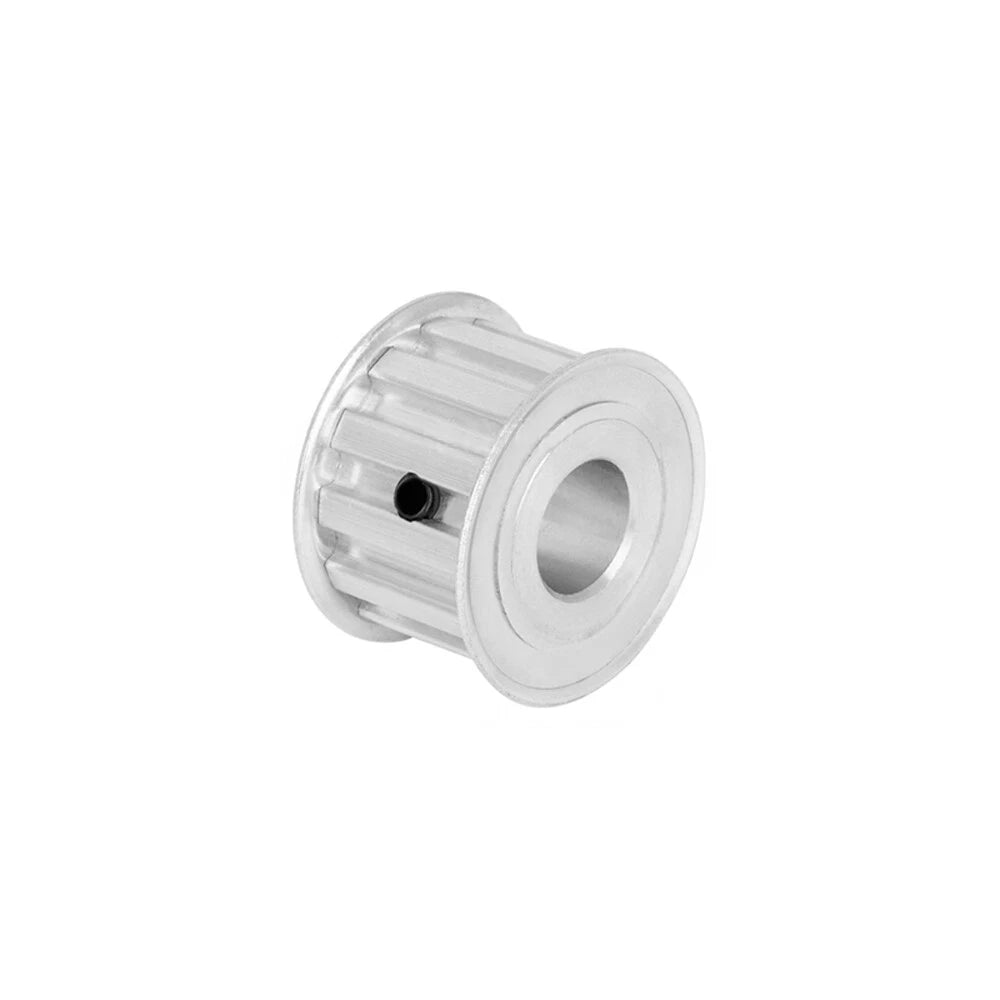
L-Type Timing Belt Pulleys with 9.525mm Pitch — Reliable Synchronous Drive for CNC and Automation

When your CNC router skips steps or your automation axis loses position, the culprit is often a mismatched or worn timing pulley. Engineers, robotics builders, and machine designers who need a dependable L-type synchronous wheel with a precise 9.525mm pitch will find this AF-bore series covers the full range of shaft sizes and tooth counts in a single catalog.

Each pulley is machined from aluminum alloy with a natural anodized finish, featuring a 27mm belt width (W27), AF-style set-screw bore, and tooth counts from 10T to 40T. Bore options span 6mm to 30mm (approximately 0.24 in to 1.18 in), accommodating stepper motor shafts, servo shafts, and lead-screw couplings across a wide range of machine frames.

Typical use cases include XY gantry drives on desktop CNC routers, axis synchronization on 3D printer frames, conveyor timing in light industrial automation, and rotary indexing tables in DIY robotics projects — all applications where an L-type synchronous belt pulley with a 9.525mm pitch delivers the low-backlash, slip-free motion control that chain or friction drives cannot match.

⚙️ Compatible with standard L-type (3/8") synchronous timing belts — pitch 9.525mm (0.375 in), belt width up to 27mm. Verify bore diameter matches your shaft before ordering.

✅ Key Features of These L-Type Timing Belt Pulleys

🔩 AF Set-Screw Bore

AF-style clamping with set-screw retention locks the pulley firmly to the shaft, resisting rotational slip under dynamic loads without requiring a keyway.

📐 9.525mm (3/8") L-Type Pitch

Matches the industry-standard L-series belt pitch, ensuring interchangeability with off-the-shelf L-type timing belts used in CNC, robotics, and conveyor systems.

🦷 10T–40T Tooth Range

Wide tooth-count selection from 10T to 40T lets you dial in the exact gear ratio needed for your drive system without custom machining.

📏 27mm Belt Width (W27)

The 27mm face width provides a stable belt contact surface, reducing edge wear and maintaining belt tracking on longer drive runs.

⚖️ Aluminum Alloy Construction

Lightweight aluminum alloy body keeps rotational inertia low — critical for high-acceleration stepper and servo axes — while offering adequate strength for typical machine loads.

🔄 Wide Bore Compatibility

Available in bore sizes from 6mm to 30mm (≈ 0.24–1.18 in), covering common stepper motor shafts (6mm, 8mm), servo shafts (10–20mm), and larger drive shafts up to 30mm.

📐 Technical Specifications — L-Type Timing Belt Pulleys

Belt Type L-Type (3/8" pitch)
Pitch 9.525mm (0.375 in)
Belt Width 27mm (W27)
Number of Teeth 10T, 12T, 14T, 15T, 16T, 17T, 18T, 19T, 20T, 22T, 24T, 25T, 26T, 28T, 30T, 32T, 33T, 40T
Bore Style AF (set-screw)
Bore Diameter Range 6mm – 30mm (see variant options)
Material Aluminum alloy
Finish Natural anodized
Outer Diameter See variant options
Hub Length See variant options
Quantity per Order 1 piece (1Pcs)

❓ Frequently Asked Questions

How do I choose the right number of teeth for my drive system?

The tooth count determines your drive ratio. Divide the driven pulley teeth by the driver pulley teeth to get the ratio. For example, a 20T driver paired with a 40T driven pulley gives a 2:1 reduction. Choose a tooth count that achieves your target speed or torque ratio while keeping the belt wrap angle above 90° on the smaller pulley for reliable engagement.

What bore size should I order for a standard NEMA 17 stepper motor?

NEMA 17 stepper motors typically have a 5mm output shaft. However, this product series starts at 6mm bore. If your motor shaft is 5mm, you would need a 5mm bore pulley (not available in this series) or use a shaft adapter/coupler to step up to 6mm. For NEMA 23 motors with 6.35mm (1/4") shafts, select the 6.35mm bore variant.

Are these pulleys compatible with standard L-type timing belts sold elsewhere?

Yes. These pulleys conform to the standard L-series (3/8") timing belt profile with a 9.525mm pitch. They are interchangeable with any L-type timing belt of matching width (up to 27mm). Verify the belt width does not exceed 27mm to ensure proper flange clearance.

How strong is the AF set-screw bore — will it slip under load?

The AF set-screw design provides adequate holding torque for typical CNC and light automation loads when the set screw is properly torqued against a flat on the shaft. For high-torque or reversing-load applications, we recommend using a shaft with a milled flat or keyway to prevent rotational slip. Always apply thread-locking compound to the set screw for vibration-prone environments.

Will aluminum pulleys corrode in humid or outdoor environments?

The natural anodized finish provides a degree of corrosion resistance suitable for indoor workshop and light industrial environments. For prolonged exposure to moisture, salt spray, or outdoor conditions, consider applying a light machine oil or protective coating. Anodized aluminum is significantly more corrosion-resistant than bare aluminum but is not rated for marine or harsh outdoor use without additional protection.

Can I use these pulleys on both the driver and driven side of the same belt run?

Yes. You can use any two pulleys from this series as a matched driver/driven pair on the same L-type belt, provided the center distance and belt length are calculated correctly for the chosen tooth counts. Using the same series on both sides ensures consistent tooth profile engagement and minimizes vibration.

What is the difference between the L10T and L40T pulleys in terms of physical size?

The outer diameter scales with tooth count. An L10T pulley has a significantly smaller pitch diameter (approximately 30mm) compared to an L40T (approximately 121mm). Larger tooth-count pulleys are physically bigger and heavier, which increases rotational inertia. Choose smaller tooth counts for high-speed, low-torque axes and larger counts where torque multiplication is needed.

🛒 Select your Number of Teeth and Bore above, then add to cart.


You may also like

Recently viewed