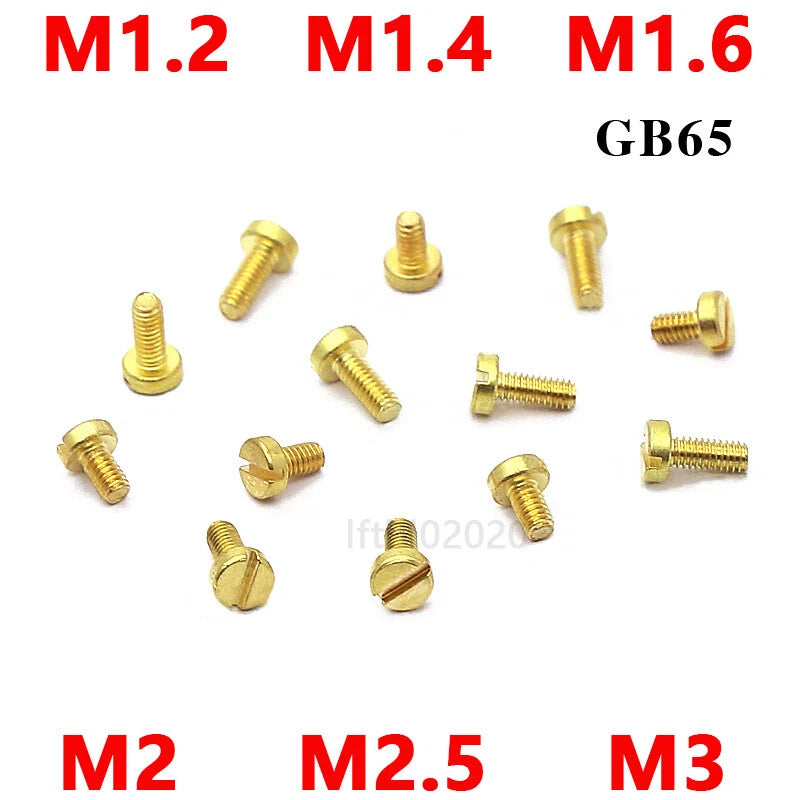
Brass Slotted Cheese Head Machine Screws M1.2–M3 — DIN 84 Precision Fasteners for Instruments & Electronics
When assembling precision instruments, optical devices, PCBs, or miniature mechanical components, standard hardware-store screws simply don't cut it. The wrong material causes galvanic corrosion, the wrong head profile won't seat properly in recessed holes, and oversized fasteners can damage delicate housings. Engineers, hobbyists, watchmakers, and electronics technicians who work with sub-M3 fasteners know how hard it is to source the right brass slotted cheese head machine screws in small, manageable quantities.
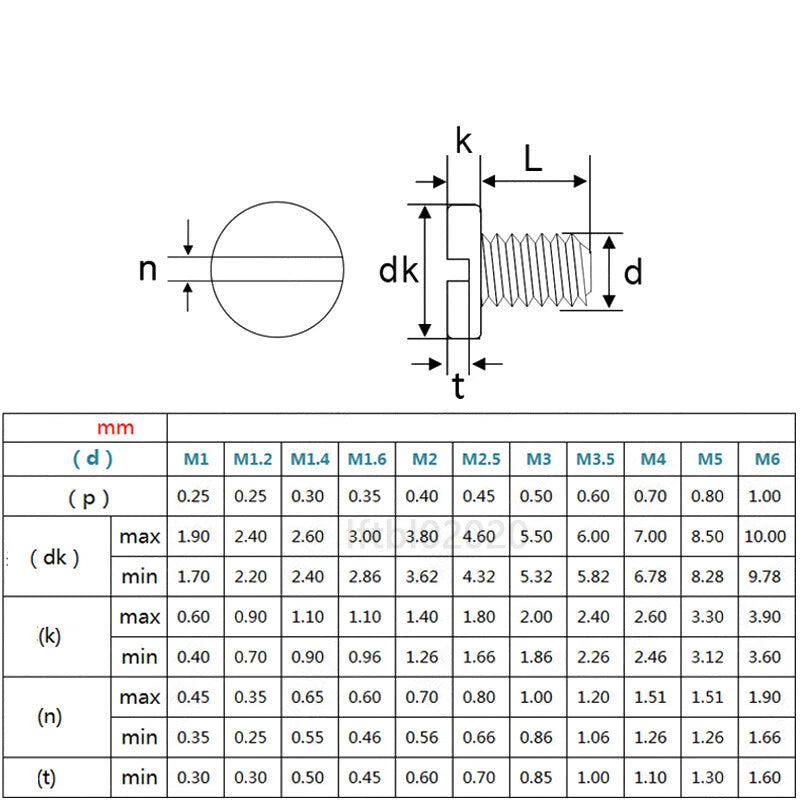
Each pack contains brass slotted cheese head machine screws conforming to DIN 84 (ISO 1207), available in diameters from M1.2 to M3 and lengths from 2mm (≈5/64") to 10mm (≈13/32"). Packs are offered in 100 or 200 pieces per order. The cheese head profile — a cylindrical head with a flat top and vertical sides — provides a deep, precise slot engagement and a clean, low-profile appearance in recessed or countersunk assemblies. Material is brass, offering natural corrosion resistance, non-magnetic behavior, and good compatibility with copper and brass mating components.
These DIN 84 brass machine screws are commonly used in precision instrument assembly, electronics enclosure fastening, optical equipment and camera body hardware, model engineering, and decorative or architectural metalwork where a polished brass finish is desired. The slotted drive is the standard specified in many legacy engineering drawings and repair manuals, making these screws an essential stock item for repair technicians and instrument makers.
🔩
DIN 84 / ISO 1207 Thread Compatibility: These screws use ISO metric threads and are compatible with standard metric nuts, brass inserts, and tapped holes (M1.2, M1.4, M1.6, M2, M2.5, M3). They are not compatible with UNC/UNF inch-standard threads. Verify thread pitch before ordering for precision-tapped components.
✅ Key Features of These Brass Slotted Cheese Head Machine Screws
-
🟡Solid Brass Construction — Made from brass (copper-zinc alloy), these screws resist corrosion without surface coatings, remain non-magnetic, and are galvanically compatible with brass, copper, and bronze mating components — critical for precision instrument and electronics assembly.
-
📐DIN 84 / ISO 1207 Cheese Head Profile — The cylindrical head with flat top and vertical sides provides a deeper slot than pan or round heads, allowing more precise torque application with a flat-blade screwdriver and a cleaner fit in recessed mounting holes.
-
🔬Sub-M3 Micro Sizes Available — With diameters starting at M1.2, these slotted machine screws cover the miniature fastener range needed for watchmaking, optical instruments, PCB standoffs, and small electronics enclosures where M3 and larger screws are too bulky.
-
📦Bulk Packs — 100 or 200 Pieces — Order in quantities that match your project scale. Whether you need a bench stock of 200 for ongoing production or 100 for a repair run, each pack contains a consistent, single-size selection for organized inventory management.
-
⚖️Slotted Drive — Legacy & Precision Standard — The straight slotted recess is the drive type specified in DIN 84 and many precision engineering standards. It works with any flat-blade screwdriver and is the correct choice when replacing fasteners in instruments originally assembled to DIN or ISO specifications.
-
🔗Wide Length Range for Varied Stack-Ups — Lengths from 2mm to 10mm accommodate thin panel assemblies, multi-layer PCB stacks, and deeper threaded inserts, giving you the flexibility to match the exact grip length required without over-penetrating delicate substrates.
📐 Technical Specifications — Brass Slotted Cheese Head Machine Screws
| Standard |
DIN 84 / ISO 1207 |
| Drive Type |
Slotted (straight flat blade) |
| Head Style |
Cheese Head (cylindrical, flat top) |
| Material |
Brass (copper-zinc alloy) |
| Finish |
Natural brass (uncoated) |
| Thread Standard |
ISO Metric (M1.2, M1.4, M1.6, M2, M2.5, M3) |
| Available Diameters |
M1.2, M1.4, M1.6, M2, M2.5, M3 |
| Available Lengths |
2mm (≈5/64") to 10mm (≈13/32") — see variant options |
| Pack Quantities |
100 Pcs / 200 Pcs |
| Magnetic Properties |
Non-magnetic |
| Corrosion Resistance |
Good — suitable for indoor and mild outdoor environments |
| Recommended Driver |
Flat-blade; 0.8–1.0mm for M1.2–M1.6; 1.0–1.5mm for M2–M3 |
| Country of Origin |
Contact us to confirm |
⚠️
Note: Brass screws are softer than steel and are not recommended for high-torque or structural load-bearing applications. If you need these for a specific engineering application, contact us to confirm material grade before ordering.
❓ Frequently Asked Questions
How do I choose the right screw length for my application?
A general guideline is to select a length that provides at least 1.5× the screw diameter of thread engagement in the base material. For example, an M2 screw threading into a brass insert would typically need at least 3mm of engagement. Available lengths in this listing range from 2mm (≈5/64") to 10mm (≈13/32"). Measure your panel thickness and add the required engagement depth before selecting your size.
What material are these screws made from?
These screws are made from brass, a copper-zinc alloy known for its corrosion resistance, electrical conductivity, and non-magnetic properties. Brass is commonly used in precision instruments, electronics, and applications where galvanic compatibility with brass or copper components is important. Contact us to confirm the specific alloy grade if needed for engineering documentation.
Are brass screws suitable for outdoor use?
Brass generally offers good corrosion resistance in mild outdoor environments and does not rust like steel. However, in marine or highly corrosive environments, brass can be susceptible to dezincification over time. For demanding outdoor applications, consider whether a higher-grade alloy or additional protection is needed.
What thread standard do these screws follow, and are they compatible with standard metric nuts?
These screws conform to DIN 84 (equivalent to ISO 1207) and use ISO metric threads (M1.2, M1.4, M1.6, M2, M2.5, M3). They are compatible with standard metric nuts, brass threaded inserts, and tapped holes machined to ISO tolerances. They are not compatible with UNC/UNF inch-standard threads.
What is a cheese head screw and how does it differ from a pan head?
A cheese head screw has a cylindrical head with a flat top and vertical sides, resembling a small wheel of cheese. Compared to a pan head, the cheese head is taller and narrower, providing a deeper slot for the screwdriver and a more precise fit in recessed holes. It is the head style specified in DIN 84 and is commonly used in precision instrument and electronics assembly.
What screwdriver do I need for these slotted screws?
These screws use a straight slotted drive. For M1.2–M1.6, a precision flat-head screwdriver with a blade width of typically 0.8–1.0mm is generally appropriate. For M2–M3, a standard flat-head screwdriver with a 1.0–1.5mm blade is typically used. Using a correctly sized blade prevents slot damage and cam-out during installation.
How strong are these brass machine screws?
Brass machine screws are generally softer than steel and are not intended for high-load structural applications. They are well suited for light-duty fastening in precision instruments, PCBs, optical equipment, and decorative assemblies where corrosion resistance and non-magnetic properties matter more than tensile strength. For load-bearing applications, consult a fastener engineer and confirm the material grade with us before ordering.
🛒 Select your size and pack quantity above, then add to cart — ships from our US warehouse.