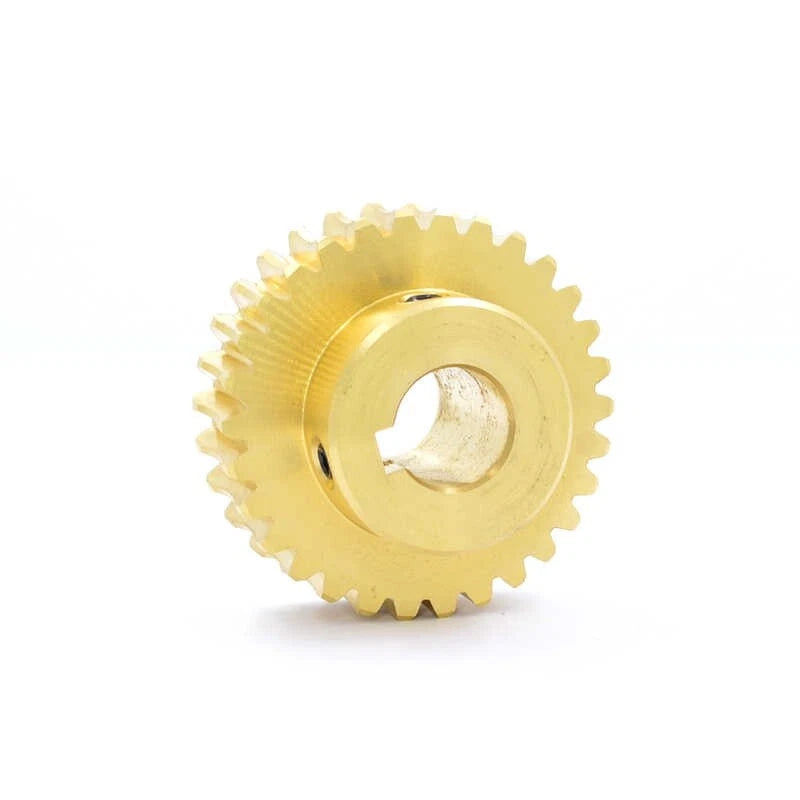
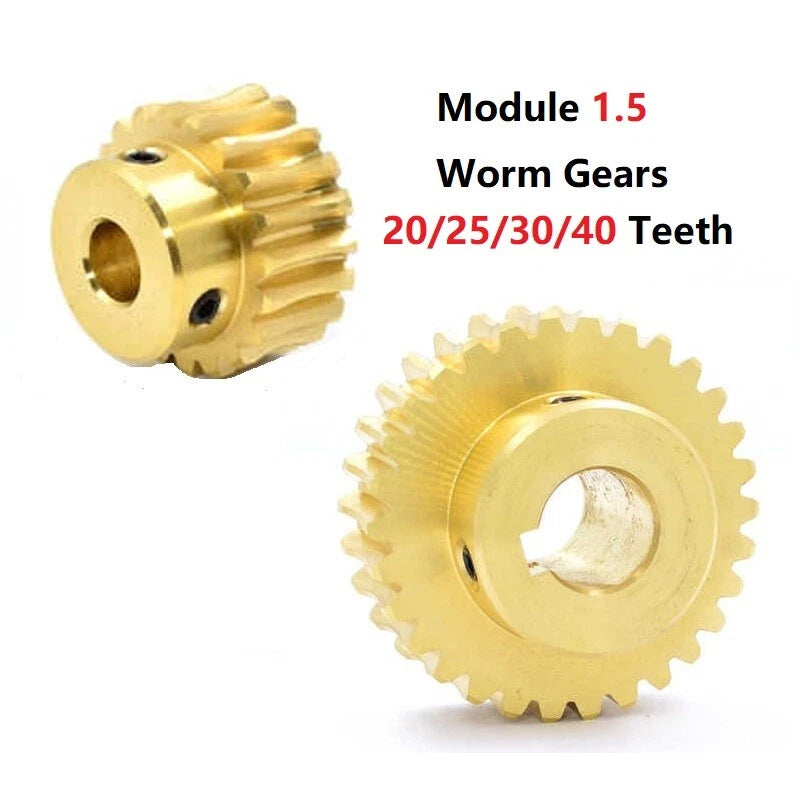
Module 1.5M Brass Worm Gear Wheel 20/25/30/40T Teeth Worm Gears Bore 8-20mm

No reviews

Price:
Sale price$16.31 USD
Stock:
In stock (500 units), ready to be shipped

Payment & Security

Ach Direct Debit Amazon American Express Apple Pay Bancontact BLIK Diners Club Discover EPS Google Pay iDEAL Wero JCB Maestro Mastercard Multibanco MobilePay PayPal Przelewy24 Shop Pay Twint Union Pay USDC Visa

Your payment information is processed securely. We do not store credit card details nor have access to your credit card information.

Limited Offer — Spend More, Save More
Spend $55+
Save $5
Spend $100+
Save $10
Spend $200+
Save $25
HomeDIYer DIY Expert Support

DIY Expert Support

Get fitment advice & recommendations

Mon–Fri  8:30 AM – 8:00 PM
24-Hour Fast Ship
Arrives in 3–14 Days
Worldwide Shipping
30-Day Returns
1 tree planted with every purchase

Description

Module 1.5M Brass Worm Gear Wheel — Smooth, Low-Backlash Power Transmission for DIY and Industrial Builds

When a motion-control project demands a reliable right-angle speed reduction with minimal backlash, the wrong gear material can mean stripped teeth, excessive noise, and premature failure. Mechanical engineers, robotics builders, and workshop DIYers who need a dependable worm gear wheel that pairs cleanly with a 1.5-module worm shaft will find this brass wheel a practical, long-lasting solution.

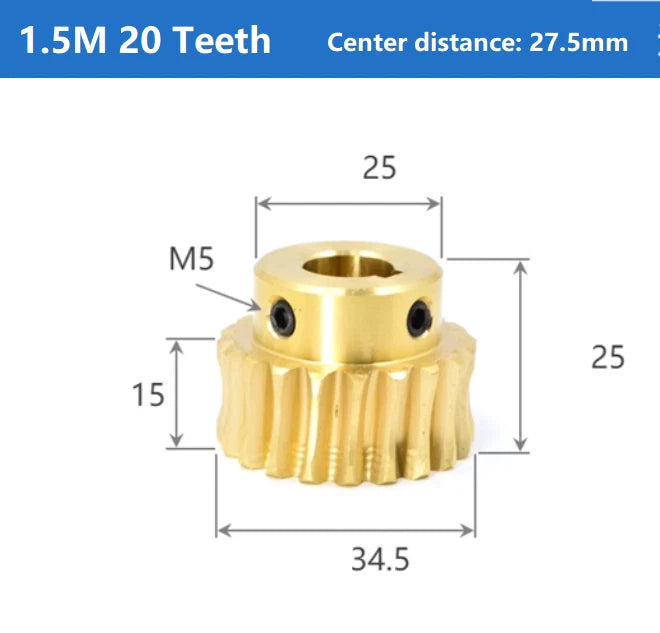
This worm gear wheel is machined from brass, a material valued for its self-lubricating properties, corrosion resistance, and compatibility with steel worm shafts. Available in four tooth counts — 20T, 25T, 30T, and 40T — with an outer diameter ranging from approximately 33 mm (1.30 in) for the 20T up to approximately 63 mm (2.48 in) for the 40T. Bore options span 8 mm to 20 mm, with keyway configurations (4 mm or 5 mm/6 mm keyway) available on larger bore sizes for positive shaft engagement.

Typical use cases include DIY rotary table drives and indexing fixtures, compact conveyor and actuator assemblies requiring high reduction ratios, and robotics joint mechanisms where a 1.5M worm gear set provides the torque multiplication needed for servo-driven axes.

⚙️ Compatibility: Designed to mesh with Module 1.5 (1.5M) worm shafts. Verify your worm shaft module before ordering. Bore and keyway dimensions must match your shaft diameter — select the correct variant above.

✅ Key Features of These Module 1.5M Brass Worm Gear Wheels

  • 🔩Brass Construction — Naturally self-lubricating brass reduces friction against steel worm shafts, extending service life and lowering operating noise compared to cast iron alternatives.
  • 📐Four Tooth Count Options — Choose 20T, 25T, 30T, or 40T to dial in your reduction ratio. Higher tooth counts deliver greater torque multiplication for heavier loads.
  • 🎯Precision Bore Range 8–20 mm — Eight bore variants cover shafts from 8 mm to 20 mm. Keyway slots (4 mm, 5 mm, or 6 mm) on applicable variants prevent rotational slip under load.
  • 🔄Right-Angle Power Transmission — Worm gear geometry provides inherent self-locking characteristics at high reduction ratios, useful for positioning and holding applications without a brake.
  • 🛡️Corrosion-Resistant Material — Brass resists oxidation in moderately humid workshop and light industrial environments, reducing maintenance intervals.
  • 🔧Direct Drop-In Sizing — Standard Module 1.5 tooth profile ensures interchangeability with commercially available 1.5M worm shafts, simplifying sourcing for replacement or new builds.

📐 Technical Specifications — Module 1.5M Worm Gear Wheel

Module 1.5M
Material Brass
Tooth Count Options 20T / 25T / 30T / 40T
Bore Diameter Range 8 mm – 20 mm (0.31 in – 0.79 in)
Keyway Options 4 mm (12 mm bore) / 5 mm (14–16 mm bore) / 6 mm (18–20 mm bore) / None (8–10 mm bore)
Outer Diameter (approx.) See variant options
Face Width (approx.) See variant options
Pressure Angle 20°
Gear Type Worm Gear Wheel (Spur-cut worm wheel)
Finish Natural brass (uncoated)
Compatible Worm Shaft Module 1.5M
Weight See variant options

❓ Frequently Asked Questions

How do I choose the right tooth count (20T, 25T, 30T, or 40T)?

The tooth count determines your reduction ratio when paired with a single-start worm shaft: a 20T wheel gives 20:1 reduction, a 40T wheel gives 40:1. Choose a higher tooth count when you need more torque multiplication or slower output speed. For lighter loads or faster output, a 20T or 25T wheel is typically sufficient.

What bore size should I select for my shaft?

Select the bore that matches your shaft diameter exactly. For shafts 8 mm or 10 mm, plain bore variants are available. For shafts 12 mm and above, keyway variants are offered — the keyway prevents the gear from rotating on the shaft under load. Measure your shaft with calipers before ordering.

Is this gear compatible with any 1.5M worm shaft?

Yes — this wheel is machined to the standard Module 1.5 tooth profile and will mesh correctly with any commercially available 1.5M single-start or multi-start worm shaft. Confirm the module (1.5M) and the lead angle of your worm shaft are compatible with your intended reduction ratio before assembly.

How strong is brass compared to steel for worm gears?

Brass is softer than steel, which is intentional in worm gear design. The brass wheel acts as the sacrificial element, wearing gradually while protecting the harder steel worm shaft. This pairing reduces galling and noise. For light-to-medium duty applications — robotics, indexing tables, small actuators — brass worm wheels are the industry-standard choice.

Does brass resist corrosion in workshop environments?

Brass offers good resistance to oxidation and mild moisture exposure, making it suitable for indoor workshop and light industrial use. It is not recommended for continuous immersion or highly corrosive chemical environments. For outdoor or wet applications, consider applying a light machine oil to the gear teeth periodically.

Will this worm gear self-lock when the motor is off?

Worm gear sets with high reduction ratios (typically above 20:1 with a single-start worm) exhibit self-locking behavior, meaning the output shaft cannot back-drive the worm. This is useful for positioning applications where you want the load to hold position without a separate brake. However, self-locking is not guaranteed under vibration or shock loads — always verify with your specific worm shaft lead angle.

Do I need to lubricate this gear before use?

Brass has inherent self-lubricating properties, but applying a light gear grease or machine oil to the tooth contact surfaces before first use will extend service life and reduce break-in wear. Re-lubricate periodically based on your duty cycle and operating environment.

🛒 Select your Model (tooth count) and Bore size above, then add to cart.

You may also like

Recently viewed