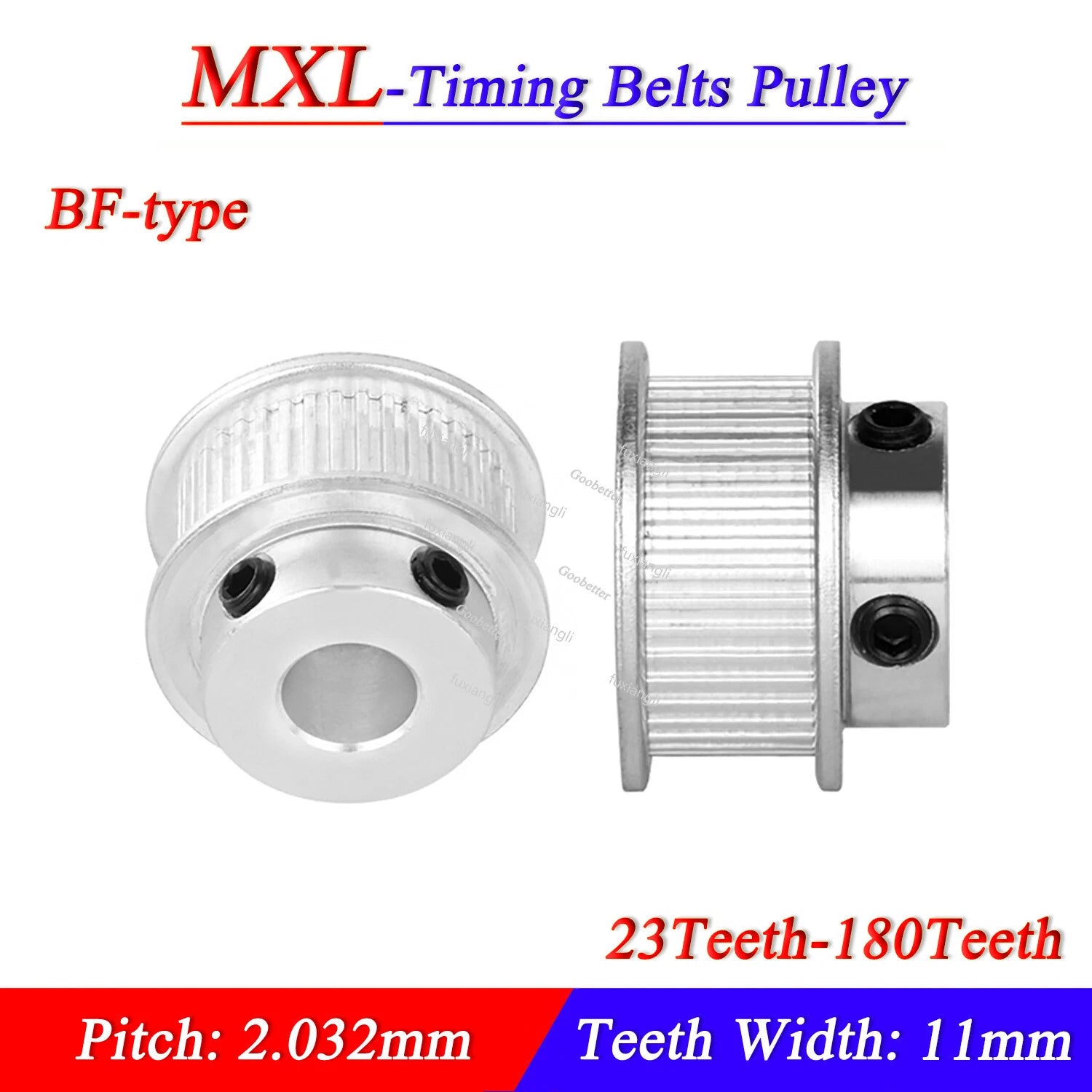
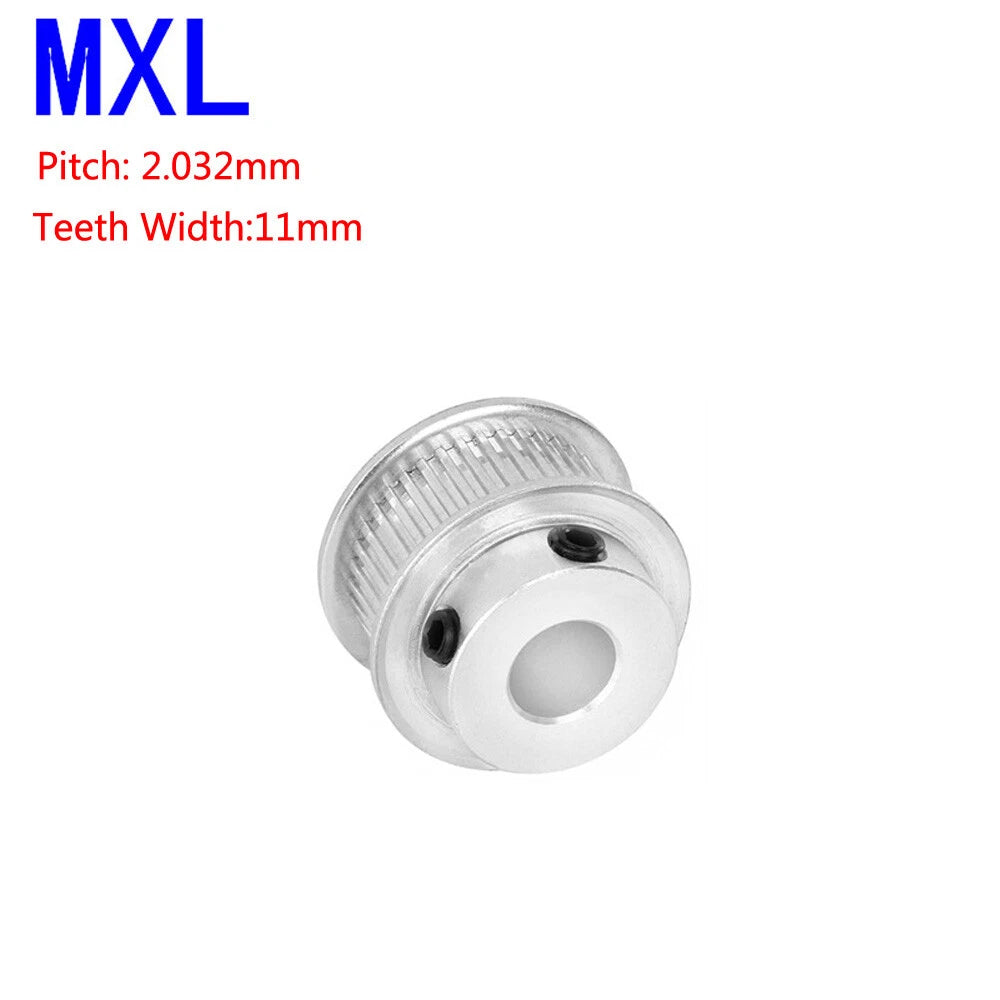
MXL 23-180T Timing Belt Pulley Pitch 2.032mm BF-type CNC Drive Pulley Width 11mm

No reviews

Price:
Sale price$10.58 USD
Stock:
In stock (500 units), ready to be shipped

Payment & Security

Ach Direct Debit Amazon American Express Apple Pay Bancontact BLIK Diners Club Discover EPS Google Pay iDEAL Wero JCB Maestro Mastercard Multibanco MobilePay PayPal Przelewy24 Shop Pay Twint Union Pay USDC Visa

Your payment information is processed securely. We do not store credit card details nor have access to your credit card information.

Limited Offer — Spend More, Save More
Spend $55+
Save $5
Spend $100+
Save $10
Spend $200+
Save $25
HomeDIYer DIY Expert Support

DIY Expert Support

Get fitment advice & recommendations

Mon–Fri  8:30 AM – 8:00 PM
24-Hour Fast Ship
Arrives in 3–14 Days
Worldwide Shipping
30-Day Returns
1 tree planted with every purchase

Description

MXL Timing Belt Pulley BF-Type — Precise CNC Drive for DIY Automation

When your CNC router, 3D printer, or linear motion system demands slip-free synchronization, a mismatched or low-tolerance pulley becomes the weakest link in the entire drive train. Makers, hobbyists, and small-workshop engineers who need repeatable positioning accuracy rely on a pulley that holds its tooth profile under load — and that is exactly what these MXL BF-type timing belt pulleys are designed to deliver.

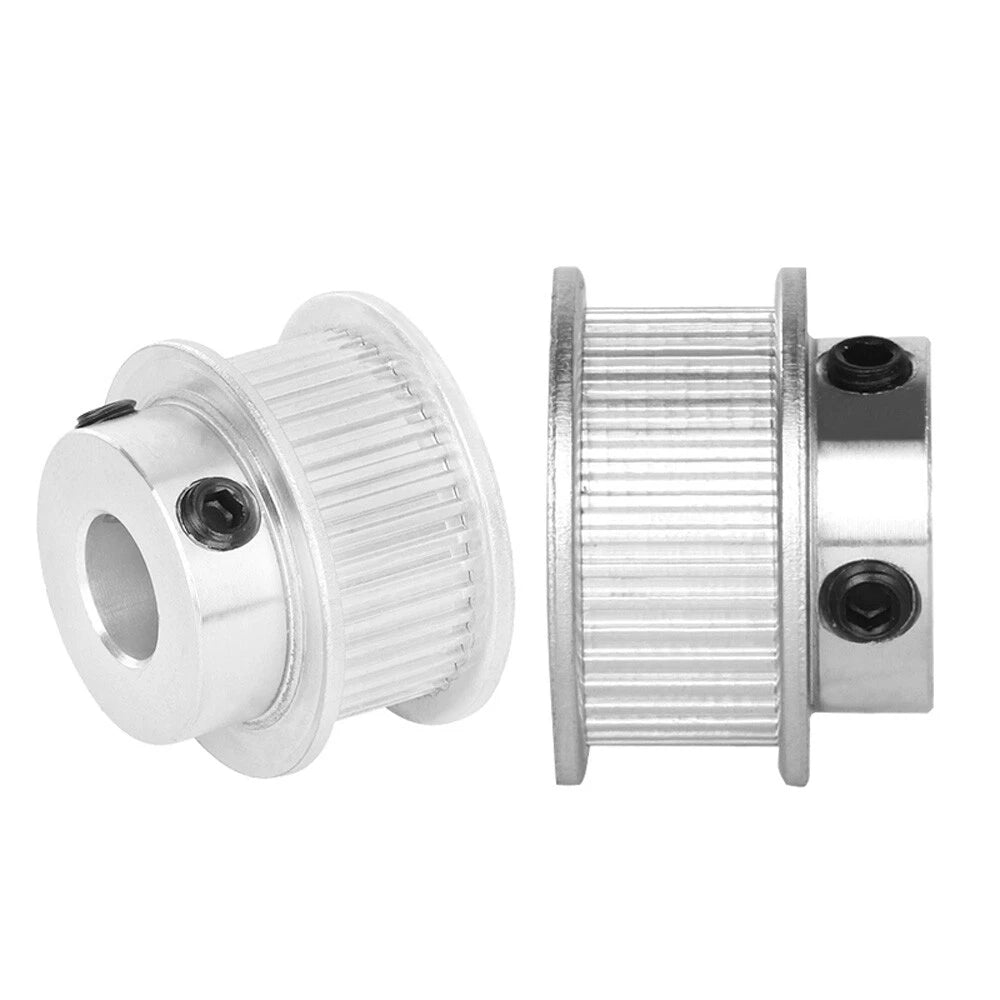
Each MXL timing belt pulley features a 2.032 mm (0.080 in) pitch tooth profile machined to MXL standard, a fixed belt-contact width of 11 mm (0.43 in), and dual flanges (BF-type) that keep the belt tracking true without additional guides. Bore options span 4 mm through 16 mm (approx. 0.16–0.63 in), and tooth counts range from 23 T to 180 T, giving you fine control over your drive ratio. The body is typically machined from aluminum alloy, keeping rotating mass low while maintaining dimensional stability across the full tooth range.

Typical use cases include X/Y axis drives on desktop CNC routers, extruder and Z-axis drives on FDM 3D printers, and lightweight conveyor or pick-and-place automation rigs where a compact MXL timing belt pulley with a precise bore fit eliminates backlash and improves step accuracy. The wide tooth-count selection also makes these pulleys a practical choice for gear-ratio experiments in educational robotics and maker-lab projects.

⚙️ Compatible with: MXL-profile open or closed timing belts, 10–11 mm belt width. Verify your motor shaft diameter matches the selected bore before ordering.

✅ Key Features of These MXL BF-Type Timing Belt Pulleys

🦷 Wide Tooth-Count Range (23 T – 180 T)

Choose the exact tooth count for your target drive ratio. More teeth mean a larger pitch diameter and smoother belt engagement at higher speeds.

📐 MXL 2.032 mm Pitch Standard

Conforms to the MXL timing belt profile (0.080 in pitch), ensuring dimensional interchangeability with standard MXL belts used across CNC and 3D-printing platforms.

🔩 BF-Type Dual Flanges

Integrated flanges on both sides of the belt groove prevent lateral belt walk, reducing wear and maintaining alignment without external guides.

🎯 Precision Bore Options (4 – 16 mm)

Multiple bore diameters — including 4, 5, 6, 6.35, 8, 10, 12, 12.7, 14, 15, and 16 mm — let you match the pulley directly to your motor or shaft without adapters.

⚖️ Lightweight Aluminum Alloy Body

The aluminum construction keeps rotational inertia low, which is critical for responsive acceleration and deceleration in servo and stepper motor applications.

🏭 11 mm Belt-Contact Width

The 11 mm groove width accommodates standard MXL belts up to 10–11 mm wide, balancing load capacity with compact form factor for space-constrained builds.

📐 Technical Specifications — MXL Timing Belt Pulley

Belt Profile MXL (Extra Light)
Tooth Pitch 2.032 mm (0.080 in)
Pulley Type BF (Dual Flange)
Belt Width (groove) 11 mm (0.43 in)
Number of Teeth 23 T – 180 T (see variant options)
Bore Diameter 4 / 5 / 6 / 6.35 / 8 / 10 / 12 / 12.7 / 14 / 15 / 16 mm (see variant options)
Body Material Aluminum alloy
Flange Configuration Dual flange (BF-type)
Pitch Diameter Range See variant options
Set Screw See variant options
Surface Finish See variant options
Package Quantity 1 piece per order

❓ Frequently Asked Questions

How do I choose the right number of teeth for my application?

The tooth count determines the pitch diameter of the pulley, which directly sets your drive ratio when paired with a second pulley. Divide the driven pulley teeth by the driving pulley teeth to get the ratio. For example, a 40 T driver paired with a 20 T driven pulley gives a 2:1 speed reduction. Smaller tooth counts produce a smaller pulley diameter, which is useful in compact builds; larger counts give smoother belt engagement at higher RPM.

What bore size should I select for my stepper or servo motor shaft?

Measure your motor shaft diameter with a caliper before ordering. Common stepper motor shaft diameters are 5 mm and 6.35 mm (1/4 in); servo motors often use 6 mm, 8 mm, or larger. Select the bore that matches your shaft exactly — a loose fit causes backlash and vibration, while an oversized bore cannot be corrected without a bushing. If your shaft has a flat (D-cut), confirm the pulley's set-screw position will engage the flat.

Are these pulleys compatible with standard MXL timing belts?

Yes. These pulleys conform to the MXL tooth profile with a 2.032 mm (0.080 in) pitch, which is the industry-standard specification for MXL belts. They are designed to work with MXL open-end or closed-loop timing belts up to 10–11 mm wide. Do not use with GT2, HTD, or other belt profiles — the tooth geometry is not interchangeable.

How strong are these pulleys under load?

The aluminum alloy body provides adequate strength for typical CNC routing, 3D printing, and light automation loads. MXL-profile drives are generally suited to low-to-medium torque applications. For heavy-duty industrial drives with high belt tension, consider a larger pitch profile such as GT2 5 mm or HTD 5 mm. Always verify that the belt's rated tension does not exceed the pulley's bore and set-screw clamping capacity for your specific shaft diameter.

Do the flanges prevent the belt from slipping off?

Yes. The BF designation means both flanges are present on the pulley. These raised edges on each side of the belt groove act as lateral guides that keep the belt centered during operation. This is especially important in vertical or angled drive orientations where gravity or side loads would otherwise cause the belt to walk off an unflanged pulley.

Will these pulleys corrode or degrade over time?

Aluminum alloy naturally forms a thin oxide layer that provides moderate corrosion resistance in typical indoor workshop and lab environments. For applications exposed to moisture, cutting fluids, or outdoor conditions, consider applying a light coat of dry lubricant or corrosion inhibitor to the bore and set-screw area. The tooth profile itself does not require lubrication when used with standard MXL rubber or polyurethane belts.

Can I use one of these pulleys as an idler?

These pulleys are designed as drive pulleys with a bore for shaft mounting. They can function as toothed idlers if mounted on a suitable shaft or bearing, but they are not supplied with bearings. If you need a smooth idler (no teeth), a different pulley type is required. Using a toothed idler on the back of the belt is generally not recommended as it can cause premature belt wear.

🛒 Select your Number of Teeth and Bore above, then add to cart.

You may also like

Recently viewed